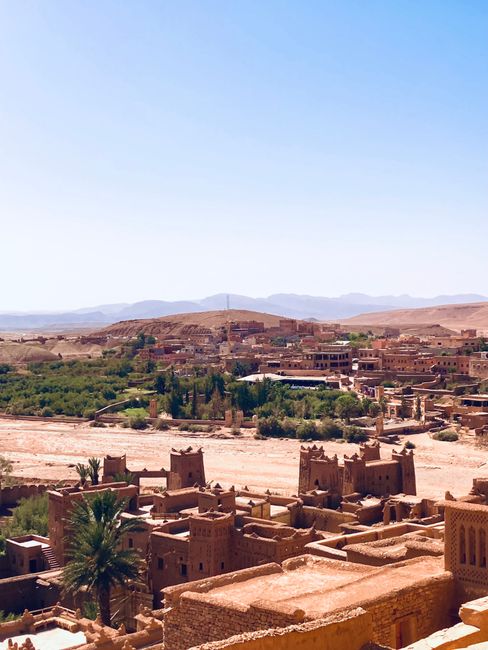
Ouarzazate, on a high plateau south of the High Atlas, is the gateway to Morocco’s deep south: the land of earth-built kasbahs and fortified villages, palm-filled valleys and stony desert. Its name is often translated from Amazigh as “without noise,” and the town grew from a crossroads of caravan routes into a garrison post under the French and then a regional capital. It’s best known as “Ouallywood“: since the 1980s, its studios and the surrounding landscapes have stood in for ancient Rome, Jerusalem, Egypt, Tibet and the fantasy kingdoms of Game of Thrones, and you can tour the sets at Atlas Studios and CLA Studios. In town, the restored Taourirt Kasbah was the seat of the powerful Glaoui family, and 30 km (19 miles) away stands the most famous fortified village in Morocco, the Ksar of Aït Ben Haddou, a UNESCO World Heritage Site since 1987. Ouarzazate is the natural overnight stop on the classic road from Marrakech over the Tizi n’Tichka pass to the Dades and Todra gorges, the Draa Valley and the Sahara dunes at Merzouga. At about 1,150 m (3,800 ft), it has sunny days all year, cold winter nights and hot summers.
Right now in Ouarzazate
- Thu15–25°C58–77°F2 mm rain
- Fri13–22°C56–71°F9 mm rain
- Sat11–19°C52–67°F1 mm rain
Top tours in Ouarzazate
See all tours for Ouarzazate →
From local operators, with prices and reviews; you check availability and book on Viator, our partner. We may earn a commission at no extra cost to you. How we earn money
Ouarzazate at a glance
- Best for: kasbahs, Aït Ben Haddou, film studios, desert scenery and the road to the Sahara and the gorges.
- How long: 1–2 nights; 3 with the Draa Valley, Skoura or Telouet.
- Best time: March to May and September to November; winter days are sunny but nights are near freezing.
- Getting there: by road from Marrakech over the Tizi n’Tichka (about 4 hours), by CTM or Supratours bus, or by plane to Ouarzazate (OZZ).
- Getting around: petit taxis in town; a car, driver or tour for Aït Ben Haddou and the valleys.
- Good to know: stay overnight near Aït Ben Haddou to see it at sunset and sunrise without the crowds.
- Before you go: visas, money and general safety are in our Morocco travel guide.
Ouarzazate’s areas and where to stay
Ouarzazate is a spread-out, modern town along one long main avenue, with the Taourirt Kasbah at its eastern end, the studios to the west, and the El Mansour Eddahbi reservoir to the south. Many visitors stay outside town, in kasbah hotels at Aït Ben Haddou or in the palm groves of Skoura.
Central Ouarzazate
Hotels along Avenue Mohammed V and near the Taourirt Kasbah are convenient for restaurants, banks, the bus stations and the studios, and range from simple to large hotels with pools.
Aït Ben Haddou
Guesthouses and kasbah hotels in the new village facing the ksar, across the Ounila river, let you see it lit up at sunset and empty at dawn. They’re the best choice for photographers and a calmer stay.
Skoura and Fint
The palm grove of Skoura, about 40 km (25 miles) east, has restored kasbahs turned into boutique hotels, set among date palms and fields. The small oasis of Fint, about 15 km (9 miles) south of town, has a few guesthouses in a green valley.
Where to stay around Ouarzazate
- Central Ouarzazate: practical hotels with pools, near the studios and buses.
- Aït Ben Haddou: kasbah guesthouses with views of the ksar.
- Skoura palm grove: restored kasbahs and gardens for a slower stay.
- Fint oasis: simple guesthouses in a quiet green valley.
Top things to see around Ouarzazate
The Ksar of Aït Ben Haddou
About 30 km (19 miles) northwest of Ouarzazate, on the old caravan route between the Sahara and Marrakech, Aït Ben Haddou is a ksar, a fortified village of tightly packed earthen houses, towers and granaries, rising up a hill above the Ounila river to a fortified granary at the top. UNESCO describes it as a striking example of southern Moroccan earthen architecture, listing it in 1987. Most families have moved to the new village across the river, but a few still live inside. It has appeared in many films, including Lawrence of Arabia, Gladiator and Game of Thrones. Walking in is free; some houses charge a small fee to visit inside or reach their roof terraces. Cross the river by the footbridge, climb to the top for the view, and come early or late to avoid the tour buses and the heat.
Atlas Studios and CLA Studios
West of town, Atlas Studios, one of the largest film studios in the world by area, offers guided tours of sets from films such as Kingdom of Heaven, Asterix and Obelix: Mission Cleopatra, Kundun and Gladiator, including Egyptian temples and a Tibetan monastery. According to the Moroccan National Tourist Office, CLA Studios has a reconstruction of medieval Jerusalem among its sets. Tours run through the day and cost a modest fee; sets may be closed when filming is under way.
The Taourirt Kasbah
At the east end of town, the Taourirt Kasbah was built in the 19th century by the Glaoui family, the “lords of the Atlas,” who controlled the caravan routes of the south. Part of the vast complex has been restored, with decorated reception rooms, painted ceilings and narrow staircases, and the rest is a living neighborhood. There’s a small entry fee. Across the road, a small Museum of Cinema in an old studio displays props and sets.
The Tifoultoute Kasbah and Fint oasis
About 8 km (5 miles) west, the Tifoultoute Kasbah, another Glaoui property above the river, has views over the palm groves. South of town, the Fint oasis, reached on a rough track, is a peaceful green valley of palms and villages beneath black hills.
Skoura and its kasbahs
The Skoura palm grove has some of the region’s finest kasbahs, including the 17th-century Kasbah Amridil, which is open to visitors as a small museum of rural life. Walk or cycle between the irrigated gardens, olive trees and earth walls, crossing the khettara and seguia channels that have carried water to the fields for centuries. Local guides lead half-day walks through the oasis, and the kasbah hotels here make a peaceful base.
Noor Ouarzazate
On the plateau east of town, the huge mirrors and tower of the Noor Ouarzazate solar complex, one of the largest concentrated solar power plants in the world, are visible from the road; it isn’t open to casual visitors.
The lords of the Atlas
In the late 19th and early 20th centuries, the Glaoui family rose from their mountain stronghold at Telouet to control the passes of the High Atlas and the trade routes to the Sahara. Under the French protectorate, T’hami el Glaoui, pasha of Marrakech, became one of the richest and most powerful men in the country, and his family built or took over kasbahs across the south, including Taourirt and Tifoultoute. After independence in 1956 their power ended, and many of their kasbahs fell into ruin; today, several have been restored with support from UNESCO and the Moroccan state.
Other things to do around Ouarzazate
Food and drink
Ouarzazate’s restaurants serve southern Moroccan dishes: tagines cooked slowly over charcoal, Amazigh “pizza” (medfouna, bread stuffed with meat, onions and spices), couscous, dates and almonds. Kasbah hotels often serve dinner on terraces under the stars. Some hotels serve alcohol.
Hiking, cycling and quads
The hills around Aït Ben Haddou and Skoura are good for walking and mountain biking in the cooler months, and operators run quad and buggy trips on the plateau. See our hiking guide.
Desert trips from Ouarzazate
Ouarzazate is the starting point for trips south through the Draa Valley to M’Hamid and the remote dunes of Erg Chigaga, a wilder alternative to Merzouga reached by four-wheel-drive across the desert, usually as a 2–3 day trip with a night in a desert camp. Book with a licensed operator, and make sure the vehicle carries water, a spare tire and a satellite or mobile phone.
Rose and date festivals
In the Dades Valley, east of Ouarzazate, the town of Kalaat M’Gouna is famous for Damask roses, harvested in spring and celebrated at a rose festival, usually in May. In autumn, the date harvest takes place in the oases of the Draa and Ziz valleys.
Day trips from Ouarzazate
- Aït Ben Haddou: about 30 minutes by road; half a day, or overnight.
- Telouet: the ruined Glaoui kasbah on the old Tichka route, about 2 hours north, whose crumbling earthen walls hide reception rooms with superb zellige, carved stucco and painted cedar ceilings; often combined with Aït Ben Haddou on the scenic back road through the Ounila valley.
- The Draa Valley and Zagora: a long ribbon of palm groves and kasbahs south of the Tizi n’Tinififft pass, about 3 hours to Zagora.
- The Dades Gorge and the “Valley of the Roses”: about 2 hours east, with rock formations and the famous zigzag road above the gorge.
- The Todra Gorge: about 3.5 hours east, a narrow canyon with walls up to about 300 m (1,000 ft) high, on the way to Merzouga.
- Merzouga and the Sahara dunes: about 6–7 hours by road; better as part of a 2–3 day route; see our Merzouga guide.
Getting there and getting around
By road from Marrakech
The N9 from Marrakech crosses the High Atlas by the Tizi n’Tichka pass at about 2,260 m (7,410 ft), the highest major road pass in Morocco. The 200 km (124 miles) trip takes about 4 hours, with hairpins, viewpoints, slow trucks and roadworks. CTM and Supratours buses make the trip several times a day, and many visitors travel with a driver or on a tour. In winter, snow can close the pass for hours or days.
By air
Ouarzazate Airport (OZZ), just outside town, has domestic flights, mainly to Casablanca, and occasional routes to Europe. Taxis take a few minutes to the center.
Getting around
Petit taxis run around town, and grand taxis go to Aït Ben Haddou, Skoura and nearby towns. For the valleys and gorges, a rental car, a driver or a tour gives the most flexibility; roads are paved but narrow in places.
When to go and how long to stay
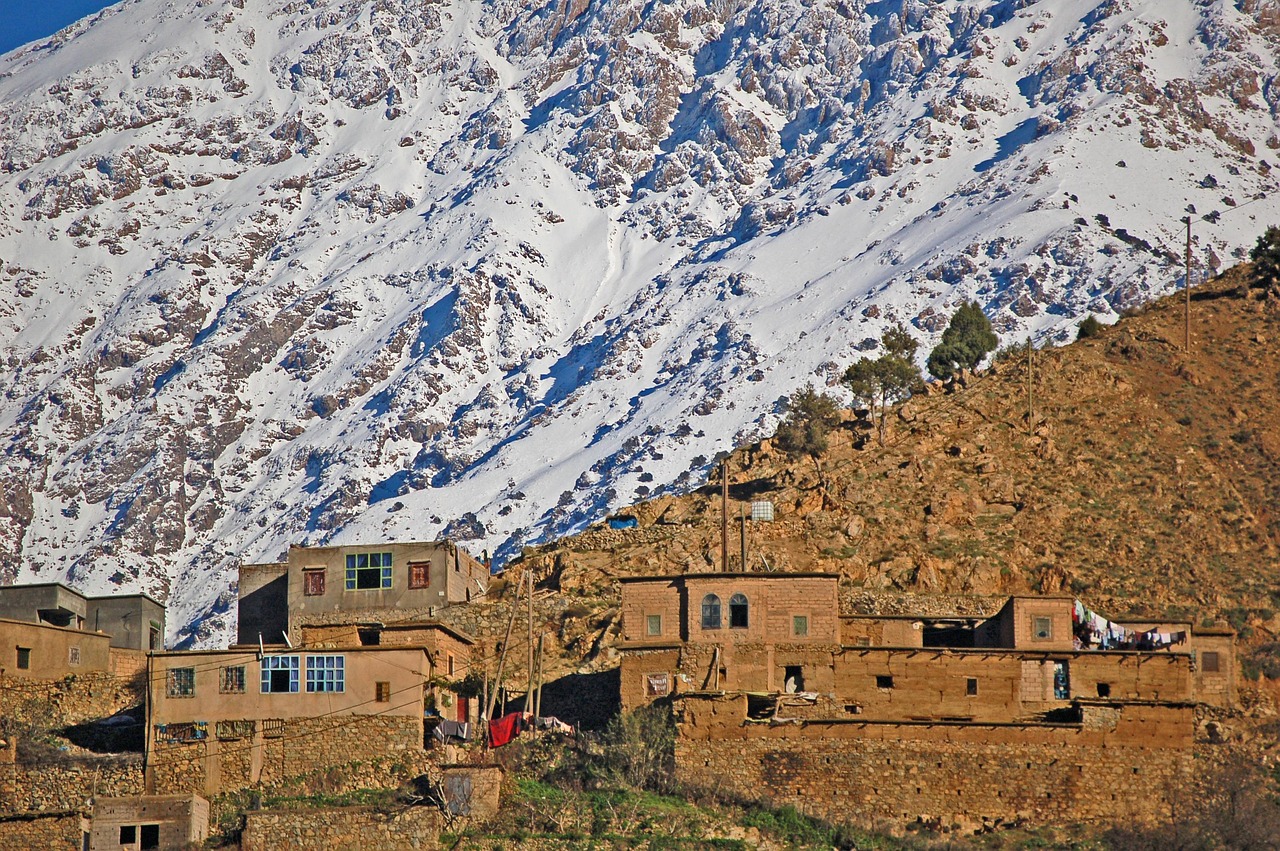
Ouarzazate has a desert climate at altitude, with very little rain and strong sunshine. Spring (March to May) and autumn (September to November) are the best times, with warm days around 23–31 °C (73–87 °F). Summer is hot, with afternoons around 38–39 °C (100–102 °F) in July and August. Winter days are sunny and pleasant at about 17–19 °C (63–66 °F), but nights drop to about 2 °C (35 °F), and the High Atlas peaks are often snow-covered. The table uses the 1991–2020 climate normals for the Ouarzazate station of Morocco’s General Directorate of Meteorology (DGM), as published by the World Meteorological Organization (WMO): average daily highs and lows, total precipitation, and days with at least 1 mm of rain.
| Month | Average high / low | Rain (days with 1 mm or more) | What to expect |
|---|---|---|---|
| January | 17 °C (63 °F) / 2 °C (35 °F) | 6 mm (0.2 in), 1 day | Sunny days, freezing nights; snow on the Atlas passes |
| February | 19 °C (67 °F) / 4 °C (40 °F) | 14 mm (0.6 in), 2 days | Sunny; cold nights |
| March | 23 °C (73 °F) / 8 °C (47 °F) | 16 mm (0.6 in), 2 days | Warm days; almond blossom in the valleys |
| April | 27 °C (80 °F) / 12 °C (53 °F) | 7 mm (0.3 in), 1 day | Pleasant; green oases |
| May | 31 °C (87 °F) / 16 °C (60 °F) | 4 mm (0.2 in), 1 day | Warm; rose harvest in the Dades Valley |
| June | 36 °C (96 °F) / 20 °C (67 °F) | 7 mm (0.3 in), 1 day | Hot afternoons |
| July | 39 °C (102 °F) / 23 °C (73 °F) | 4 mm (0.1 in), 1 day | Very hot; travel early |
| August | 38 °C (100 °F) / 22 °C (72 °F) | 12 mm (0.5 in), 3 days | Very hot; occasional storms |
| September | 33 °C (92 °F) / 18 °C (65 °F) | 13 mm (0.5 in), 2 days | Hot, then pleasant |
| October | 28 °C (82 °F) / 13 °C (56 °F) | 15 mm (0.6 in), 2 days | Warm days; date harvest |
| November | 22 °C (71 °F) / 7 °C (45 °F) | 8 mm (0.3 in), 1 day | Mild days, cold nights; excellent |
| December | 18 °C (64 °F) / 3 °C (38 °F) | 10 mm (0.4 in), 2 days | Sunny days, cold nights |
Ouarzazate receives only about 115 mm (4.5 in) of rain a year, falling on about 18 days, sometimes in short, heavy storms.
One night in Ouarzazate
Leave Marrakech early, cross the Tizi n’Tichka with a detour to Telouet, and reach Aït Ben Haddou for the afternoon and sunset. The next morning, visit Atlas Studios and the Taourirt Kasbah before continuing to Skoura and the Dades Valley.
Two to three nights
Add a full day in the Draa Valley or Fint oasis, a night in a Skoura kasbah, or a more relaxed visit to Aït Ben Haddou at sunrise.
What a trip to Ouarzazate costs
Prices are approximate, for October 2026, converted at about MAD 9.85 to the US dollar (Bank Al-Maghrib reference rate).
| Item | Typical cost |
|---|---|
| Atlas Studios guided tour | MAD 80–120 (about US$8–12) |
| Taourirt Kasbah | MAD 20–30 (about US$2–3) |
| Grand taxi seat to Aït Ben Haddou | MAD 20–30 (about US$2–3) |
| Driver for a day around Ouarzazate | MAD 800–1,300 (about US$80–130) |
| Tagine lunch | MAD 60–120 (about US$6–12) |
| Mid-range kasbah hotel double, per night | MAD 600–1,500 (about US$60–150) |
Practical tips for Ouarzazate
- Stay at Aït Ben Haddou: sunset and sunrise there are the highlights.
- Check the Tichka: in winter, ask about snow before crossing the pass.
- Pack layers: desert nights are cold from November to March.
- Carry cash: ATMs are in Ouarzazate, but villages and small kasbahs take cash only.
- Ask before filming: the studios and ksars are popular, but people’s homes are private.
Safety in Ouarzazate
Ouarzazate and the surrounding villages are calm and safe, with little hassle. At Aït Ben Haddou and the studios, you may be approached by unofficial guides and sellers; agree prices first. The main risks are environmental. The Tizi n’Tichka road is winding and busy with trucks, and snow, ice, fog and rockfalls can close it in winter; check conditions before you leave, drive in daylight and allow extra time. The September 2023 Al Haouz earthquake damaged mountain villages in the High Atlas, and road and reconstruction works continue in places. In summer, temperatures near 40 °C (104 °F) make hydration, sun protection and early starts essential, and sudden storms can cause flash floods in dry riverbeds, so never camp or park in a wadi. In an emergency, call 190 for the police, 177 for the gendarmerie outside towns, and 150 for an ambulance or fire.
What to pack for Ouarzazate
A warm jacket and layers for cold nights, sunglasses, a hat and high-factor sunscreen, a scarf against dust and wind, comfortable walking shoes for ksar stairs and trails, a refillable water bottle, and a flashlight. Morocco uses 220 V with two-pin European sockets. See our hiking shoes and travel adapters guides.
Ouarzazate travel FAQ
How far is Aït Ben Haddou from Ouarzazate?
About 30 km (19 miles), around 30 minutes by road.
How much does it cost to visit Aït Ben Haddou?
Walking into the ksar is free; some families charge a small fee to visit their houses or terraces.
Which films were shot in Ouarzazate?
Among many others, Lawrence of Arabia, Gladiator, Kingdom of Heaven, Kundun, The Mummy and scenes from Game of Thrones were filmed at the studios or nearby.
How long is the drive from Marrakech to Ouarzazate?
About 4 hours for 200 km (124 miles), over the Tizi n’Tichka pass.
Is the Tizi n’Tichka road dangerous?
It’s a good paved road but winding and busy with trucks. Drive in daylight, take breaks, and check for snow closures in winter.
Can I visit Atlas Studios?
Yes, guided tours run daily, unless filming closes some sets.
How many days do I need in Ouarzazate?
One or two nights, ideally including a night at Aït Ben Haddou; more to explore the Draa Valley or Skoura.
How far is Ouarzazate from Merzouga?
About 360 km (224 miles), around 6–7 hours by road through the Dades and Todra valleys; most travelers break the trip.
What is the best time to visit Ouarzazate?
March to May and September to November. Summers are very hot, and winter nights are near freezing.
Is Ouarzazate safe?
Yes, it’s calm and friendly. The main risks are mountain roads in winter, heat in summer and flash floods after storms.
Plan your trip
Partner links: TravelerCenter may earn a commission if you book, at no extra cost to you.
🇪🇬 Useful Arabic phrases for Ouarzazate
All 38 Arabic phrases: restaurant, hotel, emergencies, romance (printable) →
Sources · last reviewed 5 October 2026
Researched and last reviewed on 5 October 2026. The UNESCO listing of Aït Ben Haddou: the UNESCO World Heritage Center; the film studios, CLA Studios’ Jerusalem set and films shot in the region: the Moroccan National Tourist Office; earthquake reconstruction: the Moroccan government portal; emergency numbers, mountain roads and flash floods: the UK government’s factual safety pages, used for practical facts only; the exchange rate: Bank Al-Maghrib; climate normals: Morocco’s General Directorate of Meteorology via the World Meteorological Organization’s 1991–2020 normals (Ouarzazate station). Studio and kasbah prices, the Tichka altitude, distances, the solar complex, film lists beyond the tourist office’s, festivals and typical prices are general references or estimates, flagged for checking. Prices and rules change, so check locally before you go. For visas, money and general safety, see our Morocco travel guide.
Data: Weather: MET Norway (CC BY 4.0) · Rates: ECB · Costs: World Bank ICP and price levels · Wikidata (CC0)