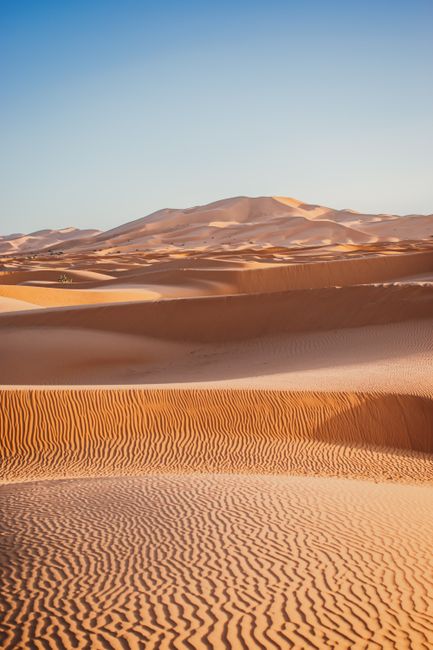
Merzouga is where most travelers meet the Sahara. This small village in southeastern Morocco sits at the foot of Erg Chebbi, a sea of orange-gold dunes about 22 km (14 miles) long that rise up to about 150 m (490 ft) above the stony desert, just a few kilometers from the Algerian border. Riding a camel into the dunes at sunset, sleeping in a desert camp under a sky full of stars and climbing a dune to watch the sunrise is one of the great experiences of a trip to Morocco. The area around Merzouga, in the Tafilalet region, also holds the Gnawa musicians of Khamlia, a seasonal lake that attracts flamingos, fossil workshops, the old caravan town of Rissani, cradle of the ruling Alaouite dynasty, and the palm groves of the Ziz valley. Merzouga is a long way from anywhere: about 9–10 hours by road from Marrakech and about 8 hours from Fez, so most visitors come on a 3-day desert tour or drive themselves via the Dades and Todra gorges. Camps range from simple tents with shared bathrooms to luxury lodges with private showers. The best months are October to April; summer days are extremely hot.
Right now in Merzouga
- Wed 19–32°C 67–89°F Mostly clear
- Thu 20–30°C 68–86°F 2 mm Partly cloudy
- Fri 16–23°C 62–73°F 9 mm Clear
Weather: MET Norway (CC BY 4.0)
Top tours in Merzouga
See all tours for Merzouga →
From local operators, with prices and reviews; you check availability and book on Viator, our partner. We may earn a commission at no extra cost to you. How we earn money
Merzouga at a glance
- Best for: Sahara dunes, camel treks, desert camps, stargazing, sandboarding, Gnawa music and the oases of the Tafilalet.
- How long: 1–2 nights; part of a 3–4 day route from Marrakech or Fez.
- Best time: October to April; from June to September afternoons are around 40 °C (104 °F) or hotter.
- Getting there: by car, tour or overnight bus from Marrakech, Fez or Ouarzazate; or fly to Errachidia and drive about 2 hours.
- Getting around: 4×4, camel, quad or on foot in the dunes; transfers arranged by your camp or hotel.
- Good to know: bring a warm jacket; desert nights are cold from November to March.
- Before you go: visas, money and general safety are in our Morocco travel guide.
Merzouga’s areas and sights
Merzouga village
The village itself is a strip of houses, small shops, cafés and guesthouses along the road at the western edge of the dunes. Most hotels sit right on the sand, with terraces facing Erg Chebbi.
Erg Chebbi
The dunes stretch north–south from near Hassi Labied to beyond Merzouga. The highest dunes rise above the village, and desert camps are scattered in hollows between them, usually 30–90 minutes by camel from the edge.
Hassi Labied and the northern dunes
North of Merzouga, the village of Hassi Labied has more hotels and kasbah-style guesthouses on the dune edge, and is slightly quieter.
Khamlia
About 7 km (4 miles) south, Khamlia is home to a community of Gnawa musicians, descendants of people brought across the Sahara from West Africa, who play hypnotic music with drums and iron castanets for visitors.
Rissani and the Ziz valley
About 35 km (22 miles) northwest, Rissani is a market town on the site of the medieval caravan city of Sijilmasa, with a big market three times a week. Further north, the Ziz valley is a long green ribbon of date palms below cliffs.
Where to stay in Merzouga
- Desert camp in the dunes: the classic experience, reached by camel or 4×4, with dinner and breakfast.
- Luxury desert camp: large tents with real beds, private bathrooms and hot showers.
- Kasbah hotel on the dune edge: pools, rooms with walls and views of the dunes.
- Guesthouse in Merzouga or Hassi Labied: budget rooms, often with a night in a camp as an add-on.
Top things to see and do in Merzouga
A camel trek and a night in a desert camp
Most visitors ride a dromedary from their hotel or the village into the dunes in the late afternoon, about 1–2 hours to camp, stopping on a crest to watch the sunset. Camps serve dinner (usually a tagine or Berber couscous), often followed by drumming around a fire, and in the morning you climb a dune for the sunrise before riding back. According to the Moroccan National Tourist Office, the camps let you experience the lifestyle of the nomads of the Sahara; standards vary widely, so check reviews, what’s included (transfers, meals, private bathroom) and how far the camp is from the dune edge.
Sunrise and sunset on the dunes
The colors of Erg Chebbi change from pink and orange to deep red through the day. The tallest dunes, near Merzouga, take 45–60 minutes to climb on foot in soft sand, but the view over the dune sea toward Algeria is worth it. Start early, carry water and a light, and go slowly.
Stargazing
Far from city lights, the desert sky is extraordinary on moonless nights, with the Milky Way stretching from horizon to horizon. Some camps offer telescopes and astronomy evenings; check the moon calendar when planning.
Khamlia and Gnawa music
A visit to Khamlia’s music houses, where musicians in white robes play and dance, usually includes mint tea; a contribution is expected.
Lake Dayet Srji
West of the dunes, the seasonal lake of Dayet Srji fills after heavy rains and can attract flamingos and other water birds in winter and spring. It’s often dry.
Rissani, the Ksar Abbar and the mausoleum
In Rissani, visit the busy souk, with its donkey park and stalls of dates, spices and livestock, the ruins of the Ksar Abbar, and the mausoleum of Moulay Ali Cherif, ancestor of the Alaouite dynasty, which non-Muslims can see from the courtyard. The Moroccan National Tourist Office describes Rissani as the cradle of the dynasty.
Fossils and the desert
The Tafilalet is rich in marine fossils, including ammonites and trilobites, around 350–500 million years old. Workshops near Erfoud cut and polish fossil-filled stone into tables and sinks. Buy only from reputable dealers, as many “trilobites” are partly carved.
Caravans, nomads and the Tafilalet
For centuries, the Tafilalet oasis was one of the great ports of the Sahara. From Sijilmasa, near today’s Rissani, camel caravans set out across the desert to West Africa, trading salt, cloth and copper for gold, ivory and slaves, and the city minted gold coins prized across the Mediterranean. The Alaouite family, which has ruled Morocco since the 17th century, came from here. Today the region’s people include Amazigh villagers, Arab-speaking families and nomadic herders, some of whom still move their tents and flocks between the desert and the mountains with the seasons, and many now work in desert tourism.
Other things to do in Merzouga
Sandboarding, 4×4 and quads
Many hotels lend sandboards for the dunes. Four-wheel-drive tours circle Erg Chebbi, with stops at Khamlia, nomad camps and abandoned mines, and quad bikes and buggies are popular but noisy; ride only with an established operator, on authorized routes, and wear a helmet.
Food and drink
Try medfouna, the stuffed flatbread often called “Berber pizza,” baked in sand ovens in Merzouga and Rissani, along with tagines, couscous and fresh dates. Most hotels serve alcohol only if licensed; many don’t.
Hiking in the dunes
Walking in the dunes at dawn or dusk is magical, but it’s easy to lose your bearings among similar slopes. Stay within sight of your camp or a high dune, tell someone your plan, and go with a guide for longer walks. See our hiking guide.
Day trips and stops on the way
The Todra Gorge
About 3 hours west, near Tinghir, the Todra Gorge narrows to a canyon with sheer limestone walls about 300 m (1,000 ft) high, popular with walkers and climbers.
The Dades Valley
Further west, the Dades Valley has kasbahs, rose gardens and rock formations, with a famous zigzag road above the gorge. Most tours stop here overnight on the way to or from Marrakech.
Erfoud and the Ziz valley
Erfoud, about an hour north, is a date-market town with fossil workshops, and the road north through the Ziz valley toward Errachidia passes palm groves and viewpoints over the river. In autumn, the date harvest fills the markets of Erfoud and Rissani with dozens of varieties, including the prized medjool.
Ouarzazate and Aït Ben Haddou
About 6–7 hours west, the gateway to the High Atlas, with film studios and the UNESCO-listed ksar; see our Ouarzazate guide.
Nearby destinations
- Ouarzazate278 km
Getting there and getting around
By road
Merzouga is reached by a good paved road from Rissani. Driving times are about 9–10 hours from Marrakech (about 560 km, or 350 miles) via the Tizi n’Tichka, Ouarzazate and the gorges, about 8 hours from Fez (about 470 km, or 290 miles) via Ifrane, Midelt and the Ziz valley, and about 6–7 hours from Ouarzazate. Most visitors split the journey over two days. Supratours and CTM run overnight buses from Marrakech and Fez to Merzouga, and many travelers come on a 3-day group or private tour from Marrakech or Fez.
By air
The nearest airport is Errachidia (ERH), about 2 hours’ drive north, with domestic flights to Casablanca. Ouarzazate Airport is about 6–7 hours away. Arrange a transfer with your hotel or camp.
Getting around
Your hotel or camp will organize camels, 4x4s and transfers. There’s no public transport in the dunes; on the road, grand taxis link Merzouga, Rissani and Erfoud.
When to go and how long to stay
Weather for your datesSunrise and sunset
Merzouga has a hot desert climate with almost no rain. Autumn (October and November) and spring (March and April) are ideal, with warm days and cool nights. Winter days are sunny and pleasant, around 16–18 °C (61–64 °F), but nights in the desert can fall close to freezing, so camps provide heavy blankets. Summer is extremely hot, with afternoon temperatures around 40 °C (104 °F) or more; camel rides happen only at dawn and dusk. In spring, strong winds can raise sandstorms. Merzouga has no station in the WMO 1991–2020 set, so the table uses the normals for Errachidia, the nearest station of Morocco’s General Directorate of Meteorology (DGM), about 130 km (81 miles) north, as published by the World Meteorological Organization (WMO). Merzouga lies about 300 m (1,000 ft) lower, so expect it to be a little hotter by day. The table shows average daily highs and lows, total precipitation, and days with at least 1 mm of rain.
| Month | Average high / low | Rain (days with 1 mm or more) | What to expect |
|---|---|---|---|
| January | 16 °C (61 °F) / 2 °C (36 °F) | 10 mm (0.4 in), 1 day | Sunny days; nights near freezing in the dunes |
| February | 18 °C (65 °F) / 5 °C (40 °F) | 13 mm (0.5 in), 2 days | Sunny; cold nights |
| March | 22 °C (72 °F) / 9 °C (48 °F) | 14 mm (0.6 in), 2 days | Warm days; windy spells |
| April | 26 °C (79 °F) / 13 °C (55 °F) | 9 mm (0.4 in), 1 day | Pleasant; sandstorms possible |
| May | 30 °C (87 °F) / 17 °C (63 °F) | 9 mm (0.3 in), 2 days | Hot afternoons; ride at dawn and dusk |
| June | 35 °C (96 °F) / 22 °C (72 °F) | 6 mm (0.2 in), 1 day | Very hot |
| July | 40 °C (103 °F) / 26 °C (78 °F) | 3 mm (0.1 in), 1 day | Extremely hot; low season |
| August | 38 °C (101 °F) / 25 °C (77 °F) | 6 mm (0.2 in), 2 days | Extremely hot; storms possible |
| September | 33 °C (91 °F) / 20 °C (68 °F) | 18 mm (0.7 in), 3 days | Hot; occasional storms and floods |
| October | 27 °C (80 °F) / 14 °C (58 °F) | 21 mm (0.8 in), 3 days | Warm days, cool nights; excellent |
| November | 21 °C (69 °F) / 8 °C (46 °F) | 16 mm (0.6 in), 2 days | Pleasant days, cold nights; excellent |
| December | 17 °C (62 °F) / 4 °C (38 °F) | 8 mm (0.3 in), 2 days | Sunny days, cold nights; busy at New Year |
The Errachidia station receives about 130 mm (5 in) of rain a year, often in short storms.
Events worth planning around
Christmas and New Year are the busiest time in the camps, so book early. During Ramadan, expected to begin in early February 2027, hotels and camps serve visitors as usual, but village cafés may open only after sunset.
How long to stay: 1, 2 and 3 nights
One night: camel trek at sunset, a night in a camp and sunrise on the dunes. Two nights: add a 4×4 tour around Erg Chebbi with Khamlia and Rissani, and a night in a kasbah hotel. Three nights: add sandboarding, stargazing and a slow day by the pool, or a visit to the Todra Gorge.
Typical costs in Merzouga
Money exchange (MAD)Tip calculator
Prices are approximate, for October 2026, converted at about MAD 9.85 to the US dollar (Bank Al-Maghrib reference rate).
| Item | Typical cost |
|---|---|
| Standard desert camp with camel ride, dinner and breakfast, per person | MAD 400–900 (about US$40–90) |
| Luxury desert camp, per person | MAD 1,500–4,000 (about US$150–405) |
| 4×4 tour around Erg Chebbi, half day (per vehicle) | MAD 700–1,200 (about US$70–120) |
| Quad bike, 1 hour | MAD 300–500 (about US$30–50) |
| Medfouna lunch | MAD 50–100 (about US$5–10) |
| Kasbah hotel double on the dune edge, per night | MAD 500–1,500 (about US$50–150) |
Safety in Merzouga
Merzouga is safe and welcoming, but the desert demands respect. Heat is the main danger from May to September: drink plenty of water, wear a hat and long sleeves, and avoid physical effort in the middle of the day. Even in winter, the sun is strong, and nights are cold. Don’t wander into the dunes alone, especially at night or in wind: tracks vanish quickly and the dunes look alike. Sandstorms can blow up in spring; follow your camp’s advice and protect your eyes and camera. Rare but violent storms can cause flash floods in dry riverbeds, so never camp in a wadi. Ride quads only with established operators and helmets. The Algerian border, a short distance east, is closed; don’t approach it. Choose a camp with good reviews and clear arrangements, and keep valuables in your hotel. In an emergency, call 177 for the gendarmerie (rural police), 190 for the police and 150 for an ambulance or fire; the nearest hospital is in Errachidia or Rissani.
Practical tips for Merzouga
- Book camps directly or through trusted tours: check what’s included and how you’ll get there.
- Pack an overnight bag: leave the big luggage at the hotel before the camel ride.
- Bring cash: there are few ATMs in Merzouga; Rissani and Erfoud have more.
- Protect cameras: sand gets everywhere; use a bag and a cloth.
- Respect the dunes: don’t litter or drive off authorized tracks.
What to pack for Merzouga
A warm jacket, hat and gloves for winter nights, light long-sleeved clothes and a wide-brimmed hat for the day, sunglasses, high-factor sunscreen, a scarf or cheche to cover your face from sand, a headlamp, a refillable water bottle, wet wipes, and closed shoes or sandals for the sand. Morocco uses 220 V with two-pin European sockets; camps may have limited power. See our hiking shoes and travel adapters guides.
Merzouga travel FAQ
How do I get to Merzouga from Marrakech?
By road, about 9–10 hours via Ouarzazate and the gorges; most people take a 3-day tour or drive themselves over two days. Overnight buses also run.
How do I get to Merzouga from Fez?
About 8 hours by road via Ifrane, Midelt and the Ziz valley, by car, tour or bus.
How much does a night in a Merzouga desert camp cost?
Roughly MAD 400–900 (about US$40–90) per person for a standard camp with a camel ride, dinner and breakfast, and much more for luxury camps.
What is the best time to visit Merzouga?
October to April. Summer afternoons are around 40 °C (104 °F) or hotter, and winter nights are near freezing.
How high are the dunes of Erg Chebbi?
The highest rise up to about 150 m (490 ft) above the surrounding desert.
Is it cold in the Sahara at night?
Yes, from November to March nights can fall close to freezing. Camps provide blankets, but bring warm layers.
Is Merzouga safe?
Yes, it’s welcoming and calm. The main risks are heat, getting lost in the dunes, sandstorms and quad accidents.
Do I need a tour to visit Merzouga?
No; you can drive or take a bus and book a camp directly. Tours are convenient for the long road from Marrakech or Fez.
Can I visit Merzouga in one day?
No. It’s too far from the main cities; plan at least one night in the desert, ideally two.
What is the nearest airport to Merzouga?
Errachidia (ERH), about 2 hours’ drive north, with domestic flights.
Plan your trip
Partner links: TravelerCenter may earn a commission if you book, at no extra cost to you.
🇪🇬 Useful Arabic phrases for Merzouga
All 38 Arabic phrases: restaurant, hotel, emergencies, romance (printable) →
Sources · last reviewed 5 October 2026
Researched and last reviewed on 5 October 2026. Desert camps, the Tafilalet and Rissani as the cradle of the Alaouite dynasty: the Moroccan National Tourist Office; the closed Algerian border, emergency numbers and quad-bike safety: the UK government’s factual safety pages, used for practical facts only; the exchange rate: Bank Al-Maghrib; climate normals: Morocco’s General Directorate of Meteorology via the World Meteorological Organization’s 1991–2020 normals (Errachidia station, used as the nearest proxy). Dune sizes, distances, driving times, bus services, the lake, fossils, Khamlia, camp standards and prices are general references or estimates, flagged for checking. Prices and rules change, so check locally before you go. For visas, money and general safety, see our Morocco travel guide.
Place data: Wikidata (CC0)