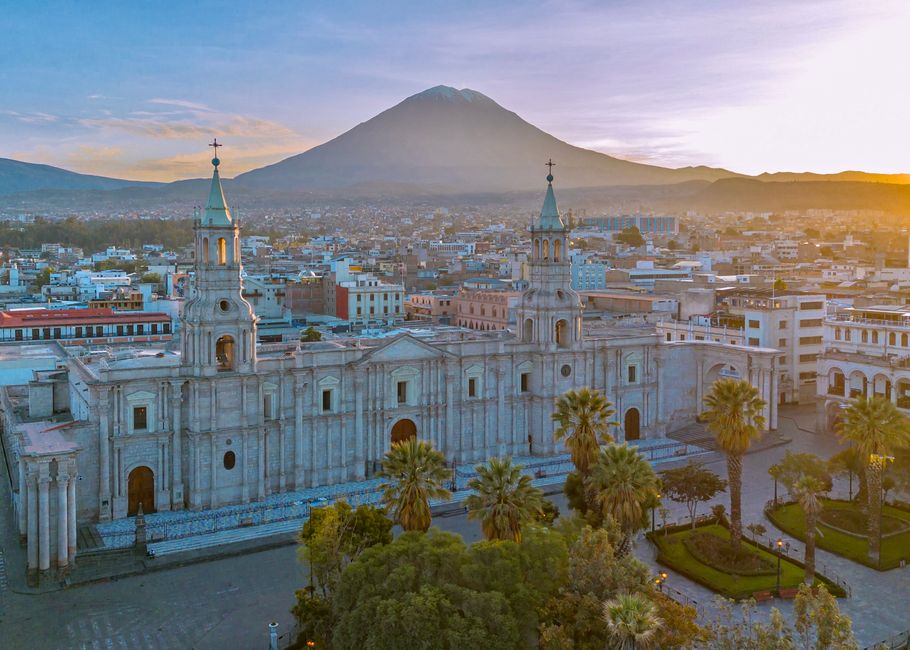
Arequipa, Peru’s second-largest city, sits in a green valley at about 2,335 m (7,660 ft) beneath three snowcapped volcanoes, El Misti, Chachani and Pichu Pichu. Its colonial center is built of sillar, a white volcanic stone, which gives it the name “La Ciudad Blanca” (the White City) and a place on UNESCO’s World Heritage List since 2000. Highlights are the grand Plaza de Armas, the walled Santa Catalina Monastery, a town within the town, the Museo Santuarios Andinos with the Inca ice maiden “Juanita,” and some of the best regional cooking in Peru in its picanterías. Arequipa is also the base for the Colca Canyon, one of the deepest in the world, where Andean condors soar past viewpoints in the morning. Sunny almost all year, it is a good stop between the coast and the higher Andes of Puno and Cusco.
Right now in Arequipa
- Tue 12–24°C 53–76°F Clear
- Wed 11–25°C 52–76°F Clear
- Thu 12–24°C 53–76°F Clear
- Thu 8 Oct Battle of Angamos (Combate de Angamos)
Weather: MET Norway (CC BY 4.0) · Holidays: Nager.Date
Top tours in Arequipa
See all tours for Arequipa →
From local operators, with prices and reviews; you check availability and book on Viator, our partner. We may earn a commission at no extra cost to you. How we earn money
Arequipa at a glance
- Best for: colonial architecture, food, museums, volcano scenery, the Colca Canyon and its condors, trekking.
- How long: 2 days for the city; 3–5 days with the Colca Canyon.
- Best time: April to November, sunny and dry; January to March brings some afternoon rain.
- Getting there: Rodríguez Ballón International Airport (AQP), about 1.5 hours by air from Lima; long-distance buses from Lima, Puno and Cusco.
- Before you go: entry rules, money and general safety are in our Peru travel guide.
Arequipa’s areas: where things are
The historic center is a grid of white stone streets around the Plaza de Armas, with the Santa Catalina Monastery a few blocks north. Across the Chili River to the north-west, the old district of Yanahuara has a famous viewpoint, and the picanterías of Cayma and Sachaca are nearby. Most hotels are in or near the center.
Neighborhoods at a glance
- The historic center (Cercado): the grid around the Plaza de Armas, with Santa Catalina, the museums, most hotels and restaurants on Calles Santa Catalina, San Francisco and Mercaderes.
- San Lázaro: the city’s oldest quarter, a few blocks north-east, with narrow lanes, small squares and guesthouses.
- Yanahuara: across the Grau bridge, a quiet district of white churches and the famous viewpoint, with picanterías nearby.
- Cayma and Sachaca: residential districts further out, with country-style restaurants, the Sachaca viewpoint tower and the Mansión del Fundador, a restored colonial mansion.
- Selva Alegre and Vallecito: leafy residential areas with a large park and quieter hotels.
Top things to see in Arequipa
Hours and prices change; check before you go.
The Plaza de Armas and the Cathedral
One of Peru’s most beautiful main squares, lined on three sides by two-story arcades of white stone, with the long facade of the Cathedral filling the fourth side, and El Misti rising behind. The Cathedral, rebuilt several times after earthquakes, has a museum and a bell tower you can visit on a tour. The Church of the Company of Jesus, a block away, has a richly carved facade and a painted chapel.
The Santa Catalina Monastery
A walled convent founded in 1579 that covers a whole city block, with narrow streets painted in blue, red and ocher, cloisters, kitchens and cells where nuns lived in seclusion for centuries; a small community still lives in one part. Allow two hours, and consider a guide; it is also open on some evenings.
The Museo Santuarios Andinos and Juanita
The museum of the Catholic University of Santa María shows “Juanita,” the frozen body of an Inca girl offered as a sacrifice on the summit of the Ampato volcano and found there in 1995, with the objects buried with her. Like the Llullaillaco children in Salta, Argentina, she is shown with care, and only on guided visits.
Yanahuara and the viewpoints
The Yanahuara viewpoint (mirador) frames El Misti through white stone arches; the church next door has a carved facade. Further out, the Carmen Alto viewpoint looks over farming terraces and the volcanoes.
More to see
- Casa del Moral and other colonial mansions: sillar houses with carved doorways.
- The San Camilo market: fruit, juices, cheese and local snacks.
- Mundo Alpaca: a free center on alpaca wool and weaving, with live animals.
- The Sabandía mill: a colonial stone mill in the countryside south-east of the city.
Food in Arequipa
Arequipa has its own strong cuisine, served in traditional picanterías: rocoto relleno (stuffed spicy pepper), chupe de camarones (river shrimp chowder), adobo (pork marinated in chicha, eaten on Sunday mornings), ocopa, solterito salad and the dessert queso helado (a spiced ice cream). Lunch is the main meal, and many picanterías close by late afternoon.
Where and what to eat
Arequipa’s picanterías are its culinary institution: big, noisy family restaurants serving huge portions at lunchtime, often cooked over wood fires, with chicha de jora in clay jugs. Each day of the week traditionally has its own dish, from chaque (a beef and vegetable broth) on Monday to chupe de camarones on Friday and adobo on Sunday. Try also ocopa (potatoes in a peanut and huacatay herb sauce), cuy chactado (flattened, fried guinea pig), pastel de papa and the spicy solterito salad of beans, cheese and onion. The San Camilo market has juice stalls and quick meals, and queso helado is sold from carts around the center. Modern restaurants in the center reinterpret regional dishes, and Arequipa has a lively café scene in colonial courtyards.
Shopping and alpaca
Arequipa is the center of Peru’s alpaca wool industry, and the big mills run showrooms where you can buy sweaters, scarves and throws of baby alpaca at factory prices; Mundo Alpaca, run by one of them, explains the process from shearing to weaving. The Fundo El Fierro, a colonial courtyard near the Church of San Francisco, houses a craft market, and stalls around the San Camilo market sell everyday goods. Look for products made of sillar stone, local chocolate and pisco from the nearby valleys of Majes and Vítor. Fine vicuña cloth is extremely expensive and should come with a certificate.
The Colca Canyon
The Colca Canyon, about 160 km (100 miles) north of Arequipa, is one of the deepest canyons in the world, more than twice the depth of the Grand Canyon by some measures, with Inca and pre-Inca terraces on its slopes, colonial villages such as Chivay, Yanque and Cabanaconde, and hot springs.
- The condors: at the Cruz del Cóndor viewpoint, Andean condors ride the morning thermals out of the canyon, usually from about 8 to 10 a.m.; sightings are best in the dry season.
- The road: the drive from Arequipa crosses the Pampa Cañahuas, with wild vicuñas, and the Patapampa pass at about 4,900 m (16,100 ft); go slowly and watch for altitude sickness.
- Tours: two-day tours with a night in Chivay or Yanque and an early start for the condors are more relaxing than one-day tours, which leave Arequipa around 3 a.m.
- Trekking: two- to three-day treks from Cabanaconde descend to the Sangalle oasis at the bottom of the canyon and climb back up; steep and hot by day.
- Fee: visitors pay a tourist ticket at the entrance to the Colca area, collected by the local authority; carry cash and your passport.
See our guide to hiking.
Other day trips from Arequipa
- El Misti and Chachani: two-day guided climbs for fit, acclimatized hikers; Chachani, at about 6,075 m (19,930 ft), is one of the easier 6,000-meter peaks in the world, but altitude makes both serious.
- The Salinas and Aguada Blanca reserve: high plains with vicuñas, flamingo lakes and volcano views on the way to Colca.
- Toro Muerto: a desert field of thousands of carved rocks (petroglyphs), a long day trip to the north-west.
Nearby destinations
- Puno173 km
Getting there and getting around
- By air: Rodríguez Ballón International Airport (AQP), about 8 km (5 miles) north-west of the center, has flights from Lima (about 1.5 hours) and Cusco; use official taxis or app rides.
- By bus: comfortable long-distance buses run to Lima (about 16 hours along the coast), Puno (about 6 hours) and Cusco (about 10 hours) from the Terrapuerto and Terminal Terrestre, side by side south of the center.
- By train: the luxury Belmond Andean Explorer sleeper train links Arequipa with Puno and Cusco on some departures.
- Getting around: the center is walkable; use app rides or official taxis elsewhere.
Getting around: practical details
The center is compact and walkable; Yanahuara is a 20-minute walk or short taxi ride across the river. Use app rides or taxis called by your hotel, and agree fares if a taxi has no meter. The two bus terminals (Terrapuerto and Terminal Terrestre) are side by side about 15 minutes south of the center by taxi; buy long-distance tickets online or at the companies’ counters, and choose reputable companies for the night routes. For the Colca, most visitors book a tour; public buses run from the Terminal Terrestre to Chivay and Cabanaconde, slower but cheap, and you can then hike or take local transport in the canyon. Renting a car is possible, but the high pass and gravel side roads demand care.
When to go and how long to stay
Arequipa has a dry, sunny highland desert climate, with mild days all year (about 20–24 °C, or 68–75 °F) and cool nights, colder in June and July; most of its little rain falls from January to March. There is no Arequipa station in the WMO normals we use, so those figures are general reference. For the Colca Canyon, the table uses SENAMHI’s 1991–2020 normals for the Chivay station (3,644 m), as published by the World Meteorological Organization.
| Colca Canyon (Chivay) | Average high / low | Rain per month | What it’s like |
|---|---|---|---|
| Rainy (Dec–Mar) | 19–21 °C (65–69 °F) / 4–5 °C (39–40 °F) | about 55–120 mm (2–5 in) | Green terraces, afternoon storms, muddy trails |
| Dry (Apr–Nov) | 19–22 °C (66–71 °F) / −2 to 3 °C (29–37 °F) | under 30 mm (1.2 in) | Sunny, clear and cold at night; best for condors and treks |
Chivay records about 450 mm (18 in) of rain a year, almost all from December to March. In 2026–27, Peru’s El Niño commission expects normal-to-below-normal rain in the southern highlands.
Arequipa and the Colca month by month
Highs and lows are for SENAMHI’s Chivay station in the Colca Canyon (1991–2020 normals, via the WMO); Arequipa itself is a little warmer and has no official station in the normals we use.
| Month | Colca high / low | What to expect |
|---|---|---|
| January | 19 °C (66 °F) / 5 °C (40 °F) | Rainy season; green terraces, muddy trails |
| February | 19 °C (65 °F) / 5 °C (40 °F) | Wettest month; Carnival celebrations |
| March | 19 °C (66 °F) / 4 °C (39 °F) | Rains easing; Easter processions |
| April | 20 °C (68 °F) / 3 °C (37 °F) | Dry and green; a great time |
| May | 20 °C (67 °F) / 0 °C (32 °F) | Dry, clear, cold nights |
| June | 19 °C (66 °F) / −2 °C (29 °F) | Cold nights; good condor sightings |
| July | 19 °C (66 °F) / −2 °C (29 °F) | Peak season; patron saint fiestas in Colca villages |
| August | 20 °C (68 °F) / −1 °C (31 °F) | Arequipa’s anniversary on August 15; busy |
| September | 21 °C (70 °F) / 1 °C (34 °F) | Dry and warming |
| October | 22 °C (71 °F) / 2 °C (35 °F) | Clear and quiet |
| November | 22 °C (71 °F) / 2 °C (36 °F) | Warm days, first clouds |
| December | 21 °C (69 °F) / 4 °C (39 °F) | Rains return; Christmas fairs in Arequipa |
Crowds: Arequipa’s anniversary on August 15 brings a week of festivities, and the Colca is busiest from June to August.
3 days in Arequipa
Day one, the Plaza de Armas, the Cathedral and the Company of Jesus, then lunch at a picantería and the Yanahuara viewpoint at sunset. Day two, the Santa Catalina Monastery in the morning and the Museo Santuarios Andinos in the afternoon. Day three, a rest day or the countryside mills and viewpoints before heading to Colca.
5 days
Add a two-day Colca Canyon trip with a night in Chivay or Yanque, the hot springs and the condors at dawn, or a three-day trek into the canyon from Cabanaconde.
Where to stay in Arequipa
- The historic center: colonial-house hotels and hostels near the Plaza de Armas and Santa Catalina.
- San Lázaro: the oldest neighborhood, quiet and charming, a short walk from the center.
- Yanahuara and Cayma: quieter hotels near the picanterías and viewpoints.
- Colca: lodges and hot spring hotels around Chivay and Yanque, and simple guesthouses in Cabanaconde.
Hotels can sell rooms to foreign tourists without Peru’s 18% IGV sales tax if you show your passport and immigration record; check whether quoted rates include tax.
Choosing where to stay
For a short stay, the historic center is unbeatable: many hotels occupy colonial houses with sillar courtyards, within walking distance of everything. Light sleepers should avoid rooms facing the busiest streets near the plaza. San Lázaro and Yanahuara are quieter and charming, a short walk or ride away. In the Colca, Chivay has the most services; Yanque and the lodges between Chivay and Achoma are more peaceful, some with their own hot springs; and Cabanaconde, at the far end, is the base for canyon treks and the closest village to the Cruz del Cóndor.
What a trip to Arequipa costs
These are our estimates for October 2026 at about S/ 3.44 per US dollar.
| Item | Typical price |
|---|---|
| Hostel dorm bed | S/ 30–60 (US$9–17) |
| Mid-range double room in the center | S/ 200–380 (US$58–110) |
| Picantería lunch | S/ 30–60 (US$9–17) |
| Santa Catalina Monastery entry | S/ 40–60 (US$12–17) |
| Two-day Colca tour with lodging | S/ 150–400 (US$44–116) plus the Colca ticket |
| Bus Arequipa–Puno | S/ 40–90 (US$12–26) |
| Taxi within the center | S/ 6–12 (US$2–3) |
Practical tips for Arequipa
- Money: cards are accepted in the center; carry soles for markets, picanterías and the Colca. On October 4, 2026, SUNAT’s published rate was about S/ 3.44 per US dollar.
- Sun: the sun is intense; wear a hat and sunscreen.
- Water: drink bottled or filtered water.
- Book Colca with care: choose a licensed agency with a reliable vehicle; the roads are high and winding.
Safety in Arequipa
Arequipa is one of Peru’s calmer big cities. Watch bags in markets and at the bus terminals, and use app rides or official taxis at night. The region is volcanic and seismic; learn your hotel’s evacuation route. Altitude: the city, at about 2,335 m, rarely causes problems, but the Colca Canyon (about 3,600 m in Chivay) and the Patapampa pass (about 4,900 m) can cause altitude sickness: headache, nausea and breathlessness. Ascend gradually, drink water, avoid alcohol on the first night in Colca, and descend if symptoms are severe. For emergencies, call 105 (police) or 106 (ambulance).
What to pack for Arequipa
Light layers for sunny days, a warm jacket for cold nights and the Colca, a sun hat, sunglasses, high-factor sunscreen, lip balm, sturdy shoes for trekking, swimwear for the hot springs, and cash for the Colca. Peru uses 220 V, with sockets for US and European plugs.
Arequipa travel FAQ
How far is the Colca Canyon from Arequipa?
About 160 km (100 miles), roughly 3.5–4 hours to Chivay over a pass at about 4,900 m.
When can I see condors in the Colca Canyon?
Usually in the morning, from about 8 to 10 a.m., at the Cruz del Cóndor viewpoint; sightings are best in the dry season.
Is Arequipa high enough for altitude sickness?
The city, at about 2,335 m, rarely causes problems, but the Colca Canyon and the road there are high enough to cause altitude sickness.
What is the Santa Catalina Monastery?
A walled 16th-century convent covering a whole city block, with colorful streets, cloisters and cells, open to visitors.
Should I do Colca in one day or two?
Two days are much more relaxing; one-day tours start around 3 a.m. and spend many hours driving.
What food should I try in Arequipa?
Rocoto relleno, chupe de camarones, adobo on Sunday mornings and queso helado, at a traditional picantería.
What is the best time to visit Arequipa?
April to November, when it is sunny and dry.
Where should I stay in Arequipa?
In the historic center for walking access to everything, or in San Lázaro or Yanahuara for quieter streets.
How do I get from Arequipa to Puno?
By bus, about 6 hours, or on the Belmond Andean Explorer luxury train on some departures.
What is a picantería?
A traditional Arequipa restaurant serving regional dishes at lunchtime, often with a different specialty each day of the week.
Sources and last review
Researched and last reviewed on 4 October 2026. Colca climate: SENAMHI’s 1991–2020 normals for the Chivay station, as published by the World Meteorological Organization; El Niño outlook: ENFEN’s statement of September 28, 2026; exchange rate: SUNAT. Altitude of the city: Wikidata. Sights and their history, museum details, the Colca’s depth, distances, heights and travel times, the Colca tourist ticket, transport, Arequipa’s climate (no official city station in the WMO normals we use), festival dates, hotel tax practice and safety tips come from general references and are flagged for checking. Prices change, so check the official sites before you go. For entry rules and money, see our Peru travel guide.
Plan your trip
Partner links: TravelerCenter may earn a commission if you book, at no extra cost to you.
🇪🇸 Useful Spanish phrases for Arequipa
All 38 Spanish phrases: restaurant, hotel, emergencies, romance (printable) →