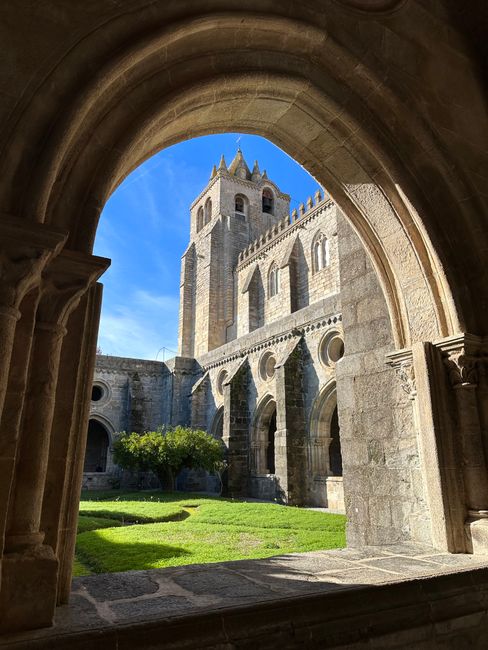
The Cathedral of Évora (Sé de Évora) is the largest and one of the most beautiful cathedrals in Portugal: a fortress-like Romanesque-Gothic church of granite on the city’s highest point, next to the Roman Temple. A visit takes in the church, the Gothic cloister, the battlemented roof terrace with views across the Alentejo plain, and a museum of sacred art. It opens daily 9:00–17:00, and entry closes 30 minutes earlier. The cathedral’s own website lists one €5 ticket for the full visit, but check on the day. Allow 1½ hours.
Right now in Cathedral of Évora
- Wed15–23°C59–73°F1 mm rain
- Thu14–26°C58–78°FClear
- Fri15–24°C59–74°FClear
Tickets and tours for Cathedral of Évora
See all tours for Cathedral of Évora →
From local operators, with prices and reviews; you check availability and book on Viator, our partner. We may earn a commission at no extra cost to you. How we earn money
Why the cathedral matters
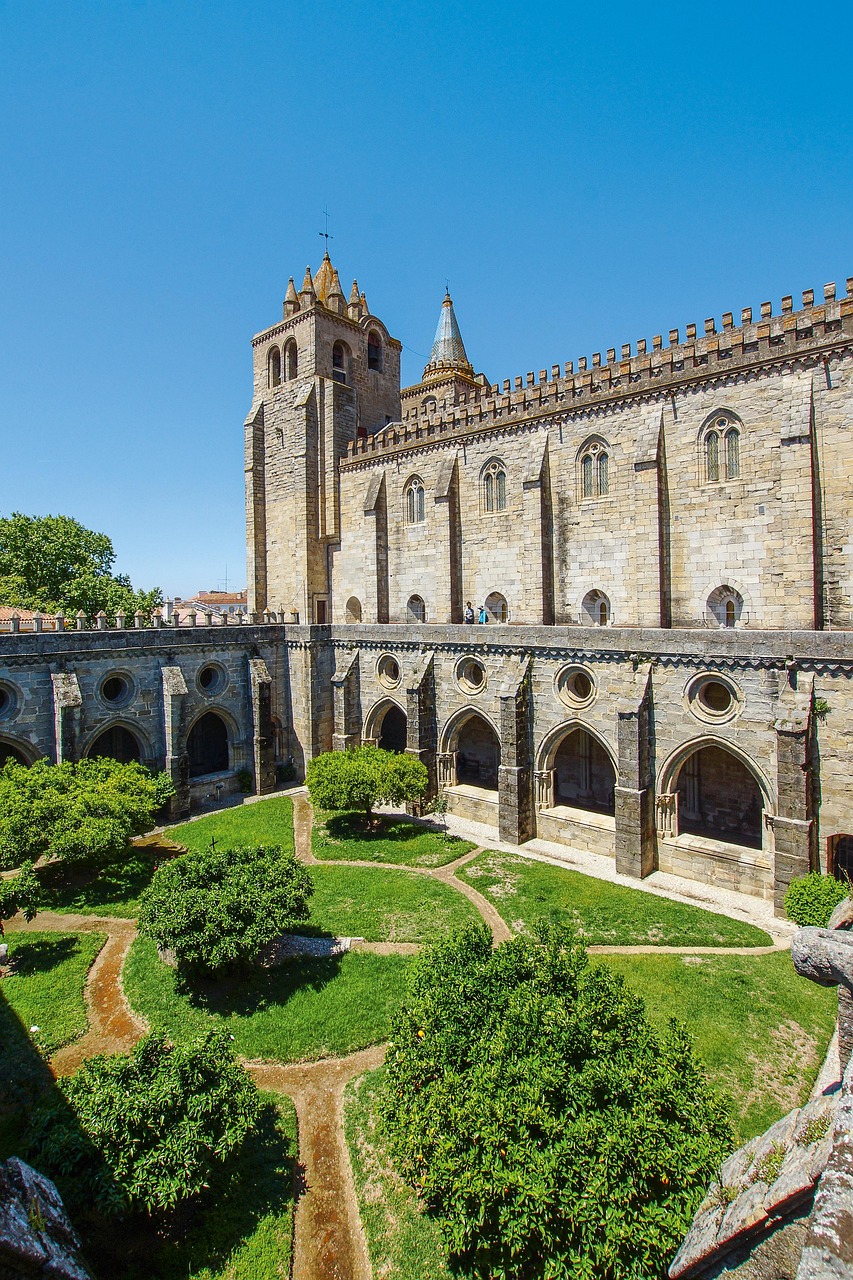
The cathedral stands on Évora’s acropolis, the highest point of the city, where the Romans built their temple. According to the cathedral chapter, the present building, in a Romanesque-Gothic style on a Latin-cross plan, was begun around 1280 and finished around 1350. From afar you spot its lantern tower over the crossing. The chapter compares it with the towers of the Old Cathedral of Salamanca and the cathedrals of Plasencia and Zamora in Spain. The battlemented roof gives it the look of the fortress-churches of the Middle Ages.
Later centuries added new treasures. In the 16th century came a Renaissance high choir with carved stalls commissioned by Évora’s first archbishop, Cardinal Henrique (later King Henry of Portugal), and a rare Iberian-type organ. The 18th century brought a new Baroque chancel. The cathedral was also home to a celebrated school of music. The chapter recalls that four Christian Japanese princes of the first Japanese embassy to the Pope played the organ while passing through Évora. The cathedral is part of the Historic Centre of Évora, a UNESCO World Heritage Site since 1986.
What you’ll see
- The church: a long granite nave in the Latin-cross plan. On the gilded altar in the nave stands Nossa Senhora do Ó, a 15th-century Gothic stone statue of the pregnant Virgin and one of the most venerated images in Évora. Local tradition is to ring the cathedral bells when a child is born.
- The chancel (capela-mor): rebuilt in the 18th century with the support of King João V by the German architect João Frederico Ludovice, who also designed the great convent at Mafra. It is lined with coloured marbles. Look for the large cedar crucifix and the painting of the Assumption.
- The high choir and organ: the Renaissance choir has relief-carved stalls, and the 16th-century organ is described by the chapter as very rare and unique in Portugal.
- The cloister: one of the finest Gothic cloisters in Portugal, with pointed arches, statues of the four Evangelists at the corners and the founder’s chapel with his Gothic marble tomb.
- The roof terrace: the highest point in Évora. You look over the walled old town and the newer districts, and on clear days across the plain to Arraiolos, Évoramonte and the Serra de Ossa to the north and Portel to the south.
- The Museum of Sacred Art (Treasury): in the restored 18th-century college of the cathedral choirboys, next door. It displays painting from the School of Évora, sculpture, goldsmiths’ work and vestments from the 13th to the 20th century. Highlights include the reliquary of the Holy Wood (Santo Lenho) and the “Virgin of Paradise”, also called the Virgem Abrideira, an image of the Virgin that opens.
How to visit
From the Cabido da Sé (cathedral chapter) website, checked October 2026:
- Hours: cathedral, museum and terrace daily 9:00–17:00; you must enter at least 30 minutes before closing.
- Closed: the afternoon of 24 December, 25 December and 1 January.
- Tickets: €5 for the full visit (cathedral, cloister, panoramic terrace and museum). Children up to 12 visiting with their parents or guardians go free.
- Note: the chapter’s website looks infrequently updated. Prices and ticket options may differ at the desk, so treat €5 as a guide.
- Contact: Largo Marquês de Marialva; tel. +351 266 759 330.
How long to allow and when to go
Allow about 1½ hours: 30–40 minutes in the church and cloister, 15–20 minutes on the terrace and 30 minutes in the museum. Climb to the terrace in the morning, when the light is clear over the plain and before the summer heat. With last entry at 16:30, don’t leave it for the end of the afternoon.
Accessibility
The chapter’s website does not publish accessibility information, including whether the roof terrace and museum floors can be reached without steps. If you need step-free access, contact the cathedral before your visit (tel. +351 266 759 330).
Getting there
The cathedral is in the heart of the walled historic centre, a few minutes’ walk from Praça do Giraldo and about 100 metres from the Roman Temple. From Lisbon, Évora is about an hour and a half by train. The centre is compact enough to explore on foot.
Combine it with
Start at the Roman Temple, visit the cathedral and terrace, then walk about 400 metres down through the town to the Chapel of Bones in the Church of São Francisco. That makes a satisfying half-day. Our Évora guide covers food, stays and day trips into the Alentejo.
Cathedral of Évora FAQ
How much does it cost to visit Évora Cathedral?
The cathedral chapter’s website lists €5 for the full visit (church, cloister, roof terrace and museum), with children up to 12 free when accompanied by their parents. Check the price at the desk, because the site may not be up to date.
Can you go on the roof of Évora Cathedral?
Yes. The battlemented roof terrace is included in the full visit and is the highest point in Évora, with views over the town and the Alentejo plain.
What are the cathedral’s opening hours?
Daily 9:00–17:00, with entry up to 30 minutes before closing. It closes on the afternoon of 24 December, on 25 December and on 1 January.
How old is Évora Cathedral?
The present Gothic building was begun around 1280 and completed around 1350, according to the cathedral chapter. The chancel is an 18th-century Baroque addition.
Is Évora Cathedral part of a UNESCO site?
Yes. It stands in the Historic Centre of Évora, a World Heritage Site since 1986.
What is the Senhora do Ó?
A 15th-century Gothic stone statue of the pregnant Virgin in the nave, one of the most venerated images in Évora.