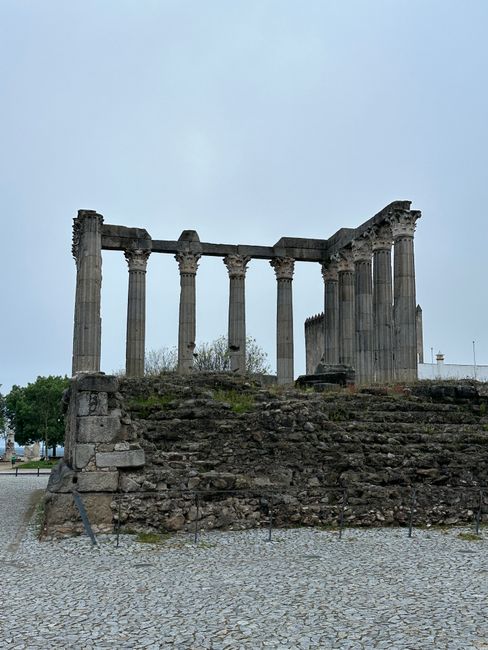
The Roman Temple of Évora is a 2,000-year-old Corinthian temple standing on the highest point of the old town, its granite podium and marble-capped columns still rising over the square. It is often called the “Temple of Diana”, but that name comes from a 17th-century legend; it was most likely built in honour of the emperor Augustus. It stands in the open, so there is no ticket and no opening time. Allow 20–30 minutes, and walk past again in the soft evening light.
Right now in Roman Temple of Évora
- Wed15–23°C59–73°F2 mm rain
- Thu15–26°C58–78°FClear
- Fri14–23°C56–73°FClear
Tickets and tours for Roman Temple of Évora
See all tours for Roman Temple of Évora →
From local operators, with prices and reviews; you check availability and book on Viator, our partner. We may earn a commission at no extra cost to you. How we earn money
Why the temple matters
Évora was a Roman town, called Liberalitas Iulia. The temple was built in the 1st century AD on its forum, the main public square, and is thought to have honoured Augustus, who was worshipped as a god. It was altered in the 2nd and 3rd centuries and damaged in the 5th, during the invasions that followed the fall of Roman rule.
Its survival is a story of reuse. In the Middle Ages the ruins were built into a tower of Évora’s castle, and from the 14th century until 1836 the building served as a butcher’s shop. The walls built around the columns protected them. The “Temple of Diana” name appeared in the 17th century, with no archaeological basis. In the 19th century the later additions were stripped away: they were removed in the early 1870s under the Italian architect Giuseppe Cinatti, leaving the temple as you see it. Excavations from 1989 to 1994, led by the German archaeologist Theodor Hauschild, found traces of a portico and a water pool that once surrounded the temple.
The temple is the emblem of the Historic Centre of Évora, a UNESCO World Heritage Site since 1986, and of a city chosen as a European Capital of Culture for 2027.
What you’ll see
What survives is a large rectangular podium of granite blocks, about 3.5 metres high, with the remains of its staircase on the south side. On top stand 14 Corinthian columns. Six are still in a row along the north side, carrying their original architrave. On the sides are four columns to the east and three to the west. The fluted granite shafts rest on bases of white Estremoz marble, and many keep their marble capitals carved with leaves. The floor, probably once covered in mosaic, has gone.
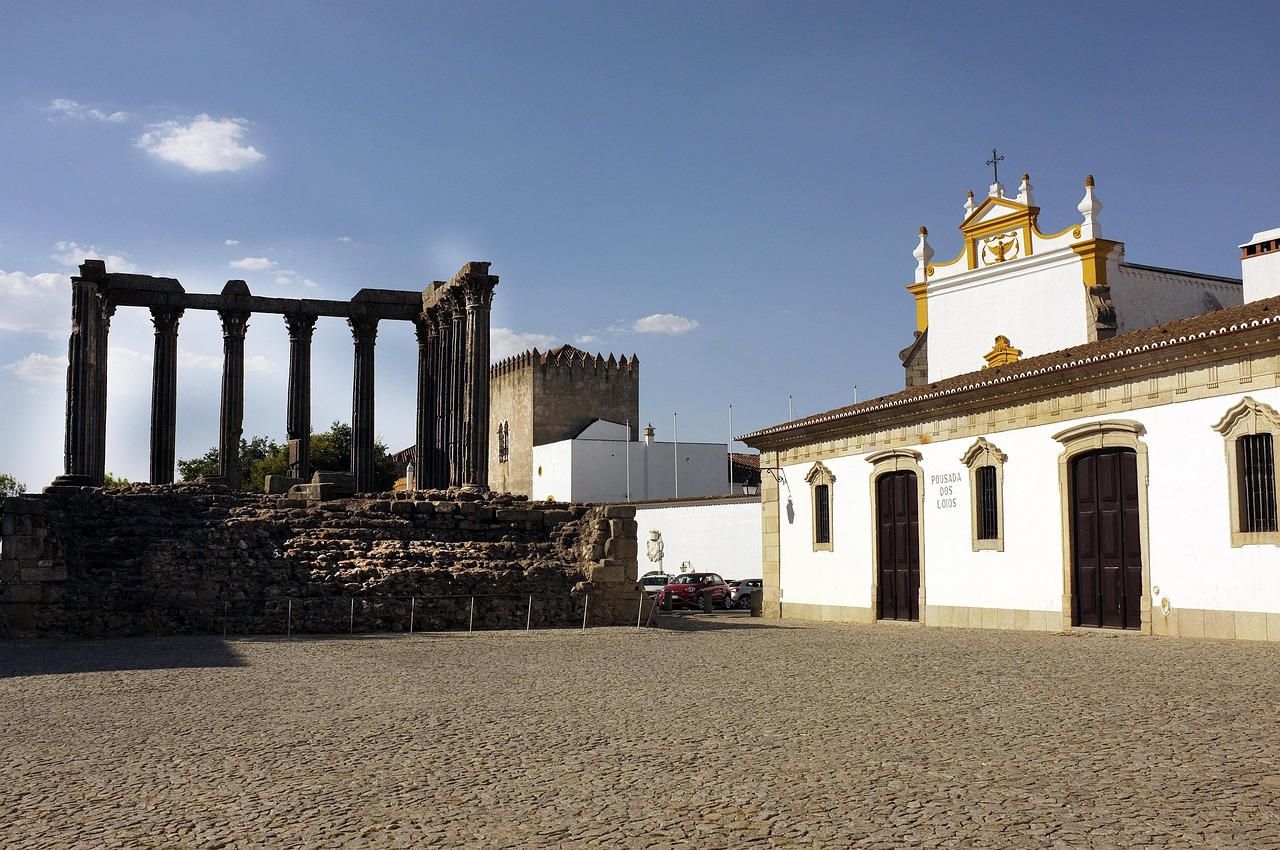
You can’t go up onto the temple. You walk around it in Largo Conde de Vila Flor and look up at the columns. The square is surrounded by some of Évora’s best buildings: the cathedral just behind, the Lóios church and convent, the Cadaval Palace, and the Évora Museum. Beside the temple, the small Diana Garden (Jardim de Diana) is a pleasant viewpoint over the town and the Alentejo plain.
How to visit
- Tickets and hours: none. The temple stands in a public square and can be seen at any time.
- Interpretation centre: the city’s interpretation centre is in the Palácio de D. Manuel and holds the accessible-tourism materials about the temple (see below).
- Photos: late-afternoon light gives the warmest colours on the granite and marble.
How long to allow and when to go
You need only 20–30 minutes at the temple itself, but most people pass it several times, because everything in the historic centre is a short walk away. Come early in the morning for an empty square, or in the evening, when the heat of an Alentejo summer day has eased. Évora gets very hot in July and August, so plan outdoor sightseeing for the morning and evening.
Accessibility
The temple is outdoors and is seen from the surrounding square; there is nothing to climb. The historic centre sits on a hill, so expect some slopes on the way up. Évora’s council and the InclusivTUR-Alentejo project (led by Accessible Portugal) made the Roman Temple a model resource for accessible tourism in 2022. They produced materials in several formats, including easy-to-read text, Braille and relief images, Portuguese Sign Language and audio description, managed from the interpretation centre in the Palácio de D. Manuel.
Getting there
The temple is in the centre of the walled historic town, a few minutes’ walk from the main square, Praça do Giraldo. From Lisbon, Évora is about an hour and a half by train. The historic centre is compact and best explored on foot.
Combine it with
Everything important is close. The Cathedral of Évora is about 100 metres away. Climb to its roof terrace for a view back over the temple. The Chapel of Bones is about 450 metres away in the Church of São Francisco. A good half-day loop is temple, cathedral and terrace, lunch near Praça do Giraldo, then the Chapel of Bones. See our Évora guide for where to stay and eat, and our Portugal guide for getting around the country.
Roman Temple of Évora FAQ
Is the Roman Temple of Évora free to visit?
Yes. It stands in an open public square, so you can see it at any time without a ticket.
Is it really the Temple of Diana?
No. The “Temple of Diana” name comes from a 17th-century legend. Historians believe the temple was built in the 1st century AD in honour of the emperor Augustus.
Why did the temple survive?
It was built into Évora’s medieval castle and later used as a butcher’s shop until 1836, and the surrounding walls protected the columns. They were removed in the 19th-century restoration.
How many columns are left?
Fourteen of the original Corinthian columns stand on the podium, six of them in a complete row on the north side with their architrave.
Can I go up onto the temple?
No. You view it from the square around the podium.
What else is near the Roman Temple?
The cathedral (with its roof terrace), the Diana Garden viewpoint, the Évora Museum and the Lóios church are all around the same square. The Chapel of Bones is less than 10 minutes’ walk away.