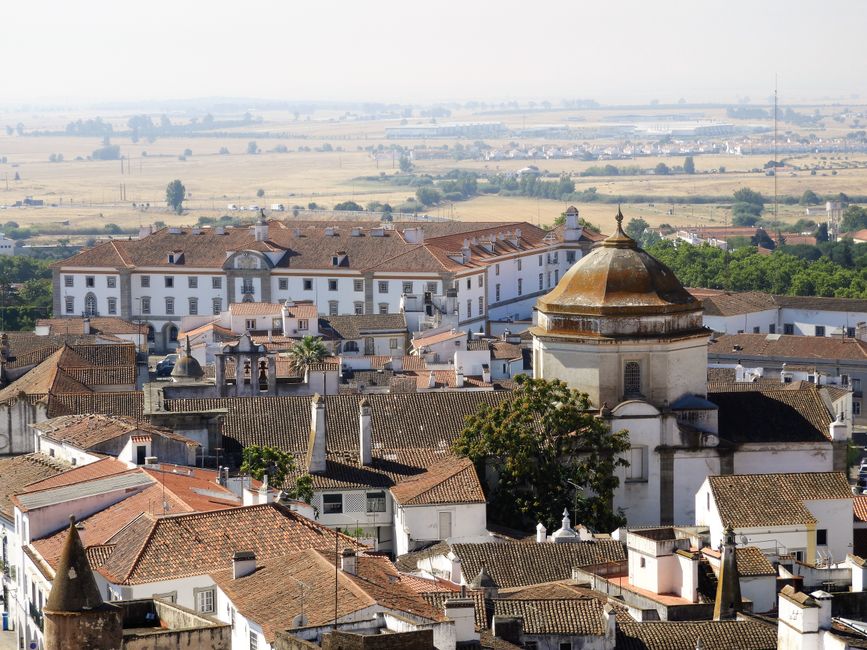
Évora is the capital of the Alentejo: a walled, whitewashed university city about an hour and 40 minutes from Lisbon by train. Its Roman temple, medieval cathedral and bone-lined chapel sit a few minutes apart, and vineyards, cork oaks and a stone circle older than Stonehenge lie just outside. Come for one full day, or better, stay a night or two.
Right now in Évora
- Wed 15–23°C 59–73°F 1 mm Partly cloudy
- Thu 14–26°C 58–78°F Clear
- Fri 15–24°C 59–74°F Clear
Weather: MET Norway (CC BY 4.0) · Rates: ECB
Top tours in Évora
See all tours for Évora →
From local operators, with prices and reviews; you check availability and book on Viator, our partner. We may earn a commission at no extra cost to you. How we earn money
Évora at a glance
- Best for: Roman and medieval history, Alentejo wine and food, megaliths, slow walks through white lanes, easy road trips to hilltop villages.
- How long: a long day trip from Lisbon covers the old town; 2 nights add a winery, the Almendres stone circle and a village such as Monsaraz.
- Best time: April–May and late September–October. July and August average highs of about 33 °C.
- Getting in: direct Intercidades trains from Lisboa Oriente in about 1 hour 40 minutes, from €13.90 in second class (as of October 2026).
- Tourist tax: €1.50 per person per night from age 16, for up to 3 nights (as of October 2026).
- Big year ahead: Évora is European Capital of Culture in 2027.
- Before you go: entry rules, money and general safety are on our Portugal travel guide.
The walled historic centre and around
Évora’s old town sits on a low hill in the middle of the Alentejo plain, wrapped in medieval walls. UNESCO listed the Historic Centre of Évora as a World Heritage Site in 1986. Its roots are Roman, and its golden age came in the 15th and 16th centuries, when Portuguese kings often lived here. Today it feels remarkably complete: whitewashed houses trimmed in ochre, tiled doorways, wrought-iron balconies and small, sleepy squares.
Everything starts at Praça do Giraldo, the arcaded main square with its marble fountain and café tables, and the tourist office. Narrow streets climb from here to the cathedral and the Roman temple at the top of the hill. Rua 5 de Outubro, lined with craft and cork shops, links the two. On the north-west side, the 16th-century Água de Prata aqueduct strides into town; in places houses and shops are built right into its arches. To the south, the shady Jardim Público (public garden) is the place for an evening stroll.
The old town is small, about a 20-minute walk from wall to wall, and the countryside starts right outside the gates.
Top things to see in Évora
Prices and hours below were checked on the official sites in October 2026. They change, so check before you go.
Roman Temple
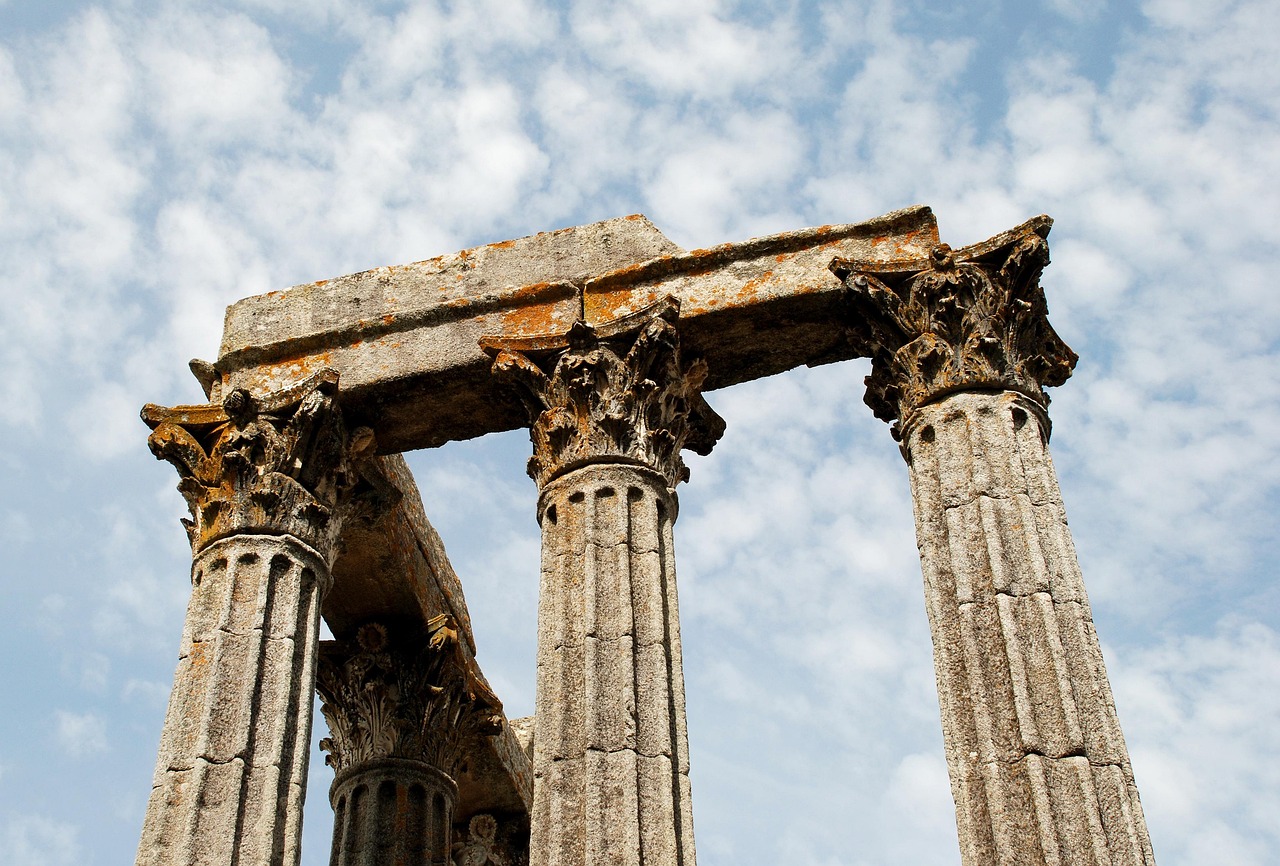
Évora’s emblem: a row of granite Corinthian columns with marble capitals, standing on a high podium at the top of the hill. It was built in the first half of the 1st century AD. For centuries it was called the Temple of Diana, but it is now thought to have been dedicated to the cult of the emperor. It stands in an open square, so it is free to see at any time from outside, and it is at its best in the golden light before sunset.
Évora Cathedral (Sé)
A fortress-like medieval cathedral a short walk from the temple. The highlight is the rooftop, where you walk among the towers with the city below you. As of October 2026 a single €5 ticket covers the cathedral, cloister, rooftop view and museum, and children up to 12 go free with their parents. It opens daily from 9:00 to 17:00, with last museum entry half an hour before closing. It closes only on the afternoon of 24 December, on 25 December and on 1 January.
Chapel of Bones (Capela dos Ossos)
Inside the Church of São Francisco, near Praça do Giraldo, Franciscan friars lined a 17th-century chapel with the bones and skulls of thousands of people from the city’s old cemeteries. It sounds macabre, but the mood is quiet and thoughtful. As of October 2026 the ticket costs €7 for adults, €5 for under-25s and over-65s, and €15 for a family, and also covers the church’s museum rooms, terrace and nativity-scene collection. The church itself is free. It opens daily from 9:00 to 18:30 in summer time and 9:00 to 17:00 in winter time, except 1 January, Easter Sunday, the afternoon of 24 December and 25 December.
University of Évora (Colégio do Espírito Santo)
The university’s main building is a Jesuit college begun in 1550, with a Renaissance cloister and classrooms lined with blue-and-white tiles. Students still have lectures here. As of October 2026 visits cost €3 (€1.50 extra for an audio guide in four languages), Monday to Saturday from 9:30 to 17:00. It is closed on Sundays and public holidays.
Frei Manuel do Cenáculo National Museum
Évora’s main museum, next to the cathedral, holds about 20,000 pieces, from Roman finds to a large Flemish altarpiece from around 1500. As of October 2026 entry is €10, half price for ages 13–24 and over-65s. It opens Tuesday to Sunday, 9:30–13:00 and 14:00–17:30 (last entry 17:00), and is closed on Mondays.
Monuments
- Almendres Cromlech
- Cathedral of Évora
- Roman Temple of Évora
- Igreja de São Francisco
Museums
- Capela dos Ossos
- Paços de Évora (restos)
Archaeological sites
- Great Dolmen of Zambujeiro
Things to do in and around Évora
Taste Alentejo wine
The Alentejo is one of Portugal’s biggest wine regions, known for generous, sun-ripened reds and fresh whites, and for vinho de talha, wine still fermented in clay amphorae as in Roman times. The official Rota dos Vinhos do Alentejo (Alentejo Wine Route), run by the regional wine commission, brings together more than 60 wineries across the region. Many offer cellar visits and tastings, some with picnics or cork-forest safaris.
Start at the Wine Route’s tasting room in the old town, at Rua 5 de Outubro 88. As of October 2026 it opens Monday to Friday 10:00–17:30 (tastings until 16:30) and Saturday 11:00–13:00 and 14:00–17:00 (tastings until 16:15). It is closed on Sundays and holidays, and booking ahead is recommended. Then pick a winery: most need a reservation and run visits at set times. Closest to town, the Cartuxa winery of the Eugénio de Almeida Foundation is about 2 km from the historic centre. As of October 2026 its guided visits last about 90 minutes and start at 10:30, 11:30, 15:00 and 16:30, and you must book in advance.
Walk among the Almendres standing stones
About 15 km west of Évora, near the village of Nossa Senhora de Guadalupe, 95 granite monoliths stand in rings on a gentle slope among cork oaks. The Almendres Cromlech is the largest megalithic enclosure in the Iberian Peninsula, and its earliest stones go back to the Neolithic, millennia before Stonehenge. It is free, unfenced and open at all times. After conservation work it reopened in 2024 with a marked path around the stones; stay on it to protect the ground. The last stretch is a dirt road that ordinary cars can drive with care. A single tall menhir stands about 1.4 km away. Go early or near sunset, when the stones glow. Near Valverde, the Anta Grande do Zambujeiro, one of Iberia’s largest dolmens (stone burial chambers), has been reachable only on foot along a dirt track since October 2024.
Eat like the Alentejo
Alentejo cooking is country food made from bread, olive oil, pork and herbs, and Évora is a great place to try it. Look for açorda alentejana (bread soup with garlic, coriander and a poached egg), migas (fried bread crumbs with pork), carne de porco à alentejana (pork with clams), black pork (porco preto) from acorn-fed pigs, lamb stews and sopa de cação (dogfish soup). Start with sheep’s cheese and olives, and finish with sericaia, a cinnamon egg pudding often served with Elvas plums.
Day trips from Évora
The best of the Alentejo is in its small towns, and you will want a car to reach them. Each one below is roughly 20–50 km from Évora.
Monsaraz
A tiny walled village of white houses and stone lanes on a hilltop about 50 km east, with a castle looking over the huge Alqueva lake and across to Spain. It is free to wander, and the Reguengos wineries are on the way.
Estremoz
A marble town about 40 km north-east, crowned by a castle. Go on a Saturday morning: the traditional market fills the big Rossio Marquês de Pombal square with farmers selling fruit, cheese, olive oil, sausages and olives, alongside an antiques and second-hand fair.
Arraiolos
About 20 km north, Arraiolos is famous for its hand-embroidered wool rugs. Learn how they are made at the Arraiolos Rug Interpretation Centre, then watch embroiderers in the workshops. As of October 2026 the centre opens Tuesday to Sunday, 10:00–13:00 and 14:00–18:00, closed on Mondays, and entry is €1.
Vila Viçosa
A marble town about 50 km north-east, home of the Dukes of Bragança, Portugal’s last royal family. The Ducal Palace is visited on guided tours in Portuguese. As of October 2026 the palace costs €9, or €16 for all the collections over three days. From October to May it opens on Tuesday afternoons (14:00–17:00) and from Wednesday to Sunday 10:00–13:00 and 14:00–17:00, with later closing in summer. It is closed on Mondays.
Évora 2027: European Capital of Culture
Évora is European Capital of Culture in 2027, together with Liepāja in Latvia. It is the fourth Portuguese city to hold the title, after Lisbon, Porto and Guimarães, and the project is backed by all 47 municipalities of the Alentejo. The theme is Vagar, an Alentejo word for taking your time, unhurried and in tune with the land around you.
Confirmed as of October 2026:
- Opening: 6 February 2027, with a free outdoor show directed by Marco Martins at Rossio de São Brás, just outside the walls. About 400 professional and amateur performers are expected, among them the fado singer Carminho.
- The full 2027 programme: not yet published. The organisers say it will be announced in the last quarter of 2026.
- Warm-up events in 2026: a preparatory programme of concerts, films, workshops and festivals is running around the region. One example is GUADIANA, a new festival of Afro-Ibero-American literature, in Évora from 9 to 11 October 2026.
Visiting in 2027? Expect more events and visitors, and book early for the opening weekend.
Getting to Évora
By train from Lisbon. CP’s Intercidades trains run direct from Lisboa Oriente (also calling at Entrecampos and Sete Rios) in about 1 hour 40 minutes. On the timetable in force since 6 September 2026 there are five direct trains a day on weekdays and three at weekends and on holidays, with a similar number back. As of October 2026 a single costs €13.90 in second class or €18.50 in first, and a second-class return €25.50. Children aged 4–12 and over-65s pay half price, and under-26s get 25% off. Seats are reserved, so book ahead for weekend trains. Évora station is just outside the walls to the south: walk into town or take a short taxi ride.
By bus. Rede Expressos coaches from Lisbon’s Sete Rios terminal take around 1 hour 30 minutes and leave several times a day. Buy on rede-expressos.pt. Évora’s bus terminal is just outside the walls, a short walk from the centre.
By car. Évora is about 130 km from Lisbon by motorway (A2 then A6, with tolls), roughly an hour and a half. More on travelling around the country is in our Portugal guide.
Getting around
- On foot: inside the walls, walking is the best way to get around. Streets are cobbled and narrow, and the main sights are 5–10 minutes apart.
- Parking: if you drive, leave the car in one of the large car parks just outside the walls, some of them free. Inside, streets are narrow and parking is scarce, paid and time-limited on weekdays.
- The region: to reach Almendres, the wineries and the villages, you need a car, a taxi or a guided tour. Public transport to the countryside is limited.
When to go and how long to stay
Évora has a hot, dry inland climate: much hotter in summer and cooler on winter nights than Lisbon. The table uses IPMA’s official 1991–2020 climate normals for the Évora station: average daily highs and lows, and the number of days with at least 1 mm of rain.
| Season | Average high / low | Rainy days per month | What it’s like |
|---|---|---|---|
| Spring (Mar–May) | 19–25 °C / 7–11 °C | 6–8 | Green fields, wildflowers and mild days; ideal for walking and the countryside |
| Summer (Jun–Aug) | 30–34 °C / 14–16 °C | under 2 | Hot and dry; sightsee early, rest at midday, live outdoors in the evening |
| Autumn (Sep–Nov) | 30 °C falling to 18 °C / 15 °C falling to 8 °C | 4 in September, 8–9 in October–November | September is still hot and is harvest time; October brings mild days and the first rains |
| Winter (Dec–Feb) | 14–16 °C / 4–5 °C | 7–9 | Cool, sometimes frosty nights, crisp sunny days and few visitors |
Summer heat is the main thing to plan around. In July and August the average high is about 33 °C, about 24–25 days a month reach 30 °C, and about 11 reach 35 °C. The highest reading in the 1991–2020 series was 45.4 °C, on 4 August 2018. Évora gets about 600 mm of rain a year, mostly from October to May. In late June and early July the Feira de São João, the city’s big annual fair, fills the Rossio de São Brás with music, food stalls and rides (in 2026 it ran from 23 June to 5 July).
Day trip or a night or two
As a day trip from Lisbon: take a morning train, see the temple, the cathedral rooftop, the Chapel of Bones and the university, and linger over an Alentejo lunch before an evening train back. With 1–2 nights: add a winery, Almendres at sunset and a morning in Monsaraz, Estremoz (on a Saturday) or Vila Viçosa, and enjoy the town in the evening, after the day visitors leave.
Weather month by month
Averages from IPMA normals 1991–2020, Évora · Last reviewed 3 Oct 2026
Where to stay in and around Évora
- Inside the walls: the best choice without a car. You can walk everywhere, and evenings are quiet and atmospheric. Rooms in old townhouses can be small.
- Just outside the walls: newer buildings, easier parking and often lower prices, 10–15 minutes’ walk from Praça do Giraldo. Handy for drivers and for the train and bus stations.
- Rural estates (herdades and montes): farmhouses and wine estates in the countryside, often with a pool, vineyards or cork oaks around you and dinner on site. You need a car.
Wherever you stay in the municipality, the €1.50 nightly tourist tax (age 16 and over, up to 3 nights) is added to your bill.
Practical tips for Évora
- Respect the summer heat: sightsee from opening time until about 13:00, spend the hottest hours over a long lunch or indoors in the cathedral or a museum, and go out again after 18:00. Carry water and keep to the shady side of the street.
- Mondays: the national museum is closed, as are the Ducal Palace in Vila Viçosa and the Arraiolos rug centre. The cathedral and the Chapel of Bones open every day, so they are your Monday plan.
- Midday closures: several places shut for lunch, for example the national museum from 13:00 to 14:00, and the Arraiolos centre and the Vila Viçosa palace at the same hours. Plan your morning around that.
- Book winery visits ahead: most estates work by appointment at set times, and Saturdays fill up first.
What to pack for Évora
Comfortable walking shoes with grip come first, because the cobbles are polished smooth. From May to September, pack a wide-brimmed hat, sunglasses, high-factor sunscreen, a refillable water bottle and light, breathable clothes, plus something to cover your shoulders in churches. For Almendres and the countryside, closed shoes are better than sandals on the dusty tracks. From November to March, bring a warm layer and a waterproof jacket: days can be sunny but nights are cold. Leave room in your bag for a bottle of Alentejo wine, olive oil or a cork souvenir.
Évora travel FAQ
Can you visit Évora as a day trip from Lisbon?
Yes. Direct trains from Lisboa Oriente take about 1 hour 40 minutes, so a morning train out and an evening train back give you enough time for the main sights and a long lunch. Stay a night to add the countryside.
How much is the train from Lisbon to Évora?
As of October 2026, a single ticket costs €13.90 in second class and €18.50 in first, and a second-class return is €25.50. Children aged 4–12 and over-65s pay half, and under-26s get 25% off.
Is the Roman Temple of Évora free?
Yes. It stands in an open square at the top of the old town, so you can see it at any time without a ticket.
How much does the Chapel of Bones cost?
As of October 2026, €7 for adults, €5 for under-25s and over-65s, and €15 for a family. The ticket also covers the museum spaces of the São Francisco church.
Can you go up on the roof of Évora Cathedral?
Yes, and it is one of the best views in town. As of October 2026 the single €5 ticket includes the cathedral, cloister, rooftop and sacred art museum, and it opens daily from 9:00 to 17:00.
How do I get to the Almendres Cromlech?
Drive about 15 km west towards Nossa Senhora de Guadalupe and follow the signs; the last part is a dirt road. There is no public transport, so go by car, taxi or tour. Entry is free and it is always open.
How hot is Évora in summer?
Very hot. IPMA’s 1991–2020 normals give average highs of about 33 °C in July and August, and on about 11 days in each of those months it reaches 35 °C or more. Plan sightseeing for mornings and evenings.
How do I visit Alentejo wineries from Évora?
Start at the Alentejo Wine Route tasting room on Rua 5 de Outubro, then book directly with one of the 60-plus wineries on the official route. Most run guided visits with tastings at fixed times, by appointment.
When does Évora 2027 European Capital of Culture start?
The opening is on 6 February 2027, with a free outdoor show at Rossio de São Brás. As of October 2026 the full programme for the year had not yet been published; the organisers expect to announce it in the last quarter of 2026.
Is there a tourist tax in Évora?
Yes. Since 1 August 2025 the municipality charges €1.50 per guest per night, for guests aged 16 and over and for up to 3 nights, paid at your accommodation (as of October 2026).
What is open in Évora on a Monday?
The cathedral, the Chapel of Bones, the university and the open-air sights, including the Roman Temple and Almendres. The national museum is closed.
Do I need a car in Évora?
Not for the city itself, which you can walk. For the megaliths, wineries and villages, a car or a guided tour makes it much easier.
Nearby destinations
Sources
- © OpenStreetMap contributors · ODbL · fetched 3 Oct 2026
- Wikidata · CC0 · fetched 3 Oct 2026
Sources and last review
Researched and last reviewed on 3 October 2026. Climate figures come from IPMA’s 1991–2020 normals for Évora; train times and fares from CP (timetable in force since 6 September 2026, 2026 fares); the tourist tax from Évora City Council; Évora 2027 details from the official Évora_27 website and press reports; and opening hours and prices from the official sites of the cathedral, the Church of São Francisco, the University of Évora, Museus e Monumentos de Portugal, the Alentejo Wine Route (CVRA), the House of Bragança Foundation and the Arraiolos rug centre. Prices, hours and timetables change, so check the official links before you go.
Plan your trip
Partner links: TravelerCenter may earn a commission if you book, at no extra cost to you.
🇵🇹 Useful Portuguese phrases for Évora
All 38 Portuguese phrases: restaurant, hotel, emergencies, romance (printable) →
Traveler centers in Évora
Tourist information offices, visitor centers and travel agencies in Évora, from OpenStreetMap.
- Travel agency
Top Atlântico
- Tourist information office
Centro Interpretativo dos Almendres
- Tourist information office
Posto de Turismo
- Travel agency
Top Atlântico
- Travel agency
Emviagem
- Tourist information office
Posto de Turismo