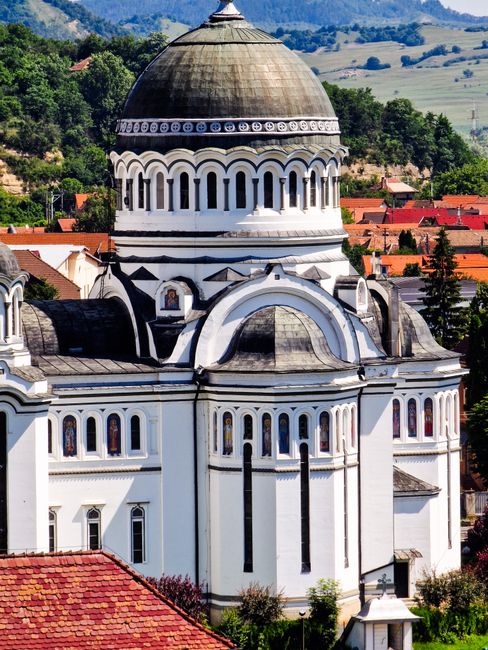
Sighișoara is a small town with a complete medieval citadel on a hill above the Târnava Mare river: colourful houses, cobbled lanes, guild towers and a 64-metre Clock Tower, all still lived in. It was built by Transylvanian Saxons from the 12th century onwards, and its historic centre has been a UNESCO World Heritage Site since 1999. Vlad III, the prince who inspired the name of Dracula, is said to have been born here around 1431. The citadel can be seen in a day, but stay a night to enjoy it when the day-trippers have gone, and use it as a base for the fortified Saxon churches of Biertan, Viscri and Saschiz in the hills around.
Right now in Sighișoara
- Wed7–22°C44–71°FPartly cloudy
- Thu6–23°C44–74°FClear
- Fri9–24°C48–75°FPartly cloudy
Top tours in Sighișoara
See all tours for Sighișoara →
From local operators, with prices and reviews; you check availability and book on Viator, our partner. We may earn a commission at no extra cost to you. How we earn money
Sighișoara at a glance
- Best for: an inhabited medieval citadel, the Clock Tower, the Saxon fortified churches and village life in the hills, and a quiet night in a historic guesthouse.
- How long: 1 day for the citadel; 2–3 days to add Biertan, Viscri and Saschiz.
- Best time: May to early October; late July for the medieval festival; December for a quiet, snowy citadel.
- Getting in: by car, about 2 hours from Brașov and 1 hour 30 minutes from Sibiu; trains are slow while the line from Brașov is rebuilt. The nearest airport is Târgu Mureș, about an hour away.
- Getting around: the citadel is small and car-free in practice; you need a car, a tour or a taxi for the villages.
- Before you go: Romania uses the leu (RON). Country-wide entry rules, money and driving (including the rovinieta road vignette) are on our Romania country page.
How Sighișoara works: the citadel and the lower town
Sighișoara (in German, Schäßburg) has two parts. The citadel (Cetatea) on the hill is the medieval walled town, about 600 m long, with the Clock Tower at its entrance, the main square (Piața Cetății), three churches and nine of the original towers, each once defended by a craft guild: the Tailors’, Shoemakers’, Tinsmiths’, Ropemakers’ and Butchers’ towers among them. People still live in its houses, and there are guesthouses, cafés and small museums. The lower town below grew up along the river, with Hermann Oberth Square, shops, the Orthodox cathedral, and the railway and bus stations on the far bank. Allow ten minutes’ walk, mostly uphill, from the stations to the citadel.
Top things to see in Sighișoara
Prices and hours below were checked on the official sites in October 2026. They change, so check before you go.
The Clock Tower and History Museum
The Clock Tower (Turnul cu Ceas) guarded the main gate of the citadel and was the seat of the town council. Its 17th-century clock has painted wooden figures that turn at midnight: one for each day of the week, plus Peace, Justice, Day and Night. Inside, the History Museum leads up six floors (about 110 steps) of town history to a wooden gallery with views over the roofs. As of October 2026, the town lists tickets at 50 lei for adults and 15 lei for pupils and students for the Clock Tower; 20 lei for the Medieval Weapons Collection in the neighbouring building; 15 lei for the Torture Room; or 70 lei for all three. The museum is closed on Mondays; from mid-September to mid-May it is usually open from 09:00 (10:00 at weekends) to 15:30, with longer summer hours to 17:30.
The Church on the Hill and the Scholars’ Stairs
From the citadel square, the covered wooden Scholars’ Stairs (Scara Școlarilor), built in 1642 with 176 steps, climb to the top of the hill, where the Gothic Church on the Hill (Biserica din Deal) stands next to the old Saxon school. The church has wall paintings, carved altars and a crypt, and is open in season for a small entry fee. Behind it, the old Saxon cemetery, with gravestones under tall trees on the slope, is one of the most peaceful places in town.
Citadel Square and the Vlad Dracul House
The small Citadel Square was the market place and site of trials and executions. On a corner nearby, the yellow Vlad Dracul House is where Vlad II “Dracul” lived in exile in the 1430s, and where his son Vlad III is said to have been born; it is now a restaurant with a small room about the legend. The Dracula myth comes from Bram Stoker’s novel of 1897, not from Romanian history, in which Vlad III is remembered as a harsh but effective ruler of Wallachia.
Church of the Dominican Monastery and the towers
Beside the Clock Tower, the Lutheran Monastery Church, once part of a Dominican monastery, has a fine collection of Anatolian carpets and a Baroque organ, and hosts concerts in summer. Walk the lanes along the walls to see the guild towers: the Ropemakers’ Tower, still lived in by the cemetery caretaker, the Tinsmiths’ Tower and the Shoemakers’ Tower.
Churches and cathedrals
- Church on the Hill
- Monastery Church (former Dominican church)
Monuments
- Scholars' Stairs
- Vlad Dracul House
Museums
- Clock Tower and History Museum
Historic centres
- Historic Centre of Sighișoara
Castles and forts
- Biertan fortified church
The fortified churches around Sighișoara
The rolling hills between Sighișoara, Brașov and Sibiu hold more than a hundred Saxon villages built around fortified churches, where villagers once sheltered from raids behind thick walls with grain stores and towers. Seven villages with fortified churches are on the UNESCO World Heritage list. Most churches are kept by a local key-holder or caretaker; opening hours are usually from about 10:00 to 17:00 or 18:00 in summer, shorter or by arrangement in winter, and there is a small entry fee.
- Biertan (about 30 km south-west): the most impressive, a hilltop church inside three rings of walls, with a sacristy door with an elaborate lock of 19 bolts and the “matrimonial prison”, where quarrelling couples were locked up until they reconciled. UNESCO-listed.
- Viscri (about 40 km south-east, partly on dirt roads): a whitewashed fortress-church in a village of pastel houses and horse carts, made famous by King Charles III, who owns a guesthouse there. UNESCO-listed.
- Saschiz (about 20 km east): a church with a tall bell tower modelled on the Clock Tower of Sighișoara, and a hill fortress in the woods. UNESCO-listed.
- Mălâncrav and Criț: quieter villages with medieval frescoes and Saxon farmhouses, good for walking and cycling.
The landscape around them, with hay meadows, beech woods and traditional farming, is one of the richest in Europe for wildflowers and birds; local trusts mark walking and cycling routes between the villages. See our cycling guide.
Activities and best months
- City sightseeingThe History Museum in the Clock Tower (64 m, six levels, 110 steps, Baroque roof of 1677) is the symbol of the citadel; 2026 tickets 50 lei for adults and 15 lei for students, 20 lei for the Medieval Weapons Collection, 15 lei for the Torture Chamber, or 70 lei for all three.
The Sighișoara Medieval Festival
Every summer, usually on the last weekend of July, the Sighișoara Medieval Festival fills the citadel with costumed parades, sword fights, craft stalls and concerts. It is lively and crowded, and guesthouses book up months ahead. The 2027 dates had not been announced at the time of writing; check the town’s official channels before planning a trip around it.
The Saxons, and what to eat
German-speaking settlers, known as Transylvanian Saxons, came to the region from the 12th century at the invitation of the Hungarian kings, to farm, trade and defend the frontier. For 800 years they kept their own language, Lutheran faith and self-governing towns, and they built Sighișoara, Brașov, Sibiu and the fortified villages. Most left for Germany in the decades around 1990, and only a few thousand remain, but foundations and returning families have restored many houses and churches, and Saxon heritage is now a source of local pride for Romanians and Hungarians living here too.
Food in Sighișoara mixes Romanian, Hungarian and Saxon cooking: try ciorbă (sour soup), tochitură (pork stew with polenta and a fried egg), stuffed cabbage, smoked bacon and sheep’s cheese, and, for dessert, papanași or a slice of Hanklich, a Saxon sweet bread. In the villages, guesthouses often cook with their own vegetables, eggs and preserves, and some sell jams and syrups made from local fruit and elderflower.
Around Sighișoara
- Brașov: about 2 hours by car, for the Black Church and day trips to Bran Castle.
- Sibiu: about 1 hour 30 minutes by car via Biertan or Mediaș, with its squares and the ASTRA museum.
- Mediaș: a small Saxon town with a fortified church and leaning tower, 40 km west.
- Târgu Mureș: about an hour north, with the Art Nouveau Palace of Culture and the nearest airport.
Getting to Sighișoara
By car. Sighișoara is on the DN13 between Brașov (about 115 km, 2 hours) and Târgu Mureș, and about 90 km from Sibiu. Buy a rovinieta before you drive on national roads. Park in the lower town; the citadel’s lanes are narrow and access by car is restricted.
By train. Sighișoara is on the railway between Brașov and Cluj-Napoca, with direct trains from Bucharest. The section from Brașov is being modernised in stages, and in 2026 trains are slow on it, often taking 3 hours or more for 128 km; check CFR Călători for current times.
By bus and air. Buses and minibuses link Sighișoara with Brașov, Sibiu and Târgu Mureș. The nearest airport is Târgu Mureș (TGM), about an hour away; Sibiu and Brașov airports are further.
When to go and how long to stay
Sighișoara sits at about 350–420 m in the Transylvanian hills, with warm summers, cold winters and rain mainly in early summer. There is no Sighișoara station in the international collection of Romanian climate normals, so the table uses the 1991–2020 normals of Romania’s National Meteorological Administration for Sibiu, about 90 km south-west at a similar height; Sighișoara’s climate is very close.
| Season | Average high | Average low | Rain per month | What it’s like |
|---|---|---|---|---|
| Winter (Dec–Feb) | 2–6 °C | −7 to −5 °C | 23–31 mm | Cold and quiet; snow on the roofs, short museum hours |
| Spring (Mar–May) | 11 °C rising to 21 °C | −1 °C rising to 9 °C | 35–77 mm | Green hills and blossom; few visitors |
| Summer (Jun–Aug) | 25–27 °C | 12–14 °C | 71–97 mm | Warm with storms; busiest, with the medieval festival in July |
| Autumn (Sep–Nov) | 22 °C falling to 10 °C | 9 °C falling to 0 °C | 33–56 mm | Golden woods and harvest in the villages |
Day-trippers fill the citadel from late morning to mid-afternoon in summer; early mornings and evenings are calm.
Sighișoara in 1 day
The Clock Tower and History Museum at opening time, the Monastery Church, the Scholars’ Stairs, the Church on the Hill and the Saxon cemetery, then a walk round the towers and lunch on the Citadel Square.
Sighișoara in 3 days
Spend the first day in the citadel. On day two, drive to Biertan and on to Mălâncrav or Mediaș. On day three, go to Saschiz and Viscri, walking between village and church, then continue to Brașov.
Weather month by month
Where to stay in Sighișoara
- Inside the citadel: guesthouses and small hotels in medieval houses; the best experience once the crowds leave, but expect stairs and cobbles and park below.
- The lower town: more choice and easier parking, a 5–10 minute walk up.
- The Saxon villages: restored farmhouses in Viscri, Biertan, Saschiz or Criț for a rural stay with a car.
Practical tips for Sighișoara
- Arrive early or stay late: the citadel is at its best before 10:00 and after 17:00.
- Mondays: the Clock Tower museum is closed.
- Carry cash: village churches often take cash only, and some guesthouses prefer it.
- Wear good shoes: the lanes and stairs are steep and cobbled.
- Drive carefully in the villages: watch for horse carts, cattle and potholed side roads.
- Emergencies: call 112.
What to pack for Sighișoara
Comfortable walking shoes with grip for cobbles and the Scholars’ Stairs, a light rain jacket for summer storms, layers for cool evenings, and a warm coat in winter. For walks between the Saxon villages, bring hiking shoes, water and sun protection. Carry some lei in cash.
What to pack
- City walking shoesLisbon and Porto are steep, with polished limestone cobbles that get slippery, so grippy soles matter.
- Day packs and anti-theft bagsA small zipped or anti-theft bag makes crowded trams and viewpoints less stressful.
- Rain jacketsFrom October to April Porto and Lisbon see rain on roughly a third of days.
- Travel adapters and convertersPortugal uses Type C and F sockets at 230 V, so most visitors from outside Europe need an adapter.
Sighișoara travel FAQ
How much does the Clock Tower in Sighișoara cost?
As of October 2026, 50 lei for adults and 15 lei for pupils and students, or 70 lei for a combined ticket that also includes the weapons collection and the torture room.
Is the Clock Tower open on Mondays?
No, the History Museum in the Clock Tower is closed on Mondays.
Was Dracula born in Sighișoara?
Vlad III, the 15th-century prince of Wallachia whose nickname inspired Bram Stoker’s Dracula, is said to have been born in Sighișoara around 1431, in the house now called the Vlad Dracul House. The vampire is fiction.
Can you visit Sighișoara as a day trip?
Yes, from Brașov (about 2 hours by car) or Sibiu (about 1 hour 30 minutes), but staying a night lets you see the citadel without the crowds and visit the fortified churches.
Which fortified churches should I see near Sighișoara?
Biertan, Viscri and Saschiz, all on the UNESCO World Heritage list. Biertan is the grandest; Viscri has the prettiest village.
When is the Sighișoara Medieval Festival?
It is usually held on the last weekend of July. The 2027 dates had not been confirmed as of October 2026.
How do I get to Sighișoara by train?
Trains run on the line between Brașov and Cluj-Napoca and from Bucharest, but works on the Brașov section make them slow in 2026. A car or bus is usually faster.
How long should I stay in Sighișoara?
One full day for the citadel; two or three to add the fortified churches and village walks.
Can you drive into the Sighișoara citadel?
Access by car is restricted to residents and guests with permission, and the lanes are narrow and steep. Park in the lower town and walk up in about five to ten minutes; if you are staying in the citadel, ask your guesthouse about luggage drop-off and parking.
Plan your trip
Partner links: TravelerCenter may earn a commission if you book, at no extra cost to you.
🇷🇴 Useful Romanian phrases for Sighișoara
All 38 Romanian phrases: restaurant, hotel, emergencies, romance (printable) →
Sources · last reviewed 4 October 2026
Researched and last reviewed on 4 October 2026. Clock Tower, weapons collection and torture room prices: the Sighișoara municipality’s History Museum page; climate: Romania’s National Meteorological Administration 1991–2020 normals for Sibiu in the WMO collection (used for Sighișoara, which has no station in the set). Museum opening hours, church entry fees and hours in the villages, the medieval festival’s usual dates, the railway works and travel times come from local tourism sites, press reports or general knowledge and are flagged for checking. Prices, timetables and rules change, so check the official sites before you go.
Also: primariasighisoara.ro · ANM normals 1991–2020, Sibiu (for Sighișoara) (climate)
Data: Weather: MET Norway (CC BY 4.0) · Rates: ECB · Costs: World Bank ICP and price levels · © OpenStreetMap contributors (ODBL) · Wikidata (CC0)