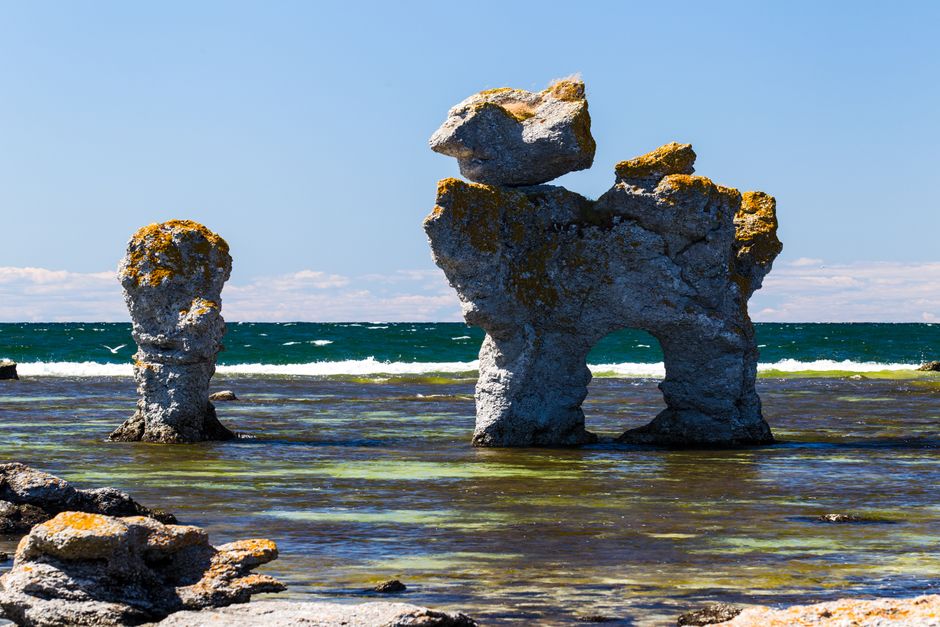
Gotland is Sweden’s largest island, a flat, sunny limestone plateau in the middle of the Baltic Sea, about three hours by fast ferry from the mainland. Its capital, Visby, is one of the best-preserved medieval towns in northern Europe: a UNESCO World Heritage Site of rose-covered cottages, steep cobbled lanes and roofless church ruins, wrapped in a 3.4 km stone wall with dozens of towers. Beyond it lie sandy beaches and pine woods, fields of poppies, some 90 medieval country churches, fishing villages with smokehouses, and in the north the island of Fårö, with its strange sea stacks (raukar) and the house where film director Ingmar Bergman lived. In summer Gotland is Sweden’s favourite holiday island, with Medieval Week in August; out of season it is very quiet. Give it three or four days, and come in June or late August.
Right now in Gotland (Visby)
- Wed 9–14°C 49–56°F Partly cloudy
- Thu 9–16°C 49–62°F 4 mm Rain
- Fri 9–11°C 48–53°F 5 mm Cloudy
Weather: MET Norway (CC BY 4.0) · Sea temperature: NOAA CoastWatch · Rates: ECB
Top tours in Gotland
See all tours for Gotland →
From local operators, with prices and reviews; you check availability and book on Viator, our partner. We may earn a commission at no extra cost to you. How we earn money
Gotland at a glance
- Best months: June and the second half of August for warm weather without the July peak; early September for quiet beaches. Average highs at Visby are about 19 °C in June and 21–22 °C in July and August (SMHI, 1991–2020), and Gotland is one of the sunniest parts of Sweden.
- Days needed: 1–2 for Visby; 3–5 to add Fårö, the beaches, the churches and the south.
- Getting there: Destination Gotland’s ferries from Nynäshamn (south of Stockholm) or Oskarshamn (on the Småland coast) take about three hours to Visby; flights from Stockholm take about 40 minutes.
- Getting around: Visby is compact and walkable; for the rest of the island, rent a bike or a car. Buses link the main villages but are infrequent.
- Budget level: summer accommodation in Visby is expensive and books up early, especially in Almedalen and Medieval Weeks; cottages and campsites in the countryside are better value. Sweden is close to cashless: pay by card everywhere.
Gotland’s areas and who each one suits
- Visby: the walled medieval town on the west coast, where the ferry and the airport are. Restaurants, ruins, the museum and summer nightlife; ideal for first-timers and anyone without a car.
- The west coast south of Visby (Tofta, Klintehamn): long sandy beaches, pine woods and holiday cottages, with boat trips from Klintehamn to the bird island of Stora Karlsö. Great for families.
- The north and Fårö: Lummelunda, Bläse, Fårösund and, across a short free ferry, Fårö’s sea stacks and wide beaches such as Sudersand. Wild, windswept and beloved by Swedes for summer.
- The east coast (Slite, Ljugarn): quieter fishing villages and beaches, with the sea stacks at Folhammar near Ljugarn.
- The south (Burgsvik, Hoburgen, Ronehamn): the least visited part of the island, with farmland, sheep, the “Hoburgsgubben” rock face at the southern tip and empty roads for cycling.
Top things to see on Gotland
Visby’s ring wall and old town
Visby grew rich in the Middle Ages as a member of the Hanseatic League, the trading network of the Baltic. Its town wall, built mostly in the late 13th century, still runs almost complete for about 3.4 km around the old town, with dozens of towers and gates; walk the outside along the grassy path, or follow it inside through the lanes. The old town is a maze of stone merchants’ houses and timber cottages covered in roses in June and July. Climb to the viewpoint at Klinten above the cathedral for views over the red roofs to the sea, and walk down to the Almedalen park by the harbour. The town has been a UNESCO World Heritage Site, the Hanseatic Town of Visby, since 1995.
The church ruins and Visby Cathedral
Medieval Visby had more than a dozen churches; only one, St Mary’s (Sankta Maria domkyrka), the cathedral with its black baroque towers, is still in use. The others stand as roofless ruins inside the walls. The largest, St Catherine’s (Sankta Karin) on the main square, Stora Torget, and the twin ruins of St Drotten and St Lars nearby are free to look at; St Nicholas (Sankt Nicolai) is used for concerts and events in summer. Some ruins have their own opening times in summer, and many are lit up at night.
Gotlands Museum (Fornsalen)
Gotland’s history museum, Fornsalen, on Strandgatan in Visby, is one of the best regional museums in Sweden. Highlights include the hall of Viking-age picture stones, carved with ships, gods and battles, the Treasure Chamber with silver hoards (more Viking silver has been found on Gotland than anywhere else in the world), and an exhibition on the bloody Danish conquest of Visby in 1361. Tickets and hours: as of October 2026, adult entry costs SEK 150 from October to April and SEK 190 from May to September; under-19s go free. It is open daily 11:00–16:00 from October to April and 9:00–17:00 from May to September, and closed on 24, 25 and 31 December and 1 January.
Fårö and the sea stacks
At Gotland’s northern tip, a free car ferry crosses in a few minutes from Fårösund to Fårö, a low, windswept island of heath, pine and stone walls. Its west coast at Langhammars and Digerhuvud is lined with raukar, tall limestone sea stacks shaped by waves and ice into strange figures, best at sunset. Fårö also has some of Gotland’s finest sandy beaches, especially the long, shallow bay at Sudersand, and the Bergman Center in Fårö village tells the story of Ingmar Bergman, who lived and filmed here. In summer, the ferry queues can be long at peak times; go early or late. Mainland Gotland has sea stacks too, at Folhammar on the east coast and around Lickershamn in the north-west.
Country churches
Gotland has about 90 medieval churches still in use, more than any area of its size in Europe, many with wall paintings, carved fonts and stained glass up to 800 years old. Favourites include Bunge and Bro in the north, Dalhem and Gothem in the middle of the island, and Öja in the south. Most are left open during the day in summer and are free to visit; please be quiet if a service or funeral is under way.
Lummelunda caves and Stora Karlsö
About 13 km north of Visby, the Lummelunda caves (Lummelundagrottan) are a limestone cave system with an underground stream, shown on guided tours in the summer season; bring a jacket, as it is cool inside. Off the west coast, the bird island of Stora Karlsö, a nature reserve with huge colonies of guillemots and razorbills on its cliffs, is visited on summer day trips by boat from Klintehamn. Both are seasonal, so check dates and book ahead.
Churches and cathedrals
- St Karin's Church Ruin (Sankta Katarina)
- Visby Cathedral (St Mary's)
Museums
- Gotlands Museum (Fornsalen)
Archaeological sites
- Visby City Wall
Caves
- Lummelunda Cave
Protected areas
- Stora Karlsö
Nature
- Digerhuvud Sea Stacks, Fårö
Beaches on Gotland
Gotland has the best beaches in the Swedish Baltic: long, sandy and shallow, though the water is cool, usually about 17–20 °C in July and August. Tofta strand, about 20 minutes south of Visby, is the island’s favourite family and summer beach, with sand dunes, pines and summer cafés. Sudersand on Fårö is a sweeping, shallow bay, perfect for children. Ljugarn on the east coast and Snäck, just north of Visby, are other easy choices. Many northern and western beaches are shingle or rock, beautiful for walks but less comfortable for sunbathing; bring swim shoes.
Activities and best months
- Beaches and swimmingGotland's official visitor site lists Tofta, about 20 km south of Visby, as one of the island's most popular beaches, a long sandy beach with dunes, beach club and bars (bus 10 from Visby), and Sudersand on Fårö as one of the most beautiful and longest, with soft sand and shallow water for children. Ljugarn's beach runs for several kilometres; Norderstrand, Snäck and Gustavsvik are near Visby, and Björkhaga rents SUPs and kayaks. · source
- City sightseeingVisby's town wall, about 3.5 km long, completed in 1288 and some 11 m high, is the best-preserved town wall in northern Europe. Inside are Sankta Maria Cathedral (begun in the late 12th century), the church ruins of St Nicholas and St Karin, Gotlands Museum with its picture stones and silver treasures, and the free Botanical Garden, founded in 1855. · source
- CyclingMany call cycling the best way to see Gotland: the island is flat and fairly small, with quiet coastal roads, farm shops, cafés and beaches along the way. The signposted Gotlandsleden goes round the island on minor roads and cycle paths, 540 km in all, and car-free cycle paths run beside road 140 from Visby to Klintehamn and road 149 from Visby to Lummelunda. · source
Medieval Week, Almedalen and summer events
- Medieval Week (Medeltidsveckan): each August, Visby goes back to the 14th century, with jousting, markets, encampments, music in the ruins and thousands of people in medieval costume. In 2026 it ran from 2 to 9 August; the 2027 dates had not been published in October 2026, but expect early August. Many street events are free; some, like the jousting and concerts, need tickets. Book accommodation many months ahead.
- Almedalen Week (Almedalsveckan): Sweden’s big week of political debate, when party leaders, organisations and journalists fill Visby with free talks and seminars. In 2027 it runs from 28 June to 2 July. All events are free, but Visby’s hotels fill up and prices rise.
- Midsummer: on Midsummer Eve (a Friday between 19 and 25 June), villages across Gotland raise maypoles, dance and eat herring and strawberries.
- Out of season: from October to April, Visby is a quiet working town; many summer restaurants and hotels close, but the museum, the walls and the ruins are lovely in winter light, and the town hosts a Christmas market in December.
Other things to do on Gotland
Cycling
Gotland is flat, sunny and threaded with quiet country roads, which makes it one of Sweden’s best islands for cycling. The signposted Gotlandsleden route loops right around the island, roughly 500 km in all; most people ride a section, for example Visby to Tofta along the coast or across the north to Fårösund. Bike-hire shops by the ferry terminal in Visby rent bikes and e-bikes by the day or week, and some deliver bikes and luggage. Watch for wind: the sea breeze can be stiff.
Walking and nature
Walk the coastal paths at Högklint, a limestone cliff just south of Visby, and at Hoburgen in the far south; the bird and orchid meadows of the island bloom in late May and June. Sweden’s Right of Public Access (allemansrätten) lets you walk and swim freely in the countryside, but stay off crops and private gardens, and never take fossils or stones from nature reserves. Gotland’s native ponies, the russ, roam the Lojsta moor in the middle of the island.
Food and drink
Gotland’s speciality is saffranspannkaka, a dense baked saffron and rice pudding served with dewberry jam (salmbärssylt) and whipped cream, found in every café. Try lamb from the island’s sheep farms, smoked fish from the coastal smokehouses, and truffles in autumn: Gotland is one of the few places in Sweden where Burgundy truffles grow. Local breweries make Gotlandsdricke, a smoky, juniper-flavoured farmhouse ale. In summer, Visby’s squares and harbour are lined with outdoor restaurants; book on Almedalen and Medieval Week evenings.
Nearby destinations
- Stockholm205 km
- Curonian Spit289 km
Getting there and getting around
Ferries
- Nynäshamn – Visby (about 3 hours 15 minutes): the main route from Stockholm. Nynäshamn is about an hour south of Stockholm by SL commuter train (the station is a few hundred metres from the terminal) or by Destination Gotland’s own Båtbussen coach from Stockholm Central and Arlanda, which stops right at the ferry. Allow plenty of time: ferries leave on schedule and don’t wait for late trains.
- Oskarshamn – Visby (about 3 hours): handy from southern Sweden, Kalmar and Öland. In summer 2026, boat buses ran to Oskarshamn from Linköping, Jönköping and Växjö (12 June to 16 August).
- The ferries: Destination Gotland runs three large fast ferries (the Gotland, the Visby and the Drotten), each carrying up to about 1,500–1,650 passengers and 500 cars. There are several sailings a day in summer and fewer in winter.
- Tickets: fares vary by departure and demand, so book early for summer and Fridays and Sundays, especially with a car. The cheapest Mini tickets can’t be changed or refunded; Flexi (20% extra) and Flexi+ (30% extra) add flexibility. Children up to 12, under-26s, students and pensioners get discounts, and Interrail and Eurail pass holders get reduced fares.
Seasonal ferries have also linked Visby with Germany and other Baltic ports in some summers; check what is running for your dates.
Flights
Visby Airport, about 4 km north of the old town, has year-round flights from Stockholm (around 40 minutes) and extra summer routes from other Swedish cities. A taxi or the airport bus takes about 10 minutes into town.
On the island
Visby itself is best on foot. To explore the island, rent a car (book early for summer; you can also bring your own on the ferry) or a bike. Region Gotland’s buses connect Visby with the main villages, including Fårösund for the Fårö ferry, but services are sparse, especially at weekends and outside summer, so plan with the timetable. The Fårö ferry from Fårösund is free and runs around the clock, roughly every half hour by day.
When to go and how long to stay
Gotland has a mild Baltic climate: the sea keeps summers pleasantly warm rather than hot and autumns long, while spring is cool, bright and the driest season. The table uses temperatures at SMHI’s Visby Airport station averaged over 1991–2020, calculated from SMHI’s official daily records, and rainfall from the nearby Visby station.
| Season | Average daily high | Average nightly low | Rain per month | What it’s like |
|---|---|---|---|---|
| Winter (Dec–Feb) | 2–4 °C | −3 to 0 °C | 33–60 mm | Dark, damp and windy; Visby quiet, Christmas market in December |
| Spring (Mar–May) | 4 °C rising to 15 °C | −2 to 5 °C | 22–28 mm | Dry and bright; orchids and birds in May; many places open from May |
| Summer (Jun–Aug) | 19–22 °C | 10–13 °C | 40–64 mm | Warm, sunny, very long days; busy, especially in July and early August |
| Autumn (Sep–Nov) | 17 °C falling to 6 °C | 10 °C falling to 3 °C | 43–58 mm | Mild September, truffle season, then quiet and wet |
Visby gets only about 530 mm of rain a year, less than most of Sweden. Midsummer days are very long, with sunrise around 03:45 and sunset around 22:00, while in December it is dark by mid-afternoon. Swedish school holidays fill the island from late June to mid-August.
Weather month by month
Averages from SMHI normals 1991–2020, Visby Flygplats; sunshine Visby Sol · Last reviewed 4 Oct 2026
3 days on Gotland
Day 1: Visby’s walls, ruins, Gotlands Museum and the view from Klinten, then dinner in the old town. Day 2: drive or bus north to Lummelunda (in season) and over to Fårö for the sea stacks at Langhammars, a swim at Sudersand and the sunset. Day 3: Tofta beach or a bike ride down the coast to Högklint, with saffron pancake on the way.
5 days on Gotland
Add a church tour through the middle of the island (Dalhem, Gothem and Bro), a day on the east coast at Ljugarn and the Folhammar sea stacks, and either a summer boat trip to Stora Karlsö from Klintehamn or the empty roads of the south to Hoburgen.
Where to stay on Gotland
- Inside Visby’s walls: boutique hotels and guesthouses in historic buildings; atmospheric and walkable, but book early and expect summer prices.
- Just outside the walls: larger hotels near the harbour and ferry, often better value.
- In the countryside: cottages (stugor), farm stays, B&Bs and campsites near Tofta, Fårö and Ljugarn, usually rented by the week in July; best with a car or bikes.
Practical tips for Gotland
- Book the ferry early: summer car spaces and Friday and Sunday sailings sell out, and the cheapest fares go first.
- Check event weeks: Almedalen Week (late June) and Medieval Week (early August) fill Visby completely.
- Pay by card: almost everything on Gotland is cashless, from cafés to parking; many places don’t take cash at all.
- Respect the ruins and nature: don’t climb on the walls or ruins, and leave fossils, flowers and stones where they are in nature reserves.
- Off-season: from October to April, many restaurants and countryside businesses close or open only at weekends; check ahead.
What to pack for Gotland
Layers and a windproof jacket even in summer, as evenings by the sea are cool; swimwear, sun cream and sunglasses for the long bright days; swim shoes for the shingle and rocky beaches; comfortable shoes for Visby’s steep cobbles; and a small daypack for cycling. In spring and autumn, add a warm sweater and a waterproof; in winter, a proper coat, hat and gloves.
What to pack
- City walking shoesLisbon and Porto are steep, with polished limestone cobbles that get slippery, so grippy soles matter.
- Day packs and anti-theft bagsCarries water, towel and sunscreen down the long stairways to Algarve coves.
- Dry bags and phone pouchesProtects phones and cameras from sand and spray on beaches reached by ferry or steep paths.
- Quick-dry beach towelsA sand-shedding quick-dry towel packs small for beach days and lido visits.
- Rain jacketsFrom October to April Porto and Lisbon see rain on roughly a third of days.
- Reef-friendly sunscreenSummer UV is strong on Portuguese beaches and there is little shade below the cliffs.
- Travel adapters and convertersPortugal uses Type C and F sockets at 230 V, so most visitors from outside Europe need an adapter.
- Water bottles and hydration packsRiding in the Algarve and Alentejo heat needs more water than you expect.
- Water shoesRocky coves, lava pools and weever fish in shallow sand make water shoes useful.
- WetsuitsOn the west and north coasts the sea stays around 16–18 °C even in summer, so a thin suit helps for long swims.
Gotland travel FAQ
How do I get from Stockholm to Gotland?
Take the SL commuter train or Destination Gotland’s Båtbussen coach to Nynäshamn (about an hour), then the ferry to Visby (about 3 hours 15 minutes). Or fly from Stockholm to Visby in about 40 minutes.
How long is the ferry to Gotland?
About 3 hours 15 minutes from Nynäshamn and about 3 hours from Oskarshamn to Visby, on Destination Gotland’s fast ferries. Book early in summer, especially with a car.
When is Medieval Week in Visby?
Medieval Week is held every August; in 2026 it ran from 2 to 9 August. The 2027 dates had not been announced in October 2026, so check medeltidsveckan.se, and book accommodation early.
When is Almedalen Week 2027?
Almedalen Week 2027 runs from Monday 28 June to Friday 2 July in Visby. All talks and seminars are free, but hotels fill up fast.
Is Visby worth visiting?
Yes. Its almost complete medieval wall, church ruins and rose-covered lanes make it one of the most atmospheric small towns in northern Europe, and a UNESCO World Heritage Site. Give it at least a full day.
Do I need a car on Gotland?
Not for Visby, and a bike is enough for nearby beaches. To see Fårö, the churches and the south in a few days, a car is much easier, as buses are infrequent. You can hire one in Visby or bring your own on the ferry.
Is the Fårö ferry free?
Yes. The short crossing from Fårösund to Fårö is part of the Swedish road network and free for cars, bikes and foot passengers. In summer, queues can build at peak times.
What are the best beaches on Gotland?
Tofta strand south of Visby and Sudersand on Fårö are the favourites: long, sandy and shallow. Ljugarn on the east coast and Snäck near Visby are good too. The water is usually about 17–20 °C in July and August.
How much does Gotlands Museum cost?
As of October 2026, adult entry to Fornsalen in Visby costs SEK 150 from October to April and SEK 190 from May to September; under-19s go free.
How many days do you need on Gotland?
Three days covers Visby, Fårö and a beach day. Five days lets you add the country churches, the east coast and the quiet south at a relaxed pace.
Is Gotland worth visiting out of season?
Yes, if you like quiet. Visby’s walls and ruins are beautiful in autumn and winter light and the museum stays open, but many summer restaurants, hotels and boat trips close from October to April, and buses are sparse.
Sources
- © OpenStreetMap contributors · ODbL · fetched 4 Oct 2026
- Wikidata · CC0 · fetched 4 Oct 2026
Sources and last review
Researched and last reviewed on 4 October 2026. Ferries, ships, ticket types, discounts and boat buses: Destination Gotland (destinationgotland.se); Gotlands Museum prices and hours: gotlandsmuseum.se; Medieval Week 2026: medeltidsveckan.se; Almedalen Week 2027: almedalsveckan.info; climate: our averages from SMHI’s official station records for Visby (1991–2020). Crossing times, flight times, the Fårö ferry frequency, Lummelunda and Stora Karlsö seasons, and bus details come partly from general knowledge and are flagged for checking. Prices, timetables and rules change, so check the official links before you go.
Plan your trip
Partner links: TravelerCenter may earn a commission if you book, at no extra cost to you.
🇸🇪 Useful Swedish phrases for Gotland
All 38 Swedish phrases: restaurant, hotel, emergencies, romance (printable) →