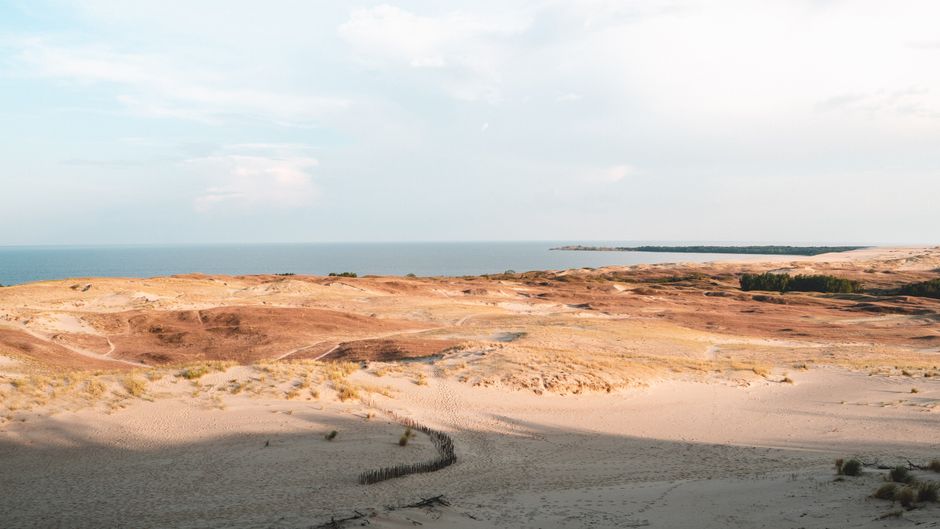
The Curonian Spit is a long, thin ribbon of sand and pine forest between the Baltic Sea and the Curonian Lagoon, 98 km long and in places only a few hundred metres wide. Its southern half belongs to Russia’s Kaliningrad region; the northern 50-odd km are Lithuania’s Curonian Spit National Park and the resort municipality of Neringa. On one side are wide, empty white beaches; on the other, calm lagoon water, fishing villages with blue and brown wooden houses, and some of the highest drifting sand dunes in Europe. UNESCO lists it as a World Heritage cultural landscape. Come in summer to cycle the forest paths, swim and watch the sunset from the Parnidis Dune above Nida, or in the quiet months for birds, solitude and smoked fish by the lagoon. Allow two to four days.
Right now in Curonian Spit (Nida)
- Wed 13–15°C 56–60°F Mostly clear
- Thu 13–16°C 55–61°F 2 mm Partly cloudy
- Fri 12–14°C 53–57°F 7 mm Showers
Weather: MET Norway (CC BY 4.0) · Sea temperature: NOAA CoastWatch · Rates: ECB
Top tours in Curonian Spit
See all tours for Curonian Spit →
From local operators, with prices and reviews; you check availability and book on Viator, our partner. We may earn a commission at no extra cost to you. How we earn money
The Curonian Spit at a glance
- Best for: dunes and sea views, quiet Baltic beaches, cycling through pine forest, fishing-village architecture, birdwatching, and slow summer holidays.
- How long: a long day trip from Klaipėda gets you to Nida and back; two to four days let you cycle, swim and see Juodkrantė, Nida and the dunes properly.
- Best time: June to August for warm beach days and every service open; late May, early June and September for fewer people and lower prices.
- Getting in: a short ferry from Klaipėda to Smiltynė, then about an hour by road to Nida. Cars pay an entry fee at the Alksnynė post: as of October 2026, €10 for a car outside summer and €50 from 20 June to 20 August.
- Getting around: local buses link Smiltynė, Juodkrantė, Pervalka, Preila and Nida about hourly; a bike path runs the length of the spit.
- Budget: Nida is Lithuania’s most expensive resort in July and August; outside high season prices fall sharply, and the beaches and dunes are free.
The spit, village by village
The Lithuanian part of the spit runs from Smiltynė, opposite Klaipėda, south to the Russian border just beyond Nida. Most villages sit on the calmer lagoon side, with the open sea beaches a short walk through the forest.
- Smiltynė: the northern tip, part of Klaipėda city, where the ferries land. It has the Lithuanian Sea Museum, sandy beaches and forest paths. Best for: a half-day from Klaipėda and families.
- Juodkrantė: about 20 km south, a former fishing village and 19th-century spa with wooden villas on the lagoon, the Hill of Witches and a big colony of cormorants and grey herons. Best for: quieter stays, folk-art carvings and birds.
- Pervalka and Preila: two tiny fishing villages with smokehouses, small marinas and the Vecekrugas and Preila dunes. Best for: peace, smoked fish and lagoon sunrises.
- Nida: the main resort, close to the Russian border, with old fishermen’s houses, a lagoon promenade and harbour, the Thomas Mann Memorial Museum, a long beach and the Parnidis Dune. Best for: first visits, restaurants and the dunes.
Top things to see on the Curonian Spit
Prices and hours below were checked on the official sites in October 2026. Many services run on reduced winter hours from October to April, so check before you go.
The Parnidis Dune
About 1.5 km south of Nida’s centre, the Parnidis Dune is a 52-metre mound of almost pure white quartz sand, part of a chain of drifting dunes that still moves a few metres east each year. A wooden staircase leads to the top, with a large stone sundial and views over the Baltic to the west, the lagoon to the east and the dunes of the Grobštas reserve to the south, towards the Russian border. It is the place to watch sunset. To protect the fragile surface, stay on the marked paths and boardwalks: there is no access to the east side of the dune. The Valley of Silence (Tylos slėnis), with its 1991 freedom sculpture, lies at its foot, and the Parnidis educational trail starts there.
Nida village and the Thomas Mann Memorial Museum
Walk the lagoon promenade past the harbour and the weathervanes, the carved wooden pennants that once identified each fishing boat’s home village. Old fishermen’s houses, painted brown and blue with reed or tiled roofs, line the lanes; the Nida Fisherman’s Ethnographic Homestead shows how a family lived about a century ago. On a hill above the village, the German writer Thomas Mann built a summer house in 1930 and spent three summers here; it is now the Thomas Mann Memorial Museum. As of October 2026, it costs €3 for adults and opens Tuesday to Saturday 10:00–17:00 from 28 September to 4 April (closed Sunday and Monday), and daily in summer. The Curonian Spit History Museum and the Mizgiris Amber Museum are also in Nida.
The Hill of Witches, Juodkrantė
A forest path on a dune hill above Juodkrantė is lined with dozens of oak carvings of witches, devils, heroes and creatures from Lithuanian folk tales, made by folk artists since 1979. It is free, open all the time and loved by children. Afterwards, walk the lagoon promenade past the 19th-century villas and the stone sculpture park.
The cormorant and heron colony
Just south of Juodkrantė, by the road to Nida, a viewing platform overlooks one of Lithuania’s largest bird colonies: in 2021, counts found more than 3,100 pairs of great cormorants and over 200 pairs of grey herons, nesting in pines turned white by their droppings. The birds return in February and the colony is at its noisiest from late March into summer.
The Lithuanian Sea Museum, Smiltynė
In a 19th-century fort at the tip of the spit, the Sea Museum has a Baltic and tropical aquarium, maritime exhibitions, seals and penguins, a dolphinarium with dolphin and sea lion shows, and an ethnographic fishermen’s homestead. As of October 2026, it opens on Fridays, Saturdays and Sundays only, 10:30–17:00, in October and in the winter months, and Tuesday to Sunday in summer. Adult tickets cost €10 from October to April and €14 from May to September; on the last Sunday of each month entry is free. Online sales were suspended in summer 2026, so buy at the ticket office if needed.
The beaches
The whole Baltic side of the spit is one long beach of fine pale sand backed by dunes and pine forest, reached by marked paths from the road and the villages. The main beaches at Nida, Juodkrantė and Smiltynė have lifeguards, toilets and changing cabins in summer, and some have separate sections for women, men and families. The sea is usually warm enough for swimming from late June to August. Away from the villages you can walk for hours without seeing anyone. Look out for small pieces of amber on the tideline after storms.
Nature
- Parnidis Dune
- Vecekrugas Dune
Other sights
- Hill of Witches, Juodkrantė
- Nida Lighthouse
Museums
- Lithuanian Sea Museum, Smiltynė
- Thomas Mann Memorial Museum, Nida
Protected areas
- Nagliai Strict Nature Reserve (Dead Dunes)
Cycling, walking and the lagoon
Cycling
A paved cycle path, part of the EuroVelo 10 Baltic Sea route, runs the length of the Lithuanian spit from Smiltynė to Nida, about 50 km through pine forest and over dunes, with detours to the lagoon villages. It is mostly flat with a few climbs. Rent bikes or e-bikes in Nida, Juodkrantė or Klaipėda; many visitors cycle one way and take the bus back. See our cycling guide.
Walking and nature trails
Signposted educational trails lead to the dunes, through the forest and along the lagoon: the Parnidis trail from the Valley of Silence, the Bear Head Dune (Urbo kalnas) with its lighthouse above Nida, and the Vecekrugas Dune near Preila. In the strict reserves of Nagliai (the “Dead Dunes”) and Grobštas, walk only on the marked paths; much of the dune landscape is off limits to protect it. Wild boar, elk and roe deer live in the forest, so drive slowly at dusk. See our hiking guide.
Beaches, boats and smoked fish
In summer, boat trips leave Nida harbour for the lagoon and the dunes, sailing and kitesurfing schools work on the shallow lagoon, and old-style wooden boats are sometimes on show. Don’t leave without trying smoked fish from one of the smokehouses in Juodkrantė, Pervalka, Preila or Nida: eel, bream, perch and other lagoon fish, eaten with bread and beer. See our beaches guide and boat trips guide.
Activities and best months
- Beaches and swimmingEvery Neringa settlement has a well-kept white-sand beach on the Baltic side, free of charge, with lifeguards and cafés; Nida's and Juodkrantė's beaches have held the Blue Flag since 2002, and Nida's has a sea-bathing wheelchair. There are nudist and dog beaches and quiet stretches as far as the eye can see. Red flag: no swimming; yellow: dangerous; inflatables are banned in the sea and SUP paddlers must wear a safety vest. · source
- Boat tripsIn season boats and yachts leave Nida every hour for one-hour sails on the Curonian Lagoon to the Great (Parnidis) Dune, with longer trips to the Nemunas delta, Mingė village, Uostadvaris and Ventė Cape (5-6 hours) or to Juodkrantė and the Dead Dunes; regular boats link Nida with Ventainė and Minija village, Juodkrantė with Dreverna and Klaipėda, and hand-made canoes go from Pervalka to the Dead Dunes. · source
- CyclingThe almost flat, recently renovated 52 km cycle route from the Smiltynė ferry ports to Nida, part of the Lithuanian Seaside Cycle Route and EuroVelo 10, runs mostly through pine forest with rest stops: 21 km from Klaipėda to Juodkrantė along the sea, 16.5 km on to Pervalka past the grey dunes of the Nagliai reserve, then along the lagoon via Preila to the foot of the Parnidis Dune; Visit Neringa calls it perfect for families. Bikes can be rented in Neringa. · source
- HikingSignposted educational trails cross the dunes: the new 1.1 km Parnidis Dune trail climbs by stairs from the Neringa Sports School to the observation deck and the Sundial, with four viewpoints over the dune landscape; in the Nagliai Nature Reserve a trail of just over 1 km from the car park at km 32 of the Smiltynė-Nida road leads into the grey 'Dead Dunes' (EUR 5 adults in season, card only; 16 May-15 September 09:30-20:30, 16 September-18 October 10:00-19:00); a third trail climbs Urbas Hill (Bear Head Dune) at Nida. · source
National park rules and the Russian border
The whole Lithuanian spit is a national park. According to the park rules published by Visit Neringa, you may drive only on paved roads and park only in marked places; tents, campervans and motorhomes are allowed only at equipped, marked sites; and fires only at marked fireplaces. Picking mushrooms and berries is allowed within the park’s rules. The dunes are fragile: never climb on them away from the marked paths and stairs.
The spit continues south into Russia’s Kaliningrad region, a few kilometres beyond Nida. This is the external border of the EU and NATO, and it is not a tourist crossing. Don’t walk, cycle or sail towards the border, keep to the marked paths around the Parnidis Dune and Grobštas, and follow your government’s travel information. You cannot travel on to the Russian part of the spit from Lithuania.
Beyond the spit: Klaipėda and Palanga
Klaipėda, Lithuania’s port city across the strait, has a small Old Town with German half-timbered warehouses, the riverside Danė embankment and the minesweeper museum ship Sūduvis. About 25 km further north, Palanga is the country’s liveliest seaside resort, with a long pier, a botanical park and the Amber Museum in the Tyszkiewicz Palace. For a wider Baltic trip, the ferries from Klaipėda to Germany and Sweden make it easy to combine with Hamburg, Berlin or Sweden, and Gdańsk is about seven hours by road; see our Gdańsk guide.
Nearby destinations
Getting there and getting around
To Klaipėda
Klaipėda is about 4 hours by LTG Link train from Vilnius and about 2½–3 hours by train or bus from Kaunas; by car it is about 3 hours from Vilnius on the A1 motorway. The nearest airport is Palanga (PLQ), about 30 km north, with flights to a handful of European cities. International ferries also arrive in Klaipėda: DFDS sails from Kiel in Germany and Karlshamn in Sweden, and TT-Line from Karlshamn, Trelleborg, Travemünde and Rostock.
Ferries to Smiltynė
Smiltynės perkėla ferries cross the narrow strait from Klaipėda in a few minutes. The Old Ferry Terminal in the city centre (Danės street) takes foot passengers and cyclists only, landing near the Sea Museum and the bus stop. The New Ferry Terminal (Nemuno street 8), south of the centre, takes cars as well. Ferries run frequently all year, and tickets are return tickets bought on the Klaipėda side. Foot passengers pay a couple of euros return, cars about €20–25 return; check the current price list on keltas.lt.
The entry fee for cars
Neringa municipality charges a local fee for motor vehicles entering the national park, paid at the Alksnynė control post, about 10 km south of Smiltynė, by card or cash, or in advance online through the UNIPARK system. As of October 2026, a single entry costs €10 for a car from 21 August to 19 June and €50 from 20 June to 20 August; €20 and €50 for a campervan or a car towing a caravan; and €10 for a motorcycle. Electric vehicles pay less (Visit Neringa says they are exempt, while the municipality’s table lists €25 in summer), so check before you drive. The high summer price is meant to keep cars off the spit, so consider the bus or a bike.
Buses and boats
Local buses run from the Smiltynė ferry stop through Juodkrantė, Pervalka and Preila to Nida bus station in about an hour. In September 2026 there were about 14 departures a day each way, roughly hourly from 09:10 to 22:10 from Smiltynė; pay on board by card or cash, online or at Nida bus station. In summer, passenger boats also reach Nida and Juodkrantė, including the Raketa hydrofoil down the Nemunas from Kaunas and boats from Šilutė and the Nemunas delta.
When to go and how long to stay
The spit has a mild maritime climate: cooler summers than inland Lithuania, a warm, rainy autumn and fairly mild winters with strong winds. The table uses the Lithuanian Hydrometeorological Service’s (LHMT) official 1991–2020 station data for Nida.
| Season | Average daily high | Average nightly low | Rain per month | What it’s like |
|---|---|---|---|---|
| Winter (Dec–Feb) | 1–3 °C | −3 to −1 °C | 46–71 mm | Windy, grey and very quiet; many places closed; frozen lagoon in cold spells |
| Spring (Mar–May) | 5 °C rising to 16 °C | −1 to 9 °C | 34–41 mm | The driest season; birds return, the colony is busy; cool sea |
| Summer (Jun–Aug) | 20–22 °C | 13–16 °C | 59–87 mm | Beach season, warm lagoon, long evenings and the busiest weeks |
| Autumn (Sep–Nov) | 18 °C falling to 6 °C | 12 °C falling to 3 °C | 77–97 mm | Mild September, then the wettest and windiest months |
Nida gets about 770 mm of rain a year, with October the wettest month, and the coast is the sunniest part of Lithuania, with about 2,000 hours of sunshine a year at nearby Klaipėda. July and August are the warmest months, with highs around 22 °C and nights around 16 °C, warmer than inland thanks to the shallow lagoon. The Baltic usually warms to about 17–20 °C in late July and August. Around Midsummer the sun is up for about 17½ hours; in December, for only about 7 hours.
The Curonian Spit in 2 days
Day 1: ferry from Klaipėda, the Sea Museum at Smiltynė if it is open, then the bus or a drive to Juodkrantė for the Hill of Witches and the cormorant colony, and on to Nida for the night; sunset from the Parnidis Dune. Day 2: Nida’s harbour, fishermen’s houses and the Thomas Mann museum in the morning, the beach in the afternoon, and smoked fish in Preila or Pervalka on the way back.
The Curonian Spit in 4 days
Base yourself in Nida for three nights. Cycle one day from Nida to Juodkrantė and back, or all the way to Smiltynė with the bus back; spend another on the beach and the dune trails to the Bear Head Dune and Vecekrugas; and take a lagoon boat trip. Finish with a night in Klaipėda’s Old Town or a day in Palanga.
Weather month by month
Averages from LHMT daily station data 1991–2020 (monthly means computed), Nida · Last reviewed 4 Oct 2026
Where to stay on the Curonian Spit
- Nida: the widest choice of guesthouses, apartments and small hotels, many in traditional houses, plus the campsite; book well ahead for July and August.
- Juodkrantė: villas and guesthouses on the lagoon; calmer, and handy for cyclists heading south.
- Preila and Pervalka: a few guesthouses and holiday homes for real quiet.
- Klaipėda: cheaper hotels in the city, with the ferry at the end of the street; good for a day trip or out of season.
Outside June to August, many restaurants and some guesthouses in Nida and Juodkrantė close or open only at weekends, so check before travelling between October and April.
Practical tips for the Curonian Spit
- Avoid the summer car fee: from 20 June to 20 August, taking a car onto the spit costs €50 a time; leave it in Klaipėda and use the foot ferry, bus and a bike.
- Check ticks: ticks are common in Lithuania’s forests and dunes and can carry tick-borne encephalitis and Lyme disease; use repellent and check your skin after walks.
- Stay on the paths: walking on the dunes off the marked paths is forbidden and damages them; fines apply.
- Respect the border: the Russian border is just south of Nida; don’t approach it.
- Bring cash and a card: cards work almost everywhere, but a few euros in cash help at smokehouses and stalls.
What to pack for the Curonian Spit
Swimwear, sun cream, sunglasses and a hat in summer, as the white sand reflects a lot of light; a windproof layer and a rain jacket in every season, since the coast is breezy and autumn is wet. Bring insect and tick repellent, comfortable shoes for sandy forest paths, and water shoes if you plan to paddle in the lagoon. Cyclists should carry water, as there are long stretches between villages.
What to pack
- Day packs and anti-theft bagsCarries water, towel and sunscreen down the long stairways to Algarve coves.
- Dry bags and phone pouchesProtects phones and cameras from sand and spray on beaches reached by ferry or steep paths.
- Fleeces and warm layersIt is cooler at sea than on land, especially on morning whale-watching trips.
- HeadlampsLevada routes such as PR1 and PR9 pass through long, dark, wet tunnels.
- Hiking shoes and bootsMadeira's levadas and the Azores' crater rims are wet, rocky and slippery, so grippy shoes matter more than anywhere else in Portugal.
- Quick-dry beach towelsA sand-shedding quick-dry towel packs small for beach days and lido visits.
- Rain jacketsA windproof, waterproof shell keeps you warm on open boats, where wind and spray cool you quickly.
- Reef-friendly sunscreenSummer UV is strong on Portuguese beaches and there is little shade below the cliffs.
- Trekking polesLong stone staircases and steep descents on Madeira's peaks and the Azores' crater rims are easier on the knees with poles.
- Water bottles and hydration packsRiding in the Algarve and Alentejo heat needs more water than you expect.
- Water shoesRocky coves, lava pools and weever fish in shallow sand make water shoes useful.
- WetsuitsOn the west and north coasts the sea stays around 16–18 °C even in summer, so a thin suit helps for long swims.
Curonian Spit travel FAQ
How do I get to the Curonian Spit?
Travel to Klaipėda by train, bus or car, then take the Smiltynės perkėla ferry across the strait to Smiltynė: foot passengers and cyclists from the Old Ferry Terminal in the centre, cars from the New Ferry Terminal. From Smiltynė, local buses reach Nida in about an hour.
How much is the entry fee to Neringa?
As of October 2026, cars pay €10 per entry from 21 August to 19 June and €50 from 20 June to 20 August, at the Alksnynė post or online. Campervans pay €20 or €50 and motorcycles €10. Foot passengers, cyclists and bus passengers pay nothing.
Can you visit the Curonian Spit as a day trip?
Yes, from Klaipėda: take an early ferry, bus to Nida, climb the Parnidis Dune and stop at the Hill of Witches in Juodkrantė on the way back. From Vilnius or Kaunas it is too far for a comfortable day; stay at least one night.
Can you cross into Russia from the Curonian Spit?
No. The southern half of the spit is part of Russia’s Kaliningrad region, but the border south of Nida is not a tourist crossing. Stay away from it and follow your government’s travel information.
How high is the Parnidis Dune?
About 52 metres. A staircase leads up from the road south of Nida to a sundial and viewpoint over the sea, the lagoon and the drifting dunes. Stay on the marked paths: the east side of the dune is closed to visitors.
Is the sea warm enough to swim?
From late June to August, usually yes: the Baltic often reaches about 17–20 °C in late summer, and the shallow lagoon is warmer. Swim at beaches with lifeguards in summer, and take care in rough seas and rip currents after storms.
Can you cycle the Curonian Spit?
Yes. A paved cycle path runs about 50 km from Smiltynė to Nida through the forest, part of the EuroVelo 10 route. Rent bikes in Klaipėda, Juodkrantė or Nida, and use the bus to skip a leg.
Can I camp on the Curonian Spit?
Only at equipped, marked campsites, such as the one in Nida. Wild camping, overnight stays in campervans outside campsites and fires outside marked fireplaces are not allowed in the national park.
When is the best time to visit the Curonian Spit?
June to August for beach weather, with highs around 20–22 °C and everything open, though Nida is busy in July. Late May, early June and September are quieter, cheaper and good for cycling, and the car fee is €10 instead of €50.
How many days do you need on the Curonian Spit?
Two days for Juodkrantė, Nida and the Parnidis Dune; three or four days to cycle, swim and enjoy the slow pace.
Sources
- © OpenStreetMap contributors · ODbL · fetched 4 Oct 2026
- Wikidata · CC0 · fetched 4 Oct 2026
Sources and last review
Researched and last reviewed on 4 October 2026. Vehicle entry fee: Neringa municipality (neringa.lt) and Visit Neringa; ferry terminals, international ferries, local bus timetable, national park rules, the Parnidis Dune, the bird colony and the Thomas Mann Memorial Museum: Visit Neringa, the official Nida tourism information centre; Lithuanian Sea Museum hours and prices: muziejus.lt; climate: the Lithuanian Hydrometeorological Service’s 1991–2020 station data for Nida and Klaipėda. Ferry prices (keltas.lt could not be read), train journey times, sea temperatures, the cycle path length and the Hill of Witches details come from secondary sources or general knowledge and are flagged for checking. Prices, timetables and rules change, so check the official links before you go.
Plan your trip
Partner links: TravelerCenter may earn a commission if you book, at no extra cost to you.
🇱🇹 Useful Lithuanian phrases for Curonian Spit
All 38 Lithuanian phrases: restaurant, hotel, emergencies, romance (printable) →