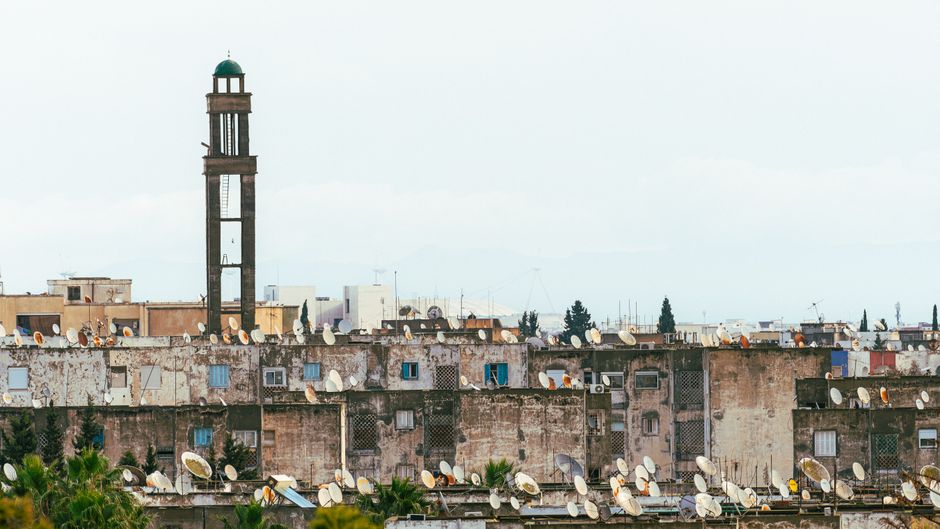
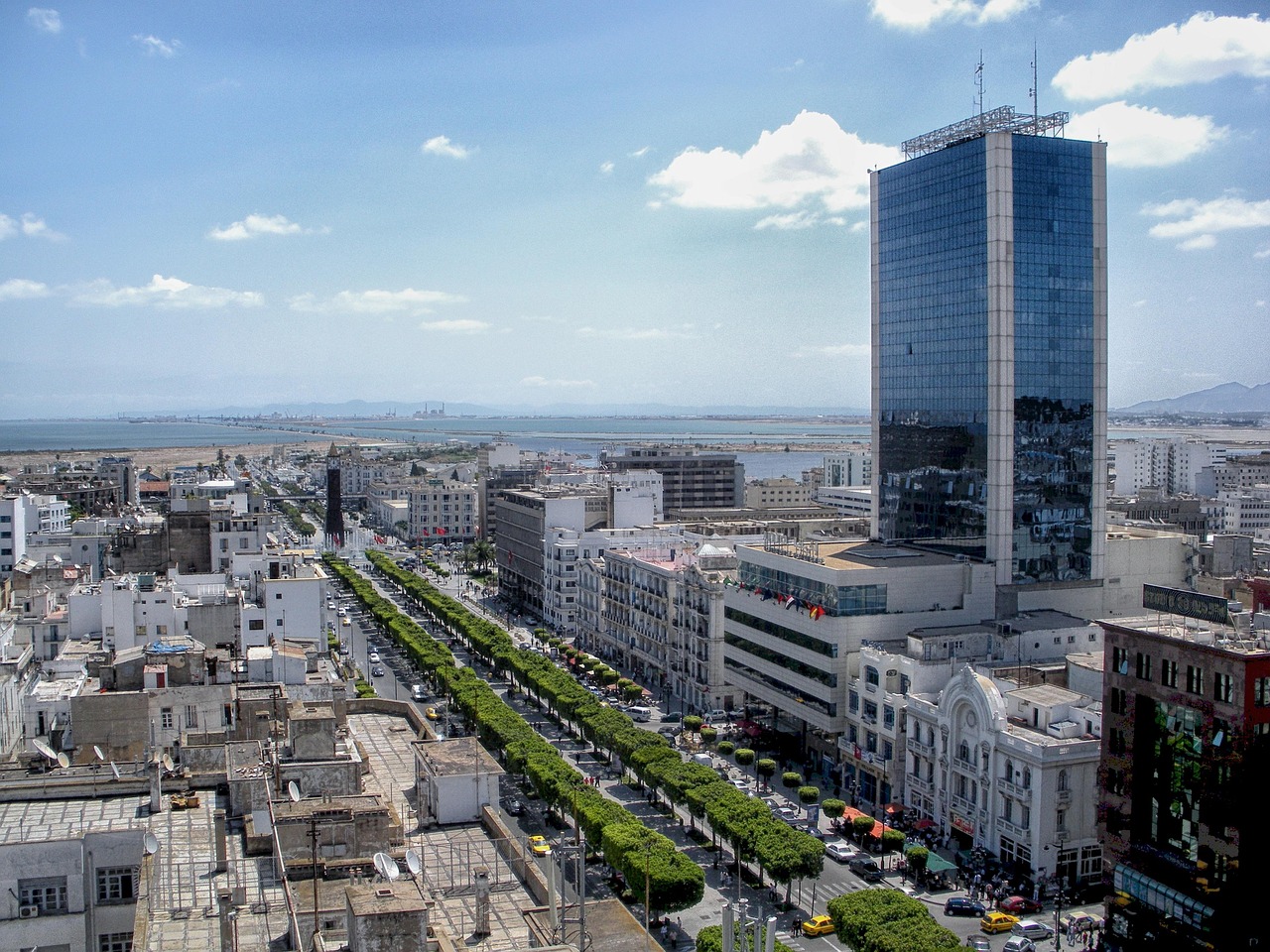
Tunis, the capital of Tunisia, sits on a shallow lake at the head of the Gulf of Tunis, a city of two faces joined by a single long avenue. On one side is the medina, founded in the early Islamic period and listed by UNESCO since 1979, a labyrinth of covered souqs, tiled palaces, mosques and studded wooden doors centered on the great Zitouna Mosque. On the other is the “ville nouvelle” built under the French protectorate, with Avenue Habib Bourguiba’s tree-lined promenade, Art Nouveau facades, cafes and the cathedral. The Bardo National Museum, in a former beylical palace, holds one of the world’s greatest collections of Roman mosaics. A short ride along the TGM light railway, the northern suburbs lead to the ruins of ancient Carthage, scattered among villas by the sea; the blue-and-white cliff-top village of Sidi Bou Said, added to UNESCO’s World Heritage List in 2026; and the beaches and cafes of La Marsa. About 600,000 people live in the city itself, the heart of a much larger metropolitan area. Tunis is the gateway for most visitors, with good connections to Hammamet, Sousse and the rest of the country by road, louage and train. Tunis has a Mediterranean climate: summers are hot and dry, with average highs of about 34 °C (93 °F) in July and August, and winters are mild and fairly wet, with average highs of about 16–18 °C (61–64 °F).
Right now in Tunis
- Wed 21–32°C 70–89°F 1 mm Light showers
- Thu 22–33°C 71–91°F Partly cloudy
- Fri 22–24°C 71–76°F 5 mm Rain
Weather: MET Norway (CC BY 4.0) · Sea temperature: NOAA CoastWatch
Top tours in Tunis
See all tours for Tunis →
From local operators, with prices and reviews; you check availability and book on Viator, our partner. We may earn a commission at no extra cost to you. How we earn money
Tunis at a glance
- Best months: April to June and September to October, with warm, sunny days. July and August are hot; winter is mild with some rain.
- Time needed: two days for the medina, the Bardo and Avenue Habib Bourguiba; three or four days with Carthage, Sidi Bou Said and La Marsa; five days with Dougga and Cap Bon.
- Getting there: Tunis-Carthage International Airport (TUN) is close to the city. Citizens of many countries can visit Tunisia for up to 90 days without a visa.
- Costs (as of October 2026): the Bardo National Museum costs TND 13 (about US$4.30) and the Carthage group ticket TND 12 (about US$4) for non-residents.
- Before you go: visas, the closed dinar, the hotel tax and laws are covered in our Tunisia travel guide.
Tunis areas and who each one suits
The medina
The old walled city climbs gently from the Bab el Bhar gate (the “Sea Gate”) to the Kasbah, with souqs grouped by trade, the Zitouna Mosque at its center and restored palaces, many now guesthouses known as “dars.” Staying in a dar suits travelers who want atmosphere; the lanes are quiet at night.
The ville nouvelle and Avenue Habib Bourguiba
The colonial-era grid between the medina and the lake, with the main avenue, the Cathedral of St. Vincent de Paul, the Municipal Theatre, cafes, hotels and the main stations. Convenient and central, with mid-range and business hotels.
Les Berges du Lac
A modern district on the northern shore of the Lake of Tunis, with offices, malls, restaurants and newer hotels near the airport. Good for business travelers and those with a car.
Carthage
A leafy residential suburb on the coast among the archaeological remains, with a few boutique hotels and guesthouses. Quiet and green, linked to the center by the TGM.
Sidi Bou Said
The cliff-top village of white houses with blue doors and shutters, overlooking the gulf, with small boutique hotels and guesthouses. Romantic, but busy with day visitors.
La Marsa and Gammarth
The seaside suburbs at the end of the TGM line, with a beach, a lively corniche, cafes, restaurants and, in Gammarth, beach hotels and nightlife. A good base for a mix of beach and sightseeing.
Top things to see in Tunis
The medina of Tunis
Enter at Bab el Bhar and follow Rue Jamaa ez Zitouna uphill through the souqs to the Zitouna Mosque, the medina’s great mosque, whose courtyard non-Muslim visitors may usually view from the entrance at set times. The covered souqs radiate around it: the Souq el Attarine for perfumes, the Souq des Chéchias for the red felt caps, and others for gold, fabrics and leather. Look for the studded, painted doors of the old houses, the Tourbet el Bey royal mausoleum and the rooftop views from cafes and carpet shops.
The Bardo National Museum
In a 19th-century palace of the beys, comprehensively renovated and extended in 2012, the Bardo has one of the finest collections of Roman mosaics anywhere, including the famous portrait of Virgil with two Muses, as well as Punic, Christian and Islamic collections. Non-residents pay TND 13; it’s open from 9:30 a.m. to 4:30 p.m. in winter and 9 a.m. to 5 p.m. in summer, and closed on Mondays.
Carthage
The ancient city founded by Phoenician settlers and rebuilt by Rome is spread over a wide area of the northern suburbs, so allow half a day and use the TGM or a taxi between sites. The main monuments are the seaside Antonine Baths, the Roman villas park, the Magon quarter, the Roman theatre, the amphitheater and the Carthage Museum on Byrsa Hill, with views over the gulf and the Punic ports. A single “billet groupé” for non-residents costs TND 12. The sites open from 8:30 a.m. to 5 p.m. in winter and from 8 a.m. to 6 p.m. in summer, with shorter hours during Ramadan. The Archaeological Site of Carthage has been on UNESCO’s World Heritage List since 1979.
Sidi Bou Said
The village’s whitewashed houses with blue doors, iron window grilles and bougainvillea cling to a cliff above the Gulf of Tunis. Visit the Dar Ennejma Ezzahra palace, now a center for Arab and Mediterranean music with a museum of musical instruments, take mint tea with pine nuts on the terrace of the Café des Nattes, and buy bambalouni doughnuts from street stalls. UNESCO added the Village of Sidi Bou Saïd to the World Heritage List in 2026.
Avenue Habib Bourguiba
The capital’s main boulevard, lined with ficus trees, cafes and colonial buildings, runs from the medina’s Bab el Bhar gate toward the lake. Highlights include the Cathedral of St. Vincent de Paul, built in 1897, and the Municipal Theatre.
Dar Ben Abdallah and the medina palaces
The Museum of Popular Arts and Traditions in the Dar Ben Abdallah palace shows how wealthy families lived in the 19th century, with tiled courtyards and period rooms. Other restored palaces in the medina host cultural centers and guesthouses.
Other things to do in Tunis
- La Marsa: a beach, a seaside corniche and cafes at the end of the TGM line.
- La Goulette: the old port district with a Spanish-era fortress and seafood restaurants.
- Belvedere Park: the city’s largest park, on a hill north of the center, with a zoo.
- Hammams: traditional bathhouses in the medina, with separate hours or sections for men and women.
- Souq shopping: chechia caps, perfumes, ceramics, brass and olive-wood items; bargain politely.
- Cultural festivals: the International Festival of Carthage in July and August in the Roman theatre.
Food and drink
Tunis is a good place to try couscous, brik (a thin, crisp pastry with egg and tuna), lablabi (chickpea soup with harissa and bread), ojja (spicy eggs with tomato and merguez) and kafteji (fried vegetables with egg). La Goulette is famous for grilled fish, and Sidi Bou Said for bambalouni doughnuts and mint tea with pine nuts. Cafes are a big part of life, especially for men; there are mixed cafes in the ville nouvelle, La Marsa and Sidi Bou Said. Alcohol is served in hotels, bars and licensed restaurants, mostly in the ville nouvelle, Les Berges du Lac and the northern suburbs.
Day trips from Tunis
Dougga
About 2 hours southwest, Dougga is one of the best-preserved Roman towns in North Africa, a UNESCO site since 1997, with a capitol, theatre, temples, baths and houses spread over a hillside among olive trees. Non-residents pay TND 8; it opens from 8:30 a.m. to 5:30 p.m. in winter and 8 a.m. to 7 p.m. in summer, every day.
Cap Bon and Kerkouane
About 2 hours east, at the tip of the Cap Bon peninsula, Kerkouane is a rare Punic town with houses, baths and streets laid out by the sea, a UNESCO site, with entry for TND 8 (its museum is closed on Monday). Combine it with the fortress of Kelibia and the pottery town of Nabeul.
Hammamet
About an hour southeast, the beach resort of Hammamet has a small walled medina by the sea. See our Hammamet guide.
Bizerte
About an hour north, Bizerte has an old port with a kasbah, cafes by the water and nearby Ichkeul National Park, a UNESCO-listed wetland for birds.
Kairouan
About 2.5 hours south, the holy city of Kairouan has the Great Mosque, open to non-Muslim visitors in the mornings (TND 12, until noon on Fridays), the Aghlabid basins and a medina known for carpets.
Getting there and getting around
Tunis-Carthage International Airport (TUN)
The airport is a short drive northeast of the center, with flights on Tunisair, Nouvelair and many European airlines. Taxis to the center take about 15–20 minutes; use a yellow taxi with a meter or agree the fare first.
By train, louage and bus
SNCFT intercity trains leave from the station on Place de Barcelone for Sousse, Monastir, Mahdia, Sfax, Gabès and Tozeur, Nabeul and Bizerte. Louages, shared minibuses that leave when full, run from stations on the city’s edges to almost every town. Intercity buses also connect Tunis with the main cities.
The TGM and the metro
The TGM light railway runs from Tunis Marine station, at the end of Avenue Habib Bourguiba, across the lake to La Goulette, Carthage (several stops), Sidi Bou Said and La Marsa, the easiest way to reach the northern suburbs. The Métro Léger tram network serves the city center and suburbs, including Le Bardo.
Taxis and walking
Yellow taxis are cheap and plentiful; insist on the meter. The medina and the ville nouvelle are best explored on foot.
When to go and how long to stay
Spring (April to June) and autumn (September to October) are the best seasons, with warm days ideal for walking the medina and Carthage. Summer (July and August) is hot and dry, with average highs of about 34 °C (93 °F), and the season of the Carthage festival and the beaches of La Marsa and Gammarth. Winter (November to March) is mild, with average highs of 16–19 °C (61–67 °F) and rain on 6 to 8 days a month, and quiet sites; it’s a good time for museums.
| Month | Average high / low | Rain (days with 1 mm or more) | What to expect |
|---|---|---|---|
| January | 16 °C (62 °F) / 8 °C (47 °F) | 59 mm (2.3 in), 8 days | Cool, wet; quiet |
| February | 17 °C (62 °F) / 8 °C (47 °F) | 55 mm (2.2 in), 8 days | Cool, showers |
| March | 19 °C (67 °F) / 10 °C (50 °F) | 46 mm (1.8 in), 6 days | Mild; spring |
| April | 22 °C (72 °F) / 12 °C (54 °F) | 38 mm (1.5 in), 6 days | Mild; very good |
| May | 26 °C (80 °F) / 15 °C (60 °F) | 22 mm (0.9 in), 4 days | Warm; excellent |
| June | 31 °C (88 °F) / 19 °C (67 °F) | 13 mm (0.5 in), 2 days | Hot; good |
| July | 34 °C (93 °F) / 22 °C (72 °F) | 4 mm (0.2 in), 0 days | Hot; festival season |
| August | 34 °C (94 °F) / 23 °C (73 °F) | 14 mm (0.6 in), 2 days | Hottest; beach |
| September | 30 °C (87 °F) / 21 °C (69 °F) | 58 mm (2.3 in), 5 days | Warm; first storms |
| October | 27 °C (80 °F) / 17 °C (63 °F) | 55 mm (2.2 in), 6 days | Warm; excellent |
| November | 22 °C (71 °F) / 13 °C (55 °F) | 53 mm (2.1 in), 7 days | Mild, rainy spells |
| December | 18 °C (64 °F) / 9 °C (49 °F) | 68 mm (2.7 in), 8 days | Cool, wet |
The figures are the 1991–2020 climate normals that Tunisia’s National Institute of Meteorology submitted to the World Meteorological Organization for Tunis-Carthage: average daily highs and lows, average monthly rainfall and days with at least 1 mm of rain.
Events worth planning around
- International Festival of Carthage: concerts in the Roman theatre in July and August.
- Ramadan: in 2027 expected from about 8 February to 9 March; the medina comes alive after sunset.
- National holidays: 20 March (Independence Day) and 25 July (Republic Day), among others, when offices close.
Dates change each year; check with the organizers.
How long to stay: 2, 3 and 5 days
- Two days: the medina and Dar Ben Abdallah on day one; the Bardo and Avenue Habib Bourguiba on day two.
- Three days: add Carthage and Sidi Bou Said by TGM, ending at La Marsa.
- Five days: add day trips to Dougga and to Kerkouane and Cap Bon.
Where to stay in Tunis
- Medina: restored dar guesthouses with courtyards and roof terraces.
- Ville nouvelle: mid-range and business hotels near Avenue Habib Bourguiba and the stations.
- Les Berges du Lac: modern hotels near the airport.
- Sidi Bou Said and Carthage: boutique hotels with sea views.
- La Marsa and Gammarth: beach hotels and apartments at the end of the TGM.
A tourist tax of TND 8 to 12 per person per night, depending on the hotel’s category, is added to the bill.
Typical costs in Tunis
| Item (as of October 2026) | Tunisian dinars | About US dollars |
|---|---|---|
| Bardo National Museum, non-resident | TND 13 | $4.30 |
| Carthage group ticket, non-resident | TND 12 | $4 |
| Dougga, non-resident | TND 8 | $2.70 |
| Hotel tax per person per night (3-star / 4–5-star) | TND 8 / 12 | $2.70 / $4 |
| Taxi from the airport to the center | about TND 10–20 | about $3–7 |
| TGM ticket to Sidi Bou Said | about TND 1–2 | under $1 |
| Lunch of couscous or brik in a local restaurant | about TND 12–25 | about $4–8 |
| Mid-range hotel or dar, per night | about TND 150–350 | about $50–115 |
Site fees are those published by the Agency for the Development of Heritage and Cultural Promotion (AMVPPC); taxi, TGM, meal and hotel prices are typical ranges. The dinar is worth about US$0.33.
Safety in Tunis
Tunis is generally safe for visitors, with a visible police presence. The main issues are petty theft, hustlers in the medina and traffic.
- Petty theft: keep valuables out of sight in the medina, on the TGM and at busy stations, and use a cross-body bag.
- Medina hustlers: self-appointed guides may lead you to shops or claim a site is closed; decline politely and use a map.
- Traffic: drivers don’t always give way at crossings or roundabouts; cross with care.
- Dress codes: cover shoulders and knees in the medina and at mosques.
- Demonstrations and strikes: avoid protests, which sometimes take place in the city center, and allow for transport disruption during strikes.
- ID checks: carry a copy of your passport’s photo page.
- Emergencies: ambulance 190, police 197, fire 198.
Practical tips for Tunis
- Time zone: UTC+1 all year.
- Weekend: Saturday and Sunday for offices; many medina shops close on Friday afternoon and Sunday.
- Money: change money or use ATMs in Tunisia and keep receipts; you can’t take dinars out of the country.
- Power: 230 V, with two-pin European sockets.
What to pack for Tunis
Pack comfortable walking shoes for cobbled lanes and ruins, light clothes that cover shoulders and knees, a scarf for women visiting religious sites, a hat, sunglasses and sunscreen. Add a light jacket and umbrella from November to March, swimwear for La Marsa, and a plug adapter.
Tunis travel FAQ
How much does the Bardo Museum cost?
TND 13 for non-residents. It’s closed on Mondays and opens from 9:30 a.m. to 4:30 p.m. in winter and 9 a.m. to 5 p.m. in summer.
How much is the Carthage ticket?
A group ticket for non-residents costs TND 12 and covers the main sites, including the Antonine Baths and the Carthage Museum.
How do I get to Carthage and Sidi Bou Said from Tunis?
Take the TGM light railway from Tunis Marine station; it stops at several Carthage stations, Sidi Bou Said and La Marsa.
Is Sidi Bou Said a UNESCO site?
Yes. UNESCO added the Village of Sidi Bou Saïd to the World Heritage List in 2026.
How long do I need in Tunis?
Two days for the medina and the Bardo, three or four with Carthage and Sidi Bou Said.
Can non-Muslims visit the Zitouna Mosque?
Non-Muslim visitors can usually view the courtyard from the entrance at set times; check locally, as hours change.
What is the best time to visit Tunis?
April to June and September to October.
Can I visit Dougga on a day trip from Tunis?
Yes, it’s about two hours away by car or tour; entry costs TND 8.
Is the medina of Tunis safe?
Yes, in the daytime and on the main lanes in the evening; watch your belongings and ignore hustlers.
Do I need a visa for Tunis?
Citizens of many countries, including the US, Canada, the UK and EU countries, can stay up to 90 days without a visa. See our Tunisia guide.
Sources and last review
Researched and last reviewed on 5 October 2026. Fees and opening hours for the Bardo, the Carthage sites (Antonine Baths, Roman villas park, Magon quarter, amphitheater, Roman theatre and museum), Dougga, Kerkouane and the Great Mosque of Kairouan come from the Agency for the Development of Heritage and Cultural Promotion (AMVPPC); the Bardo’s 2012 renovation, Dar Ben Abdallah and Ennejma Ezzahra from the Tunisian National Tourist Office; World Heritage listings, including Sidi Bou Saïd (2026), from UNESCO; train destinations from SNCFT; the hotel tax, currency rules, laws, demonstrations and emergency numbers from GOV.UK’s Tunisia travel information (updated 24 July 2026), used for practical facts only; climate normals from Tunisia’s National Institute of Meteorology via the World Meteorological Organization; population and coordinates from Wikidata. Neighborhoods, the Zitouna Mosque’s visiting arrangements, the TGM and Métro Léger, the cathedral’s date, festivals, drive times, holidays, Ramadan 2027 dates and taxi, meal and hotel prices are general references and flagged for checking. For entry rules and money, see our Tunisia travel guide.
Plan your trip
Partner links: TravelerCenter may earn a commission if you book, at no extra cost to you.
🇪🇬 Useful Arabic phrases for Tunis
All 38 Arabic phrases: restaurant, hotel, emergencies, romance (printable) →