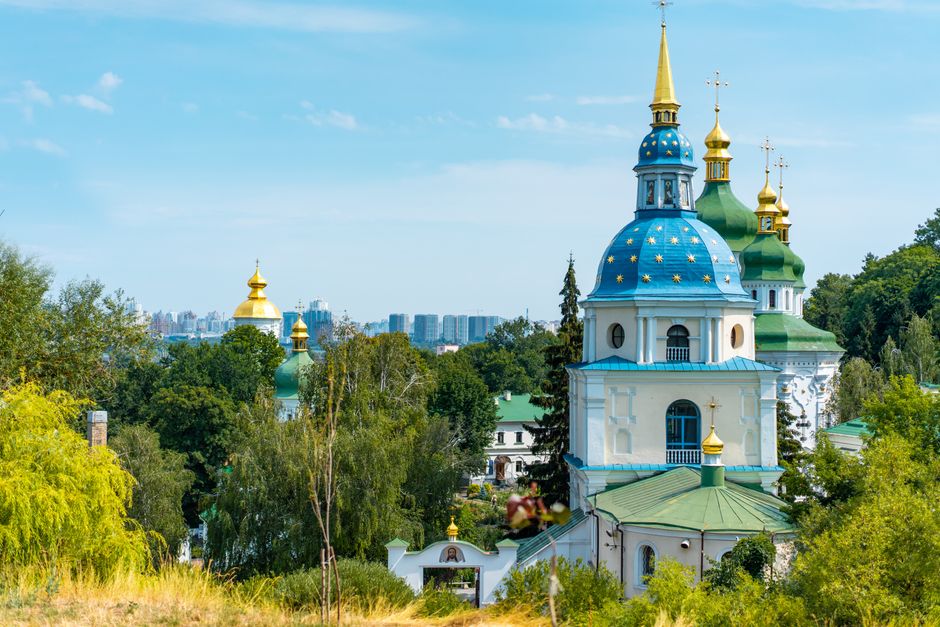
Ukraine is the largest country entirely within Europe, a land of wide black-earth plains, the great Dnipro river, the Carpathian mountains in the west and a long Black Sea coast, although Russia now occupies Crimea and the shores of the Sea of Azov. Its capital, Kyiv, was the centre of medieval Kyivan Rus’, and its cities are full of golden-domed churches, Habsburg, Polish and Soviet architecture and a rich food and coffee culture. Since Russia’s full-scale invasion in February 2022, the country has been at war: Russia occupies parts of the east and south, missiles and drones strike cities across the country, and air-raid alerts are part of daily life. This guide describes the country region by region, its history, landmarks and climate, and explains what entry, travel and daily life currently involve.
Right now in Ukraine
- Wed 10–20°C 51–68°F Partly cloudy
- Thu 12–22°C 54–71°F Clear
- Fri 14–21°C 57–69°F 2 mm Clear
Weather: MET Norway (CC BY 4.0)
Ukraine at a glance
Ukraine covers about 603,500 square kilometres within its internationally recognised borders, which include Crimea and other areas that Russia currently occupies. It borders Poland, Slovakia, Hungary, Romania and Moldova to the west and south-west, Belarus to the north and Russia to the north and east. Most of the country is flat steppe and farmland, crossed by the Dnipro, which flows from north to south through Kyiv and Dnipro to the Black Sea. In the west, the Ukrainian Carpathians rise to Hoverla (2,061 m), the highest point, and Crimea has its own mountains along its southern coast.
Ukraine’s State Statistics Service stopped publishing population estimates after the full-scale invasion. Its last figure, for 1 February 2022, was about 41.1 million, not counting Crimea and Sevastopol; millions have since fled abroad or been displaced inside the country. Ukrainian is the state language; Russian is also widely spoken, particularly in the east and south, and Crimean Tatar, Hungarian, Romanian and other minority languages are used in some regions. Most believers are Orthodox Christians, with a large Greek Catholic church in the west. The currency is the hryvnia (UAH). On 2 October 2026 the National Bank of Ukraine’s official rate was 44.83 hryvnias to the US dollar and 50.70 to the euro. Ukraine uses Eastern European Time (UTC+2, UTC+3 in summer). It has been a candidate for EU membership since June 2022.
A short history
Kyiv was the capital of Kyivan Rus’, the medieval state of the Eastern Slavs that adopted Christianity in 988 and built St Sophia’s Cathedral in the 11th century. After the Mongol invasion of 1240, most of today’s Ukraine came under the Grand Duchy of Lithuania and then the Polish-Lithuanian Commonwealth, while the south belonged to the Crimean Khanate, an ally of the Ottoman Empire. In the 17th century the Zaporozhian Cossacks led a rising against Polish rule and created the Cossack Hetmanate, which in 1654 allied with Muscovy; over the next century and a half most of Ukraine was absorbed into the Russian Empire, while Galicia in the west, around Lviv, belonged to the Habsburg Empire from 1772 to 1918.
After a brief period of independence between 1917 and 1921, most of Ukraine became a Soviet republic. The man-made famine of 1932–33, the Holodomor, killed millions, and the Second World War brought occupation, the Holocaust and immense destruction. In 1986 the Chornobyl nuclear disaster took place north of Kyiv. Ukraine declared independence on 24 August 1991, confirmed by a referendum that December. The Orange Revolution of 2004 and the Revolution of Dignity of 2013–14 centred on Kyiv’s Maidan. In 2014 Russia annexed Crimea and backed armed separatists in the Donbas, and on 24 February 2022 it launched a full-scale invasion. Ukrainian forces pushed Russian troops back from Kyiv in spring 2022 and later from parts of the north-east and south, but fighting continues along a long front line in the east and south.
Regions and current conditions
| Region | Current conditions | What the region is known for |
|---|---|---|
| Lviv, Ternopil, Ivano-Frankivsk, Zakarpattia, Chernivtsi | Further from the front line; air-raid alerts and strikes still occur | Lviv’s historic centre, the Carpathians, Chernivtsi University, Uzhhorod and Mukachevo castles |
| Volyn, Rivne, Zhytomyr | Areas within 50 km of the Belarusian border are restricted; air-raid alerts elsewhere | Lutsk castle, forests and lakes of Polesia |
| Kyiv and central Ukraine | Frequent air-raid alerts and missile and drone strikes | Kyiv’s cathedrals and monasteries, Chernihiv, Uman, Kamianets-Podilskyi |
| Odesa and the south | Frequent strikes; parts are close to the front line | Odesa’s historic centre, the Black Sea coast, the Danube delta |
| Kharkiv and the east | Close to the front line, with heavy fighting in parts | Kharkiv’s Constructivist architecture, the Donbas |
| Crimea and other Russian-occupied areas | Occupied by Russia; entering through Russia is illegal under Ukrainian law | Crimea’s coast and mountains (occupied by Russia since 2014) |
Safety and current conditions
- Air attacks: Russian missiles and drones strike cities, energy facilities, railways and homes across Ukraine. Air-raid alerts sound frequently, including in the west. Install an air-alert app, know where the nearest shelter is and take shelter immediately when an alert sounds.
- Martial law: martial law has been in force since 24 February 2022 and has been extended every 90 days; the extension in force in October 2026 runs until 31 October 2026, and further extensions are expected. Regions set their own rules, which can include curfews, document checks, restrictions on movement and on public events. Men aged 23 to 60 with Ukrainian citizenship, including dual nationals, cannot leave the country.
- Power cuts: attacks on the energy system cause scheduled and emergency blackouts, which can also cut heating and water; winter temperatures can fall below −20 °C. Cash machines and card terminals may not work during power cuts.
- Unexploded weapons: mines and unexploded munitions are a hazard throughout the country, especially near the front lines and in areas that saw ground fighting; strikes can scatter munitions in public areas. Never touch them; report them on 101.
- Occupied areas: Russia controls Crimea and parts of the Donetsk, Luhansk, Zaporizhzhia, Kherson and other regions. Entering through Russia is illegal under Ukrainian law, and foreigners have been detained by the occupying forces.
- Cyber attacks: large attacks have disrupted mobile networks, banking and railway ticketing in the past.
- Insurance: standard travel insurance policies almost always exclude war zones, so anyone travelling needs specialist cover; check the wording carefully.
- Consular help: in-person consular help in Ukraine is very limited, and some countries offer full consular services only in neighbouring countries.
Places travellers have known
These places drew visitors before 2022. They are described here as background.
Kyiv
The capital on the Dnipro, with St Sophia’s Cathedral and the Kyiv-Pechersk Lavra (a UNESCO World Heritage Site), St Michael’s Golden-Domed Monastery, the Andriivskyi Descent and Maidan. Read more about its history in our page on Kyiv.
Lviv
The historic capital of Galicia, whose UNESCO-listed centre mixes Renaissance, Baroque and Habsburg architecture with coffee houses and churches of several faiths. Read more in our page on Lviv.
Odesa
The Black Sea port founded in 1794, known for its Opera House, the Potemkin Stairs and its seafront, and for a cosmopolitan history of trade and humour. Its historic centre was added to the List of World Heritage in Danger in 2023.
The Carpathians
The forested mountains of the west, with Hoverla, Ukraine’s highest peak, the Hutsul villages and wooden churches of the region, and the resort of Bukovel.
Kamianets-Podilskyi and Chernivtsi
Kamianets-Podilskyi’s castle stands on a rocky loop of the Smotrych river, and Chernivtsi’s former residence of the Bukovinian metropolitans, now its university, is a World Heritage Site.
Kyiv Travel Guide
Kyiv travel guide: St Sophia's Cathedral and the Kyiv-Pechersk Lavra, St Michael's and St Andrew's, the Golden Gate and Maidan, the Dnipro hills, safety…
Lviv Travel Guide
Lviv travel guide: the UNESCO-listed old town and Market Square, churches of many faiths, the Opera House, coffee culture and Lychakiv Cemetery, getting there…
Climate and seasons
Ukraine has a temperate continental climate: cold, snowy winters and warm summers, milder near the Black Sea and wetter and cooler in the Carpathians. The table uses official 1991–2020 averages.
| City | January average | July average | Rain and snow per year |
|---|---|---|---|
| Kyiv | −3.2 °C | 21.3 °C | 618 mm |
| Lviv | −2.7 °C | 19.0 °C | 764 mm |
Entry rules
The Ukrainian State Border Guard Service makes the final decision on entry. In summary:
- Visas: citizens of the EU, the UK, the US, Canada, Australia, New Zealand and Japan can visit without a visa for up to 90 days in any 180-day period, according to Ukraine’s Ministry of Foreign Affairs. Ukraine has confirmed visa-free entry for British citizens until 30 January 2027.
- Passport: for visa-free visits, your passport must be valid for the length of your stay.
- At the border: fill in an immigration card (the State Border Guard Service provides it at checkpoints and on international trains and coaches), give fingerprints if asked, and be ready to show evidence of enough money for your stay, such as cash, bank cards with statements, accommodation bookings or return tickets.
- Insurance: have travel insurance with medical cover. Permanent residents are exempt from showing proof of insurance, so other visitors can be asked for it.
- Overstaying: brings a fine and a possible 90-day ban on returning.
- Illegal entry: entering through a crossing not controlled by Ukraine, including from Russia into the occupied areas or into Crimea, is illegal and can lead to arrest, a fine and a travel ban.
- Customs: declare anything that may be prohibited or taxable, and do not take antiques out without permission.
Getting in and out
- No flights: Ukraine’s airspace is closed to civil aviation. The nearest airports are in Poland (Rzeszów, Kraków, Warsaw), Slovakia, Hungary, Romania and Moldova.
- By train: since 2022 international trains from Poland, mainly via Przemyśl, have been the main way in for people who must travel, with connections to Lviv and Kyiv; check current timetables with Ukraine’s railway, Ukrzaliznytsia, and Polish operators. Hungary’s railway, MÁV, runs daily trains between Hungary and Mukachevo in Zakarpattia via Záhony, and there are also cross-border trains from Slovakia. Trains can stop or be delayed during air-raid alerts.
- By road: you can enter and leave through most crossings with Poland, Slovakia, Hungary, Romania and Moldova; expect long queues and bring food, water, warm clothing and fuel. The borders with Russia and Belarus are closed. You need a 1968 international driving permit, a green card for insurance and the vehicle’s original documents, and car-hire companies must allow you to take the car into Ukraine.
- Leaving: expect thorough document checks. Dual nationals and men with a Ukrainian parent or born in Ukraine may be treated as Ukrainian citizens and subject to exit restrictions.
Money, phones and daily life
Cash machines are available and credit cards are widely used in cities, but cash machines may not be refilled and some foreign cards may not be accepted, and card terminals fail during power cuts. Carry enough hryvnias in cash. US dollars and euros are the easiest currencies to exchange, at official exchange booths only; keep the receipt. Since 1 January 2026, Ukraine has been part of the EU’s “roam like at home” area, so EU mobile plans work at domestic prices. Smoking and drinking alcohol in public places, including parks, stops and public transport, is illegal. Ukraine uses 230 V and European plugs, type C and F.
Safety, health and the law
Beyond the war, watch for street crime, theft from vehicles, card cloning and drink spiking. Carry your passport at all times. Do not photograph military sites, checkpoints or the results of attacks. Drug penalties are severe. State hospitals are generally poor and private clinics better, though not always to Western standards; some medicines are hard to find, so bring what you need. Emergency numbers: 101 fire and rescue, 102 police, 103 ambulance.
Ukraine travel FAQ
Is it safe to travel to Ukraine now?
An armed conflict is ongoing. Russian missile and drone attacks take place across the country, including in Kyiv and the west, air-raid alerts are frequent, martial law and curfews apply, and the airspace is closed. Many travel insurers exclude Ukraine. See the safety section above for the details.
Can I travel to Lviv or western Ukraine?
Lviv and the other western regions are further from the front line, but air-raid alerts sound there too and attacks do happen. Areas within 50 km of the Belarusian border are restricted. Anyone there should follow local rules on shelters, air alerts and curfews.
Are there flights to Ukraine?
No. Ukrainian airspace has been closed to civilian flights since 24 February 2022. People who must travel go by train or road, usually through Poland.
Do I need a visa for Ukraine?
Not for short visits if you are a citizen of the EU, the UK, the US, Canada, Australia, New Zealand or Japan: Ukraine allows 90 days in any 180-day period without a visa, and has confirmed this for British citizens until 30 January 2027. You fill in an immigration card at the border and may be asked to show funds.
Does travel insurance cover Ukraine?
Standard policies almost never do, as most exclude war zones. People travelling for work or humanitarian reasons usually need specialist war-risk cover.
Can I visit Chornobyl?
Not as a tourist. Tours to the Chornobyl Exclusion Zone stopped when Russian forces occupied the area in 2022, and the area north of Kyiv is close to the Belarusian border.
Can I use my bank card in Ukraine?
Usually, in cities, but cash machines can run out and card terminals fail during power cuts, so carry hryvnias in cash. Change US dollars or euros only at official exchange booths.
What currency does Ukraine use?
The hryvnia (UAH). In early October 2026, US$1 was worth about 44.8 hryvnias and €1 about 50.7 hryvnias, according to the National Bank of Ukraine.
Sources and last review
Researched and last reviewed on 4 October 2026. Regional conditions, entry rules, borders, money and safety from GOV.UK foreign travel information (updated 2 October 2026) and the US State Department’s country information (27 August 2026); roaming from the European Commission; visa-free countries from Ukraine’s Ministry of Foreign Affairs (archived copy); the immigration card from the State Border Guard Service; the martial-law extension from the official text of Presidential Decree 64/2022 (archived copy); exchange rates from the National Bank of Ukraine; the last pre-war population estimate from the State Statistics Service; World Heritage listings and danger status from UNESCO; Hungarian cross-border trains from MÁV; climate from the official 1991–2020 normals Ukraine submitted to the World Meteorological Organization. Train routes from Poland, Chornobyl tours and the EU candidate date come from secondary sources or general knowledge and are flagged for checking. History and geography are summarised from standard reference works. Conditions can change at short notice, so check the latest official information.
Plan your trip
Partner links: TravelerCenter may earn a commission if you book, at no extra cost to you.
🇺🇦 Useful Ukrainian phrases for Ukraine
All 38 Ukrainian phrases: restaurant, hotel, emergencies, romance (printable) →