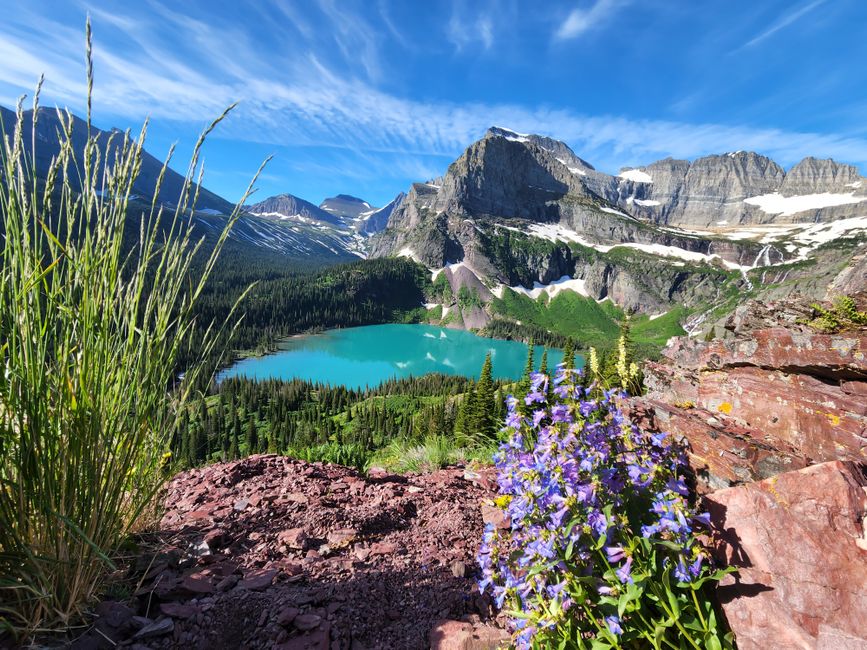
Glacier National Park, in northwest Montana on the Canadian border, protects more than a million acres of the northern Rocky Mountains: knife-edged peaks and ridges carved by ice, turquoise lakes, waterfalls, wildflower meadows and the last of the park’s shrinking glaciers. The famous Going-to-the-Sun Road crosses the Continental Divide at Logan Pass, 6,646 ft (2,026 m) high, and is one of the most spectacular drives in North America; from Many Glacier, Two Medicine and the remote North Fork, trails lead into some of the best hiking country in the US. Grizzly bears, mountain goats and bighorn sheep live here, and the park joins Canada’s Waterton Lakes National Park as an international peace park. The summer season is short, crowds are heavy in July and August, and access rules change from year to year, so check what applies in the year you travel.
Right now in Glacier National Park (West Glacier)
- Wed7–21°C45–70°FMostly clear
- Thu7–21°C45–70°FPartly cloudy
- Fri9–19°C48–66°F1 mm rain
- Mon 12 Oct Columbus Day · regional holiday in Montana
Top tours in Glacier National Park
See all tours for Glacier National Park →
From local operators, with prices and reviews; you check availability and book on Viator, our partner. We may earn a commission at no extra cost to you. How we earn money
Glacier at a glance
- Best months: mid-July to mid-September, when Going-to-the-Sun Road is usually fully open and high trails are free of snow. September is quieter, with fall color and active wildlife; from October to May most roads and services close.
- Time needed: one day for Going-to-the-Sun Road and a short hike at Logan Pass; three to five days to add Many Glacier, Two Medicine, Lake McDonald and a long hike such as the Highline Trail.
- Getting there: Glacier Park International Airport (FCA) near Kalispell is about 30 miles (48 km) from the West Entrance, and Amtrak’s Empire Builder stops at West Glacier all year and at East Glacier Park in summer.
- Fees (as of October 2026): $35 per car for 7 days in summer ($25 from 1 November to 30 April), plus $100 per person for non-US residents aged 16 and over without an annual or America the Beautiful pass. The park is cashless. No vehicle reservations were required in 2026.
- Before you go: entry rules for international visitors (ESTA or visa), driving and tipping are in our United States travel guide.
Entrance fees and passes (as of October 2026)
Everyone entering Glacier needs an entrance pass. The park does not accept cash: buy your pass online in advance or pay by card at an entrance station; when a station is not staffed, a self-registration area sells 7-day passes. Fees are lower in winter.
| Pass | Summer price | Winter price (1 Nov–30 Apr) | What it covers |
|---|---|---|---|
| Private vehicle | $35 | $25 | One non-commercial car, truck or van and everyone in it, 7 days |
| Motorcycle | $30 | $20 | Up to 2 motorcycles, 4 riders, 7 days |
| Per person (foot or bike) | $20 | $15 | Each person 16 or over; under-16s free; 7 days |
| Non-resident fee | +$100 per person | Non-US residents 16 and over, unless entering with an annual or America the Beautiful pass; also charged on commercial tours | |
| Glacier annual pass | $70 | This park only, valid for a year; US citizens and residents | |
| America the Beautiful pass | $80 residents / $250 non-residents | All national parks and federal recreation lands for 12 months; one vehicle or four people paying per person | |
For international visitors: two adults from abroad in a rental car would pay $35 plus $200 in non-resident fees at Glacier. The $250 non-resident America the Beautiful pass covers the car’s entrance and waives the $100 fee for the pass holder and up to three other adults, so it pays for itself on a single visit, and it also covers Yellowstone, Grand Teton and every other national park on a Northern Rockies road trip. US seniors 62 and over can buy a $20 annual or $80 lifetime pass; US military, US 4th graders and US residents with a permanent disability get free passes. US citizens and residents enter free on the remaining 2026 fee-free days, 27 October and 11 November.
Vehicle reservations, the Logan Pass shuttle and 2027
From 2021 to 2025 Glacier required vehicle reservations for Going-to-the-Sun Road and, in some years, for Many Glacier, Two Medicine and the North Fork. In 2026 the park dropped vehicle reservations everywhere, including the Going-to-the-Sun Road and the North Fork. Instead, it piloted two measures from 1 July to Labor Day, 7 September 2026:
- Three-hour parking at Logan Pass: all private-vehicle parking was limited to three hours, enforced 24 hours a day. Drivers parked, took a free timestamped permit from a kiosk and put it on the dashboard; overnight parking was allowed only for permitted backcountry users and Granite Park Chalet guests. Three hours is enough for the Hidden Lake Overlook, the visitor center or a ranger program.
- Ticketed Logan Pass Shuttle: express shuttles from Apgar Visitor Center and Lake McDonald Lodge on the west side, and St. Mary Visitor Center and Rising Sun on the east side, carried hikers to Logan Pass for longer walks such as the Highline Trail, with a stop at The Loop. Each rider aged 2 and over needed a ticket from Recreation.gov, costing only a $1 processing fee; tickets were not sold in the park. Some were released 60 days ahead from 2 May at 8 a.m. MDT, the rest at 7 p.m. MDT the evening before. The shuttle did not stop at Avalanche Lake or the Trail of the Cedars in 2026.
- Diversions: when an area became too congested, rangers could temporarily turn cars away, letting in only visitors with lodging, camping, boat-tour, horseback, guided-hike or backcountry reservations.
The park said the timed parking and the shuttle would not continue after Labor Day 2026, so this fall you can drive and park freely while the road is open. As of October 2026 the park had not announced its plans for 2027, including whether vehicle reservations, the ticketed shuttle or timed parking at Logan Pass will be used. In 2026 the summer plan was announced on 18 February, so watch the park’s website and Recreation.gov in late winter. For comparison, Rocky Mountain National Park in Colorado still uses timed entry.
Going-to-the-Sun Road: seasons, closures and vehicle limits
The 50-mile (80 km) road runs from West Glacier past Lake McDonald, climbs along the Garden Wall to Logan Pass, then descends past St. Mary Lake to St. Mary. Without stops, the full drive takes about 2 hours; Logan Pass is 32 miles (51.5 km) from the West Entrance and 18 miles (29 km) from the St. Mary Entrance. The speed limit is 40 mph (64 km/h) in the lower sections and 25 mph (40 km/h) in the alpine section. There is no gas station anywhere in the park.
- Opening: crews start plowing in early April, working across about 40 avalanche paths; the road over Logan Pass usually opens between mid-June and early July, but there is no set date. While it is being plowed, sections are often open to hikers and cyclists only.
- Fall closure: the alpine section typically stays open until the third Monday of October (19 October in 2026), but snow can close it sooner, for a day or for the season; in mid-September 2026 snow at Logan Pass briefly closed the road between Avalanche and Jackson Glacier Overlook. After the seasonal closure, gates move to Avalanche Creek or Lake McDonald Lodge on the west side, and the road beyond is open to walkers and cyclists until it is snow-covered.
- Winter: the section from West Glacier to Lake McDonald Lodge is usually plowed and open all year, weather permitting, and the closed road becomes a ski and snowshoe route.
- Vehicle size: vehicles or combinations longer than 21 ft (6.4 m), including bumpers, or wider than 8 ft (2.4 m), including mirrors, may not drive between Avalanche Creek and Rising Sun. Vehicles over 10 ft (3 m) tall may have trouble with rock overhangs west of Logan Pass. Leave big RVs and trailers at a campground and take a tour or shuttle.
- Cycling limits: in summer, bicycles are banned on parts of the road between Apgar and Logan Pass during the busiest afternoon hours; check current times before you ride.
For road status, use the park’s road status map, tune to 1610 AM near the entrances, call (406) 888-7800, or text GNPROADS to 333111 for alerts. Roads outside the park are on the Montana Department of Transportation map.
Many Glacier, Two Medicine and the North Fork in 2026–27
- Many Glacier: after the 2025 season, when the Swiftcurrent area was closed for water-system and road work, the valley reopened fully in 2026 with no major construction and a larger Swiftcurrent parking area. The Many Glacier Road usually stays open until about the third weekend of November, weather permitting, though lodges and services close in September.
- Two Medicine: a water-system project and a multi-year rehabilitation of the Two Medicine Road mean the area is closed for fall 2026. The road closed at the Running Eagle Falls Trailhead from 8 September and, from mid- to late September, at its junction with Highway 49. Two Medicine Campground did not open in 2026, and the road work is scheduled to finish in late 2027 but may continue into 2028, so expect closures or restrictions in 2027 too.
- North Fork: from 4 October 2026 the Inside North Fork Road is closed to all traffic from the Polebridge Ranger Station toward Logging Creek for water-system work, expected to finish in November. Bowman Lake and Kintla Lake remain reachable. The North Fork roads are rough gravel; allow plenty of time.
- St. Mary and Lake McDonald: expect partial closures in St. Mary Campground from fall 2026 to spring 2027 for water-system work, and culvert work on the North Lake McDonald Road in fall 2026.
Bear and water safety
Glacier has habitat for nearly a thousand black and grizzly bears. Approaching or staying within 100 yards (91 m) of bears or wolves is prohibited, and you must keep 25 yards (23 m) from all other wildlife, including the mountain goats and bighorn sheep around Logan Pass. If you see a bear by the road, don’t stop near it: drive at least 100 yards on and pull over safely. On the trail, carry bear spray where you can reach it, make noise by calling out and clapping (bells are not enough), hike in groups (the park has no reported attacks on groups of four or more), don’t run on trails, and avoid early morning, late evening and dark. Store all food, cookware and scented items in your car or a food locker, never leave a pack unattended, and remember that pets are not allowed on park trails. If you plan to cross into Canada, only bear spray with “USEPA” on the label is accepted at the border.
Water is the leading cause of death in Glacier. Streams are cold and fast, and rocks near waterfalls and creeks are slippery with moss; stay back from edges and never wade above falls. Mountain weather changes quickly, with snow possible at Logan Pass in any month, and wildfires and smoke are common in late summer; check the park’s fire updates and air quality before you hike.
Top things to see in Glacier
Logan Pass and the Hidden Lake Overlook
The high point of Going-to-the-Sun Road sits on the Continental Divide among meadows of wildflowers in July and August. From the visitor center, a boardwalk and trail climb about 1.4 miles (2.3 km) to the Hidden Lake Overlook, often with mountain goats nearby; it is one of the busiest trails in the park. The lot usually fills by sunrise in summer, so arrive very early or come in late afternoon.
The Highline Trail
Glacier’s most famous day hike follows the Garden Wall north from Logan Pass, with a narrow ledge section near the start and huge views all the way. Most hikers walk about 11.8 miles (19 km) one way to Granite Park Chalet and down to The Loop on Going-to-the-Sun Road, then ride a shuttle back; it often stays snowy and closed into July.
Lake McDonald and Apgar
The park’s largest lake, 10 miles (16 km) long, is famous for its colored pebbles and calm morning reflections. Apgar Village at its foot has the main visitor center, a camp store and boat rentals, and the historic Lake McDonald Lodge sits on its east shore. Nearby, the flat Trail of the Cedars and the climb to Avalanche Lake lead through old-growth cedar forest to a lake ringed by waterfalls.
St. Mary Lake and Wild Goose Island
On the drier east side, the road runs above long, windy St. Mary Lake. Stop at the Wild Goose Island turnout for the classic view, walk to St. Mary and Virginia falls, and look for Jackson Glacier from its overlook, the best glacier view from the road. Boat tours run from Rising Sun in summer.
Many Glacier
Often called the heart of Glacier’s backcountry, this northeastern valley has the Swiss-style Many Glacier Hotel on Swiftcurrent Lake, boat tours across two lakes, and trails to Grinnell Glacier, Iceberg Lake and Ptarmigan Tunnel. It is one of the best places in the park to see grizzlies, moose and bighorn sheep, usually from a distance across the valley. It is about 20 miles (32 km), 40 minutes, from St. Mary.
Two Medicine
A quieter valley in the southeast, with Running Eagle Falls, a boat on Two Medicine Lake and trails to alpine lakes. It is closed for road and utility work in fall 2026 and may have restrictions in 2027, so check before you go.
Nature
- Highline Trail
- Lake McDonald
- Many Glacier
- Saint Mary Lake
- Two Medicine Lake
- Wild Goose Island
Viewpoints
- Logan Pass
Monuments
- Going-to-the-Sun Road
Other sights
- Apgar Visitor Center
Other things to do in Glacier
- Hiking: more than 700 miles (1,100 km) of trails; to escape the crowds, try less famous trails or start very early. See our hiking guide for general advice.
- Cycling Going-to-the-Sun Road: in spring, before the road opens to cars, cyclists can ride sections closed to traffic; in fall, the road beyond the closure gates is open to bikes until snow arrives. See our cycling guide.
- Boat tours: Glacier Park Boat Co. runs narrated cruises at Many Glacier, Two Medicine, Rising Sun and Lake McDonald, some with guided hikes, plus small-boat rentals. See our boat trips guide.
- Red Bus and Blackfeet-led tours: the historic open-top red buses and Sun Tours, which shares the perspective of the Blackfeet Nation, drive Going-to-the-Sun Road so you can enjoy the views; tours can also be a way around vehicle limits.
- Rafting and horse rides: outfitters in West Glacier raft the Middle and North forks of the Flathead River, and guided rides leave from Many Glacier, Lake McDonald and Apgar in summer.
- Backcountry chalets and camping: Sperry and Granite Park chalets offer simple overnight stays reached only on foot; wilderness camping needs a permit all year.
Activities and best months
- HikingJulAugSepNo vehicle reservations in 2026; the ticketed Logan Pass Shuttle ran 1 July-7 September ($1 booking fee) and Logan Pass parking was limited to 3 hours in that period.
Getting there
The West Entrance at West Glacier is reached on US Highway 2, about 33 miles (53 km) from Kalispell. The east-side entrances at St. Mary, Many Glacier and Two Medicine are reached on US 89 from Great Falls through Browning, on the Blackfeet Reservation. Most visitors rent a car; there is no gas inside the park, so fill up in West Glacier, St. Mary or East Glacier Park.
| From | Distance | Notes |
|---|---|---|
| Glacier Park International Airport (FCA), near Kalispell | about 30 miles (48 km) to the West Entrance | The closest airport, with seasonal and year-round flights |
| Missoula, MT (MSO airport) | about 150 miles (241 km) to the West Entrance | About 2.5–3 hours |
| Great Falls, MT (GTF airport) | 130–165 miles (209–266 km) to the east entrances | Via US 89 and Browning |
| Amtrak Empire Builder | West Glacier (all year), Essex (all year), East Glacier Park (summer) | Chicago–Seattle/Portland route; summer lodge shuttle from West Glacier station (fee, reservation needed) |
| West Glacier to St. Mary | 50 miles (80 km) via Going-to-the-Sun Road; 90 miles (145 km) via US 2 and US 89 | About 2 hours either way |
| St. Mary to Waterton Lakes National Park, Canada | 50 miles (80 km) | About 1 hour plus border time |
Waterton and Canada: Glacier and Canada’s Waterton Lakes National Park together form the Waterton-Glacier International Peace Park. To drive between them, use the Chief Mountain border crossing (open only from 15 May to 30 September, with varying hours) or the Piegan/Carway crossing on US 89 north of Babb. Everyone needs a passport, Canada charges its own park fee, and visitors need whatever entry documents Canada requires for their nationality. A boat on Waterton Lake links the two parks in summer.
Around Glacier
- Whitefish: a lively mountain town with a ski resort, restaurants and lots of lodging, about 25 miles (40 km) west of the park.
- Kalispell, Columbia Falls and Flathead Lake: the Flathead Valley’s towns and the largest natural freshwater lake west of the Mississippi, with cherry orchards on its shores.
- Browning and the Blackfeet Nation: on the east side, home of the Museum of the Plains Indian and the annual North American Indian Days.
- Waterton Lakes National Park: Canada’s half of the peace park, with Waterton village and the Prince of Wales Hotel.
Nearby destinations
- Calgary256 km
- Banff National Park296 km
When to go and how long to stay
About three million people visit each summer, mostly in July and August. Lower areas such as Lake McDonald and Apgar open earlier, but high trails stay snowy until late June or July. September brings fewer crowds, cold mornings and turning leaves, and the western larch turn gold in mid-October, but most visitor centers close in late September and early October and lodging inside the park closes for the season. From late October to late May the park is quiet, snowy and largely self-service, with skiing and snowshoeing near Lake McDonald.
| Season | Average high | Average low | What it’s like |
|---|---|---|---|
| Spring (Mar–May) | 43–64 °F (6–18 °C) | 25–39 °F (−4 to 4 °C) | Snow in the mountains; plowing season; hiker and biker access on parts of Going-to-the-Sun Road. |
| Summer (Jun–Aug) | 70–80 °F (21–27 °C) | 45–50 °F (7–10 °C) | Road over Logan Pass opens late June–early July; busiest season; wildfire smoke possible in August. |
| Fall (Sep–Nov) | 68–37 °F (20–3 °C) | 41–26 °F (5 to −3 °C) | Quieter; fall color; road over Logan Pass closes around the third Monday of October. |
| Winter (Dec–Feb) | 29–34 °F (−2 to 1 °C) | 19–20 °F (−7 °C) | Snowy; few services; skiing and snowshoeing near Lake McDonald. |
Figures are NOAA 1991–2020 normals for the West Glacier weather station, at about 3,150 ft (960 m) near the West Entrance. It gets about 31 inches (784 mm) of precipitation a year, including about 115 inches (293 cm) of snow. Logan Pass, 3,500 ft (1,070 m) higher, is much colder and snowier, and the east side is windier and drier.
Weather month by month
Glacier in one day
Start before sunrise from West Glacier, stop at Lake McDonald and the Trail of the Cedars, and drive up to Logan Pass for the Hidden Lake Overlook. Continue east past Jackson Glacier Overlook to the Wild Goose Island viewpoint and St. Mary Falls, then return over the pass in the evening light or carry on toward Many Glacier.
Three to five days
Spend a day or two on each side. On the west, add Avalanche Lake, a lake cruise and the Highline Trail; on the east, base yourself at Many Glacier for Grinnell Glacier and Iceberg Lake, and add Two Medicine when it is open or a day trip to Waterton in Canada.
Where to stay in and near Glacier
- Park lodges (summer only): Glacier National Park Lodges, run by Xanterra, operates Lake McDonald Lodge, Many Glacier Hotel, Rising Sun Motor Inn, Swiftcurrent Motor Inn and the Village Inn Motel at Apgar; the Glacier Park Collection operates Apgar Village Lodge and Motel Lake McDonald. Most open from late May or June to September; book many months ahead.
- Backcountry chalets: Sperry and Granite Park chalets, reached only on foot, run by Belton Chalets.
- Gateway towns: West Glacier, Columbia Falls, Whitefish and Kalispell on the west side; St. Mary and East Glacier Park on the east side, where lodging is mostly seasonal.
- Camping: 13 drive-up campgrounds, eight of them by reservation only on Recreation.gov; the rest are first come, first served. Apgar and St. Mary offer primitive camping all year, and a permit is needed for wilderness camping.
Room taxes: room rates are quoted before tax. Montana has no general sales tax, but lodging, including campgrounds, carries an 8% state lodging facility sales and use tax (4% use tax plus 4% sales tax). Some resort towns, such as Whitefish, add a local resort tax. Check the total when you book.
Practical tips for Glacier
- Arrive early: Logan Pass and Avalanche Creek parking fill before sunrise in summer; if a lot is full, move on and come back later rather than circling.
- Have a backup plan: congestion, wildlife, weather and wildfires close areas every year; flexible plans make for a better trip.
- No cash, no fuel: the park is cashless and has no gas stations; fill up and carry a card.
- Limited signal: download maps, tickets and the NPS app before you go; Apgar and St. Mary visitor centers have free Wi-Fi in season.
- Leave no trace: stay on trails, pack out trash, and never feed wildlife. Pets are not allowed on trails, and drones are not allowed in national parks.
- Time zone: Mountain Time; daylight saving time ends on 1 November 2026. Emergencies: call 911.
What to pack for Glacier
Pack for cold and wet even in summer: a warm fleece, a waterproof jacket and rain pants, a hat and gloves for Logan Pass, plus sunscreen and sunglasses. Bring broken-in hiking boots with good grip, a daypack with water and snacks, a headlamp, binoculars and bear spray in a holster (it can’t go on planes; buy or rent it locally). In spring and fall, add warm layers and traction devices for icy trails.
What to pack
- Day packs and anti-theft bagsA 20–30 litre pack carries layers, water, a head torch and snacks on full-day levada walks.
- Fleeces and warm layersSummits like Pico do Areeiro averaged about 11 °C over 2024, so a fleece is needed even in summer.
- HeadlampsLevada routes such as PR1 and PR9 pass through long, dark, wet tunnels.
- Hiking shoes and bootsMadeira's levadas and the Azores' crater rims are wet, rocky and slippery, so grippy shoes matter more than anywhere else in Portugal.
- Rain jacketsMountain and island weather changes fast; a real shell beats an umbrella in the wind.
- Trekking polesLong stone staircases and steep descents on Madeira's peaks and the Azores' crater rims are easier on the knees with poles.
- Water bottles and hydration packsAlgarve and Alentejo trails are hot and exposed with few refill points.
Glacier travel FAQ
How much does it cost to enter Glacier National Park?
$35 per car in summer and $25 from 1 November to 30 April, valid 7 days. Non-US residents aged 16 and over also pay $100 each unless they have an annual or America the Beautiful pass ($250 for non-residents). The park takes cards only.
Do I need a vehicle reservation for Going-to-the-Sun Road?
Not in 2026: no vehicle reservations were required anywhere in the park. As of October 2026 the park had not announced its access plan for 2027; watch for an announcement in late winter.
How does the Logan Pass shuttle work?
In 2026 it ran from 1 July to 7 September as a ticketed express service from Apgar, Lake McDonald Lodge, St. Mary and Rising Sun. Tickets cost a $1 fee on Recreation.gov, released 60 days ahead and the evening before.
When does Going-to-the-Sun Road close for the season?
The alpine section usually closes around the third Monday of October, 19 October in 2026, or earlier if it snows. The lower road from West Glacier to Lake McDonald Lodge is usually open all year.
When does Going-to-the-Sun Road open in summer?
There is no set date. The road over Logan Pass usually opens between mid-June and early July, once plows clear the snow and avalanche paths.
Can I drive an RV on Going-to-the-Sun Road?
Only if it is no more than 21 ft (6.4 m) long and 8 ft (2.4 m) wide, including mirrors, between Avalanche Creek and Rising Sun. Larger vehicles must go around on US 2 or use a tour or shuttle.
Is Two Medicine open?
Not in fall 2026: the road is closed at Highway 49 for a rehabilitation project scheduled to finish in late 2027, possibly 2028, and the campground did not open in 2026. Check the park’s construction page for 2027.
How do I get to Glacier by train?
Amtrak’s Empire Builder stops at West Glacier and Essex all year and at East Glacier Park in summer. A paid summer shuttle links West Glacier station with Apgar and Lake McDonald Lodge.
What is the best time to visit Glacier National Park?
Mid-July to mid-September, when Going-to-the-Sun Road and the high trails are usually open. Early September offers smaller crowds, but services start closing later in the month.
Plan your trip
Partner links: TravelerCenter may earn a commission if you book, at no extra cost to you.
Sources · last reviewed 4 October 2026
Researched and last reviewed on 4 October 2026. Fees, passes and fee-free days, the 2026 access plan (no vehicle reservations, the ticketed Logan Pass Shuttle and three-hour parking), Going-to-the-Sun Road seasons and vehicle limits, 2026–27 construction at Two Medicine, the North Fork and St. Mary, bear and water safety, lodging and camping, airports, Amtrak stops and drive times come from Glacier National Park (National Park Service); the lodging tax from the Montana Department of Revenue; climate from NOAA’s 1991–2020 normals for the West Glacier station. The mid-September 2026 temporary road closure, the completed Swiftcurrent work, the Xanterra operator name, Whitefish’s resort tax and some distances are flagged for checking. Plans for 2027 had not been announced. For entry rules, driving and tipping, see our United States travel guide.
Also: nps.gov · NOAA NCEI normals 1991–2020, West Glacier (climate)
Data: Weather: MET Norway (CC BY 4.0) · Air quality: OpenAQ · Rates: ECB · Holidays: Nager.Date · Costs: World Bank ICP and price levels · © OpenStreetMap contributors (ODBL) · Wikidata (CC0)