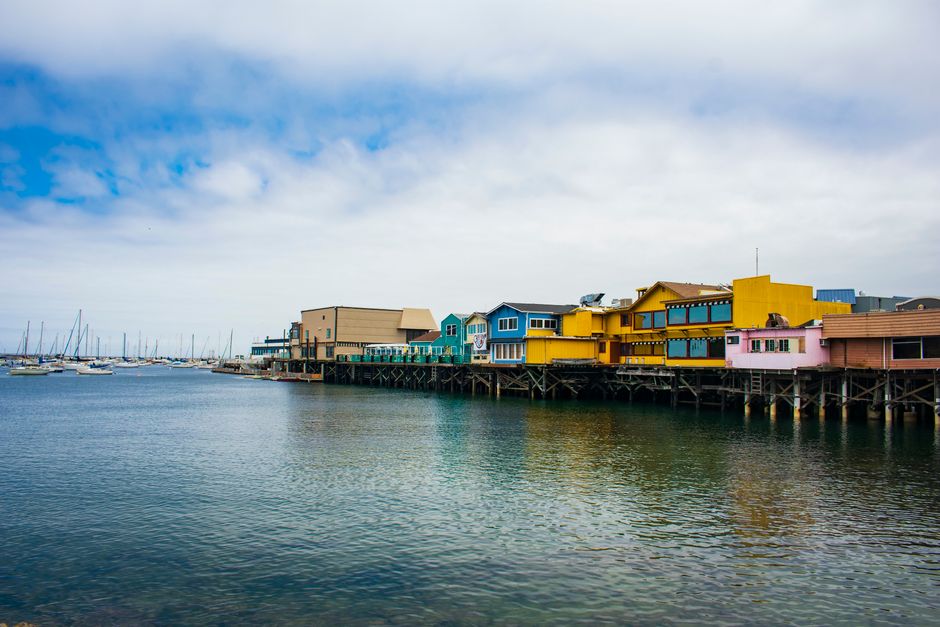
Monterey is a historic harbor town on the southern curve of Monterey Bay, about two and a half hours south of San Francisco, and the natural base for exploring the Monterey Peninsula: the world-famous Monterey Bay Aquarium on Cannery Row, sea otters and sea lions in the harbor, whale-watching boats from Fisherman’s Wharf, the scenic 17-Mile Drive through Pebble Beach, the fairy-tale village of Carmel-by-the-Sea and the start of the Big Sur coast. It was California’s capital under Spain and Mexico, and its adobe old town is full of history. The climate is cool and mild all year, often foggy in summer, with the sunniest weather in September and October.
Right now in Monterey
- Tue15–24°C58–74°FClear
- Wed16–25°C61–77°FClear
- Thu15–20°C58–68°FMostly clear
- Mon 12 Oct Columbus Day
- Mon 12 Oct Indigenous Peoples' Day · regional holiday in California
Top tours in Monterey
See all tours for Monterey →
From local operators, with prices and reviews; you check availability and book on Viator, our partner. We may earn a commission at no extra cost to you. How we earn money
Monterey at a glance
- Best for: the aquarium, marine wildlife and whale watching, coastal walks and cycling, golf, seafood and day trips to Carmel and Big Sur.
- How long: 2 days for Monterey and Carmel; 3–4 days to add the 17-Mile Drive, whale watching and Big Sur.
- Best time: September and October, the warmest and clearest months, with highs around 70 °F (21 °C). Summer is often gray and cool; winter is mild and wetter.
- Getting there: about 120 miles (193 km), 2–2.5 hours, from San Francisco; Monterey Regional Airport (MRY) has nonstop flights from several Western hubs.
- Getting around: walkable between downtown, the wharf and Cannery Row; MST buses cost $2 a ride as of October 2026. A car helps for Carmel, Pebble Beach and Big Sur.
- Before you go: entry rules, money, tipping and driving are in our United States travel guide.
Monterey and the peninsula: where things are
The Monterey Peninsula is small: Monterey, Pacific Grove and Carmel-by-the-Sea are a few miles apart, linked by the shoreline and the Monterey Bay Coastal Recreation Trail.
Downtown and Old Monterey
The historic center around Alvarado Street has restaurants, bars and the adobe buildings of Monterey State Historic Park, including the Custom House, the oldest government building in California, beside the plaza near the wharf.
Fisherman’s Wharf and Cannery Row
Old Fisherman’s Wharf is a pier of seafood restaurants, chowder stands and whale-watching and fishing boats. A mile or so west along the waterfront trail, Cannery Row, made famous by John Steinbeck’s novel, has turned its old sardine canneries into hotels, shops, tasting rooms and the aquarium.
Pacific Grove and Carmel-by-the-Sea
Pacific Grove, just west, is a quiet Victorian town with a rocky shoreline path, the Point Pinos Lighthouse and a winter monarch butterfly sanctuary. Carmel-by-the-Sea, about 5 miles (8 km) south, is a village of cottages, galleries and courtyards above a white-sand beach, with the historic Carmel Mission nearby.
Top things to see in Monterey
The Monterey Bay Aquarium
At 886 Cannery Row, built in an old cannery over the bay, this is one of the finest aquariums in the world, with a towering kelp forest, sea otters, the vast Open Sea gallery of tuna, sharks and sea turtles, and jellyfish galleries. As of October 2026, admission is $65 for adults (18–69), $50 for youth aged 5–17 and seniors 70 and over, and free for children 4 and under. Buy tickets in advance on the aquarium’s own website for a smoother entry (it warns against resellers); general admission lets you arrive any time up to an hour before closing. Hours vary by date, so check the schedule. The aquarium has no parking of its own: use the Cannery Row garage or walk or cycle along the waterfront trail.
Whale watching
The bay is part of the Monterey Bay National Marine Sanctuary, which protects 276 miles (444 km) of coast and 6,094 square miles (15,780 km²) of ocean, including a deep submarine canyon that brings feeding whales close to shore. Boats leave Fisherman’s Wharf all year: gray whales migrate past in winter and spring, and humpbacks, with the chance of blue whales in summer and early fall, feed in the bay from spring to fall, along with dolphins and sea lions. Trips take about 2.5–4 hours; the sea can be rough, so take seasickness tablets beforehand if you need them. See our boat trips guide.
The 17-Mile Drive and Pebble Beach
This private toll road loops through the gated Del Monte Forest between Pacific Grove and Carmel, past windswept beaches, mansions, golf links and the famous Lone Cypress on its rock. A per-car gate fee is charged (about $12 in 2026, according to secondary sources; check at the gate), and motorcycles are not allowed. Allow 2–3 hours with stops. The Pebble Beach Golf Links, one of the world’s most famous courses, is on the route.
Sea otters and the coastal trail
The paved Monterey Bay Coastal Recreation Trail runs along the shore from Pacific Grove past Cannery Row and the wharf and on around the bay, ideal for walking or renting a bike or surrey. Watch for sea otters floating in the kelp, especially near the aquarium and Coast Guard Pier, and sea lions on the breakwater. Kayak and paddleboard rentals let you see them from the water; keep at least 60 ft (18 m) away so you do not disturb them. See our cycling guide.
Old Monterey and the adobes
Monterey was the capital of Spanish and then Mexican Alta California, and the state’s first constitution was drafted here in 1849 at Colton Hall. Monterey State Historic Park preserves a walkable group of adobe houses, gardens and the Custom House near the wharf; follow the Path of History markers through downtown. The Royal Presidio Chapel, still in use, dates from the 1790s. It makes a peaceful, mostly free morning before the crowds reach Cannery Row.
Point Lobos and Carmel
Point Lobos State Natural Reserve, 3 miles (5 km) south of Carmel, has some of the most beautiful coastal walks in California, with seals, otters and cypress groves; day use costs $10 per vehicle and it opens 8 a.m.–7 p.m. (last entry 6:30 p.m.) as of October 2026. Combine it with Carmel’s beach and the 18th-century Carmel Mission.
Other things to do in Monterey
Diving and kayaking: the kelp forests off Monterey and Pacific Grove are among the best cold-water dive sites in the country; local shops run guided dives and rentals. See our diving guide. Wine: Carmel Valley, 20 minutes inland, and the Santa Lucia Highlands have tasting rooms in a sunnier climate. Golf: the peninsula has some of the most famous courses in the United States. Food: try clam chowder on the wharf, local Monterey Bay seafood and the farm produce of the Salinas Valley.
Day trips from Monterey
- Big Sur: the dramatic coast begins just south of Carmel; Bixby Bridge is about 30 minutes away and McWay Falls about 1.5 hours. Check Highway 1’s status first; see our Big Sur travel guide.
- Salinas and the National Steinbeck Center: the author’s hometown, about 20 miles (32 km) inland.
- Santa Cruz: a surf town with a classic beach boardwalk, about an hour north around the bay.
- Moss Landing and Elkhorn Slough: a wetland full of sea otters and birds, with kayak and boat tours, 30 minutes north.
- San Francisco: about 2–2.5 hours north; see our San Francisco travel guide.
Nearby destinations
- Big Sur60 km
- San Francisco139 km
- Napa Valley203 km
- Yosemite National Park244 km
- Sequoia National Park279 km
Getting there and getting around
By air: Monterey Regional Airport (MRY), about 4 miles (6 km) from downtown, has nonstop flights from cities including San Francisco, Los Angeles, San Diego, Las Vegas, Phoenix, Dallas–Fort Worth, Denver, Chicago, Seattle and Salt Lake City; some are seasonal. San José (SJC), about 70 miles (113 km) away, and San Francisco (SFO) have many more flights.
By car: from San Francisco take US 101 south and Highway 156 to Highway 1, about 120 miles (193 km), or the slower coastal Highway 1 via Santa Cruz. From Los Angeles it is about 320 miles (515 km), 5.5–6 hours via US 101, or longer through Big Sur when Highway 1 is open; see our Los Angeles travel guide.
Buses: Monterey-Salinas Transit (MST) runs buses around the peninsula and to Carmel, Salinas and Big Sur in season. As of October 2026 a ride costs $2, a day GoPass $6 and a 7-day pass $20; you can tap a contactless card on board, and fares are capped at $6 a day. The free MST Monterey Trolley between downtown and Cannery Row runs in summer only; daily service resumes on May 22, 2027. Downtown parking is metered or in city garages.
When to go and how long to stay
Monterey’s climate is cool and remarkably even. Summer brings morning fog off the cold ocean, so the warmest, sunniest days come in September and October. The table uses NOAA’s 1991–2020 normals for the Monterey Peninsula Airport station.
| Season | Average high / low | Rain per month | What it’s like | Good for |
|---|---|---|---|---|
| Winter (Dec–Feb) | 62 °F (17 °C) / 43–45 °F (6–7 °C) | 2.8–3.5 in (72–89 mm) | Mild, with rain between sunny spells | Gray whales, monarch butterflies, the aquarium |
| Spring (Mar–May) | 63–65 °F (17–19 °C) / 46–50 °F (8–10 °C) | 0.5–2.8 in (13–71 mm) | Fresh and green; windy afternoons | Whale migration, wildflowers, hiking |
| Summer (Jun–Aug) | 68–70 °F (20–21 °C) / 52–55 °F (11–13 °C) | Almost none | Morning fog, cool breezes; busiest season | Humpbacks, kayaking, events |
| Fall (Sep–Nov) | 71 °F falling to 65 °F (22–18 °C) / 54 °F falling to 46 °F (12–8 °C) | 0.1–1.5 in (2–37 mm) | The sunniest, warmest weeks | Everything outdoors; fewer crowds after Labor Day |
The airport gets about 16 inches (412 mm) of rain a year, mostly from November to March. Bring a jacket even in August: Monterey rarely gets hot.
Events worth planning around
- August: Monterey Car Week, with the Pebble Beach Concours d’Elegance; hotels sell out and prices soar.
- September: the Monterey Jazz Festival, one of the oldest in the world.
- Winter: monarch butterflies in Pacific Grove and the gray whale migration.
How long to stay: 2, 3 and 4 days
2 days: day one, the aquarium and Cannery Row, then a bike ride along the coastal trail to Pacific Grove; day two, a morning whale-watching trip and an afternoon in Carmel. 3 days: add the 17-Mile Drive and Point Lobos. 4 days: add a day down the Big Sur coast, or kayaking at Moss Landing and wine tasting in Carmel Valley.
Where to stay in Monterey and the hotel taxes
- Cannery Row: waterfront hotels steps from the aquarium.
- Downtown and near the wharf: mid-range hotels, walkable to restaurants.
- Munras Avenue and North Fremont Street: motels and chain hotels, usually the best value.
- Pacific Grove and Carmel: quiet inns and B&Bs; Pebble Beach for luxury golf resorts.
Room rates are quoted before tax and are highest on summer weekends and during Car Week. According to the City of Monterey, hotels in the city charge a 12% transient occupancy tax, plus a Conference Center Facilities District charge of 0.8% to 4.15% depending on the hotel, and a Tourism Improvement District assessment of $1.70 to $5.10 per room per night (rates in force from July 2025 to June 2027). Unincorporated areas such as Pebble Beach and Carmel Valley charge 10.5%, according to summaries of the county’s information, and Measure E on the November 3, 2026, ballot would raise that to 12.5%. Carmel-by-the-Sea and Pacific Grove set their own rates.
Practical tips for Monterey
- Sales tax: according to the state tax agency (CDTFA), the rate is 9.25% in the cities of Monterey, Pacific Grove and Carmel-by-the-Sea and 8.75% in unincorporated areas, as of October 2026.
- Book the aquarium online on its own website, especially for weekends and holidays.
- Parking: Cannery Row and the wharf fill up on summer weekends; park once in a downtown or Cannery Row garage and walk the waterfront trail between them.
- Ocean safety: the water is cold all year, around the mid-50s °F (12–14 °C), with strong surf on exposed beaches; swim only at sheltered beaches and never turn your back on the waves.
- Wildlife: keep your distance from otters, seals and sea lions; it is illegal to disturb them.
- Tipping: 18–22% at sit-down restaurants; more in our United States travel guide.
- Emergencies: call 911.
What to pack for Monterey
Pack layers and a warm, windproof jacket in every season, since summer fog can keep days in the 60s °F (15–20 °C). Bring comfortable walking shoes for the coastal trail, sunglasses and sunscreen for clear fall days, binoculars for whales and otters, and seasickness tablets if you plan a boat trip.
Monterey travel FAQ
How much are Monterey Bay Aquarium tickets?
As of October 2026, $65 for adults, $50 for ages 5–17 and seniors 70 and over, and free for children 4 and under. Buy on the aquarium’s own website.
When is the best time for whale watching in Monterey?
Whales are seen all year: gray whales in winter and spring, humpbacks from spring to fall, and sometimes blue whales in summer and early fall.
Is the 17-Mile Drive worth it?
Yes, for the coastal scenery, the Lone Cypress and Pebble Beach. There is a per-car gate fee (about $12 in 2026), and motorcycles are not allowed.
How far is Monterey from San Francisco?
About 120 miles (193 km), roughly 2–2.5 hours by car without heavy traffic.
Is the Monterey trolley running?
Not in fall 2026. The free MST Monterey Trolley runs in summer; daily service resumes on May 22, 2027. MST buses cost $2 a ride.
What is the weather like in Monterey?
Cool and mild all year, with highs of 62–71 °F (17–22 °C). Summer mornings are often foggy; September and October are the warmest months.
Can I drive from Monterey to Big Sur?
Yes. Highway 1 runs south from Carmel through Big Sur; check Caltrans for closures and roadwork before you go.
What taxes are added to Monterey hotel bills?
In the City of Monterey, a 12% hotel tax plus a conference-center charge of 0.8–4.15% and a tourism assessment of $1.70–$5.10 per room night.
Where can I see sea otters in Monterey?
Look in the kelp beds off Cannery Row, near the aquarium and Coast Guard Pier, and at Moss Landing’s Elkhorn Slough. Bring binoculars and keep your distance.
Plan your trip
Partner links: TravelerCenter may earn a commission if you book, at no extra cost to you.
Sources · last reviewed 4 October 2026
Researched and last reviewed on 4 October 2026. Aquarium prices, tickets and parking: Monterey Bay Aquarium; the sanctuary: NOAA’s Monterey Bay National Marine Sanctuary; Point Lobos: California State Parks; buses, fares and the trolley: Monterey-Salinas Transit; flights: Monterey Regional Airport; hotel taxes: City of Monterey Finance Department; sales tax: the California Department of Tax and Fee Administration; climate: NOAA’s 1991–2020 normals for Monterey Peninsula Airport. The 17-Mile Drive fee, the county hotel tax, whale seasons, event months and driving distances come from secondary or summarized sources and are flagged for checking. Check the official sites before you go. For entry rules, tipping and driving, see our United States travel guide.
Data: Weather: MET Norway (CC BY 4.0) · Sea temperature: NOAA CoastWatch · Rates: ECB · Holidays: Nager.Date · Costs: World Bank ICP and price levels · Wikidata (CC0)