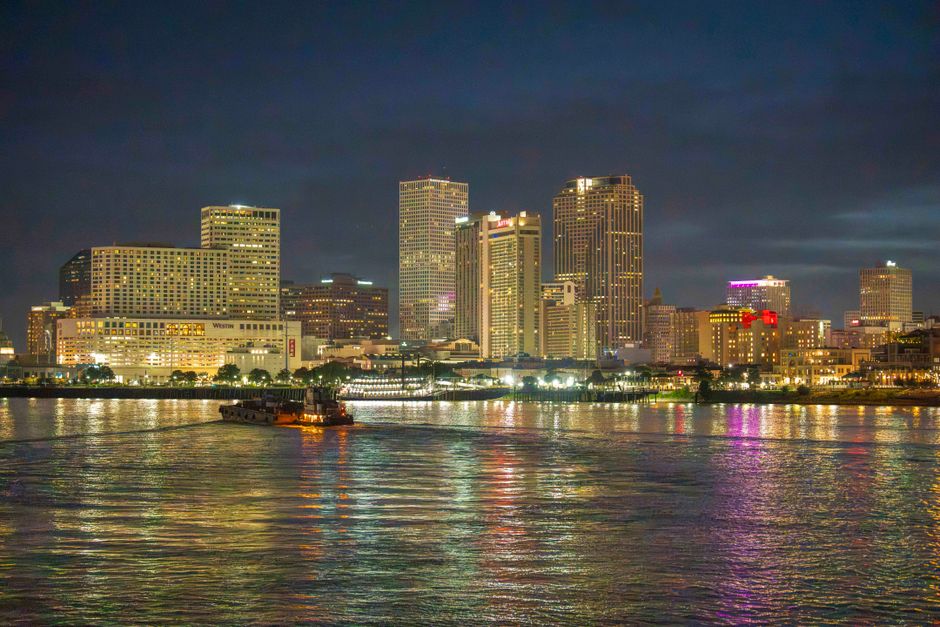
New Orleans is unlike any other American city. Founded by the French in 1718 on a bend of the Mississippi River, ruled by Spain and then sold to the United States in 1803, it mixes French, Spanish, African and Caribbean roots into its own food, music and architecture. It is the birthplace of jazz, the home of Mardi Gras, and a place where brass bands march down the street, iron balconies drip with ferns and dinner is taken very seriously. Spring and late autumn are the most pleasant times to visit; summers are hot and humid, and the hurricane season runs from June to November.
Right now in New Orleans
- Wed23–28°C74–82°FMostly clear
- Thu23–27°C73–81°FPartly cloudy
- Fri23–26°C73–79°F29 mm rain
- Mon 12 Oct Columbus Day · regional holiday in Louisiana
- Mon 12 Oct Indigenous Peoples' Day · regional holiday in Louisiana
Top tours in New Orleans
See all tours for New Orleans →
From local operators, with prices and reviews; you check availability and book on Viator, our partner. We may earn a commission at no extra cost to you. How we earn money
New Orleans at a glance
- Best for: live music, Creole and Cajun food, historic architecture, festivals and nightlife.
- How long: 3 days for the city; 4–5 days to add a swamp tour, a plantation and more music.
- Best time: February to May and October to November. From June to September average highs reach 90–91 °F (32–33 °C) with high humidity.
- Getting there: fly to Louis Armstrong New Orleans International Airport (MSY), with buses and fixed-fare taxis to the city; Amtrak trains arrive at the Union Passenger Terminal.
- Getting around: walk the French Quarter and ride the RTA streetcars and buses, paying with the Le Pass app or a Jazzy Pass.
- Before you go: entry rules (visas and ESTA), money, tipping and driving are covered in our United States travel guide.
New Orleans neighborhoods and who each one suits
Most of what visitors want is in a crescent along the river, from the French Quarter upriver to the Garden District and downriver to the Marigny and the Bywater.
The French Quarter
The original city, or Vieux Carré, a grid of about 13 by 6 blocks between Canal Street, Rampart Street, Esplanade Avenue and the river. Its Creole townhouses with wrought-iron balconies, hidden courtyards, Jackson Square, restaurants, antique shops and jazz bars make it the obvious first-time base. Bourbon Street is loud and packed with bars until very late; Royal and Chartres Streets are calmer. Ask for a room away from Bourbon if you want to sleep.
The Marigny and the Bywater
Just downriver, the Faubourg Marigny has colorful Creole cottages and Frenchmen Street, where locals go for live music. The Bywater beyond is artsy and relaxed, with murals, small restaurants and the riverside Crescent Park. Good for music lovers who prefer guesthouses to big hotels.
The CBD and the Warehouse District
Across Canal Street from the Quarter, the Central Business District has most of the big hotels, while the Warehouse District, also called the Arts District, has galleries, the National WWII Museum, the Ogden Museum of Southern Art and many good restaurants. Practical and well connected, a short walk from the Quarter.
The Garden District and Uptown
The “American” side of town, built by 19th-century newcomers who filled oak-shaded streets with grand Greek Revival and Italianate mansions. Magazine Street runs for miles with boutiques, cafés and bars, and the St. Charles streetcar rolls through to Audubon Park and Tulane University. Quieter, with bed-and-breakfasts and boutique hotels.
Tremé and Mid-City
Tremé, just beyond Rampart Street, is one of the oldest African American neighborhoods in the country and a cradle of brass-band music, with Congo Square in Louis Armstrong Park. Mid-City stretches along the Canal streetcar to City Park, the New Orleans Museum of Art and the Fair Grounds, where Jazz Fest takes place.
Top things to see in New Orleans
Prices and hours below were checked on the official sites in October 2026, unless we say otherwise; check again before you go. US prices exclude sales tax, which is added when you pay.
Jackson Square and St. Louis Cathedral
The old parade ground of the colonial city is now a garden square with a statue of Andrew Jackson, ringed by artists, fortune tellers and street musicians. Facing it, the white, triple-spired St. Louis Cathedral, one of the oldest Catholic cathedrals in the United States, is usually free to visit outside services. It is flanked by the Cabildo, where the Louisiana Purchase transfer took place in 1803, and the Presbytère, both part of the Louisiana State Museum, and framed by the red-brick Pontalba Buildings. Across Decatur Street, have beignets and café au lait at Café du Monde, then walk the Moonwalk along the river.
Walking the French Quarter
Explore the Quarter slowly on foot. Royal Street has galleries, antique shops and afternoon street performers; the French Market, by the river, has food stalls and a flea market. Bourbon Street is the party street after dark. Walking tours cover history, food, cocktails and ghost stories. Preservation Hall, on St. Peter Street, holds short traditional jazz concerts most nights; buy tickets in advance.
Frenchmen Street and live music
For the music locals go out for, head to Frenchmen Street in the Marigny, a few blocks of small clubs where jazz, blues, funk and brass bands play from late afternoon until the early hours. Many clubs have little or no cover charge but expect you to buy a drink per set, and tipping the band is customary. Brass bands also play in Tremé bars, and second-line parades take to the streets on many Sundays from late summer to spring.
The National WWII Museum
Spread over several buildings in the Warehouse District, with aircraft hanging in the pavilions and immersive galleries on the war in Europe and the Pacific. Plan at least half a day. As of October 2026 admission costs $37 for adults, $34 for seniors (65+) and $27 for students and military, with children under 5 and WWII veterans free; Beyond All Boundaries, a 4D film narrated by Tom Hanks, costs $9 extra. The museum is open daily from 9 am to 5 pm, and closed on Mardi Gras Day, Thanksgiving, Christmas Eve and Christmas Day.
The Garden District and the St. Charles streetcar
Ride the green St. Charles streetcar, among the oldest continuously operating street railways in the world, from Canal Street to the Garden District. Get off around Washington Avenue to walk the streets of mansions and gardens, then follow Magazine Street for lunch, or ride on under the live oaks to Audubon Park. A single ride costs $1.25, so it is the cheapest sightseeing tour in town.
The cemeteries, or “cities of the dead”
Because of the high water table, New Orleans buries its dead above ground in family tombs and wall vaults, creating whitewashed streets of tombs. The two most famous have strict access rules.
St. Louis Cemetery No. 1, founded in 1789 just outside the Quarter, holds the tomb said to be that of the voodoo priestess Marie Laveau. To protect the tombs, the Archdiocese of New Orleans admits only families with a pass and visitors on the Official Tour, run by Cemetery Tours NOLA with New Orleans Catholic Cemeteries; you cannot enter on your own or with another company. As of October 2026 the 55-minute tour, limited to 20 people, costs from $29 for adults (13+) and from $22 for children aged 3–12. Book online or at the tour desk at Basin St. Station, 501 Basin Street, across from the cemetery, and arrive 15 minutes early.
Lafayette Cemetery No. 1, in the Garden District, reopened on 1 October 2026 after a seven-year closure for repairs. According to local news reports, access is now only on guided tours run by the Preservation Resource Center (through its Save Our Cemeteries program): small groups of up to 16, about six tours a day, with history-focused tours and no ghost tours. Book through the Preservation Resource Center’s website.
More to see
- City Park: one of the largest urban parks in the country, with ancient live oaks, the New Orleans Museum of Art and its free sculpture garden, at the end of the Canal streetcar.
- Mardi Gras World: the workshops where many of the parade floats are built, by the river in the Warehouse District.
- The riverfront: the Moonwalk, Woldenberg Park and paddle-wheel steamboat cruises on the Mississippi.
- Ogden Museum of Southern Art: art from the American South, near the WWII Museum.
- Algiers Point: a quiet historic neighborhood across the river, reached by the $2 RTA ferry from the foot of Canal Street, with skyline views back to the city.
Other sights
- French Quarter
Churches and cathedrals
- St. Louis Cathedral
Parks and gardens
- City Park
- Jackson Square
Museums
- National World War II Museum
Historic centres
- Garden District
- St. Charles Streetcar Line
Monuments
- Lafayette Cemetery No. 1
Activities and best months
- CultureThe National WWII Museum opens daily 9:00-17:00; adults $37.
Other things to do in New Orleans
Eat your way through Creole and Cajun food
Eating is the main event here. Try gumbo, jambalaya, red beans and rice (traditionally on Mondays), crawfish étouffée, chargrilled oysters, a po’boy sandwich and the muffuletta, a round sandwich of Italian meats and olive salad. Boiled crawfish season runs roughly from January to June. Old-line Creole restaurants and jazz brunches sit alongside neighborhood joints, and the Sazerac is the local cocktail.
Swamp and bayou tours
The wetlands start just outside the city. Private operators run boat and airboat tours through the bayous to see alligators (most active in the warm months), herons, turtles and cypress trees draped with Spanish moss, many with hotel pickup; compare group size and boat type before you book. Jean Lafitte National Historical Park’s Barataria Preserve, south of the city, is free, but the National Park Service closed its visitor center and most trails from 2 February 2026 for about two years of repairs after Hurricane Ida; the Twin Canals trail and canoe launch stay open, and rangers lead walks at the nearby Wetland Trace boardwalk in Jean Lafitte. See our boat trips guide.
Walking and cycling
New Orleans is flat, so walking and cycling are easy when it is not too hot. Ride along the levee-top paths, through City Park or the Lafitte Greenway from the Quarter to Mid-City. See our city sightseeing and cycling guides.
Day trips and onward travel
Whitney Plantation and River Road
Along River Road, upriver from the city, former sugar plantations line the Mississippi. Whitney Plantation, about an hour’s drive away in Wallace, is a museum dedicated to the lives of enslaved people, told through memorials, original buildings and first-hand testimony; plan at least two hours. As of October 2026 it opens 9:30 am–4:30 pm (last entry 3 pm), closed on Tuesdays; self-guided audio tours cost $25 for adults and $11 for children aged 6–18, and guided tours, which include the upstairs of the main house, $32 and $15. Booking online adds sales tax and fees. Other River Road plantations, such as Oak Alley with its famous alley of live oaks, focus more on the houses and gardens. Many visitors join a coach tour if they don’t have a car.
Cajun Country and the Gulf Coast
Further west, Lafayette and the towns of Acadiana are the heart of Cajun culture, with zydeco dance halls and boudin, about two and a half hours by car. Amtrak trains from the Union Passenger Terminal run north to Chicago overnight on the City of New Orleans; our Chicago travel guide covers the other end of the line.
Nearby destinations
- Gulf Shores231 km
Getting there and getting around
From the airport (MSY)
Louis Armstrong New Orleans International Airport is in Kenner, about 15 miles (24 km) west of downtown. Buses leave from Level 1 baggage claim, outside Door 2, zones B4 and B5. According to the airport, as of October 2026 the RTA’s Airport Express (202) runs to two downtown stops, Elk Place at Cleveland and the Union Passenger Terminal, for $1.25; check the timetable on the RTA’s website, as it does not run all day. Jefferson Transit’s Veterans–Airport (E1) bus runs to City Park Avenue in Mid-City for $2, cash in the fare box, and connects with the Canal streetcar. Taxis wait at Door 7 and charge a flat $36 to the CBD or the French Quarter for up to two passengers, or $15 per person for three or more; they must accept cards. Ride-hailing and shuttles are also available.
By train and bus
The Union Passenger Terminal, on the edge of the CBD, is the station for Amtrak’s long-distance trains to Chicago, to New York via Atlanta and Washington, D.C., and to Los Angeles, and for intercity buses.
Streetcars, buses and ferries
The Regional Transit Authority (RTA) runs five streetcar lines, St. Charles, Canal–Cemeteries, Canal–City Park, Riverfront and Rampart–Loyola, plus buses and two river ferries, to Algiers Point and Chalmette. As of October 2026 a single ride on a bus or streetcar costs $1.25 and the ferry $2. Jazzy Passes give unlimited rides: $3 for 1 day, $8 for 3 days, $15 for 7 days and $45 for 31 days, and the $6 Regional Ride pass also covers Jefferson Transit buses. The easiest way to pay is the RTA’s free Le Pass app, where you buy tickets and passes, activate one and show it to the driver; it also has a trip planner and live vehicle tracking. Otherwise pay exact cash when you board. Children under 5 ride free with a paying adult. Parades stop many lines on parade days.
Driving and parking
You don’t need a car in the city, where the Quarter’s streets are narrow, parking is scarce and hotel parking is expensive. Rent one only for River Road or Cajun Country; for US driving rules, see our United States travel guide.
When to go and how long to stay
New Orleans has a humid subtropical climate: mild winters, warm springs, long hot summers with afternoon thunderstorms, and a pleasant autumn. The table uses NOAA’s official 1991–2020 climate normals for New Orleans International Airport (MSY): average daily highs and lows and average monthly rainfall.
| Season | Average high / low | Rainfall | What it’s like | Good for |
|---|---|---|---|---|
| Winter (Dec–Feb) | 63–66 °F (17–19 °C) / 46–50 °F (8–10 °C) | 4–5 in (105–132 mm) a month | Mild, sometimes damp, with occasional cold snaps | Mardi Gras season, museums, food |
| Spring (Mar–May) | 72–85 °F (22–30 °C) / 55–69 °F (13–21 °C) | 4.4–5.6 in (111–143 mm) | Warm and sunny, getting humid by May | Festivals, Jazz Fest, crawfish, walking |
| Summer (Jun–Aug) | 90–91 °F (32–33 °C) / 75–77 °F (24–25 °C) | 6.8–7.6 in (172–194 mm), the wettest season | Hot and very humid, with daily storms; hurricane season | Lower hotel prices, indoor sights, early mornings |
| Autumn (Sep–Nov) | 88 °F (31 °C) falling to 71 °F (22 °C) / 74 °F (23 °C) falling to 54 °F (12 °C) | 3.7–5.1 in (94–130 mm); October is the driest month | Still hot in September, lovely from mid-October | Festivals, the swamps, walking tours |
The airport averages about 63 inches (1,609 mm) of rain a year, one of the wettest totals of any big US city, with rain on about 13–14 days a month in July and August. The Atlantic hurricane season runs from 1 June to 30 November, according to NOAA’s National Hurricane Center, with the greatest risk from August to October. Most trips are not affected, but if you travel then, buy travel insurance, follow the National Weather Service and local officials, and leave if an evacuation is ordered.
Mardi Gras, Jazz Fest and other events
- Mardi Gras 2027: Carnival season starts on Twelfth Night, 6 January, and ends on Mardi Gras Day (Fat Tuesday), 9 February 2027, according to New Orleans & Company, the city’s official tourism organization. The big parades roll on the last two weekends before it. Book rooms months ahead.
- Jazz Fest 2027: the New Orleans Jazz & Heritage Festival takes place at the Fair Grounds Race Course over two weekends, 22–25 April and 29 April–2 May 2027, according to the festival.
- Spring: French Quarter Festival in April and many smaller music and food festivals.
- Autumn and winter: Halloween in the Quarter, and Christmas lights and Réveillon dinners in December.
How long to stay: 3, 4 and 5 days
3 days: day one, Jackson Square, the cathedral, beignets and a French Quarter walk, with music on Frenchmen Street at night; day two, the National WWII Museum and the Warehouse District; day three, the St. Charles streetcar, the Garden District, Magazine Street and a cemetery tour.
4 days: add a swamp tour and City Park. 5 days: add Whitney Plantation and River Road, or Tremé, the Bywater and the ferry to Algiers Point.
Weather month by month
Where to stay in New Orleans and the hotel tax
- French Quarter: historic hotels and courtyards in the middle of everything; noisy near Bourbon Street.
- CBD and Warehouse District: big hotels, often better value, walking distance to the Quarter.
- Marigny: guesthouses near Frenchmen Street’s music.
- Garden District: bed-and-breakfasts and boutique hotels on the streetcar line.
Rates rise sharply for Mardi Gras, Jazz Fest, the Sugar Bowl and big conventions, and fall in the summer heat. Hotel taxes are added to the quoted rate. At hotels with 10 or more rooms, the percentage taxes add up to 15%: according to the Louisiana Department of Revenue, 3% state sales tax, 4% for the Louisiana Stadium and Exposition District and 3% for the Ernest N. Morial Exhibition Hall Authority, plus the City of New Orleans’ 5% hotel-motel sales tax. On top come small per-room, per-night charges that depend on the size of the hotel: 50 cents to $2 for the Exhibition Hall Authority and 50 cents or $1 for the city’s occupancy privilege tax, so $1–$3 a night in total. Many hotels also add a tourism assessment and a daily amenity or “resort” fee and charge for parking, so compare the full price.
Practical tips for New Orleans
- Drinking on the street: you may carry an alcoholic drink on the street in a plastic “go-cup,” and bars will pour your drink into one when you leave, but glass containers are banned on the streets and sidewalks of the French Quarter. Open containers are not allowed in cars.
- Tipping: 18–22% of the restaurant bill before tax is usual, and tip musicians when the jar goes round; our United States travel guide explains tipping in full.
- Safety: the busy parts of the Quarter, the CBD, the Garden District and Frenchmen Street are well visited by tourists. As in any big city, keep an eye on your belongings in crowds, stick to lit, busy streets at night, take a taxi or ride-hail late at night rather than walking through empty blocks, and ask your hotel about areas you don’t know.
- Heat: from June to September, sightsee early, drink water and plan indoor breaks in the afternoon.
- Parade days: during Carnival, streets close and streetcars stop for parades; check parade routes before you move around.
- Emergencies: call 911.
What to pack for New Orleans
For most of the year pack light, breathable clothes, a hat, sunscreen and insect repellent for swamp tours. A compact umbrella or light rain jacket is useful in every season, essential in summer. Bring comfortable shoes for uneven sidewalks and a light sweater for air-conditioned museums; from December to February add a warm layer for evenings. Some old-line restaurants expect a jacket for men at dinner, and something purple, green and gold helps at Mardi Gras.
New Orleans travel FAQ
When is Mardi Gras 2027?
Mardi Gras Day (Fat Tuesday) is 9 February 2027. Carnival season begins on 6 January, and the biggest parades roll over the two weekends before Fat Tuesday.
When is Jazz Fest 2027?
The New Orleans Jazz & Heritage Festival runs over two weekends, Thursday to Sunday, 22–25 April and 29 April–2 May 2027, at the Fair Grounds Race Course in Mid-City.
How do I get from New Orleans airport to the French Quarter?
A taxi costs a flat $36 for up to two people to the French Quarter or the CBD as of October 2026. The cheapest option is the RTA Airport Express (202) bus downtown for $1.25; check its timetable.
How much is the streetcar in New Orleans?
As of October 2026, $1.25 a ride. A 1-day Jazzy Pass costs $3, a 3-day pass $8 and a 7-day pass $15, valid on RTA streetcars and buses. Buy them in the Le Pass app.
Can you visit St. Louis Cemetery No. 1 on your own?
No. Only families with a pass and visitors on the Official Tour, run with New Orleans Catholic Cemeteries, may enter. As of October 2026 the 55-minute tour costs from $29 for adults and from $22 for children aged 3–12.
Is Lafayette Cemetery No. 1 open?
Yes, since 1 October 2026, after seven years closed, but only on small guided tours run by the Preservation Resource Center, which you book on its website.
Can you drink on the street in New Orleans?
Yes, in plastic go-cups. Glass containers are banned on French Quarter streets and sidewalks, and open containers are not allowed in vehicles.
How much does the National WWII Museum cost?
As of October 2026, $37 for adults, $34 for seniors and $27 for students and military; the 4D film Beyond All Boundaries is $9 extra. It opens daily 9 am–5 pm.
What is the hotel tax in New Orleans?
At hotels with 10 or more rooms, state, district and city taxes total 15% of the room rate, plus $1–$3 per room per night depending on hotel size. Many hotels add a daily fee as well.
Is it safe to visit New Orleans in hurricane season?
Hurricane season runs from 1 June to 30 November, peaking from August to October. Most visits go ahead normally; buy travel insurance, watch the forecasts and follow official instructions if a storm approaches.
Plan your trip
Partner links: TravelerCenter may earn a commission if you book, at no extra cost to you.
Sources · last reviewed 4 October 2026
Researched and last reviewed on 4 October 2026. WWII Museum prices and hours: the National WWII Museum; St. Louis Cemetery No. 1: the Official Tour (Cemetery Tours NOLA with New Orleans Catholic Cemeteries); Lafayette Cemetery No. 1 reopening: local news reports, flagged for checking with the Preservation Resource Center; Whitney Plantation: Whitney Plantation; Barataria Preserve: National Park Service; fares, passes and Le Pass: New Orleans RTA; airport buses and taxis: Louis Armstrong New Orleans International Airport; Mardi Gras 2027: New Orleans & Company; Jazz Fest 2027: the festival; hotel taxes: Louisiana Department of Revenue and City of New Orleans Bureau of Revenue; glass-container rule: New Orleans City Code; hurricane season: NOAA National Hurricane Center; climate: NOAA’s 1991–2020 normals for New Orleans International Airport. Cathedral and Louisiana State Museum details, distances and drive times are general references. Prices and timetables change, so check the official sites before you go. For entry rules, money, tipping and driving, see our United States travel guide.
Also: nationalww2museum.org · NOAA NCEI normals 1991–2020, New Orleans International Airport (climate)
Data: Weather: MET Norway (CC BY 4.0) · Rates: ECB · Holidays: Nager.Date · Costs: World Bank ICP and price levels · © OpenStreetMap contributors (ODBL) · Wikidata (CC0)