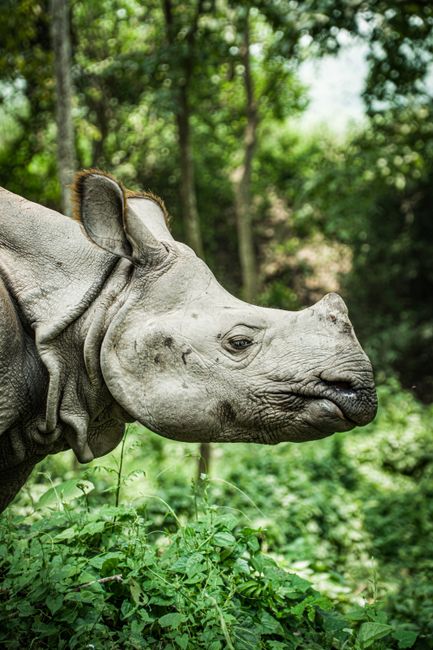
Chitwan National Park, in the lowlands of south-central Nepal, is the country’s best place to see big wildlife and one of the finest parks in Asia for the greater one-horned rhinoceros. Established in 1973 as Nepal’s first national park and inscribed by UNESCO as a World Heritage Site in 1984, it covers about 950 km² (370 sq miles) of sal forest, riverine woodland and tall elephant grass between the Rapti, Narayani and Reu rivers, against the Siwalik and Mahabharat hills. Rhinos graze in the grasslands and wallow in the rivers; Bengal tigers, leopards and sloth bears hide in the forest; mugger crocodiles and the rare, fish-eating gharial bask on the riverbanks; and birders come for hundreds of species, from hornbills to the endangered Bengal florican. Most visitors stay in Sauraha, a village on the park’s northern edge, and explore by jeep, canoe and on foot with licensed guides. The best months are October to March, with February to April the best for spotting animals after the grass is cut; from June to September, the monsoon floods the rivers and many activities stop.
Right now in Chitwan National Park (Sauraha)
- Wed21–29°C70–85°F3 mm rain
- Thu20–30°C69–86°F1 mm rain
- Fri21–26°C69–79°F3 mm rain
Top tours in Chitwan National Park
See all tours for Chitwan National Park →
From local operators, with prices and reviews; you check availability and book on Viator, our partner. We may earn a commission at no extra cost to you. How we earn money
Chitwan at a glance
- Best for: rhinos and other wildlife, birding, jeep and canoe safaris, guided jungle walks, and Tharu village life.
- How long: 2 nights for a jeep safari, a canoe trip and a jungle walk; 3–4 nights for a full-day safari or serious birding.
- Best time: October to March, when it is dry and mild; February to April, when the grass has been cut, is best for sightings, though it gets hot by April.
- Getting there: Sauraha is about 150 km (95 miles) from Kathmandu: 5 to 7 hours by tourist bus, or a 25-minute flight to Bharatpur and a 30-minute drive.
- Fees: according to the Nepal Tourism Board, foreigners pay NPR 2,000 plus 13% VAT per day per entry; children under 10 enter free.
- Rules to know: enter the park only with a licensed guide, never approach rhinos, elephants or bears on foot, and stay out of the rivers, which have crocodiles.
- Before you go: the visa, money and general safety are in our Nepal travel guide.
Fees, permits and rules (as of October 2026)
Chitwan is managed by Nepal’s Department of National Parks and Wildlife Conservation, with the Nepal Army guarding the park against poaching. The headquarters is at Kasara, in the west of the park; most tourism is based in Sauraha in the northeast, with smaller lodges near Meghauli and Amaltari in the west and on the eastern edge.
Entry fees
According to the Nepal Tourism Board, foreign visitors pay NPR 2,000 per person per day per entry, plus 13% VAT (about NPR 2,260, or US$14.70), SAARC citizens NPR 1,000 plus VAT and Nepalis NPR 150 plus VAT; children under 10 enter free. The fee is usually collected by your lodge or guide with the activity price, and each new day or entry inside the park requires a new permit. The Elephant Breeding Center near Sauraha charges NPR 100 for foreigners, and the Tharu Cultural Museum NPR 25.
Guides and access
You cannot enter the park alone. Jeep drives, canoe trips and walks inside the park must be accompanied by licensed nature guides, and walking safaris normally have two guides. Activities run during daylight hours, generally from about sunrise to sunset; there are no overnight stays inside the core park, as the lodges inside it closed in 2012, so all accommodation is in the villages and buffer zone around it.
The park’s key rules
Stay with your guide, keep quiet and keep your distance from animals; do not feed wildlife or leave the jeep tracks; take all trash out; and do not fly drones without permission from the park authorities. Do not swim in the Rapti or Narayani rivers, which have crocodiles and strong currents.
Wildlife and where to see it
Greater one-horned rhinoceros
Chitwan holds the large majority of Nepal’s rhinos, which recovered from a few hundred in the 1960s thanks to the park and anti-poaching patrols; national counts carried out every few years have put Chitwan’s population at several hundred. You are very likely to see them grazing in the grasslands or bathing in the rivers and ponds, often close to Sauraha.
Tigers, leopards and sloth bears
Chitwan is one of the best tiger habitats in Nepal, and the 2022 national tiger survey found that numbers in the park had risen strongly, but tigers are shy and sightings are a matter of luck, more likely on long jeep safaris deep in the park in the dry season. Leopards, sloth bears, gaur (the world’s largest wild cattle), wild boar, four species of deer, langurs and rhesus macaques also live here, and wild elephants occasionally wander into Sauraha.
Crocodiles and gharials
The rivers have two species of crocodile: the broad-snouted mugger and the critically endangered gharial, with its long, narrow snout for catching fish. The Gharial Breeding Center at Kasara raises young gharials for release into the rivers.
Birds
More than 500 species of birds have been recorded, including great hornbills, kingfishers, storks, eagles, the Bengal florican and many winter migrants; the wetlands of Bis Hajar Tal (Twenty Thousand Lakes) in the buffer zone are a Ramsar site. Winter, from November to March, is the best season for birding.
Things to do in Chitwan
Jeep safaris
Half-day and full-day jeep safaris follow the park’s tracks through the grasslands and forests, stopping at watchtowers and waterholes. Full-day trips go deeper into the park, toward the remote grasslands and lakes, and give the best chance of seeing tigers and gaur.
Canoe trips
Dugout canoes drift down the Rapti or Budhi Rapti River from Sauraha for an hour or so, passing basking crocodiles, kingfishers and wading birds; trips usually end with a walk back through the forest or a short drive to the Elephant Breeding Center.
Jungle walks
Guided walking safaris, from half a day to a full day, are the most exciting way to experience the forest, and the riskiest: you may meet rhinos or sloth bears on foot. Go only with experienced licensed guides and follow their instructions exactly.
Elephant Breeding Center and the elephant question
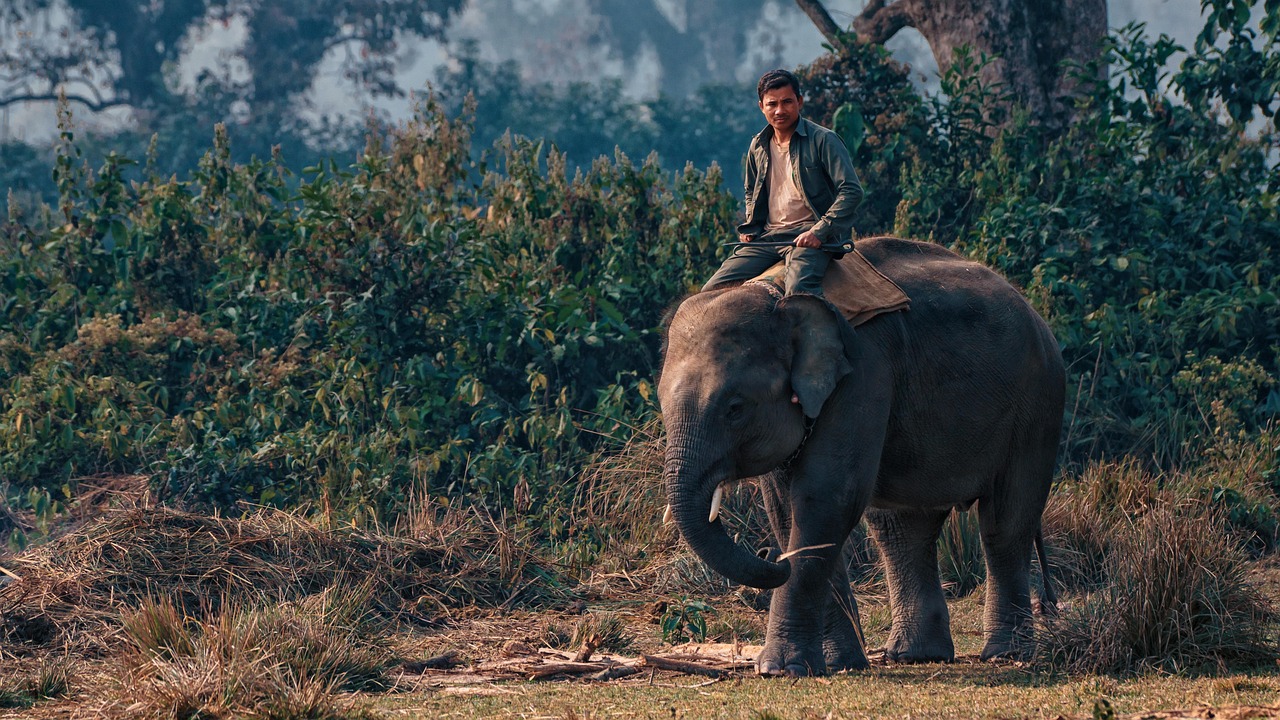
The government’s Elephant Breeding Center near Sauraha keeps domesticated elephants used for park patrols; visitors can see calves and adults. Elephant-back safaris, once Chitwan’s signature activity, are still offered by some operators but have declined as many travelers and lodges have turned to jeep and walking safaris; elephant-bathing sessions have largely stopped.
Tharu villages and culture
The Tharu, the indigenous people of the Terai, have lived in the Chitwan valley for centuries. Cycle or walk through Tharu villages near Sauraha, with mud-plastered houses and rice fields; visit the Tharu Cultural Museum; and watch a stick-dance performance in the evening.
Birding and nature walks outside the park
You do not need to enter the park to see a lot of wildlife. The community forests of the buffer zone, such as those around Bis Hajar Tal and the Baghmara Community Forest near Sauraha, are managed by local user groups that share park revenue and run their own guided walks, jeep drives and watchtowers. Early morning walks along the Rapti riverbank in Sauraha often reveal rhinos grazing on the far bank, kingfishers and egrets, and in winter, flocks of migrant ducks.
Food and drink
Lodges and Sauraha’s riverfront restaurants serve dal bhat, Nepali curries, momos and Western dishes; try Tharu specialties such as ghonghi (river snails in curry) and dhikri (steamed rice-flour dumplings) at a village homestay or cultural program. Sunset drinks by the Rapti, watching rhinos across the river, are a Sauraha tradition.
Around Chitwan
- Bis Hajar Tal: a network of lakes and forest in the buffer zone, excellent for birds, reached by jeep or on foot with a guide.
- Devghat: a pilgrimage site at the confluence of the Kali Gandaki and Trishuli rivers, about an hour from Sauraha.
- Bardia National Park: in the far west, quieter and wilder than Chitwan, with a good chance of tigers; about 10 hours by road or a flight to Nepalgunj.
- Lumbini: the birthplace of the Buddha, about 4 to 5 hours west by road.
- Pokhara: 5 to 6 hours by tourist bus. See our Pokhara guide.
Nearby destinations
- Pokhara86 km
- Kathmandu100 km
- Annapurna Conservation Area147 km
- Sagarmatha National Park (Everest Region)236 km
- Varanasi276 km
Getting there
By road
Tourist buses leave Kathmandu (from Kantipath, near Thamel) and Pokhara every morning for Sauraha, taking about 5 to 7 hours; the road follows the Trishuli River through the hills via Mugling, a scenic but slow route with frequent traffic and, in the monsoon, landslides. Private cars take a little less. Buses drop passengers at the tourist bus park, a short jeep ride from the lodges, and many lodges offer pickups.
By air
Bharatpur Airport (BHR), about 15 km (9 miles) from Sauraha, has several daily flights from Kathmandu, taking about 25 minutes. Lodges arrange transfers.
From the Indian border
Sauraha is about 3 to 4 hours by road from the Birgunj–Raxaul border crossing and 4 to 5 hours from Sunauli–Bhairahawa.
Getting around
Sauraha is small and walkable, and bicycles are available to rent. Everything inside the park is by guided jeep, canoe or on foot. Lodges package activities into two- and three-night programs that include park fees, guides and meals, but you can also book activities individually through registered agencies in Sauraha.
When to go and how long to stay
Chitwan lies in the subtropical Terai at about 150 m (500 ft), so it is warmer than Kathmandu all year. October and November are pleasant, with dry, sunny days, but the grass is still very tall after the monsoon, which hides animals. From December to February, days are mild and nights cool, with morning fog. In February and March, local people are allowed into the park to cut the tall grass for thatch, opening up the grasslands, so February to April is the best time for sightings, although April and May are hot, with temperatures above 35 °C (95 °F). The monsoon, from June to September, floods the rivers and tracks; many activities are suspended, and leeches and mosquitoes are everywhere. There is no long-term climate station inside the park in the World Meteorological Organization’s (WMO) public lists, so the table uses the 1991–2020 normals for Simara, a Terai station about 70 km (45 miles) east of Sauraha, from Nepal’s Department of Hydrology and Meteorology (DHM).
| Month | Average high / low | Rain (rainy days) | What to expect |
|---|---|---|---|
| January | 21 °C (70 °F) / 8 °C (46 °F) | 14 mm (0.6 in), 2 days | Mild days, cool foggy mornings; good birding |
| February | 26 °C (78 °F) / 10 °C (50 °F) | 16 mm (0.6 in), 2 days | Warming; grass-cutting season begins |
| March | 31 °C (88 °F) / 14 °C (57 °F) | 17 mm (0.7 in), 2 days | Warm and dry; good sightings |
| April | 35 °C (95 °F) / 19 °C (67 °F) | 41 mm (1.6 in), 4 days | Hot; animals gather at water |
| May | 35 °C (95 °F) / 23 °C (74 °F) | 136 mm (5.3 in), 9 days | Very hot and humid; pre-monsoon storms |
| June | 34 °C (94 °F) / 25 °C (78 °F) | 274 mm (10.8 in), 13 days | Monsoon arrives; activities reduced |
| July | 33 °C (91 °F) / 26 °C (78 °F) | 549 mm (21.6 in), 19 days | Wettest month; rivers in flood |
| August | 33 °C (92 °F) / 26 °C (78 °F) | 422 mm (16.6 in), 16 days | Very wet; leeches on trails |
| September | 33 °C (91 °F) / 24 °C (76 °F) | 258 mm (10.2 in), 12 days | Rain easing; humid; tall grass |
| October | 32 °C (89 °F) / 20 °C (68 °F) | 68 mm (2.7 in), 3 days | Drying out; lush and green |
| November | 29 °C (84 °F) / 14 °C (57 °F) | 4 mm (0.2 in), under 1 day | Dry and pleasant; migrant birds arrive |
| December | 24 °C (75 °F) / 10 °C (49 °F) | 8 mm (0.3 in), 1 day | Mild and dry; foggy mornings |
Two nights in Chitwan
Arrive by midday, cycle or walk through a Tharu village and watch the sunset by the Rapti. The next morning, take a canoe trip and a short jungle walk; in the afternoon, a half-day jeep safari. Leave on the third morning after a visit to the Elephant Breeding Center.
Three or four nights
Add a full-day jeep safari deep into the park, a morning of birding at Bis Hajar Tal, and a day trip to the Gharial Breeding Center at Kasara.
Where to stay
- Sauraha: the main base, with lodges and guesthouses of every level along the Rapti River, close to the park entrance, restaurants and agencies.
- Meghauli and Amaltari: fewer, more upscale lodges and community homestays on the western edge, quieter and close to remote parts of the park.
- Barauli and the buffer zone: eco-lodges and Tharu homestays on the southwest side, along the Narayani River.
Lodges fill in the winter high season and around Christmas and the New Year; many offer all-inclusive packages with activities.
What a trip to Chitwan costs
Prices are approximate, for October 2026, converted at about 154 rupees (NPR) to the US dollar. The park fee is the one listed by the Nepal Tourism Board.
| Item | Typical cost |
|---|---|
| Park entry, foreigners, per day per entry | NPR 2,000 + 13% VAT (about US$14.70) |
| Half-day shared jeep safari, per person, plus park fee | NPR 3,000–5,000 (about US$19–32) |
| Full-day private jeep safari, per jeep | NPR 20,000–35,000 (about US$130–227) |
| Canoe trip with guide, per person, plus park fee | NPR 1,500–3,000 (about US$10–19) |
| Half-day jungle walk with two guides, per person | NPR 2,500–4,500 (about US$16–29) |
| Tourist bus from Kathmandu | NPR 1,200–4,000 (about US$8–26) |
| Dal bhat in Sauraha | NPR 350–700 (about US$2.30–4.50) |
| Mid-range lodge double, per night | NPR 4,000–12,000 (about US$26–78) |
Practical tips for Chitwan
- Wear muted colors: khaki, green and brown clothes are best for walks and safaris; avoid white and bright colors.
- Bring binoculars: for birds and distant animals.
- Go early: wildlife is most active at dawn and dusk, and mornings are cooler.
- Use registered guides: book through your lodge or licensed agencies in Sauraha, and ask about the guide’s experience on walking safaris.
- Protect against insects: use repellent, especially at dusk and in the wet season.
Safety
Chitwan’s animals are wild and can be dangerous. Rhinos charge when surprised, wild elephants and sloth bears have killed people in and around the park, and tigers occasionally attack villagers in the buffer zone; on foot, stay close to your guides, follow their instructions, and climb a tree or move behind a large trunk if told to. Do not swim in the rivers, which have crocodiles and strong currents, and do not walk along the riverbanks at night. Ticks and leeches are common in the wet season, and mosquitoes can carry dengue and, rarely, malaria in the Terai, so use repellent and cover up. From June to September, monsoon floods close tracks and can cut roads to Sauraha. In April and May, heat can exceed 35 °C (95 °F); drink plenty of water. For emergencies, call 100 for police and 102 for an ambulance; the nearest large hospitals are in Bharatpur.
What to pack for Chitwan
Light, long-sleeved clothes in neutral colors, a warm layer for cold winter mornings, sturdy closed shoes for walks, a hat and sunscreen, insect repellent, binoculars and a camera with a zoom lens. In the wet season, bring a rain jacket and leech socks. Nepal uses 230 V, with round two-pin (type C) and three-pin (types D and M) sockets. See our rain jackets, hiking shoes and travel adapters guides.
Chitwan travel FAQ
How much does it cost to enter Chitwan National Park?
According to the Nepal Tourism Board, foreigners pay NPR 2,000 per day per entry plus 13% VAT, about US$14.70; SAARC citizens pay NPR 1,000 plus VAT, and children under 10 enter free.
Can I visit Chitwan without a guide?
No. You need licensed guides to enter the park by jeep, canoe or on foot. You can walk freely in Sauraha and the surrounding villages.
Will I see a rhino in Chitwan?
Very likely. Rhinos are common in the grasslands and rivers near Sauraha, especially from February to April.
Can I see tigers in Chitwan?
Tigers live in good numbers in the park, but they are elusive. Full-day jeep safaris in the dry season, from February to May, give the best chance.
How do I get from Kathmandu to Chitwan?
By tourist bus to Sauraha in 5 to 7 hours, or by a 25-minute flight to Bharatpur and a 30-minute drive.
What is the best time to visit Chitwan?
October to March for pleasant weather; February to April for the best wildlife sightings after the grass is cut. The monsoon, from June to September, is the worst time.
How many days do I need in Chitwan?
Two nights cover the main activities; three or four allow a full-day safari and birding.
Are jungle walks in Chitwan safe?
They carry real risks, as you may meet rhinos, elephants or bears on foot. With experienced licensed guides and by following their instructions, most walks pass without incident.
Can I stay inside Chitwan National Park?
No. Lodges inside the core park closed in 2012; you stay in Sauraha or other villages and buffer-zone lodges on the edge.
Is elephant riding still possible in Chitwan?
Some operators still offer it, but many lodges and travelers now choose jeep and walking safaris instead, and elephant bathing with tourists has largely ended.
Plan your trip
Partner links: TravelerCenter may earn a commission if you book, at no extra cost to you.
🇳🇵 Useful Nepali phrases for Chitwan National Park
All 38 Nepali phrases: restaurant, hotel, emergencies, romance (printable) →
Sources · last reviewed 4 October 2026
Researched and last reviewed on 4 October 2026. Park entry fees and VAT, the Elephant Breeding Center and Tharu Cultural Museum fees and child exemptions: the Nepal Tourism Board; climate normals for Simara: Nepal’s Department of Hydrology and Meteorology, via the World Meteorological Organization (1991–2020 normals archived by NOAA’s National Centers for Environmental Information); exchange rate: Nepal Rastra Bank. The park’s establishment and UNESCO dates, area, rhino and tiger trends, bird numbers, the 2012 closure of lodges inside the park, the grass-cutting season, travel times and all typical prices are general references or estimates, flagged for checking. Fees and rules change, so check with the park or your lodge before you go. For entry rules, money and general safety, see our Nepal travel guide.
Data: Weather: MET Norway (CC BY 4.0) · Air quality: OpenAQ · Rates: ECB · Costs: World Bank ICP and price levels · Wikidata (CC0)