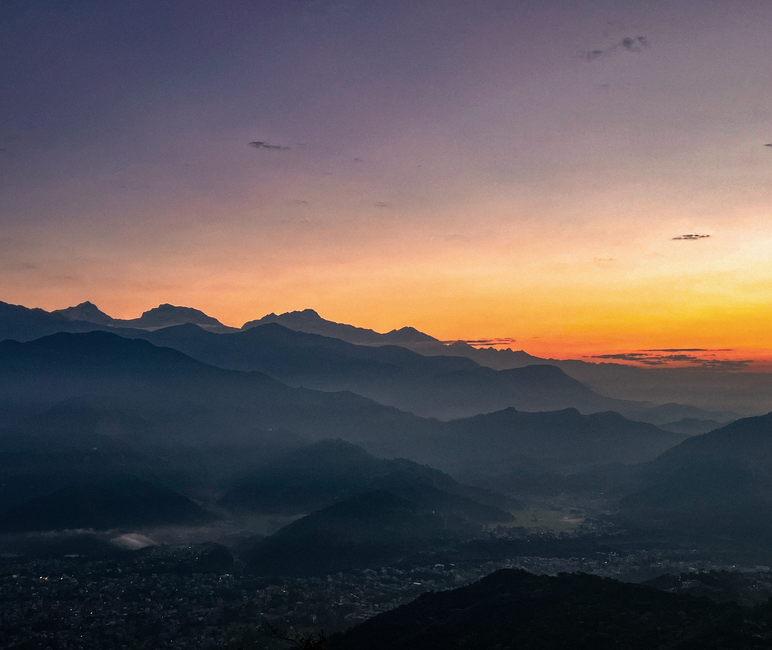
Pokhara, Nepal’s second city and the gateway to the Annapurna region, spreads along the shore of Phewa Lake at about 800 m (2,600 ft), with a wall of snow peaks rising almost straight above it: the fishtail summit of Machhapuchhre, 6,993 m (22,943 ft), stands only about 30 km (19 miles) from the lake. It is the most relaxed place in Nepal for travelers, with a long lakeside strip of guesthouses, cafés and bookshops, rowing boats for hire, a temple on an island, and viewpoints for watching the sunrise light up the Annapurnas. Pokhara is also Nepal’s adventure capital, famous for paragliding from Sarangkot, and the starting point for treks to Poon Hill, Annapurna Base Camp and Mardi Himal and the end point of the Annapurna Circuit. The best months are October and November, followed by March and April; the city is one of the wettest in Nepal, and from June to September heavy rain hides the mountains.
Right now in Pokhara
- Wed 18–24°C 64–75°F 10 mm Heavy showers
- Thu 17–24°C 63–76°F 4 mm Showers
- Fri 17–21°C 62–70°F 5 mm Rain
Weather: MET Norway (CC BY 4.0)
Top tours in Pokhara
See all tours for Pokhara →
From local operators, with prices and reviews; you check availability and book on Viator, our partner. We may earn a commission at no extra cost to you. How we earn money
Pokhara at a glance
- Best for: mountain views, lakeside relaxation, paragliding and adventure sports, and starting or ending an Annapurna trek.
- How long: 2–3 days in the city; a week or more with a trek.
- Best time: October and November, with clear skies; March and April are warmer and hazier, with rhododendrons in the hills.
- Getting there: about 200 km (125 miles) west of Kathmandu: a 25-minute flight or 6 to 8 hours by tourist bus.
- Getting around: on foot or by bicycle along the lake, by taxi to the viewpoints and sights.
- Good to know: many treks around Pokhara enter the Annapurna Conservation Area, where foreigners need an entry permit, a TIMS card and a licensed guide.
- Before you go: the visa, trekking permits, money and general safety are in our Nepal travel guide.
Pokhara’s areas and where to stay
The tourist part of Pokhara lies along the eastern shore of Phewa Lake, a few kilometers west of the city center and the old bazaar.
Lakeside (Baidam)
The main tourist strip runs for about 2 km (1.2 miles) along the lake, with hundreds of guesthouses and hotels on the lanes behind, restaurants with lake views, trekking agencies, gear shops and bars. It is busy but pleasant, and everything is within walking distance.
North Lakeside (Khahare)
North of the main strip, Lakeside becomes quieter and greener, with budget guesthouses, yoga centers and cafés facing the water, popular with long-stay travelers.
Damside
At the southern end of the lake, near the dam on the Pardi Khola river, Damside is calmer, with clear mountain views on dry mornings and easy access to the Peace Pagoda trail.
Sarangkot and the hills
A few hotels and lodges on the ridge of Sarangkot, about 1,600 m (5,200 ft), and on the hillsides around the lake offer sunrise views from your room, at the cost of a drive into town.
Top things to see in Pokhara
Phewa Lake and Tal Barahi Temple
Phewa Lake, about 4 km (2.5 miles) long, is the heart of Pokhara. Rent a brightly painted wooden boat with or without a rower, or a kayak or paddleboard, and cross to the small two-tiered Tal Barahi Temple on its island, dedicated to the goddess Barahi; on calm mornings, the Annapurnas and Machhapuchhre are reflected in the water.
Sarangkot
The ridge of Sarangkot, northwest of the lake, is the classic place to watch the sun rise over the Annapurna and Dhaulagiri ranges. Drive up in about 30 minutes before dawn or hike up in about 2 hours from Lakeside. It is also the launch site for most paragliding flights.
The World Peace Pagoda
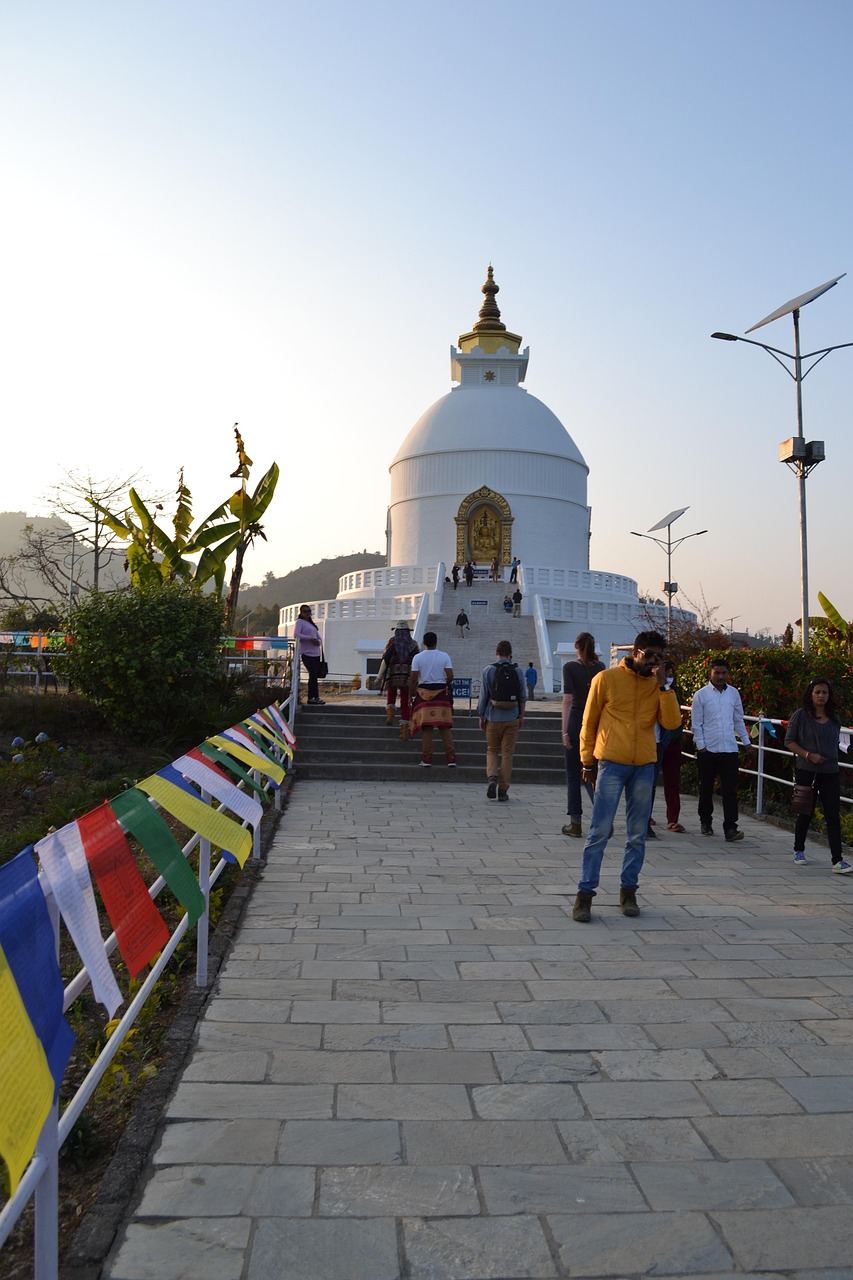
The white Shanti Stupa, built by Japanese Buddhist monks of the Nipponzan Myohoji order on a hill on the lake’s southern shore, has wide views over the lake, the city and the mountains. Reach it by boat across the lake and a steep 45-minute climb through forest, or by road.
The International Mountain Museum
This large museum south of the airport covers the Himalaya’s peaks, geology, mountaineering history and mountain peoples, with exhibits on Everest’s first ascents and climbing equipment.
Davis Falls and Gupteshwor Mahadev Cave
At Davis Falls (Patale Chhango), the Pardi Khola river plunges into an underground channel; across the road, steps lead down into Gupteshwor Mahadev Cave, a Shiva shrine with a passage that ends behind the falls. Both are busiest in and just after the monsoon, when the water is high.
The Old Bazaar walk
North of the center, the Old Bazaar was the trading hub of western Nepal for centuries, when Newar merchants settled here on the trade route between India and Tibet. Walk its narrow streets of brick houses with carved windows to the hilltop Bindhyabasini Temple, dedicated to the goddess Durga, which is busiest on Saturdays and during Dashain, with views of Machhapuchhre from the courtyard. The bazaar’s small shops sell brass pots, spices and religious items.
More classic sights
- Old Bazaar and Bindhyabasini Temple: the old trading town north of the center, with Newar houses and a hilltop Hindu temple.
- Seti River Gorge: the milky Seti River runs through a narrow gorge in places only a few meters wide, visible from bridges around the city.
- Mahendra Cave and Bat Cave: limestone caves north of the city.
- Begnas and Rupa Lakes: quieter lakes about 15 km (9 miles) east, with fish farms and rowing boats.
- Tibetan settlements: Tashi Palkhel at Hyangja and Tashiling near Damside, with monasteries and carpet weaving.
Other things to do in Pokhara
Paragliding and adventure sports
Pokhara is one of the world’s best-known paragliding sites, with tandem flights of 20 to 60 minutes from Sarangkot gliding over the lake with Himalayan views; the flying season runs mostly from September to May, and flights depend on the weather. The city also offers ultralight flights over the mountains, a long zip-line from Sarangkot, bungee jumping over the Modi Khola at Hemja, mountain biking, and rafting and kayaking on the Seti and Kali Gandaki rivers. Choose registered operators and check that equipment and pilots are certified.
Food and drink
Lakeside has a huge range of restaurants, from Nepali, Thakali and Tibetan to Italian, Korean and Israeli, plus bakeries and coffeehouses. Try a Thakali set, the dal bhat of the Kali Gandaki valley, with buckwheat dishes, gundruk (fermented greens) and pickles; momos; and freshly caught lake fish. Lakeside bars have live music in the evenings.
Yoga and wellness
North Lakeside and the hillsides around the lake have yoga and meditation centers, from drop-in classes to residential courses.
Festivals and events
Pokhara is lively at the turn of the year, when the Pokhara Street Festival fills Lakeside with food stalls, music and crowds between Christmas and New Year, and the Gurung community celebrates Tamu Lhosar, its New Year, at the end of December with dances and cultural programs. During Dashain, in October, children fly kites from every rooftop and bamboo swings are put up in the villages, and during Tihar, in October or November, houses along the lake are lit with oil lamps and strings of lights. Many Nepali families take their holidays in Pokhara around these festivals, so book rooms early.
Shopping and trekking gear
Lakeside’s shops sell Tibetan and Nepali handicrafts, including singing bowls, prayer flags, thangka paintings, pashmina shawls, felt goods and handmade paper, much of it made in the Tibetan settlements nearby. Bargain politely in small shops. Gear shops rent and sell down jackets, sleeping bags and trekking poles, useful if you are starting a trek, though quality varies; check zips and seams before you pay.
Short hikes
Easy walks lead to the Peace Pagoda, Sarangkot and the ridges around the lake. The two- to three-day Panchase trek and the short climbs to Dhampus and Australian Camp give mountain views with little time; check whether your route enters the Annapurna Conservation Area, where permits and a licensed guide are required. See our hiking guide.
Day trips and treks from Pokhara
- Annapurna treks: Ghorepani and Poon Hill (4 days), Mardi Himal (4–5 days) and Annapurna Base Camp (7–10 days) start a short drive from Pokhara. See our Annapurna Conservation Area guide.
- Bandipur: a preserved Newar hill town with mountain views, about 2.5 hours east by road, best with a night.
- Begnas Lake: a quiet lake for boating and walking, 30 minutes east.
- Sirubari and Ghalegaun: community homestay villages in the hills, for a night with Gurung families.
- Chitwan: about 5 to 6 hours by tourist bus to Sauraha. See our Chitwan National Park guide.
Nearby destinations
Getting there and getting around
By air
Pokhara International Airport (PHH), on the eastern edge of the city, opened in January 2023 and replaced the old domestic airport; it has frequent domestic flights to Kathmandu, about 25 minutes, and a few other domestic routes, but international flights are few. Mountain flights to Jomsom, for the Annapurna Circuit and Mustang, leave early in the morning when the wind in the Kali Gandaki gorge is calm and are often delayed or canceled by weather. Taxis to Lakeside take 15 to 20 minutes.
By bus
Tourist buses from Kathmandu (about 6 to 8 hours) and Chitwan (5 to 6 hours) arrive at the tourist bus park just east of Lakeside; local buses use the main bus park in the city. The Prithvi Highway from Kathmandu is often slowed by roadworks, traffic and, in the monsoon, landslides.
Around the city
Lakeside is easily walkable, and bicycles and scooters can be rented. Taxis wait along the main road; agree the fare first. Ride-hailing apps operate in Pokhara. Hotels arrange cars and drivers for Sarangkot sunrise trips and trailheads.
When to go and how long to stay
The Annapurnas block the monsoon clouds, so Pokhara receives far more rain than Kathmandu: about 3,900 mm (152 in) a year, most of it from June to September. October and November are the best months, with clear skies and the sharpest mountain views. December to February is dry and sunny, with chilly mornings and evenings. March to May is warm, with spring haze and afternoon thunderstorms building from April. The monsoon, from June to September, brings very heavy rain and hides the mountains for days at a time. The table shows 1991–2020 normals for the Pokhara station from Nepal’s Department of Hydrology and Meteorology (DHM), as published by the World Meteorological Organization (WMO).
| Month | Average high / low | Rain (rainy days) | What to expect |
|---|---|---|---|
| January | 20 °C (68 °F) / 7 °C (45 °F) | 22 mm (0.9 in), 2 days | Dry and sunny; cool mornings with lake fog |
| February | 23 °C (73 °F) / 10 °C (49 °F) | 35 mm (1.4 in), 4 days | Mild and mostly clear |
| March | 27 °C (81 °F) / 13 °C (56 °F) | 64 mm (2.5 in), 6 days | Warm; spring haze; rhododendrons in the hills |
| April | 30 °C (86 °F) / 16 °C (61 °F) | 142 mm (5.6 in), 10 days | Warm, with afternoon storms |
| May | 30 °C (87 °F) / 19 °C (66 °F) | 353 mm (13.9 in), 18 days | Hot and humid; pre-monsoon rains |
| June | 31 °C (87 °F) / 21 °C (70 °F) | 648 mm (25.5 in), 22 days | Monsoon arrives; mountains hidden |
| July | 30 °C (87 °F) / 22 °C (72 °F) | 941 mm (37.0 in), 26 days | Wettest month; landslides on roads |
| August | 30 °C (87 °F) / 22 °C (72 °F) | 839 mm (33.0 in), 24 days | Very wet; Davis Falls at full flow |
| September | 30 °C (86 °F) / 21 °C (70 °F) | 635 mm (25.0 in), 19 days | Rain easing late in the month |
| October | 28 °C (82 °F) / 17 °C (63 °F) | 159 mm (6.3 in), 8 days | Clear and warm after the first week or two; peak season |
| November | 24 °C (76 °F) / 12 °C (54 °F) | 17 mm (0.7 in), 1 day | Clear and dry; the best mountain views |
| December | 21 °C (70 °F) / 8 °C (47 °F) | 12 mm (0.5 in), 1 day | Dry and sunny; cool nights |
2 days in Pokhara
Day one, sunrise at Sarangkot, breakfast back at Lakeside, a boat to Tal Barahi Temple and the hike up to the Peace Pagoda for sunset. Day two, a tandem paragliding flight, then Davis Falls, Gupteshwor Mahadev Cave and the International Mountain Museum.
A week with a trek
Add the four-day Ghorepani–Poon Hill circuit or the Mardi Himal trek, returning to Pokhara for a rest day by the lake.
Where to stay in Pokhara
- Lakeside: the widest range of hotels and guesthouses, close to restaurants, agencies and the boat docks.
- North Lakeside: quieter budget guesthouses, yoga retreats and long-stay rooms.
- Damside: calm streets with mountain views, near the Peace Pagoda trail.
- Sarangkot and the hills: lodges and resorts with sunrise views, a drive from town.
Rooms fill in October and November and around Dashain and Tihar, when many Nepali families travel.
What a trip to Pokhara costs
Prices are approximate, for October 2026, converted at about 154 rupees (NPR) to the US dollar.
| Item | Typical cost |
|---|---|
| Rowing boat on Phewa Lake, per hour | NPR 700–1,000 (about US$4.50–6.50) |
| Tandem paragliding flight, 20–30 minutes | NPR 10,000–15,000 (about US$65–97) |
| Taxi from Lakeside to Sarangkot for sunrise, return | NPR 1,500–2,500 (about US$10–16) |
| Thakali set or dal bhat | NPR 400–900 (about US$2.60–6) |
| Dinner in a mid-range Lakeside restaurant | NPR 1,000–2,500 (about US$6.50–16) per person |
| Annapurna Conservation Area entry permit, foreigners | NPR 3,000 (about US$19.50) |
| Flight Kathmandu–Pokhara, foreigners, one way | about US$100–130 |
| Mid-range hotel double, per night | NPR 4,000–10,000 (about US$26–65) |
Practical tips for Pokhara
- Get up early: mountain views are clearest at dawn; clouds often build by late morning.
- Arrange trek permits in Kathmandu or Pokhara: your agency handles the TIMS card; the ACAP permit is issued at the Nepal Tourism Board office in Pokhara or in Kathmandu.
- Wear a life jacket: on boats on Phewa Lake, especially in the afternoon wind.
- Book paragliding with registered companies: and ask about weight limits and insurance.
- Carry cash before a trek: ATMs are plentiful in Pokhara but not on the trails.
Safety
Pokhara is safe and relaxed, with little crime beyond occasional theft from rooms and bags, so use your hotel’s safe. Swim in Phewa Lake only where locals do, and wear a life jacket in boats, as afternoon winds can make the water choppy. Adventure sports carry real risks; use licensed operators and check your travel insurance covers them. During the monsoon, from June to September, landslides block roads around Pokhara and on the highway to Kathmandu, and flash floods occur on the Seti River. Trekkers heading into the Annapurnas face altitude sickness above about 2,500 m (8,200 ft) on the longer treks; follow the Nepal Tourism Board’s guidance to ascend slowly. The Tourist Police operate around the clock in Pokhara and can be reached on 1144; for other emergencies, call 100 for police and 102 for an ambulance.
What to pack for Pokhara
Light clothes for warm days, a fleece for cool mornings and evenings, sunscreen and a hat, a rain jacket and quick-drying shoes from May to September, and, if you are trekking, broken-in boots and warm layers for the mountains. Nepal uses 230 V, with round two-pin (type C) and three-pin (types D and M) sockets. See our hiking shoes, rain jackets and travel adapters guides.
Pokhara travel FAQ
How many days do I need in Pokhara?
Two or three days for the lake, Sarangkot, the Peace Pagoda and a paragliding flight; a week or more with a trek.
How do I get from Kathmandu to Pokhara?
By a 25-minute flight to Pokhara International Airport, or by tourist bus in about 6 to 8 hours.
What is the best time to visit Pokhara?
October and November, for clear mountain views. December to April is also good; June to September is very wet.
Where can I see the sunrise over the Annapurnas?
From Sarangkot, about 30 minutes by car from Lakeside, or from the World Peace Pagoda and the hills around the lake.
How much does paragliding in Pokhara cost?
Roughly NPR 10,000–15,000 (US$65–97) for a 20- to 30-minute tandem flight, more for longer flights and photo packages.
Do I need a permit to trek from Pokhara?
For treks into the Annapurna Conservation Area, such as Poon Hill, Mardi Himal and Annapurna Base Camp, yes: an ACAP entry permit (NPR 3,000 for foreigners), a TIMS card and a licensed guide arranged through a registered agency.
Can I swim in Phewa Lake?
Some people swim near the shore in calm weather, but there are no lifeguards, and the lake has strong afternoon winds; most visitors stick to boats and kayaks.
Is Pokhara better than Kathmandu?
They are different: Kathmandu has the heritage sites and festivals, and Pokhara has the mountain views, the lake and the relaxed pace. Most trips include both.
What is the closest trek to Pokhara?
The Ghorepani–Poon Hill circuit, starting about 1.5 hours’ drive away and taking about four days, with sunrise views of Dhaulagiri and the Annapurnas.
Is Pokhara safe?
Yes. Take care on boats and with adventure sports, keep valuables locked up, and watch for landslides on the roads in the monsoon.
Sources and last review
Researched and last reviewed on 4 October 2026. The guide and TIMS rules and the Annapurna Conservation Area entry fee: the Nepal Tourism Board; climate normals for Pokhara: Nepal’s Department of Hydrology and Meteorology, via the World Meteorological Organization (1991–2020 normals archived by NOAA’s National Centers for Environmental Information); exchange rate: Nepal Rastra Bank; road and monsoon conditions: the UK government’s travel pages (factual content only). Peak heights, distances, the airport’s opening date, site descriptions, paragliding seasons and all typical prices are general references or estimates, flagged for checking. Prices change, so check with operators before you go. For entry rules, trekking permits, money and general safety, see our Nepal travel guide.
Plan your trip
Partner links: TravelerCenter may earn a commission if you book, at no extra cost to you.
🇳🇵 Useful Nepali phrases for Pokhara
All 38 Nepali phrases: restaurant, hotel, emergencies, romance (printable) →