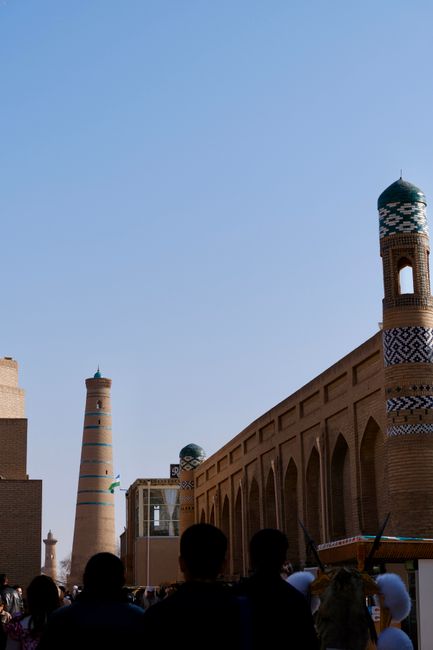
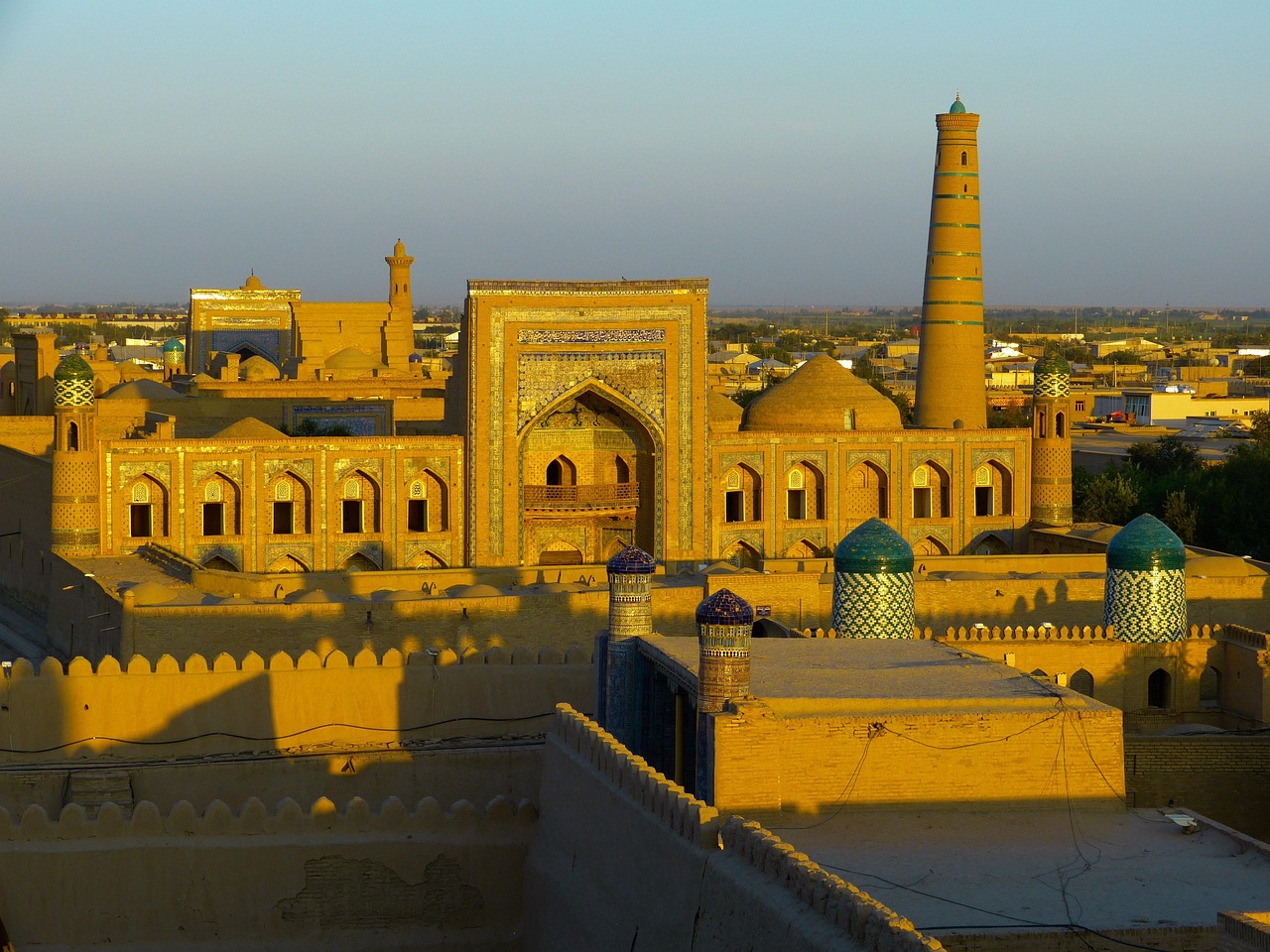
Khiva is the Silk Road’s open-air museum: a complete walled city of mud-brick ramparts, turquoise-tiled minarets, madrasas, palaces and flat-roofed houses rising from the desert in Khorezm, in the far west of Uzbekistan. Its inner town, Itchan Kala, enclosed by walls about 2 km (1.4 miles) around, was the seat of the khans of Khiva, a desert state notorious in the 19th century for its slave market, until Russian troops took it in 1873. Restored in the Soviet era, it became Uzbekistan’s first UNESCO World Heritage Site in 1990. Today, about 60 historic monuments stand within the walls, along with hundreds of houses where families still live. Come for the unfinished turquoise tower of Kalta Minor, the forest of carved wooden columns in the Juma Mosque, the khans’ palaces of Kunya Ark and Tash Khauli, the view from the Islam Khoja minaret, sunset from the walls, and the ruined fortresses of ancient Khorezm in the nearby desert. Since May 2026, a new high-speed train has linked Khiva with Tashkent in about seven and a half hours. The best months are April, May, September and October; summers are very hot and winters cold.
Right now in Khiva
- Wed10–20°C51–68°FPartly cloudy
- Thu11–25°C51–77°FMostly clear
- Fri13–26°C55–78°FClear
Top tours in Khiva
See all tours for Khiva →
From local operators, with prices and reviews; you check availability and book on Viator, our partner. We may earn a commission at no extra cost to you. How we earn money
Khiva at a glance
- Best for: a walled city of monuments, sunsets from the ramparts, crafts and desert fortresses.
- How long: 1–2 days for Itchan Kala, plus a day for the desert fortresses of Karakalpakstan.
- Best time: April to May and September to October; June to August is very hot, and December to February is cold.
- Getting there: by train to Khiva station, including the high-speed service from Tashkent since 2026; by air to Urgench International Airport, about 30 km (19 miles) away; by road from Bukhara across the desert.
- Getting around: on foot inside the walls; taxis to Urgench and the fortresses.
- Good to know: a combined ticket covers most monuments inside Itchan Kala; the minarets and some sights cost extra.
- Before you go: visas, the registration rule, money and general safety are in our Uzbekistan travel guide.
Khiva’s areas and where to stay
Khiva has two concentric towns: the walled Itchan Kala, with almost all the monuments, and the outer town, Dishan Kala, once enclosed by a longer wall of its own, where most people live today.
Inside Itchan Kala
Staying inside the walls is magical, especially after the day visitors leave and the lanes go quiet under the lit minarets. Family guesthouses fill traditional houses with courtyards and rooftop terraces, and one hotel occupies the Muhammad Amin Khan Madrasa, with rooms in former students’ cells. Rooms are small and simple, and cars cannot reach most of them.
Just outside the walls
Hotels and guesthouses along the walls, especially near the western gate, Ata Darvoza, and the northern gate, have views of the ramparts, more space and car access, within a few minutes’ walk of the sights.
Dishan Kala and the new town
Larger hotels in the outer town and along the road to Urgench are quieter and have pools and parking, 10–20 minutes’ walk from the walls.
Where to stay in Khiva
- Itchan Kala: family guesthouses and a madrasa hotel inside the walls.
- Near the gates: small hotels with views of the ramparts.
- Dishan Kala: larger hotels with pools and parking.
- Urgench: business hotels near the airport, 30 minutes away.
Rooms are limited, so book ahead for spring and autumn.
Top things to see in Khiva
Khiva’s story in brief
According to legend, Khiva grew around a well dug by Shem, the son of Noah, and the town has existed for well over a thousand years in Khorezm, a fertile delta of the Amu Darya river famous in antiquity and home to the mathematician al-Khwarizmi, whose name gave us the word “algorithm.” Khiva became the capital of the Khanate of Khiva in the early 17th century, after the Amu Darya changed course and left the old capital, Konye-Urgench, without water. For three centuries, its khans grew rich on trade and on slaves seized by raiders in the desert, until Russian forces captured the city in 1873 and made it a protectorate. Most of the monuments inside the walls date from the 18th and 19th centuries, when the khans rebuilt the city in brick and tile.
Itchan Kala and its walls
Built of sun-dried mud brick and up to about 10 m (33 ft) high, the walls of Itchan Kala have four gates, one on each side, and crenellated towers. Walk along the northern section of the ramparts near the Bogcha Darvoza (north gate), where you can climb to the top, ideally at sunset, when the minarets glow orange. The main entrance for visitors is the western gate, Ata Darvoza, where the ticket office sells the combined ticket. Inside, the main street runs east from Ata Darvoza to Palvan Darvoza, past most of the great monuments.
Kalta Minor and the Muhammad Amin Khan Madrasa
The squat, unfinished Kalta Minor (“short minaret”), covered in bands of turquoise, green and white tiles, was begun in the 1850s by Muhammad Amin Khan, who reportedly wanted it to be the tallest minaret in the Islamic world; work stopped when he died in 1855. Beside it, his madrasa, once the largest in Khiva, is now a hotel.
Kunya Ark
The Kunya Ark (“old fortress”) was the khans’ residence from the 17th century, a citadel with a mint, a harem, a summer mosque with brilliant blue and white tilework, and a reception courtyard where the khan held court in a yurt. Climb the Aq Shikh Bobo watchtower for one of the best views over the walls and domes, especially at sunset.
The Juma Mosque
The Juma (Friday) Mosque, rebuilt in the 18th century on much older foundations, is a vast hall of more than 200 carved wooden columns, some dating back as far as the 10th century, holding up a flat roof pierced by skylights. It is cool, dim and atmospheric. Next door, its minaret can be climbed.
Tash Khauli Palace
Built in the 1830s by Allakuli Khan, Tash Khauli (“stone house”) is a palace of courtyards lined with deep porches (ayvans) and spectacular blue majolica tiles and carved columns, with the khan’s harem, quarters for his four wives and reception halls.
Islam Khoja Minaret and Madrasa
Built in 1910, the Islam Khoja Minaret is Khiva’s tallest, at about 57 m (187 ft), banded with tiles; you can climb a dark, narrow staircase of more than a hundred steps to the top for views across the city and the desert. The adjoining madrasa houses a museum of applied arts.
More classic sights
- Pakhlavan Makhmud Mausoleum: the tomb of Khiva’s patron saint, a poet, philosopher and champion wrestler, with a beautifully tiled interior and a stream of pilgrims.
- Allakuli Khan Madrasa and Caravanserai: a madrasa and a covered bazaar near the eastern gate, Palvan Darvoza.
- Muhammad Rakhim Khan Madrasa: facing the Kunya Ark, with a museum on the last khans.
- Nurullaboy Palace: a 20th-century palace outside the walls mixing Central Asian and European styles.
- Museums: small museums inside the madrasas cover the history of Khorezm, music, crafts and the Silk Road.
Other things to do in Khiva
Food and drink
Khorezm has its own cuisine. Try shivit oshi, bright green dill noodles served with meat stew and yogurt; tukhum barak, egg-filled dumplings; gumma, fried pies; and the region’s plov, often cooked with fish or quince. Rooftop terraces inside the walls serve dinner with views of the minarets. Melons from Khorezm are famous across Central Asia in late summer.
Crafts and workshops
Khiva is known for its wood carving: the carved doors and columns of its houses and mosques are still made in workshops you can visit. Suzani embroidery, silk carpets woven to patterns from the Juma Mosque’s tiles, ceramics and the tall fur hats (chugurma) of Khorezm are sold in the madrasa courtyards and along the main street.
Evenings and performances
In the evening, the lanes inside the walls are lit and quiet, and some restaurants and courtyards stage performances of lazgi, the lively Khorezmian folk dance, which UNESCO listed as intangible cultural heritage in 2019. See our city sightseeing guide.
Day trips from Khiva
- The desert fortresses (Elliq Qal’a): the ruined mud-brick fortresses of ancient Khorezm, such as Ayaz Kala, Toprak Kala and Kyzyl Kala, about 1.5–2 hours north in Karakalpakstan; climb to Ayaz Kala for a view of the desert, and stay in a yurt camp nearby.
- Nukus and the Savitsky Museum: about 3 hours by road, home to a renowned collection of Soviet avant-garde art banned in the Stalin era, as well as Karakalpak crafts and archaeology.
- Moynaq and the Aral Sea: a former fishing port about 5–6 hours north, where rusting ships lie in the desert that was once the seabed; the shore is now far away, reached only on a long 4×4 trip.
- Urgench: the modern regional capital, 30 km (19 miles) away, with the airport and markets; not to be confused with Konye-Urgench in Turkmenistan.
- Turkmenistan: the Shavat–Dashoguz border crossing, about 1 hour away, is used by tours heading to the Darvaza gas crater; you need a Turkmen visa arranged through a travel agency. See our Turkmenistan guide.
Getting there and getting around
By train
Khiva’s station lies a short taxi ride outside the walls. Since May 2026, the new Jaloliddin Manguberdi high-speed train, built by Hyundai Rotem, has linked Tashkent with Khiva via Samarkand, Bukhara and Urgench in about seven and a half hours, nearly half the time of the conventional train; at its launch, it ran on three days a week in each direction, and economy seats cost 780,000 som and VIP seats 1,815,000 som, according to local press reports. Conventional and overnight trains also run to Tashkent and other cities. Buy tickets on railway.uz, the official site and app of Uzbekistan Railways, or at stations, with your passport, and book early.
By air
Urgench International Airport (UGC), about 30 km (19 miles) northeast, has flights from Tashkent in about 1.5 hours and some international flights, including from Istanbul and Moscow; see our Istanbul guide. Taxis to Khiva take about 30–40 minutes.
By road
Shared taxis and minibuses run between Urgench and Khiva frequently. The road from Bukhara across the Kyzylkum Desert takes about 6–7 hours by car, with few services on the way; take water and snacks.
Around town
Itchan Kala is small and car-free, so walk: it takes about 10 minutes to cross from gate to gate. Taxis wait outside the gates for trips to Dishan Kala, the station and Urgench.
When to go and how long to stay
Khiva lies in the desert at about 100 m (330 ft) above sea level and has an extreme continental climate. Spring, from April to May, is warm and pleasant, the best time to visit. Summer, from June to August, is very hot and dry, with average highs of 34–36 °C (93–97 °F) and stronger heat on many days; sightsee early and late. Autumn, from September to October, is warm and sunny, with harvest melons. Winter, from December to February, is cold, with average lows of −4 to −6 °C (21–24 °F), and the monuments are nearly empty. The table uses the 1991–2020 climate normals for the Urgench station of Uzhydromet, about 30 km (19 miles) northeast of Khiva, as submitted to the World Meteorological Organization (WMO): average daily highs and lows, total precipitation, and days with at least 1 mm of rain or snow.
| Month | Average high / low | Rain (days with 1 mm or more) | What to expect |
|---|---|---|---|
| January | 3 °C (37 °F) / −6 °C (22 °F) | 13 mm (0.5 in), 12 days | Coldest month; empty lanes |
| February | 6 °C (42 °F) / −4 °C (24 °F) | 16 mm (0.6 in), 9 days | Cold; quiet |
| March | 14 °C (57 °F) / 2 °C (36 °F) | 22 mm (0.9 in), 8 days | Mild; the wettest month |
| April | 22 °C (72 °F) / 9 °C (48 °F) | 19 mm (0.7 in), 8 days | Warm; peak season begins |
| May | 29 °C (85 °F) / 15 °C (59 °F) | 12 mm (0.5 in), 8 days | Warm to hot; busy |
| June | 35 °C (94 °F) / 19 °C (67 °F) | 5 mm (0.2 in), 5 days | Hot |
| July | 36 °C (97 °F) / 21 °C (69 °F) | 1 mm (0.0 in), 3 days | The hottest month |
| August | 34 °C (93 °F) / 18 °C (64 °F) | 2 mm (0.1 in), 2 days | Hot; melon season |
| September | 28 °C (82 °F) / 12 °C (53 °F) | 2 mm (0.1 in), 3 days | Warm and dry; busy |
| October | 20 °C (69 °F) / 5 °C (42 °F) | 6 mm (0.2 in), 5 days | Ideal; cool nights |
| November | 11 °C (51 °F) / 0 °C (31 °F) | 12 mm (0.5 in), 7 days | Cool; quiet |
| December | 4 °C (40 °F) / −4 °C (24 °F) | 12 mm (0.5 in), 10 days | Cold |
The Khiva area receives only about 120 mm (5 in) of precipitation a year.
One day in Khiva
Enter through Ata Darvoza, see Kalta Minor, the Kunya Ark and the Muhammad Rakhim Khan Madrasa, then the Juma Mosque and Tash Khauli, with lunch on a rooftop. In the afternoon, visit the Pakhlavan Makhmud Mausoleum and climb the Islam Khoja Minaret, and end with sunset from the Aq Shikh Bobo watchtower or the northern walls.
Two to three days
Add the smaller museums and workshops, a walk through Dishan Kala and the Nurullaboy Palace, and a day trip to the desert fortresses, with a night in a yurt camp; or continue to Nukus and Moynaq.
What a trip to Khiva costs
Prices are approximate, for October 2026, converted at about 11,800 som to the US dollar.
| Item | Typical cost |
|---|---|
| Combined ticket for Itchan Kala | about 150,000–250,000 UZS (about US$13–21) |
| Minaret climb or extra-cost sight | 20,000–50,000 UZS (about US$1.70–4.20) |
| High-speed train to Tashkent, economy | 780,000 UZS (about US$66) at launch in 2026 |
| Taxi to Urgench airport | 70,000–150,000 UZS (about US$6–13) |
| Plate of shivit oshi or plov | 40,000–70,000 UZS (about US$3.40–6) |
| Rooftop dinner | 120,000–300,000 UZS (about US$10–25) per person |
| Day tour to the desert fortresses, per car | 600,000–1,200,000 UZS (about US$51–100) |
| Guesthouse double inside the walls, per night | 400,000–1,000,000 UZS (about US$34–85) |
Practical tips for Khiva
- Buy the combined ticket: it covers most monuments for one or two days; keep it with you, as it is checked at each door.
- Stay overnight: Khiva is at its best in the early morning and evening, when the tour groups have gone.
- Climb at sunset: the northern walls and the Aq Shikh Bobo watchtower have the best views.
- Bring cash: many guesthouses and stalls accept only som, and ATMs inside the walls are few.
- Plan desert trips with a driver: the fortresses are spread out, with little public transport.
- Keep registration slips: your guesthouse registers you; keep the slips until you leave Uzbekistan.
Safety
Khiva is very safe and quiet. The main risks are the summer heat, with little shade in the lanes at midday, and steep, dark staircases in the minarets and watchtowers, which have low ceilings and uneven steps; use a phone light and take care on the way down. The tops of the walls have no railings in places. On desert trips, travel with a reliable driver, carry water and avoid driving at night. Respect religious sites such as the Pakhlavan Makhmud Mausoleum, and ask before photographing people. Carry your passport. In an emergency, call 102 for police and 103 for an ambulance.
What to pack for Khiva
Light, loose clothes that cover shoulders and knees, a hat, sunglasses and sunscreen, a refillable water bottle, sturdy shoes for dusty lanes and steep stairs, a small flashlight for the minarets, a scarf for women at shrines, and warm clothes for desert nights and winter. Uzbekistan uses 220 V, with round two-pin plugs. See our hiking shoes and travel adapters guides.
Khiva travel FAQ
How many days do I need in Khiva?
One full day for Itchan Kala, with a night inside or near the walls; two to three days if you want to visit the desert fortresses or Nukus.
How do I get from Tashkent to Khiva?
By the high-speed train via Samarkand and Bukhara in about seven and a half hours since May 2026, by conventional or overnight train, or by flight to Urgench, about 30 km away.
How much is the Itchan Kala ticket?
A combined ticket for most monuments costs roughly 150,000–250,000 som for foreign visitors; minarets and some sights cost extra. Check current prices at the Ata Darvoza ticket office.
Can you stay inside Itchan Kala?
Yes. Family guesthouses and a hotel in the Muhammad Amin Khan Madrasa are inside the walls; book ahead, as rooms are limited.
Can you climb the minarets in Khiva?
Yes. The Islam Khoja Minaret and the Juma Mosque minaret can be climbed with an extra ticket, via narrow, dark staircases.
What is the best time to visit Khiva?
April to May and September to October. Summers are very hot, and winters are cold but quiet.
How far is Khiva from Urgench airport?
About 30 km, or 30–40 minutes by taxi.
What are the desert fortresses near Khiva?
Ruined mud-brick fortresses of ancient Khorezm, such as Ayaz Kala and Toprak Kala, about 1.5–2 hours north in Karakalpakstan; they are best visited with a driver.
Can I go to Turkmenistan from Khiva?
Yes, through the Shavat–Dashoguz border crossing about an hour away, but only with a Turkmen visa arranged in advance through a travel agency.
Is Khiva worth visiting?
Yes. It is the most complete walled city on the Silk Road, and staying overnight lets you enjoy it at its quietest.
Plan your trip
Partner links: TravelerCenter may earn a commission if you book, at no extra cost to you.
🇺🇿 Useful Uzbek phrases for Khiva
All 38 Uzbek phrases: restaurant, hotel, emergencies, romance (printable) →
Sources · last reviewed 4 October 2026
Researched and last reviewed on 4 October 2026. Visas and registration: the Ministry of Foreign Affairs of Uzbekistan and the Uzbek government services portal; climate normals: Uzhydromet via the World Meteorological Organization’s 1991–2020 normals for the Urgench station; the exchange rate: the Central Bank of the Republic of Uzbekistan. The May 2026 high-speed train to Khiva, its journey time, days of operation and launch fares are from local press reports, flagged for checking. The UNESCO inscription, monument dates, wall and minaret heights, the Itchan Kala ticket price, the lazgi listing, distances, journey times and typical prices are general references or estimates, flagged for checking. Prices and rules change, so check locally before you go. For entry rules, money and general safety, see our Uzbekistan travel guide.
Data: Weather: MET Norway (CC BY 4.0) · Rates: ECB · Costs: World Bank ICP and price levels · Wikidata (CC0)