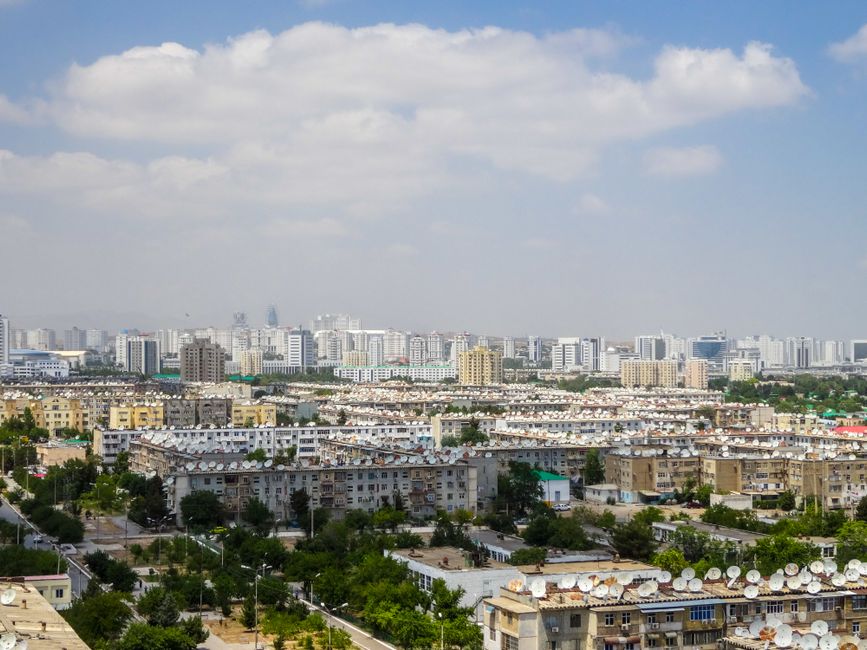
Ashgabat, the capital of Turkmenistan, is one of the strangest and most striking cities on Earth: a vision of gleaming white marble, golden domes, fountains, monuments and immaculate parks spread along the foot of the Kopetdag mountains, on the edge of the Karakum Desert near the Iranian border. Destroyed by an earthquake in 1948 and rebuilt in Soviet style, it was transformed again from the 1990s into a showcase of independent Turkmenistan, and in 2013 Guinness World Records listed it as the city with the highest density of white marble-clad buildings. Its wide boulevards are often almost empty, and its monuments celebrate independence, neutrality and the nation’s leaders. Come for the Independence Monument, the Arch of Neutrality, the Turkmen Carpet Museum and the National Museum, the sprawling Tolkuchka Bazaar, the earthquake memorial and the mosques, and for trips to the Parthian ruins of Nisa, the underground lake of Kow Ata and the Darvaza gas crater. Visiting needs planning: you need a visa backed by a letter of invitation, usually arranged by a travel agency, and photography and conduct are closely regulated. The best months are April, May, September and October.
Right now in Ashgabat
- Wed 13–25°C 55–78°F Mostly clear
- Thu 14–27°C 58–80°F Partly cloudy
- Fri 17–28°C 62–82°F Clear
Weather: MET Norway (CC BY 4.0)
Top tours in Ashgabat
See all tours for Ashgabat →
From local operators, with prices and reviews; you check availability and book on Viator, our partner. We may earn a commission at no extra cost to you. How we earn money
Ashgabat at a glance
- Best for: surreal marble architecture and monuments, carpets and museums, bazaars, and the starting point for Darvaza, Nisa and the rest of the country.
- How long: 1–2 days for the city, plus excursions to Nisa and Kow Ata and an overnight trip to Darvaza.
- Best time: April to May and September to October; June to August is extremely hot, and winter is cool with cold nights.
- Getting there: by air to Ashgabat International Airport, about 10 km (6 miles) north of the center; overland from Uzbekistan with your tour or transit visa.
- Getting around: with your guide and driver, or by licensed white-and-green taxis.
- Good to know: photography of government buildings and the presidential palace is restricted; follow your guide’s advice.
- Before you go: the letter of invitation, visas, fees, money and general safety are in our Turkmenistan travel guide.
Ashgabat’s areas and where to stay
Ashgabat is laid out on a grid between the railway in the north and the Kopetdag foothills in the south. Most monuments and new government buildings lie along the broad avenues of the center and the south, while older Soviet-era districts remain in the north and around the markets.
The center
Around the Turkmenbashi Avenue, the Ruhyýet Palace and the new government buildings, the center has large marble hotels, museums and parks. It is quiet at night.
The south and the foothills
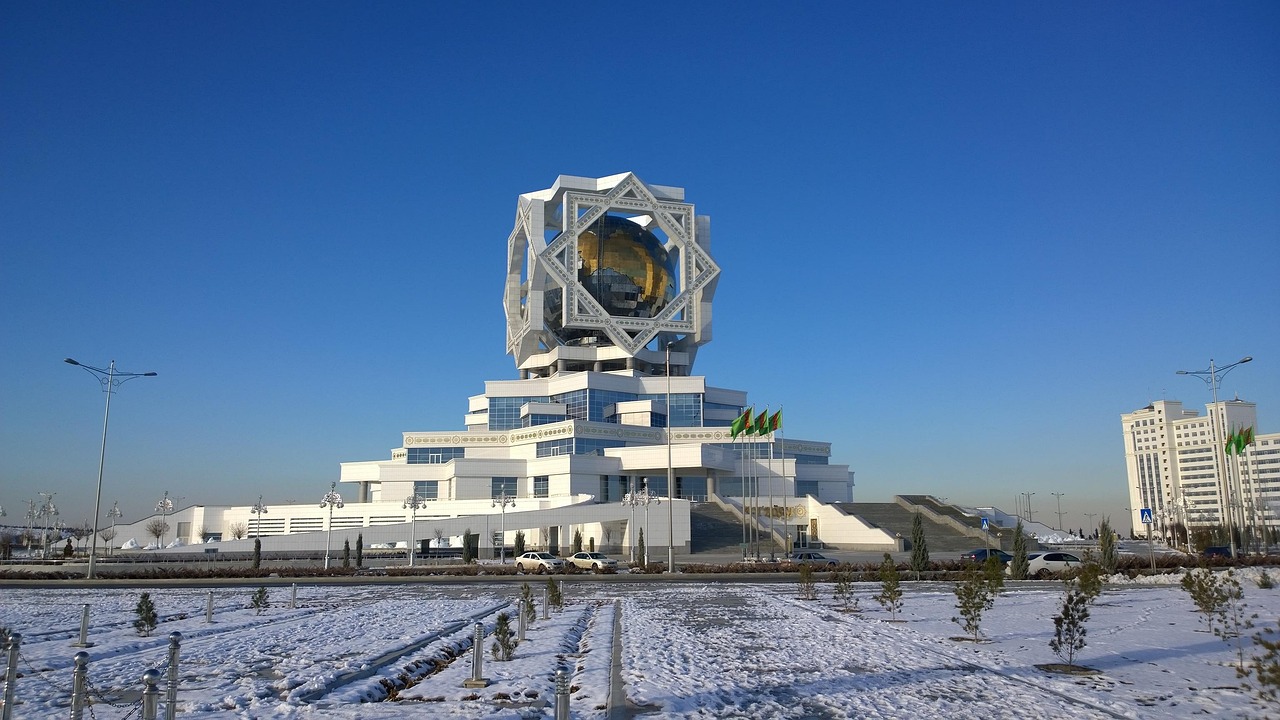
Along the avenues climbing toward the Kopetdag, the south has the Independence Monument, the Arch of Neutrality, the Wedding Palace and the Olympic complex, with several large hotels with views of the mountains.
The older north
Near the railway station and the Russian Bazaar (Gulistan), the older districts have Soviet-era buildings, everyday shops and markets and more modest hotels.
Where to stay in Ashgabat
- Large state-built hotels: marble hotels across the city, with restaurants and spacious rooms.
- International-brand hotels: a few upscale options with better Wi-Fi.
- Mid-range hotels: in the center and north, often booked by agencies.
- Your agency’s choice: most tours include hotels, so ask what is planned.
Hotels must register foreign guests; your agency and hotel handle the paperwork.
Top things to see in Ashgabat
Ashgabat’s story in brief
Ashgabat grew from a village and a Russian fort founded in 1881, on the Transcaspian Railway, into the capital of the Turkmen SSR. On the night of October 6, 1948, a massive earthquake destroyed almost the entire city and killed tens of thousands of people, including the mother and brothers of Saparmurat Niyazov, who later became the country’s first president. After independence in 1991, Niyazov, who called himself Turkmenbashi (“leader of the Turkmen”), began rebuilding Ashgabat as a monumental capital, a policy continued by his successors. Since 2013, it has held the Guinness World Record for the highest density of buildings clad in white marble, along with records such as the largest indoor Ferris wheel and the largest architectural image of a star, on the TV tower.
The Independence Monument and park
In a large park in the south of the city, the Independence Monument, built in 2001, rises about 118 m (387 ft) to a golden crescent, surrounded by statues of Turkmen heroes, fountains and a giant gilded statue of the first president. It is one of the city’s most photographed sights, especially at night.
The Arch of Neutrality
The Arch of Neutrality, a three-legged tower about 95 m (310 ft) tall topped by a golden statue of Niyazov, was built in 1998 in the center to celebrate Turkmenistan’s neutrality and moved in 2010 to the southern edge of the city, near the foothills. The statue once rotated to face the sun. An elevator rises to a viewing platform with views over the marble city and the mountains.
The Turkmen Carpet Museum
The Turkmen Carpet Museum displays hundreds of hand-woven carpets from the 17th century to the present, showing the gul patterns of the different tribes, and one of the largest hand-woven carpets in the world. It is a highlight even if you are not a carpet enthusiast; your guide can explain the motifs.
The National Museum of History
In a grand building in the south, the National Museum of History of Turkmenistan has archaeological treasures from Nisa, Merv and Gonur Depe, including Parthian ivory drinking horns (rhytons), Bronze Age seals and jewelry, as well as ethnography and exhibits on independence.
Earthquake memorial
The Halk Hakydasy memorial complex commemorates the victims of the 1948 earthquake and of World War II, with a bronze sculpture of a bull carrying the globe on its horns and a mother holding a child, symbolizing the earthquake.
Mosques
- Ertugrul Gazi Mosque: a mosque in the Ottoman style with four minarets in the center, built with Turkish support.
- Turkmenbashi Ruhy Mosque: about 12 km (7 miles) west of the center at Kipchak, the birthplace of the first president, one of the largest mosques in Central Asia, with golden domes and the president’s mausoleum alongside.
More classic sights
- Monument to the Constitution: a tower in the south with a golden statue and views.
- Alem Cultural and Entertainment Center: home to the world’s largest enclosed Ferris wheel, according to Guinness World Records.
- Bagt Köşgi (Wedding Palace): a star-shaped building topped by a globe, where couples marry.
- The Russian Bazaar (Gulistan): a covered market in the center, selling food, spices and household goods.
- The Walk of Health: a paved path along the Kopetdag foothills, built for public exercise, with views over the city.
Other things to do in Ashgabat
The Tolkuchka Bazaar
On the edge of the desert north of the city, the vast Tolkuchka (Altyn Asyr) Bazaar is the largest market in Turkmenistan, busiest on weekends, selling carpets, embroidered robes, silk, tall sheepskin hats (telpek), jewelry, camel-wool socks, food and household goods. It is the best place to buy a Turkmen carpet; dealers can help with the export certificate you need to take one out of the country.
Food and drink
Try Turkmen plov (palow), dograma, a bread and mutton soup, ishlekli, meat pies, gutap, crescent-shaped pastries filled with meat, pumpkin or greens, manty and shashlik, with chorek bread baked in tandoor ovens and plenty of green tea. Hotel restaurants also serve Russian, Turkish and international dishes. Remember that drinking alcohol in public places is prohibited.
Akhal-Teke horses
The golden Akhal-Teke horses, a national symbol, can be seen at stud farms and the hippodrome near the city; ask your agency to include a visit, especially around Turkmen Racehorse Day on the last Sunday of April.
Culture
Ashgabat has opera, drama and puppet theaters and concert halls, and large state celebrations on Independence Day (September 27) and Neutrality Day (December 12). See our city sightseeing guide.
Day trips from Ashgabat
- Nisa: the ruins of a Parthian royal city about 18 km (11 miles) west, a UNESCO World Heritage Site, with mud-brick walls, temples and views of the mountains.
- Kow Ata underground lake: about 100 km (60 miles) west, a warm sulfur lake in a cave at about 33–36 °C (91–97 °F), reached down a long staircase, where you can swim.
- Geok Tepe: a fortress where Turkmen tribes resisted the Russian army in 1881, with a mosque and a museum, about 45 km (28 miles) west.
- Kopetdag valleys: the green valleys of Archabil and the mountain village of Nokhur, for walks and village life.
- The Darvaza gas crater: about 260 km (160 miles) north in the Karakum Desert, best as an overnight trip by 4×4 with camping. In June 2025, the state gas company Türkmengaz said that wells drilled around the crater had reduced the burning about threefold, according to media reports; it was still burning in 2026, with smaller flames.
Getting there and getting around
Arriving by air
Ashgabat International Airport (ASB), about 10 km (6 miles) north of the center, has a terminal shaped like a flying falcon. Flights arrive from Istanbul, Dubai, Frankfurt, Moscow, Almaty and other cities; see our Istanbul guide. If you are getting a visa on arrival, you need your approved letter of invitation, your passport and cash in clean US dollars for the visa fee, the migration fee of US$14 and, according to the UK government, a COVID-19 test costing US$31; your guide usually meets you to help. Licensed taxis wait outside Exit 2, and hotels can arrange transfers.
Arriving overland
Most overland visitors arrive from Uzbekistan via Dashoguz or Turkmenabat, then travel to Ashgabat with their tour, often via Darvaza; domestic flights and trains also link these cities with the capital. See our Khiva and Bukhara guides.
Around town
Most visitors travel with their agency’s driver. Licensed taxis, white with green markings, are easy to find; drivers usually charge foreigners about 20 manat for a trip in the center, and you should agree the price before setting off and pay in manat. Much of the city has a 60 km/h (37 mph) speed limit enforced by cameras. Buses cover the city, but signs are mainly in Turkmen.
When to go and how long to stay
Ashgabat has a hot, dry desert climate. Spring, from March to May, is warm, with the year’s rain falling mainly from February to April and the Kopetdag foothills turning green. Summer, from June to August, is extremely hot, with afternoons often above 40 °C (104 °F). Autumn, from September to November, is warm and sunny, the best time to visit. Winter, from December to February, is cool, with average temperatures around 4–5 °C (39–41 °F), frosty nights and occasional snow. The World Meteorological Organization’s 1991–2020 normals do not include an Ashgabat station; the table uses the normals of Turkmenhydromet’s Baherden station, about 90 km (55 miles) west of the city at a similar altitude in the foothills, as submitted to the WMO, which give reliable average temperatures and precipitation. Afternoon highs in summer are about 10 °C (18 °F) above the average.
| Month | Average temperature | Precipitation | What to expect |
|---|---|---|---|
| January | 3.7 °C (39 °F) | 17 mm (0.6 in) | Cool days, frosty nights |
| February | 5.5 °C (42 °F) | 24 mm (1.0 in) | Cool and showery |
| March | 11.2 °C (52 °F) | 31 mm (1.2 in) | The wettest month; Novruz |
| April | 17.7 °C (64 °F) | 28 mm (1.1 in) | Warm and green; ideal |
| May | 24.5 °C (76 °F) | 19 mm (0.8 in) | Warm to hot; good |
| June | 30.0 °C (86 °F) | 5 mm (0.2 in) | Hot |
| July | 32.3 °C (90 °F) | 3 mm (0.1 in) | Extremely hot afternoons |
| August | 30.7 °C (87 °F) | 2 mm (0.1 in) | Extremely hot |
| September | 24.8 °C (77 °F) | 4 mm (0.2 in) | Hot days, cooler nights; Independence Day |
| October | 17.3 °C (63 °F) | 12 mm (0.5 in) | Warm; one of the best months |
| November | 9.6 °C (49 °F) | 18 mm (0.7 in) | Cool and pleasant |
| December | 4.7 °C (40 °F) | 16 mm (0.6 in) | Cool; Neutrality Day |
The Ashgabat area receives about 180 mm (7 in) of precipitation a year.
One day in Ashgabat
Morning at the Independence Monument and the National Museum, then the Arch of Neutrality and the Carpet Museum; lunch of plov or dograma; afternoon at the earthquake memorial and the Ertugrul Gazi Mosque, ending with the illuminated city from the Arch of Neutrality or the Alem Ferris wheel.
Two to three days
Add the Tolkuchka Bazaar on a weekend, Nisa and the Turkmenbashi Ruhy Mosque, Kow Ata, and an overnight trip to Darvaza.
What a trip to Ashgabat costs
Most visitors pay for an organized tour that includes hotels, guide and transport. Prices below are approximate, for October 2026, at the official rate of 3.50 manat to the US dollar.
| Item | Typical cost |
|---|---|
| Migration fee on arrival | US$14 |
| Tourism tax | US$2 per day, added to hotel bills |
| Museum entry | 20–60 TMT (about US$6–17) |
| Licensed taxi in the center | about 20 TMT (about US$5.70) |
| Meal in a local café | 60–150 TMT (about US$17–43) |
| Dinner in a hotel restaurant | 150–350 TMT (about US$43–100) |
| Overnight Darvaza trip with camping | US$150–350 per person, depending on group size |
| Hotel double, per night | US$80–150 |
Practical tips for Ashgabat
- Follow your guide on photography: ask before photographing buildings, and never photograph the presidential palace, police or soldiers.
- Bring clean US dollars: for fees on arrival and for exchange at the official rate.
- Expect limited internet: many sites and apps are blocked, and VPNs are illegal.
- Don’t drink in public: alcohol is allowed in restaurants and hotels but not in parks or squares.
- Visit the bazaar on a weekend: Tolkuchka is liveliest then.
- Keep your documents handy: carry your passport and a copy of your letter of invitation.
Safety
Ashgabat has a low crime rate and is very orderly, with a strong police presence. The main issues are rules rather than crime: photography of government buildings, the presidential palace, airports, military and police sites and embassies is restricted, and police may ask you to delete photos; follow your guide’s advice. Drinking alcohol in public places and smoking outdoors outside designated areas are prohibited, and comments criticizing the government, including online, can be treated as offenses. Carry your passport, as police may check identity documents. Summer heat is extreme, so carry water and avoid walking long distances at midday. Ashgabat lies in an active earthquake zone. In an emergency, ask your guide or hotel to call the police or an ambulance.
What to pack for Ashgabat
Light, modest clothing that covers shoulders and knees, a scarf for women at mosques, a sun hat and high-factor sunscreen, comfortable walking shoes, warm layers and a sleeping bag liner for desert nights at Darvaza, a flashlight, and clean, recent US dollar bills. Turkmenistan uses 220 V, with round two-pin plugs. See our hiking shoes and travel adapters guides.
Ashgabat travel FAQ
Do I need a visa to visit Ashgabat?
Yes. Almost all visitors need a visa backed by a letter of invitation certified by the State Migration Service, usually arranged by a travel agency; you can collect a visa on arrival at Ashgabat airport with the approved letter.
Why is Ashgabat all white marble?
Since independence, the city has been rebuilt with white marble-clad government buildings, monuments and apartment blocks; in 2013, Guinness World Records named it the city with the highest density of white marble buildings.
Can I take photos in Ashgabat?
Of most monuments, parks and museums, yes, but not of the presidential palace, government buildings, police, soldiers or airports; ask your guide.
How far is Darvaza from Ashgabat?
About 260 km north, roughly 4–5 hours by road and 4×4; most visitors camp overnight near the crater.
Is the Darvaza crater still burning?
Yes, as of 2026, but much less than before: in June 2025, Türkmengaz said wells around the crater had reduced the burning about threefold, according to media reports.
What is the best time to visit Ashgabat?
April to May and September to October. Summers are extremely hot.
Can I walk around Ashgabat on my own?
In the city, yes, with your documents and respecting the photography rules; most tours give you some free time, but trips outside the city follow your agency’s itinerary.
What is Nisa?
The ruins of a Parthian royal city about 18 km west of Ashgabat, a UNESCO World Heritage Site.
Can I use cards in Ashgabat?
Only in some large hotels and shops. Bring clean US dollars and change them at the official rate.
Is Ashgabat safe?
Yes, crime is low. Respect the rules on photography, alcohol and smoking, and carry your passport.
Sources and last review
Researched and last reviewed on 4 October 2026. The letter of invitation and visa on arrival at Ashgabat airport: the Embassy of Turkmenistan in the United States; the migration fee, COVID-19 test, tourism tax, registration, photography, alcohol, smoking, internet, taxis, speed limits and earthquakes: the UK government’s factual entry and safety pages; the official exchange rate: the Central Bank of Turkmenistan; climate normals: Turkmenhydromet via the World Meteorological Organization’s 1991–2020 normals for the Baherden station (no Ashgabat station is in the set). The Darvaza crater statement is from media reports citing Türkmengaz. The city’s history, Guinness records, monument dates and heights, distances, entry fees, tour and typical prices are general references or estimates, flagged for checking. Rules change at short notice, so check with your agency before you go. For entry rules, money and general safety, see our Turkmenistan travel guide.
Plan your trip
Partner links: TravelerCenter may earn a commission if you book, at no extra cost to you.
🇷🇺 Useful Russian phrases for Ashgabat
All 38 Russian phrases: restaurant, hotel, emergencies, romance (printable) →