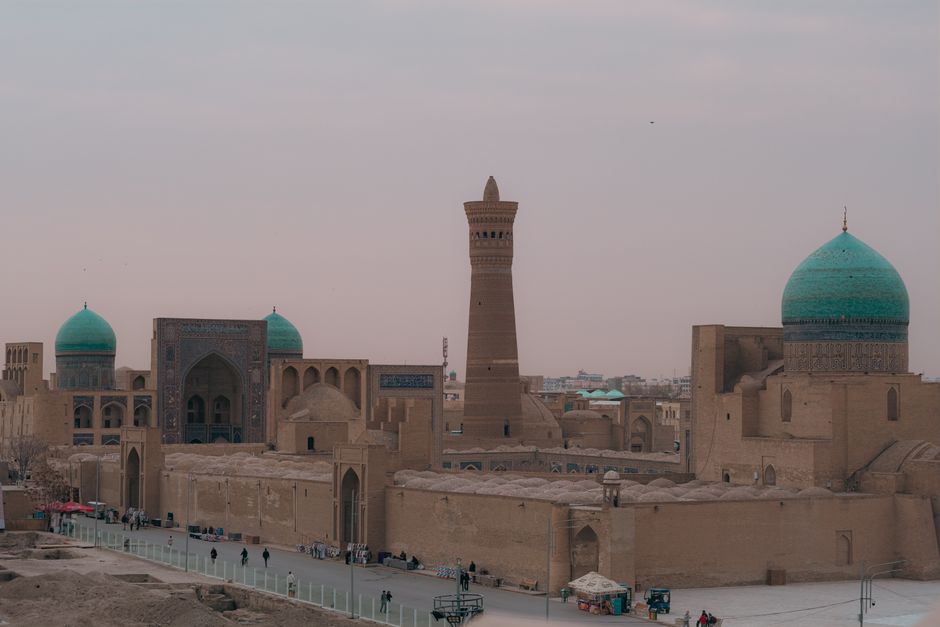
Bukhara is the most complete and atmospheric of the Silk Road cities, a desert oasis in the west of Uzbekistan where the old town of mud-brick lanes, domed bazaars, madrasas and minarets is still lived in and still busy with trade. For more than a thousand years, it was a great center of Islamic learning, the capital of the Samanid dynasty in the 9th and 10th centuries and of the emirs of Bukhara until 1920, and it was said that while light shone down on the rest of the world, in Bukhara it shone up. More than a hundred historic buildings survive in a compact center that you can explore on foot in a day or two. Come for the shady Lyabi-Hauz pool, the 12th-century Kalyan Minaret towering over the Po-i-Kalyan ensemble, the fortress of the Ark, the covered trading domes, the jewel-like Samanid Mausoleum and the four towers of Chor Minor, and for evenings at teahouses under the mulberry trees. The historic center has been a UNESCO World Heritage Site since 1993. High-speed trains link Bukhara with Samarkand and Tashkent, and since 2026 with Khiva. The best months are April, May, September and October; July and August are very hot.
Right now in Bukhara
- Wed 7–23°C 45–73°F Cloudy
- Thu 11–29°C 51–84°F Clear
- Fri 13–25°C 56–78°F Clear
Weather: MET Norway (CC BY 4.0)
Top tours in Bukhara
See all tours for Bukhara →
From local operators, with prices and reviews; you check availability and book on Viator, our partner. We may earn a commission at no extra cost to you. How we earn money
Bukhara at a glance
- Best for: a living old town, Islamic architecture, bazaars, crafts, hammams and relaxed evenings by the pools.
- How long: 2–3 days for the old town and nearby sights.
- Best time: April to May and September to October; June to August is very hot, and winter is cold but quiet.
- Getting there: by Afrosiyob train from Samarkand (about 1.5 hours) or Tashkent (about 4 hours), by high-speed train to Khiva since 2026, or by air to Bukhara International Airport, about 4 km (2.5 miles) from the old town.
- Getting around: on foot in the old town; taxis by app for the station, airport and outlying sights.
- Good to know: the main station is in Kagan, about 12–15 km (7–9 miles) southeast of the old town; allow time for the transfer.
- Before you go: visas, the registration rule, money and general safety are in our Uzbekistan travel guide.
Bukhara’s areas and where to stay
Bukhara’s historic center fills a compact area around Lyabi-Hauz, the trading domes and the Po-i-Kalyan ensemble, with the Ark on its western edge; the modern city spreads around it.
Around Lyabi-Hauz
The heart of the old town, with guesthouses and boutique hotels in restored merchants’ houses, teahouses and restaurants around the pool. It is lively in the evening and within a 10-minute walk of most sights.
The old Jewish quarter
South of Lyabi-Hauz, the lanes of the former Jewish quarter, where a small community still keeps a 17th-century synagogue, have quiet family guesthouses with courtyards and painted ceilings.
Between the domes and the Ark
Hotels and guesthouses near the trading domes, the Kalyan Minaret and the Ark put you at the center of sightseeing, though the area is quiet after dark when the shops close.
The new town
Larger hotels with pools stand along the roads outside the old town, 10–20 minutes’ walk away; they are convenient for drivers and tour groups.
Where to stay in Bukhara
- Lyabi-Hauz: boutique hotels in old houses, close to restaurants.
- Jewish quarter: quiet family guesthouses with courtyards.
- Around the domes: central hotels near the main monuments.
- New town: larger hotels with pools and parking.
Rooms fill in spring, in autumn and during the Silk and Spices festival; book ahead.
Top things to see in Bukhara
Bukhara’s story in brief
Bukhara grew up on a branch of the Zarafshan river at the edge of the Kyzylkum Desert, where caravans from China, India and Persia met. Under the Samanids, in the 9th and 10th centuries, it was one of the great cities of the Islamic world, home to the physician and philosopher Ibn Sina (Avicenna) and the poet Rudaki. Genghis Khan’s armies sacked it in 1220, but it revived under the Shaybanids in the 16th century, when most of the madrasas and trading domes you see today were built. From 1785, the emirs of Bukhara ruled a conservative state that became a Russian protectorate in 1868; the last emir fled in 1920 when the Red Army took the city. Because the city was spared heavy Soviet rebuilding, its old town survives remarkably intact, and much of it has been restored since independence.
Lyabi-Hauz
The Lyabi-Hauz ensemble grew in the 17th century around a stone-lined pool, one of the few survivors of the many pools that once supplied the city with water. Ancient mulberry trees shade the teahouses on its banks; the Nadir Divan-Begi Madrasa, whose portal shows two mythical birds carrying lambs toward a human-faced sun, stands on one side, and the large Kukeldash Madrasa on another. A statue of the folk hero Khoja Nasreddin on his donkey is a favorite meeting place. In the evening, the square fills with families, musicians and diners.
The trading domes
Between Lyabi-Hauz and the Kalyan Minaret, three 16th-century covered bazaars survive at former crossroads: Toki Sarrafon (the money changers’ dome), Toki Telpak Furushon (the cap makers’ dome) and Toki Zargaron (the jewelers’ dome). They still house shops selling suzani embroideries, carpets, ceramics, knives, hats and jewelry. Nearby are the Tim of Abdullah Khan, a domed trading hall for silk, and the Magoki Attori Mosque, among the oldest in Central Asia, sunk below the modern street level.
Po-i-Kalyan: the Kalyan Minaret, mosque and madrasa
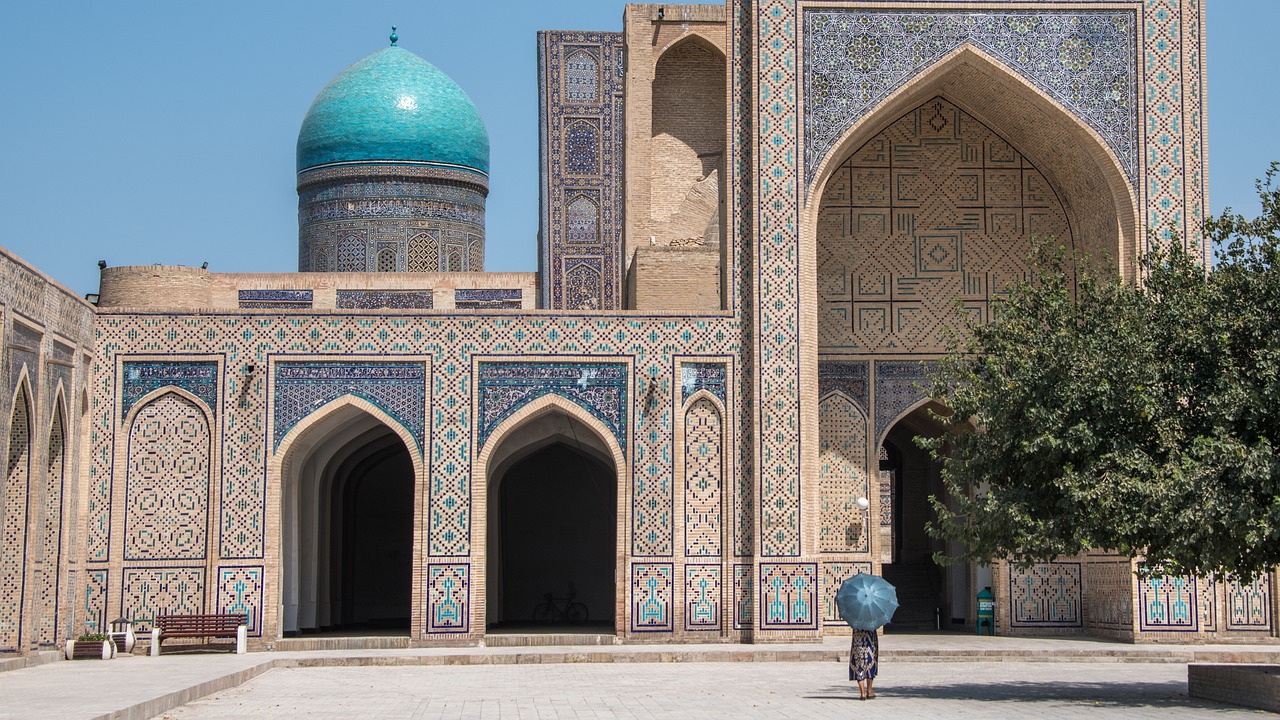
The Kalyan Minaret, built in 1127, rises about 46 m (150 ft) above the old town, decorated with bands of patterned brick; it so impressed Genghis Khan that he spared it when he destroyed much of the city in 1220. It stands between the Kalyan Mosque, a vast Friday mosque with a courtyard for thousands of worshippers, and the Mir-i-Arab Madrasa, with its twin blue domes, still a working religious school. The square is magical at sunset and after dark, when the buildings are lit.
The Ark
The Ark, a massive fortress on an artificial mound at the western edge of the old town, was the residence of Bukhara’s rulers for more than a thousand years. Inside its walls, partly ruined, are the emir’s throne room, a mosque, a coronation court and museums on local history and archaeology. Opposite the main gate, the Bolo Hauz Mosque (1712) has a summer porch supported by 20 slender wooden columns reflected in its pool. The Registan square in front of the Ark was once a place of public executions.
The Samanid Mausoleum and Chashma-Ayub
In a park west of the Ark, the Samanid Mausoleum, built in the 9th or 10th century for the ruler Ismail Samani and his family, is a small cube of baked brick laid in intricate patterns that change with the light; it is one of the masterpieces of early Islamic architecture and survived buried under sand. Nearby, the Chashma-Ayub (“Job’s well”) shrine has a conical dome and a small museum of water.
More classic sights
- Chor Minor: a quirky gatehouse with four turquoise-domed towers, built in 1807 for a madrasa that has disappeared, hidden in the lanes northeast of Lyabi-Hauz.
- Ulugh Beg and Abdulaziz Khan madrasas: two facing madrasas, one built in 1417 by Ulugh Beg, the other in the 17th century with rich decoration.
- The synagogue and the Jewish quarter: reminders of the Bukharan Jewish community, which lived here for centuries.
- The city walls: stretches of the old mud-brick walls and the Talipach Gate on the northwest of the old town.
Other things to do in Bukhara
Food and drink
Bukhara’s plov is often cooked with raisins and quince, and its specialties include oshi sofi, a white plov; khalvaitar, a sweet flour halva; and somsa from the tandoor. Dine on rooftop terraces with views of the Kalyan Minaret or at the teahouses around Lyabi-Hauz, and try the green tea with nabot (crystallized sugar) and dried fruit. Many restaurants in old merchants’ houses offer dinner with folk music and dance performances.
Crafts, workshops and hammams
Bukhara is famous for its crafts: suzani and gold embroidery, carpets, miniature painting, ceramics, puppets and hand-forged stork-shaped scissors made by blacksmiths in the old town. Many workshops welcome visitors to watch the makers. The 16th-century Bozori Kord hammam near the trading domes still offers traditional baths and massages in a domed stone interior, with separate times for men and women.
Festivals
The Silk and Spices festival, usually held in late spring, fills the old town with craft fairs, music and dancing; check dates before you go. Navruz on March 21 is celebrated with sumalak and folk festivities. See our city sightseeing guide.
Day trips from Bukhara
- Sitorai Mohi Xosa: the summer palace of the last emir of Bukhara, about 4 km (2.5 miles) north, an eclectic mix of Russian and Central Asian styles with peacocks in the gardens.
- Bahauddin Naqshband Complex: the shrine of the founder of the Naqshbandi Sufi order, about 12 km (7 miles) east, an important place of pilgrimage.
- Chor-Bakr: a “city of the dead” of family tombs and mosques about 6 km (4 miles) west.
- Gijduvan: a town about 45 km (28 miles) northeast known for its ceramics workshop, run by a family of potters for generations.
- The Kyzylkum Desert: yurt camps near Aydarkul lake and the Nuratau mountains, with camel rides, about 3–4 hours by road on the way to Samarkand.
Nearby destinations
- Samarkand218 km
Getting there and getting around
By train
Bukhara’s main station is in Kagan, about 12–15 km (7–9 miles) southeast of the old town; taxis take about 20–30 minutes. The Afrosiyob high-speed train reaches Samarkand in about one and a half hours and Tashkent in about four hours. Since May 2026, the new Jaloliddin Manguberdi high-speed train has stopped in Bukhara on its way between Tashkent and Khiva, which it reaches via Urgench; slower conventional trains to Urgench and Khiva take around six to eight hours across the desert. Buy tickets on railway.uz, the official site and app of Uzbekistan Railways, or at stations, with your passport, and book early in spring and autumn.
By air
Bukhara International Airport (BHK), about 4 km (2.5 miles) from the old town, has flights from Tashkent and international flights from cities such as Istanbul and Moscow; see our Istanbul guide.
By road
Shared taxis link Bukhara with Samarkand (about 3–4 hours) and with Khiva across the Kyzylkum Desert (about 6–7 hours on a road that has been largely rebuilt). The Farap–Turkmenabat crossing to Turkmenistan is about 1.5 hours southwest; see our Turkmenistan guide for the visa rules.
Around town
The old town is small and flat, so walking is the way to explore; most sights are within 1.5 km (1 mile) of Lyabi-Hauz. Use ride-hailing apps such as Yandex Go for the station, the airport and the outlying sights.
When to go and how long to stay
Bukhara lies in the desert at about 220 m (720 ft) and has a hot, dry climate. Spring, from April to May, is warm and pleasant, the best time to visit. Summer, from June to August, is very hot, with average highs around 36–37 °C (97–99 °F) and almost no rain; sightsee early and late, and rest in the shade at midday. Autumn, from September to October, is warm, dry and sunny. Winter, from December to February, brings frosty nights and the occasional dusting of snow, with few visitors. The table uses the 1991–2020 climate normals for the Bukhara station of Uzhydromet, as submitted to the World Meteorological Organization (WMO): average daily highs and lows, total precipitation, and days with at least 1 mm of rain or snow.
| Month | Average high / low | Rain (days with 1 mm or more) | What to expect |
|---|---|---|---|
| January | 7 °C (45 °F) / −2 °C (28 °F) | 16 mm (0.6 in), 10 days | Cold nights; very quiet |
| February | 10 °C (50 °F) / 0 °C (31 °F) | 24 mm (0.9 in), 10 days | Chilly; the wettest month |
| March | 17 °C (63 °F) / 5 °C (40 °F) | 25 mm (1.0 in), 10 days | Mild; Navruz |
| April | 24 °C (76 °F) / 10 °C (51 °F) | 22 mm (0.9 in), 8 days | Warm; peak season begins |
| May | 31 °C (87 °F) / 16 °C (60 °F) | 11 mm (0.4 in), 7 days | Hot afternoons; busy |
| June | 36 °C (97 °F) / 20 °C (68 °F) | 2 mm (0.1 in), 3 days | Very hot and dry |
| July | 37 °C (99 °F) / 22 °C (71 °F) | under 1 mm, 1 day | The hottest month |
| August | 36 °C (96 °F) / 19 °C (67 °F) | under 1 mm, 1 day | Very hot; melon season |
| September | 30 °C (86 °F) / 14 °C (56 °F) | 1 mm (0.0 in), 1 day | Warm and dry; busy |
| October | 23 °C (73 °F) / 7 °C (45 °F) | 3 mm (0.1 in), 4 days | Ideal; cool nights |
| November | 14 °C (58 °F) / 2 °C (36 °F) | 14 mm (0.6 in), 8 days | Cool; quieter |
| December | 8 °C (47 °F) / −1 °C (30 °F) | 13 mm (0.5 in), 9 days | Cold; empty monuments |
Bukhara receives only about 130 mm (5 in) of precipitation a year, almost all from November to April.
Two days in Bukhara
Day one, Lyabi-Hauz, the Nadir Divan-Begi Madrasa, the trading domes and Magoki Attori, then the Kalyan Minaret and Mir-i-Arab, with sunset over Po-i-Kalyan and dinner on a rooftop. Day two, the Ark and Bolo Hauz Mosque, the Samanid Mausoleum and Chashma-Ayub, Chor Minor, and an evening in the hammam or at a folk show.
Three to four days
Add the emir’s summer palace and the Bahauddin Naqshband complex, a ceramics visit in Gijduvan, or a night in a desert yurt camp.
What a trip to Bukhara costs
Prices are approximate, for October 2026, converted at about 11,800 som to the US dollar.
| Item | Typical cost |
|---|---|
| Afrosiyob train to Samarkand, economy | about 150,000–250,000 UZS (about US$13–21) |
| Ark entry | 40,000–70,000 UZS (about US$3.40–6) |
| Other madrasas, museums and mausoleums | 20,000–50,000 UZS (about US$1.70–4.20) each |
| Hammam with massage | 300,000–600,000 UZS (about US$25–51) |
| Plate of plov or shashlik | 40,000–70,000 UZS (about US$3.40–6) |
| Rooftop dinner with a view | 150,000–350,000 UZS (about US$13–30) per person |
| Taxi to Kagan station | 40,000–80,000 UZS (about US$3.40–6.80) |
| Guesthouse or boutique hotel double, per night | 450,000–1,100,000 UZS (about US$38–93) |
Practical tips for Bukhara
- Allow for the station transfer: trains use Kagan station, 20–30 minutes from the old town.
- Go out early and late in summer: the old town has little shade at midday.
- Bargain in the domes: start low and settle in the middle; ask for receipts for carpets.
- Respect working religious sites: Mir-i-Arab is an active madrasa, and the Kalyan Mosque is used for prayer.
- Keep registration slips: your guesthouse registers you; keep the slips until you leave Uzbekistan.
- Carry cash: many guesthouses, workshops and small museums take only som.
Safety
Bukhara is very safe, and the old town is pleasant to walk in at night. The main risks are the summer heat, uneven paving and steep stairs in some buildings, and traffic on the roads outside the pedestrian old town. Watch your belongings in the trading domes and at evening events, and be firm with persistent sellers. Use app-based taxis rather than unofficial drivers. Ask before photographing people, particularly women and worshippers at mosques, and avoid photographing police or government buildings. Carry your passport. In an emergency, call 102 for police and 103 for an ambulance.
What to pack for Bukhara
Light, loose clothes that cover shoulders and knees, a hat, sunglasses and high-factor sunscreen, a refillable water bottle, comfortable shoes for cobbles and dust, a scarf for women at religious sites, and a warm layer for winter nights and desert evenings. Uzbekistan uses 220 V, with round two-pin plugs. See our hiking shoes and travel adapters guides.
Bukhara travel FAQ
How many days do I need in Bukhara?
Two days for the old town’s main sights; three or four to add the emir’s summer palace, the Naqshband shrine, Gijduvan or a desert yurt camp.
How do I get from Samarkand to Bukhara?
By Afrosiyob high-speed train in about one and a half hours, by slower trains, or by shared taxi in about 3–4 hours.
How do I get from Bukhara to Khiva?
By train, including the high-speed service to Khiva via Urgench that began in May 2026, or by shared taxi across the Kyzylkum Desert in about 6–7 hours.
How far is Bukhara station from the old town?
About 12–15 km; the main station is in Kagan, about 20–30 minutes by taxi.
What is the best time to visit Bukhara?
April to May and September to October. June to August is very hot, often above 36 °C (97 °F).
Can you climb the Kalyan Minaret?
Visitors are not normally allowed to climb it; the best views of it are from the square and from rooftop terraces nearby.
What should I buy in Bukhara?
Suzani embroideries, carpets, ceramics, miniature paintings, gold embroidery and the stork-shaped scissors made by local blacksmiths, ideally from the workshops themselves.
Is there a hammam in Bukhara?
Yes. The 16th-century Bozori Kord hammam near the trading domes offers traditional baths and massages, with separate times for men and women.
Is Bukhara safe at night?
Yes. The old town is lively around Lyabi-Hauz in the evening and generally very safe; watch your step on uneven lanes.
Is Bukhara worth visiting if I have seen Samarkand?
Yes. Samarkand has the grandest monuments, but Bukhara’s lived-in old town, bazaars and evening atmosphere make it many visitors’ favorite.
Sources and last review
Researched and last reviewed on 4 October 2026. Visas and registration: the Ministry of Foreign Affairs of Uzbekistan and the Uzbek government services portal; climate normals: Uzhydromet via the World Meteorological Organization’s 1991–2020 normals; the exchange rate: the Central Bank of the Republic of Uzbekistan. The 2026 high-speed train to Khiva is from local press reports. The UNESCO inscription, monument dates and history, minaret height, station and airport distances, journey times, entry fees and typical prices are general references or estimates, flagged for checking. Prices and rules change, so check locally before you go. For entry rules, money and general safety, see our Uzbekistan travel guide.
Plan your trip
Partner links: TravelerCenter may earn a commission if you book, at no extra cost to you.
🇺🇿 Useful Uzbek phrases for Bukhara
All 38 Uzbek phrases: restaurant, hotel, emergencies, romance (printable) →