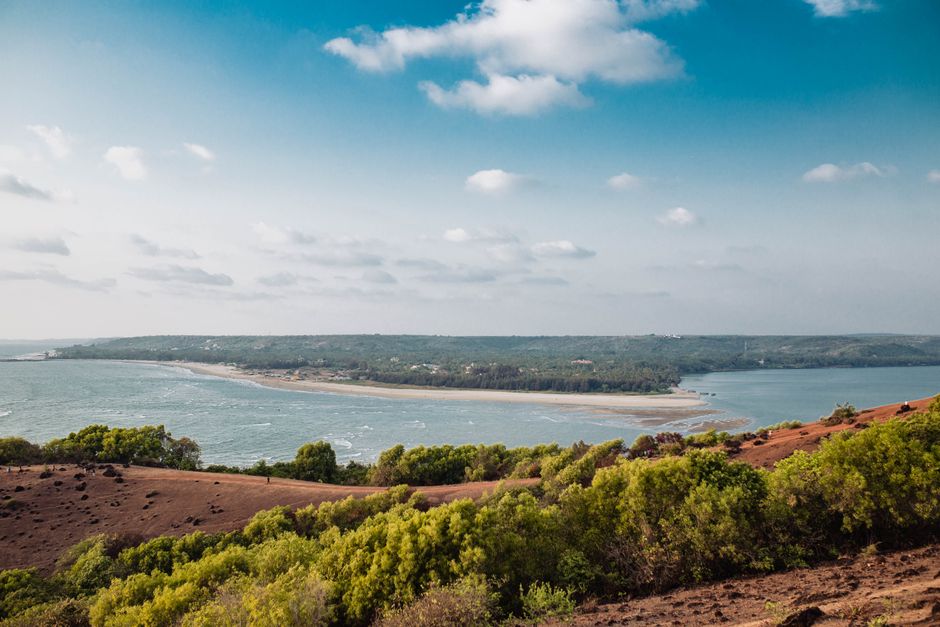
Goa, India’s smallest state, is a strip of palm-fringed coast on the Arabian Sea between Maharashtra and Karnataka, famous for its beaches, its laid-back pace and a culture shaped by 450 years of Portuguese rule that ended in 1961. Whitewashed baroque churches stand among the rice paddies, Hindu temples crown the hills of the interior, and the food mixes coconut, chili and vinegar with Portuguese bread and sausage. The Churches and Convents of Old Goa, the former Portuguese capital, are a UNESCO World Heritage Site. Most visitors come for the sand: the busy resort beaches of North Goa around Calangute and Baga, the cliffs and cafés of Anjuna, Vagator and Arambol, or the long, quieter beaches and sheltered coves of the south, from Colva to Palolem. Goa covers 3,702 km² (1,429 sq miles), smaller than Delaware, with about 1.5 million residents, according to the 2011 census. The beach season runs from about October or November to April or May; from June to September, the monsoon turns the state lush and green, the sea becomes dangerous, swimming is off-limits and water sports stop.
Right now in Goa (Panaji)
- Wed 26–34°C 78–93°F Partly cloudy
- Thu 26–33°C 78–92°F Partly cloudy
- Fri 27–32°C 80–89°F 1 mm Mostly clear
Weather: MET Norway (CC BY 4.0) · Sea temperature: NOAA CoastWatch
Top tours in Goa
See all tours for Goa →
From local operators, with prices and reviews; you check availability and book on Viator, our partner. We may earn a commission at no extra cost to you. How we earn money
Goa at a glance
- Best for: beaches, seafood, Portuguese-era churches and villages, water sports, nightlife and yoga retreats.
- How long: a week lets you combine a northern and a southern beach with Panaji and Old Goa; many visitors stay much longer.
- Best time: November to March for calm seas and dry, sunny weather; December and New Year are the peak.
- Getting there: two airports, Dabolim (GOI) in the center and Manohar International at Mopa (GOX) in the north, and trains on the Konkan Railway from Mumbai and Kerala.
- Getting around: taxis and app cabs, rented scooters, local buses and river ferries.
- Good to know: Goa’s tourism department says beaches are open for swimming from 7 a.m. to sunset, and swimming is off-limits during the monsoon.
- Before you go: the e-Visa, money and general safety are in our India travel guide.
Goa’s regions: where things are
Goa is only about 100 km (60 miles) from north to south. The coast is divided into two districts, North and South Goa, with the capital, Panaji, in the middle at the mouth of the Mandovi River.
North Goa: Calangute to Candolim
The stretch of beaches from Candolim through Calangute to Baga is Goa’s busiest resort strip, packed with hotels, beach shacks, water-sports operators, markets and nightclubs, popular with Indian families and package tourists. Fort Aguada guards its southern end.
North Goa: Anjuna, Vagator and the far north
North of Baga, the coast becomes rockier and more bohemian. Anjuna, with its Wednesday flea market, and Vagator, below the ruined Chapora Fort, were the heart of the hippie scene of the 1960s and 1970s and still have cafés, clubs and trance parties. Farther north, Morjim, Ashwem, Mandrem and Arambol are quieter, with yoga schools, beach huts and long sandy beaches.
Panaji and Old Goa
Panaji (Panjim), the small, relaxed state capital, has a riverside promenade, Portuguese-era squares and the colorful Latin Quarter of Fontainhas. Old Goa, 10 km (6 miles) upriver, was once the capital of Portuguese India and is now a cluster of great churches and convents in green lawns.
South Goa: Colva to Cavelossim
South of the airport, a single sandy beach runs for some 25 km (15 miles) past Majorda, Colva, Benaulim, Varca and Cavelossim, lined with resorts and fishing villages but much less crowded than the north. Margao (Madgaon), the commercial center of the south, is the main railway hub.
South Goa: Agonda, Palolem and the far south
In the far south, the coves of Agonda, Palolem, Patnem and Galgibaga are framed by forested headlands, with beach huts, cafés and calm, swimmable water in season. Agonda and Galgibaga are nesting beaches for olive ridley sea turtles.
The hinterland
Inland, the Western Ghats rise to forested hills with spice plantations, Hindu temples around Ponda, the Bhagwan Mahavir Wildlife Sanctuary and the four-tiered Dudhsagar Falls.
Top things to see in Goa
The beaches
Every visitor has a favorite. Calangute and Baga are lively and crowded, with every kind of water sport. Anjuna and Vagator have red cliffs, sunset cafés and nightlife. Arambol and Mandrem are relaxed and long. In the south, Colva and Benaulim are wide and family-friendly, Agonda is quiet and unspoiled, and Palolem, a crescent of sand backed by palms, is many travelers’ idea of the perfect Goan beach. See our beaches guide.
The Churches and Convents of Old Goa
The UNESCO-listed churches of Old Goa are among the finest Portuguese colonial buildings in Asia. The Basilica of Bom Jesus, completed in 1605, holds the tomb of St. Francis Xavier, the Jesuit missionary, whose relics are shown to the public in an exposition roughly every ten years. Across the lawns, the Sé Cathedral is one of the largest churches in Asia; the Church of St. Francis of Assisi has a gilded interior, and its convent houses the Archaeological Museum. Visit in the morning, dress modestly and remain quiet during services.
Panaji and Fontainhas
Wander the narrow lanes of Fontainhas, Panaji’s Latin Quarter, with its ochre, blue and green houses, tiled roofs, balconies and small art galleries, then climb to the white zigzag staircase of the Church of Our Lady of the Immaculate Conception, which overlooks the main square. Sunset river cruises leave from the Mandovi riverfront.
Forts
Goa’s coast is studded with Portuguese forts. Fort Aguada, of 1612, with its lighthouse at the mouth of the Mandovi, has views over Candolim; Chapora Fort, a ruin above Vagator, is a favorite sunset spot; and Cabo de Rama in the far south looks out over empty cliffs.
More classic sights
- Mapusa Friday market: the region’s biggest weekly market for spices, sausages, fish and produce.
- Anjuna flea market: clothes, crafts and souvenirs every Wednesday in season.
- Spice plantations: guided tours with a Goan lunch near Ponda.
- Mangueshi and Shantadurga temples: two of the most important Hindu temples, near Ponda.
- Dudhsagar Falls: a 300 m (1,000 ft) waterfall on the Karnataka border, reached by jeep safari after the monsoon.
- Divar and Chorao islands: sleepy river islands reached by free ferry, with a bird sanctuary on Chorao.
- Chandor and Loutolim: villages with grand old Portuguese-style mansions.
Other things to do in Goa
Food and drink
Goan cuisine is one of India’s most distinctive. Hindu and Catholic cooking both revolve around fish curry and rice, made with coconut and kokum, but the Portuguese influence shows in dishes such as vindaloo (pork in a vinegar and chili marinade), sorpotel, chouriço sausages and xacuti, a curry of roasted coconut and spices. Try prawn balchão, chicken cafreal, recheado mackerel stuffed with red masala, the local poi bread, and bebinca, a many-layered coconut pudding. Goa’s own spirit is feni, distilled from cashew fruit or coconut sap. Beach shacks serve fresh seafood and cold beer in season. Drink bottled or filtered water.
Water sports, diving and boat trips
In the fair-weather season, operators at the main beaches offer parasailing, jet skiing, banana rides and kayaking, and boat trips go out to watch dolphins at sunrise. Goa’s water sports policy limits activities to licensed operators working between 8 a.m. and 6:30 p.m., or sunset if earlier, in zones marked with black-and-white checkered flags, and bans them in the monsoon and in bad weather. Divers and snorkelers head to Grande Island off the Mormugao peninsula, where visibility is best from about December to April. See our boat trips, diving and snorkeling guides.
Yoga and wellness
The quieter northern beaches of Mandrem and Arambol, and Patnem in the south, are centers for yoga teacher training, retreats and Ayurvedic treatments, mainly from November to April.
Festivals and nightlife
Carnival, in February or March, fills the towns with parades and music; Shigmo, the Hindu spring festival, brings floats and folk dance; on São João, June 24, young men leap into flooded wells; and the Feast of St. Francis Xavier, on December 3, draws pilgrims to Old Goa. Christmas and New Year’s Eve are celebrated with midnight masses, beach parties and big electronic music festivals. Nightlife is centered on Baga, Anjuna and Vagator in season.
Day trips from Goa
- Old Goa and Panaji: easily combined in one day from any beach.
- Dudhsagar Falls and the Bhagwan Mahavir sanctuary: best from October to January, when the falls are in full flow and the jeep tracks have reopened.
- Ponda’s temples and spice farms: a half-day trip inland.
- Gokarna: a temple town in Karnataka with quiet beaches, about 3 hours south.
- Hampi: the extraordinary ruins of the Vijayanagara Empire, a UNESCO site, about 8 hours inland by road or overnight train; best as a two- or three-day trip.
- Mumbai: about 8 hours north by fast train. See our Mumbai travel guide.
Nearby destinations
- Hampi259 km
Getting there and getting around
By air
Goa has two airports, both designated e-Visa entry points, according to the Bureau of Immigration: Dabolim (GOI), in the center near Vasco da Gama, about 30 minutes from Colva, and the newer Manohar International Airport (GOX) at Mopa in the far north, about 30 to 45 minutes from Arambol and Anjuna. Check which one your flight uses: the drive between them takes about 1½ to 2 hours. Charter flights from Russia, the UK and Eastern Europe arrive in winter, and there are frequent flights from Mumbai, Delhi, Bengaluru and the Gulf. Prepaid and app-based taxis wait at both airports.
By train
Goa lies on the scenic Konkan Railway between Mumbai and Kerala. The main stations are Madgaon (Margao) for South Goa, Karmali for Panaji and Old Goa, and Thivim for North Goa. Fast trains from Mumbai, including the Vande Bharat Express, take about 8 hours; trains also run to Kochi, Mangaluru, Delhi and Hampi’s station at Hosapete.
Getting around
Goa has no metro and limited buses, so most visitors use taxis, which are expensive by Indian standards, Goa’s app-based taxi services, or rented scooters and motorbikes. To ride, you need a valid license for that class, preferably with an International Driving Permit, and helmets are compulsory. Government Kadamba buses link the main towns, and free car ferries cross the rivers, for example from Ribandar to Chorao and Divar. Don’t drink and drive: police run checks, especially around New Year.
When to go and how long to stay
Goa has a tropical monsoon climate, warm all year. The dry season, from about November to May, has sunny days of 32 to 34 °C (90 to 93 °F) and almost no rain; December to February are the most pleasant months, with lower humidity and cooler nights, and April and May are hot and humid. The monsoon, from June to September, brings close to 3,000 mm (118 in) of rain, rough seas and a beach shutdown: many shacks and huts are dismantled, Goa’s tourism department asks visitors not to swim in the monsoon, and water sports stop; but the countryside turns spectacularly green, and hotels drop their prices. October is a transitional month, with showers, rising humidity and the season reopening. The table shows 1991–2020 normals for Panaji (Panjim) from the India Meteorological Department (IMD), as published by the World Meteorological Organization (WMO); rainy days are days with at least 2.5 mm of rain.
| Month | Average high / low | Rain (rainy days) | What to expect |
|---|---|---|---|
| January | 32 °C (90 °F) / 20 °C (68 °F) | 1 mm, 0 days | Peak season; sunny and dry; calm seas |
| February | 32 °C (90 °F) / 21 °C (69 °F) | under 1 mm, 0 days | Dry and pleasant; Carnival in some years |
| March | 33 °C (91 °F) / 23 °C (74 °F) | under 1 mm, 0 days | Warmer; Shigmo; Holi |
| April | 33 °C (92 °F) / 25 °C (78 °F) | 5 mm (0.2 in), 0 days | Hot and humid; season winding down |
| May | 34 °C (93 °F) / 26 °C (79 °F) | 77 mm (3.0 in), 4 days | Very humid; pre-monsoon storms; shacks close |
| June | 31 °C (88 °F) / 25 °C (77 °F) | 890 mm (35.1 in), 21 days | Monsoon arrives; no swimming; São João |
| July | 29 °C (85 °F) / 24 °C (76 °F) | 955 mm (37.6 in), 27 days | Wettest month; lush and green |
| August | 30 °C (85 °F) / 24 °C (76 °F) | 572 mm (22.5 in), 23 days | Heavy rain; low prices |
| September | 30 °C (86 °F) / 24 °C (75 °F) | 304 mm (12.0 in), 14 days | Rains easing; Ganesh Chaturthi |
| October | 32 °C (90 °F) / 24 °C (75 °F) | 156 mm (6.2 in), 7 days | Showers; season reopening late in the month |
| November | 34 °C (92 °F) / 23 °C (73 °F) | 21 mm (0.8 in), 2 days | Dry season begins; beaches reopen |
| December | 33 °C (92 °F) / 21 °C (70 °F) | 2 mm (0.1 in), 0 days | Busiest month; Christmas and New Year |
Panaji gets about 2,980 mm (117 in) of rain a year, more than 90% of it from June to September.
One week in Goa
Spend three nights in the north, with the Mapusa market, Anjuna and Chapora Fort, a day in Panaji’s Fontainhas and Old Goa, then four nights on a southern beach such as Palolem or Agonda, with a day trip to Cabo de Rama or a spice farm.
Ten days or more
Add a jeep trip to Dudhsagar Falls, a dolphin cruise, a few days of yoga in Mandrem, or a side trip to Gokarna or Hampi.
Where to stay in Goa
- Candolim, Calangute and Baga: resorts, mid-range hotels and nightlife; busy and convenient.
- Anjuna, Vagator and Assagao: boutique villas, guesthouses and cafés with a creative scene.
- Mandrem, Ashwem and Arambol: beach huts, yoga retreats and quieter sands.
- Panaji: heritage guesthouses in Fontainhas, close to Old Goa and the riverfront.
- Colva to Cavelossim: large beach resorts for families.
- Agonda and Palolem: beach huts and small hotels in scenic coves.
Book well ahead for Christmas and New Year, when prices can double or triple; many beach huts open only from November to April.
What a trip to Goa costs
Prices are approximate, for October 2026, converted at about 96 rupees (₹) to the US dollar.
| Item | Typical cost |
|---|---|
| Fish curry rice in a local restaurant | ₹200–450 (about US$2–4.70) |
| Seafood dinner at a beach shack | ₹800–2,000 (about US$8–21) per person |
| Beer at a beach shack | ₹150–300 (about US$1.50–3) |
| Scooter rental, per day | ₹350–700 (about US$3.60–7.30) |
| Taxi from Dabolim airport to Palolem or from Mopa to Anjuna | ₹1,500–2,500 (about US$16–26) |
| Parasailing or jet-ski ride | ₹800–2,000 (about US$8–21) |
| Beach hut, per night in season | ₹2,000–6,000 (about US$21–63) |
| Mid-range resort double, per night in season | ₹6,000–15,000 (about US$63–156) |
Practical tips for Goa
- Swim between the flags: Goa’s lifesavers mark safe swimming zones with red-and-yellow flags; red flags mean no swimming.
- Know the beach rules: drinking alcohol and smoking on the beach, driving on the sand, littering and nudity are offenses under Goa’s rules.
- Pick your airport: book a hotel close to the airport your flight uses, especially for late arrivals.
- Respect the turtles: keep away from marked nesting areas at Morjim, Agonda and Galgibaga.
- Carry cash: many shacks and small guesthouses prefer cash or UPI payments, and ATMs on the remote beaches run dry at peak times.
Safety
Goa is relaxed and generally safe, but most serious incidents involving visitors happen in the sea or on the roads. Drowning is the biggest risk: rip currents are strong on many beaches, especially in the monsoon and when the sea is rough. According to Goa’s tourism department, lifesavers watch the beaches from 7 a.m. to sunset; swim only in the zones marked with red-and-yellow flags, never where red flags fly, never after sunset, when beaches are closed for swimming, and never after drinking alcohol. Avoid wet rocky outcrops, where waves can sweep walkers away, and do not jump or dive from rocks. In the monsoon, from June to September, swimming and water sports stop altogether. Road safety: scooter accidents are common, often involving tourists without helmets or after drinking, on narrow roads with cattle and stray dogs; wear a helmet and avoid riding at night. Drugs are illegal: Goa’s tourism department warns that drug offenses carry up to 10 years in prison and a fine of ₹1 lakh (₹100,000). Theft from unattended bags on beaches and from rooms happens, so use safes. Women travelers should take the usual care at late-night parties and when walking alone on dark beaches. Food and water: choose busy shacks and drink bottled or filtered water. In an emergency, call 112, or ask the nearest lifesaver tower for help on the beach.
What to pack for Goa
Swimwear and a cover-up (beachwear is not appropriate in towns, churches or temples), high-factor sunscreen, a hat, sandals or water shoes for rocky coves, insect repellent, and a light rain jacket for the shoulder months. India uses 230 V, with round-pin plugs of types C, D and M. See our water shoes, rain jackets and travel adapters guides.
Goa travel FAQ
When is the beach season in Goa?
From about November to April or May, when the sea is calm, the weather dry and the beach shacks open. December and New Year are the busiest weeks.
Can I swim in Goa during the monsoon?
No. Goa’s tourism department asks visitors not to swim in the monsoon, from about June to September, when currents are dangerous, and water sports are not allowed in that season.
Is North or South Goa better?
North Goa is livelier, with more nightlife, markets and water sports; South Goa is quieter, with longer, emptier beaches and scenic coves such as Palolem and Agonda.
Which airport should I fly into for Goa?
Manohar International Airport at Mopa is closest to the northern beaches, and Dabolim to Panaji and South Goa. Both are designated e-Visa entry airports.
How do I get from Mumbai to Goa?
By fast train in about 8 hours on the Konkan Railway, by a one-hour flight, or by overnight bus.
Can I drink alcohol on Goa’s beaches?
No. According to Goa’s tourism department, drinking alcohol on the beach itself is prohibited and punishable with a fine. Beach shacks serve drinks on their own premises.
Can I rent a scooter in Goa?
Yes, scooters are widely rented. You need a valid license for that class, ideally with an International Driving Permit, and a helmet, which is compulsory.
What should I see in Old Goa?
The Basilica of Bom Jesus, with the tomb of St. Francis Xavier, the Sé Cathedral and the Church of St. Francis of Assisi, all part of a UNESCO World Heritage Site.
What food is Goa famous for?
Fish curry and rice, pork vindaloo, xacuti, prawn balchão, chicken cafreal, bebinca and feni, the local cashew spirit.
Is Goa safe for tourists?
Generally, yes. The main risks are drowning in rough seas, scooter accidents, theft from beaches and the strict drug laws; swim only in lifesaver-patrolled zones.
Sources and last review
Researched and last reviewed on 4 October 2026. Beach hours, lifesaver coverage, flag zones, the ban on swimming after sunset and in the monsoon, beach rules, drug penalties and other visitor instructions: the Goa Department of Tourism’s published dos and don’ts; water sports hours, zones and the monsoon ban: Goa’s Policy for Regulation of Water Sports and the Goa Water Sports Rules, 2005; designated e-Visa airports and seaport: the Bureau of Immigration’s e-Visa site; climate normals for Panaji: the India Meteorological Department, via the World Meteorological Organization (1991–2020 normals archived by NOAA’s National Centers for Environmental Information); area and population: Wikidata (2011 census); the exchange rate: the Reserve Bank of India (FBIL reference rate). Beach-season dates, church and fort history, UNESCO dates, train times, festival dates, distances, the turtle-nesting beaches, the dive season and typical prices are general references or estimates, flagged for checking. Rules and prices change, so check locally before you go. For the e-Visa and money, see our India travel guide.
Plan your trip
Partner links: TravelerCenter may earn a commission if you book, at no extra cost to you.
🇮🇳 Useful Hindi phrases for Goa
All 38 Hindi phrases: restaurant, hotel, emergencies, romance (printable) →