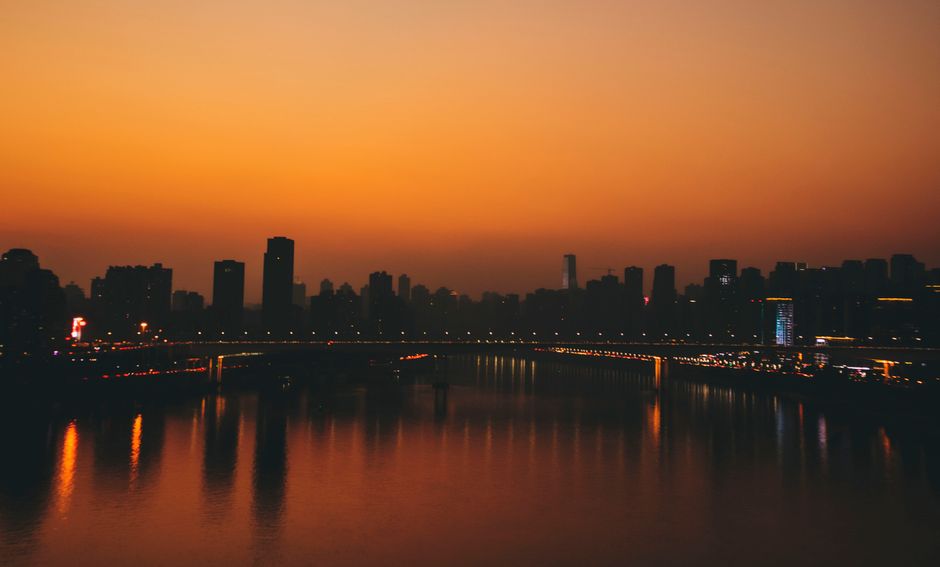
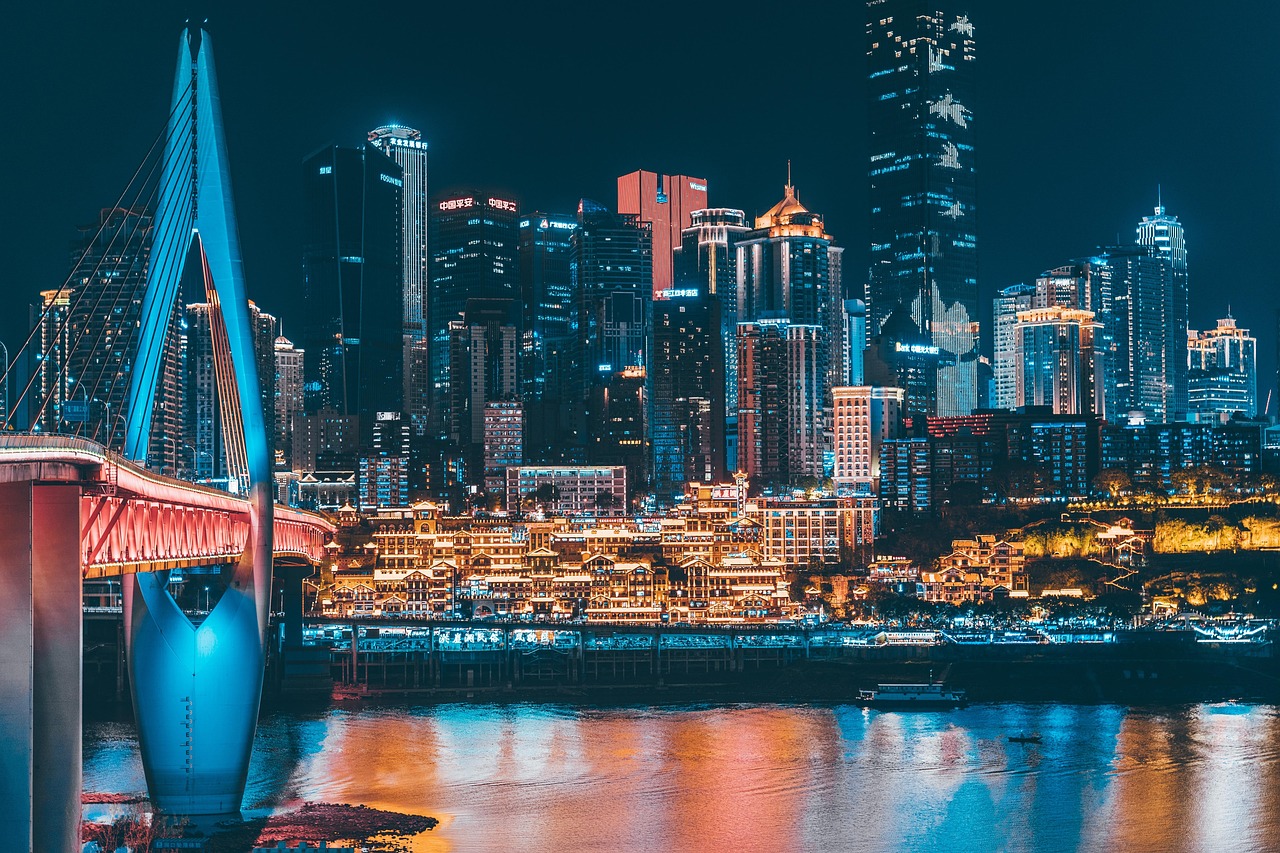
Chongqing is China’s most dramatic city: a mountain metropolis built on steep hills at the meeting of the Yangtze and Jialing rivers, where skyscrapers rise from cliffs, roads stack on top of each other, a monorail runs straight through an apartment block and the main street of one district can be the 22nd floor of a building in the next. Locals call it the “8D city,” and visitors come to experience it: ride the Yangtze River Cableway across the water, watch the tiered stilt-house complex of Hongyadong light up at night, see the trains vanish into the building at Liziba, wander the stepped lanes of Shibati and the old river port of Ciqikou, and look down on the peninsula from the viewing points of Nanshan. Chongqing is a municipality reporting directly to the central government, covering a territory the size of Austria with about 32 million people. It is also the hometown of Chongqing hotpot, the fiercest in China, and the starting point for Yangtze River cruises through the Three Gorges, as well as for the UNESCO-listed Dazu Rock Carvings and the natural bridges of Wulong. Summers are among the hottest in China, so come in spring or autumn.
Right now in Chongqing
- Wed 17–28°C 63–82°F Clear
- Thu 19–28°C 67–83°F Clear
- Fri 21–27°C 69–81°F Partly cloudy
Weather: MET Norway (CC BY 4.0)
Top tours in Chongqing
See all tours for Chongqing →
From local operators, with prices and reviews; you check availability and book on Viator, our partner. We may earn a commission at no extra cost to you. How we earn money
Chongqing at a glance
- Best for: spectacular cityscapes and night views, hotpot and street food, Yangtze cruises, Dazu’s Buddhist carvings and Wulong’s karst.
- How long: 2–3 days for the city, plus a day for Dazu or Wulong, or 3–4 nights for a Yangtze cruise.
- Best time: March to May and September to November; July and August are extremely hot, and winters foggy and damp.
- Getting there: by high-speed train from Chengdu (about 1–1.5 hours), Guiyang, Wuhan and Xi’an, or by air to Chongqing Jiangbei (CKG).
- Getting around: by metro and monorail, which climb the hills, by taxi or DiDi, and on foot with plenty of stairs.
- Good to know: map apps struggle with the city’s levels; look for the right floor or exit when meeting a taxi.
- Before you go: visa-free entry, the 240-hour transit, the arrival card, payments and general safety are in our China travel guide.
Chongqing’s areas and where to stay
The heart of the city is the Yuzhong peninsula, a hilly tongue of land between the two rivers that ends at Chaotianmen. Across the rivers lie Jiangbei to the north and Nan’an to the south, linked by bridges, cable cars and the metro.
Jiefangbei and Yuzhong
The center of the peninsula, around the Jiefangbei (Liberation Monument), is the best base: international and mid-range hotels, malls, food streets and walking distance to Hongyadong, the cableway and Shibati. Expect to climb.
Chaotianmen and Hongyadong
At the tip of the peninsula, the giant towers of Raffles City, with a horizontal skyscraper “sky bridge,” overlook the confluence of the rivers and the cruise piers at Chaotianmen; hotels here have river views and are close to the night sights and the boats.
Jiangbei and Guanyinqiao
North of the Jialing River, Jiangbei has modern hotels, the Guanyinqiao shopping area and the river promenades facing Hongyadong, and is closer to the airport and Chongqing North station.
Nan’an and Nanshan
South of the Yangtze, Nan’an has riverfront hotels with views of the peninsula skyline, and the forested hills of Nanshan have viewing points, hotpot restaurants and resorts.
Where to stay in Chongqing
- Jiefangbei: the most central, for walking, food and the metro.
- Chaotianmen: river-view hotels near the cruise piers.
- Jiangbei: modern hotels, convenient for the airport and trains.
- Nan’an and Nanshan: skyline views and quieter hills.
- Ciqikou or Shapingba: near the old town and Shapingba station.
Rooms fill at weekends and holidays, when Chongqing is one of China’s most popular destinations for domestic travelers.
Top things to see in Chongqing
Hongyadong
On the cliff above the Jialing River, Hongyadong is an 11-story complex built in the style of the traditional stilted houses (diaojiaolou) that once lined the riverbanks, filled with shops, restaurants, bars and teahouses. You enter from the street at the top and descend through the floors to the river; at night, the whole building glows with golden lights, a scene compared to a fantasy film, best seen from the Qiansimen Bridge or the Jiangbei shore opposite. It is free and extremely busy on summer evenings.
The Yangtze River Cableway
Since 1987, the Yangtze River Cableway has carried commuters, and now mostly sightseers, in cabins over the Yangtze between Xinhua Road on the peninsula and Shangxin Street in Nan’an, a ride of a few minutes with superb views. Expect long queues on holidays; go early or late.
Liziba and the monorail
On monorail Line 2, trains pass through a 19-story residential building at Liziba station, which occupies its 6th to 8th floors. A viewing platform below the tracks lets you watch them go in and out. Line 2 also runs along the river at the height of the hillside, a cheap scenic ride.
Chaotianmen and the rivers
At Chaotianmen, the old city gate at the tip of the peninsula, the brown Jialing meets the Yangtze. The square below Raffles City overlooks the cruise piers. Evening Two Rivers night cruises leave from here for about an hour among the illuminated skylines and bridges.
Shibati and the old city
Shibati (the “18 Steps”), a historic stairway neighborhood between the upper and lower city, has been rebuilt as a lantern-lit district of restored houses, cafés and snack stalls. Nearby, the Huguang Guild Hall is a beautiful 18th-century merchants’ guild complex with an opera stage, and Eling Park and the Eling Second Factory creative park have views over the two rivers.
Ciqikou
In the west of the city, the old Jialing River port of Ciqikou (“porcelain port”) has stone-paved lanes of Ming and Qing buildings, teahouses, snack shops selling mahua twisted dough and spicy food, and the Baolun Temple. It is crowded at weekends; come in the morning.
More classic sights
- Three Gorges Museum: the history of Chongqing and the Yangtze, with models of the Three Gorges Dam area, opposite the Great Hall of the People.
- Great Hall of the People: a grand 1950s building with a dome modeled on Beijing’s Temple of Heaven.
- Nanshan viewing points: the One Tree viewing platform gives the classic night panorama of the peninsula.
- Jinyun Mountain: a forested mountain with temples, northwest of the city.
- Jiefangbei Pedestrian Street: the shopping heart of the city around the Liberation Monument.
Other things to do in Chongqing
Food and drink
Chongqing hotpot is the city’s soul: a bubbling pot of beef tallow, chili and Sichuan pepper, with a nine-square grid to keep ingredients apart, into which you dip tripe, duck intestines, beef, tofu, mushrooms and vegetables, then dunk them in sesame oil and garlic. Ask for a yuanyang (split) pot with a mild side if you prefer, and “wēi là” for less heat. Try also Chongqing xiaomian, spicy breakfast noodles; suanlafen, hot and sour sweet-potato noodles; laziji, chicken fried with a mountain of dried chilies; grilled fish in chili oil; and chuanchuan skewers. Ice jelly with brown sugar cools the palate.
Yangtze River cruises
Chongqing is the western starting point for cruises down the Yangtze through the Three Gorges (Qutang, Wu and Xiling) to Yichang, usually 3–4 nights downstream, with shore excursions to sights such as the White Emperor City, the Lesser Three Gorges or Shennong Stream and the Three Gorges Dam. International-standard cruise ships and simpler domestic boats operate, mostly from March to November; ship schedules can change with water levels.
Nights out
Chongqing is a city that lives at night: food streets, rooftop bars on the peninsula, riverbank lights and night markets stay busy late. See our boat trips and city sightseeing guides.
Day trips from Chongqing
- Dazu Rock Carvings: thousands of Buddhist, Taoist and Confucian sculptures carved into cliffs from the 9th to the 13th centuries, with the vivid scenes of Baodingshan as the highlight; a UNESCO site, about 1.5–2 hours west by road or train.
- Wulong Karst: the giant natural stone arches of the Three Natural Bridges, the Longshuixia Fissure gorge and the Furong Cave, part of the UNESCO-listed South China Karst, about 2.5–3 hours east by road or train; a long day or an overnight.
- Fishing Town (Diaoyucheng): a mountaintop fortress in Hechuan that held out against the Mongols for 36 years.
- Zhongshan and Tongjing: riverside old towns in the hills.
- Chengdu: pandas and teahouses, about 1–1.5 hours by high-speed train.
Nearby destinations
- Chengdu265 km
Getting there and getting around
By air
Chongqing Jiangbei International Airport (CKG), about 20 km (12 miles) north of the peninsula, is one of China’s busiest, with flights across the country and to Asia and Europe, and is a designated port for the 240-hour visa-free transit, with the whole municipality as a permitted area. Metro Lines 3 and 10 run to the city in about 40–60 minutes, and taxis take 30–45 minutes.
By train
Chongqing has several stations: Chongqing North and Chongqing West are the main high-speed stations, and Shapingba serves some trains to Chengdu. Trains run to Chengdu in about 1–1.5 hours, and to Guiyang, Wuhan, Xi’an, Shanghai, Beijing and Guangzhou. Check which station your train uses, as they are far apart. Book on the 12306 website or app with your passport.
By river
Cruise ships for the Three Gorges dock at Chaotianmen and other piers; book through cruise lines or agencies with your passport.
Around town
The metro and monorail are the easiest way to cope with the hills, with English signs; pay with Alipay or WeChat Pay QR codes. Taxis and DiDi are cheap, but drivers may struggle to find pickup points on different levels; share your location and the exact entrance. Walking involves many stairs, escalators and elevators; the Huangguan escalator, one of the longest in Asia, links the upper city with the Lianglukou area.
When to go and how long to stay
Chongqing has a humid subtropical climate and is known as one of China’s “furnaces.” Spring (March–May) is warm and pleasant, with some rain. Summer (June–August) is hot and humid, with average highs around 34 °C (93 °F) in July and August and heat waves pushing temperatures toward 40 °C (104 °F); June is the wettest month. Autumn (September–November) is mild but often drizzly. Winter (December–February) is cool and damp, rarely below freezing, and the city lives up to its old name of “fog capital,” with frequent mist on the rivers. The table uses the 1991–2020 climate normals for the Chongqing (Shapingba) station of the China Meteorological Administration (CMA), as submitted to the World Meteorological Organization (WMO): average daily highs and lows, total precipitation, and days with at least 1 mm of rain.
| Month | Average high / low | Rain (days with 1 mm or more) | What to expect |
|---|---|---|---|
| January | 10 °C (51 °F) / 6 °C (44 °F) | 21 mm (0.8 in), 6 days | Cool, damp and foggy |
| February | 14 °C (56 °F) / 8 °C (47 °F) | 22 mm (0.9 in), 5 days | Cool; Chinese New Year |
| March | 19 °C (65 °F) / 12 °C (53 °F) | 56 mm (2.2 in), 8 days | Mild; spring blossom |
| April | 24 °C (75 °F) / 16 °C (61 °F) | 103 mm (4.1 in), 10 days | Warm and pleasant; very good |
| May | 27 °C (81 °F) / 19 °C (67 °F) | 142 mm (5.6 in), 12 days | Warm; showers increase |
| June | 30 °C (86 °F) / 22 °C (72 °F) | 212 mm (8.4 in), 12 days | Hot; the wettest month |
| July | 34 °C (93 °F) / 25 °C (78 °F) | 174 mm (6.9 in), 9 days | Very hot; heat waves |
| August | 34 °C (93 °F) / 25 °C (78 °F) | 126 mm (4.9 in), 9 days | Very hot; the hottest month with July |
| September | 29 °C (83 °F) / 22 °C (71 °F) | 125 mm (4.9 in), 10 days | Warm; frequent rain |
| October | 22 °C (72 °F) / 17 °C (62 °F) | 95 mm (3.8 in), 12 days | Mild; drizzle; Golden Week crowds |
| November | 17 °C (63 °F) / 13 °C (54 °F) | 50 mm (2.0 in), 7 days | Cool and misty |
| December | 12 °C (53 °F) / 8 °C (46 °F) | 25 mm (1.0 in), 6 days | Cool, damp and foggy |
Chongqing receives about 1,150 mm (45 in) of rain a year, most of it from April to October.
Two days in Chongqing
Day one, Jiefangbei, the Huguang Guild Hall and Shibati, the Yangtze River Cableway, then Chaotianmen and Hongyadong at night, with hotpot. Day two, Liziba on monorail Line 2, the Three Gorges Museum and the Great Hall of the People, Ciqikou in the afternoon and the Nanshan viewpoint after dark.
Three days or more
Add a day trip to Dazu or Wulong, a night river cruise, or a 3–4-night Yangtze cruise to Yichang, then continue by train to Wuhan, Xi’an or Shanghai.
What a trip to Chongqing costs
Prices are approximate, for October 2026, converted at about 6.74 yuan to the US dollar.
| Item | Typical cost |
|---|---|
| Yangtze River Cableway, one way | about 20–30 CNY (about US$3–4.50) |
| Metro or monorail ride | 2–10 CNY (about US$0.30–1.50) |
| Hotpot dinner | 80–150 CNY (about US$12–22) per person |
| Bowl of xiaomian noodles | 10–20 CNY (about US$1.50–3) |
| Two Rivers night cruise | about 100–200 CNY (about US$15–30) |
| Dazu Rock Carvings (Baodingshan) ticket | about 100–150 CNY (about US$15–22) |
| Three Gorges cruise, 3–4 nights, per person | about 3,000–10,000 CNY (about US$445–1,484) |
| Mid-range hotel double, per night | 300–700 CNY (about US$45–104) |
Practical tips for Chongqing
- Wear good shoes: the city is all slopes, stairs and escalators.
- Time the night sights: Hongyadong and the river lights are best after dusk, but very crowded at weekends.
- Pace the hotpot: order a split pot and “wēi là” if you’re not used to the heat.
- Share exact pickup points: taxi meeting points can be on different levels.
- Avoid midsummer: if you come in July or August, plan indoor sights for midday.
- Check cruise details: confirm the departure pier, schedule and what excursions are included.
Safety
Chongqing is a safe city, with little violent crime. Watch for pickpockets in the crowds at Hongyadong, Jiefangbei and Ciqikou, and on the cableway queues; agree prices before buying from unlicensed vendors or taking unofficial river trips. Traffic is fast on steep, winding roads, and pedestrian crossings can be confusing; use underpasses and footbridges. The biggest natural hazard is summer heat: temperatures near 40 °C (104 °F) are possible, so drink plenty of water and rest in air-conditioning at midday. Heavy rain in summer can cause floods on the riverbanks and landslides in the hills, and river levels can rise quickly; follow local alerts and stay away from the water’s edge. Hotpot is very spicy; go gently. Carry your passport for hotels, trains, cruises and police checks. In an emergency, call 110 for police, 120 for an ambulance and 119 for fire.
What to pack for Chongqing
Comfortable shoes with good grip for stairs and slopes, light, breathable clothes and a hat for the summer heat, an umbrella for spring and autumn drizzle, warm layers for damp, unheated winters, layers for cool evenings on a river cruise, and stomach remedies for the spice. China uses 220 V, with flat two-pin, round two-pin and angled three-pin sockets. See our hiking shoes and travel adapters guides.
Chongqing travel FAQ
What is Chongqing famous for?
Its dramatic hillside cityscape at the meeting of the Yangtze and Jialing rivers, Hongyadong, the Liziba monorail, hotpot and Yangtze cruises through the Three Gorges.
How do I get from Chengdu to Chongqing?
By high-speed train from Chengdu East to Chongqing in about 1–1.5 hours, with frequent departures.
Where can I see the train go through a building?
At Liziba station on monorail Line 2, where trains run through a residential block; watch from the viewing platform below the tracks.
How long is a Yangtze cruise from Chongqing?
Usually 3–4 nights downstream to Yichang, through the Three Gorges and past the Three Gorges Dam; upstream trips take longer.
When is Hongyadong lit up?
Every evening after dusk; the best views are from the Qiansimen Bridge and the Jiangbei shore opposite.
Is Chongqing hotpot very spicy?
Yes, it is among the spiciest in China. Ask for a split yuanyang pot with a mild broth, or for mild (wēi là) seasoning.
What is the best time to visit Chongqing?
March to May and September to November. July and August are extremely hot, and winters are damp and foggy.
How do I get to the Dazu Rock Carvings?
By train or bus from Chongqing to Dazu in about 1.5–2 hours, then a local bus or taxi to Baodingshan; tours also run from the city.
Can I use the 240-hour visa-free transit in Chongqing?
Yes. Chongqing Jiangbei airport is a designated port, and the whole municipality is a permitted area, with travel on to other permitted areas such as Sichuan’s.
How many days do I need in Chongqing?
Two to three days for the city, plus a day for Dazu or Wulong, or 3–4 nights for a Yangtze cruise.
Sources and last review
Researched and last reviewed on 4 October 2026. Visa-free transit ports and the Chongqing permitted area: the National Immigration Administration; train booking with a passport: China Railway’s official 12306 site; climate normals: the China Meteorological Administration via the World Meteorological Organization’s 1991–2020 normals (Chongqing station); the exchange rate: the CFETS central parity rate; UNESCO inscriptions: the UNESCO World Heritage List. Population and area, the cableway and Liziba details, airport and train times, cruise lengths and seasons, Dazu and Wulong access, history and typical prices are general references or estimates, flagged for checking. Prices and rules change, so check locally before you go. For entry rules, money and general safety, see our China travel guide.
Plan your trip
Partner links: TravelerCenter may earn a commission if you book, at no extra cost to you.
🇨🇳 Useful Mandarin Chinese phrases for Chongqing
All 38 Mandarin Chinese phrases: restaurant, hotel, emergencies, romance (printable) →