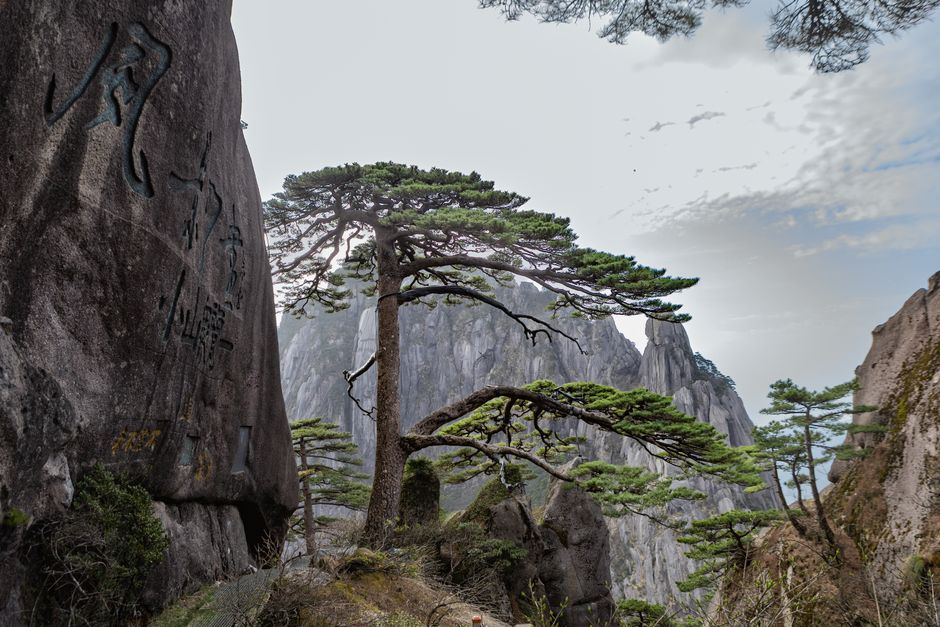
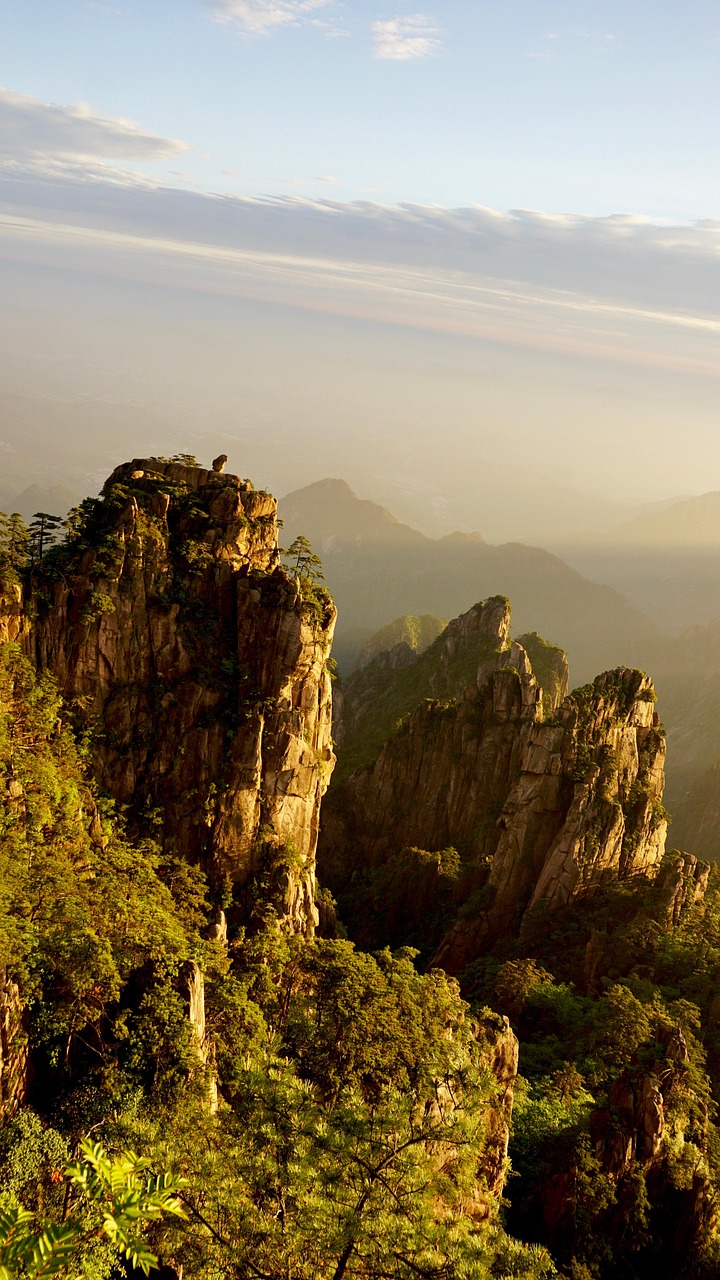
Huangshan, the Yellow Mountain, in southern Anhui province in eastern China, is the most celebrated mountain landscape in China: a granite massif of sheer peaks and pinnacles, clinging pines, and seas of cloud that pour through the valleys at dawn, painted and praised by artists and poets for more than a thousand years. Its highest point, Lotus Peak, reaches about 1,864 m (6,115 ft), with Bright Summit Peak and Celestial Capital Peak close behind, and stone stairways, carved over centuries, link dozens of viewpoints across the summit area. The Chinese speak of Huangshan’s “four wonders”: strangely shaped pines, such as the famous Welcoming Guest Pine; grotesque rocks; the sea of clouds; and the hot springs at its foot, with snow and ice adding a fifth in winter. Huangshan is a UNESCO World Heritage Site for both its scenery and its culture. Three cable cars and steep walking routes lead up from the gates; staying a night on the summit lets you see sunset and sunrise. In 2026, the entrance ticket is 190 yuan (150 yuan in the winter season) and is valid for three days, with all tickets booked in advance under your real name. Below the mountain are the whitewashed villages of Hongcun and Xidi and the old streets of Tunxi. Huangshan’s airport is a port for the 240-hour visa-free transit. The best seasons are April to May and September to November.
Right now in Huangshan (Yellow Mountain) (Huangshan Scenic Area)
- Wed6–17°C43–62°FClear
- Thu6–17°C43–63°FClear
- Fri7–19°C44–66°FMostly clear
Top tours in Huangshan (Yellow Mountain)
See all tours for Huangshan (Yellow Mountain) →
From local operators, with prices and reviews; you check availability and book on Viator, our partner. We may earn a commission at no extra cost to you. How we earn money
Huangshan at a glance
- Best for: mountain scenery, sunrise and the sea of clouds, hiking on stone stairways, photography, Huizhou villages and green tea.
- How long: 2–3 days on and around the mountain, plus 1–2 days for Hongcun, Xidi and Tunxi.
- Best time: April to May and September to November; summer is busy, humid and stormy; winter is cold and icy, with beautiful rime and snow.
- Getting there: by high-speed train to Huangshan North from Hangzhou, Shanghai, Hefei, Nanjing and Beijing, or by air to Huangshan Tunxi (TXN), then bus to Tangkou.
- Getting around: by shuttle bus from Tangkou to the cable cars and trailheads, then on foot or by cable car.
- Good to know: book tickets in advance with your passport; the ticket is valid three consecutive days from first entry.
- Before you go: visa-free entry, the 240-hour transit, the arrival card, payments and general safety are in our China travel guide.
The mountain and the towns: where things are
The Huangshan Scenic Area covers about 160 km² (62 sq miles) of mountains. The main summit area, with most viewpoints and hotels, is a plateau of peaks between about 1,600 and 1,864 m (5,250–6,115 ft), reached from two main gates.
Tangkou and the South Gate
Tangkou, a small town at the southern foot of the mountain, is the main base for climbing Huangshan, with hotels, restaurants and the transfer center where shuttle buses leave for the Yungu (Cloud Valley) and Ciguang Pavilion (Yuping) cable car stations and trailheads. It is about 1 hour by bus from Huangshan North station and Tunxi.
The summit area
On the mountain, hotels cluster around Beihai (North Sea), Xihai (West Sea), Bright Summit Peak and Baiyun, close to the best sunrise and sunset points. Rooms are expensive, simple for the price and in high demand; dormitories are available in some.
The North and West Gates
The North Gate on the Taiping side, with the Taiping cable car from Songgu, serves visitors coming from the north, and the West Gate gives access to quieter western valleys.
Tunxi (Huangshan city)
Tunxi, the center of Huangshan city, about 65 km (40 miles) south of the mountain, has the airport, the Old Street, more hotels and restaurants, and easy access to the villages of Hongcun and Xidi. Huangshan North high-speed station is on the northern edge of the city.
Tickets, booking and the cable cars
Under the price policy for 2026 published by the Huangshan city government, the Huangshan Scenic Area ticket costs 190 yuan (half price 95 yuan) from 21 January to 19 December 2026, and 150 yuan (half price 75 yuan) in the winter season from 20 December 2025 to 20 January 2026. A ticket is valid for three consecutive days, starting on the day you first enter, with unlimited entries: book your first day on the official “Huangshan Tourism official platform” (Huangshan Lüyou Guanfang Pingtai) mini program in WeChat or Alipay, make sure the ticket is checked at the gate on that first day to activate the multi-entry pass, and then book each later day’s entry as a “multiple entry” ticket in the same app. Tickets are real-name, so use your passport. Discounts and free entry apply to some groups, such as children, students and older visitors, with ID.
The three cable cars cost, one way, in the regular season: Yungu and Taiping 80 yuan each, Yuping 90 yuan, and the West Sea Grand Canyon sightseeing cable car (a funicular railway into the canyon) 100 yuan; in the winter season, 65, 75 and 80 yuan. Shuttle buses from Tangkou to the cable car stations are paid separately. Daily visitor numbers are capped, so book early for holidays.
Top things to see in Huangshan
Sunrise and the sea of clouds
The highlight of a summit stay is sunrise, best seen from Refreshing Terrace (Qingliang Tai), Beginning-to-Believe Peak, Bright Summit Peak or Lion Peak. The sea of clouds, when cloud fills the valleys below the peaks, is most common from November to May, after rain. Sunset is often best from Paiyun Pavilion or Bright Summit.
Lotus Peak and the Welcoming Guest Pine
Near the Yuping (Jade Screen) cable car, the Welcoming Guest Pine, more than 800 years old, stretches out a branch like an arm in greeting, guarded around the clock. From here, steep steps lead to Lotus Peak, the highest point, when its path is open; the summit paths of Lotus Peak and Celestial Capital Peak are closed in rotation for rest and restoration.
Celestial Capital Peak
Celestial Capital Peak (Tiandu Feng), about 1,810 m (5,940 ft), is the steepest climb on the mountain, with a narrow ridge called the Carp’s Backbone, stairs cut into the rock and chains to hold. It is exposed and not for those afraid of heights; check that it is open.
West Sea Grand Canyon
The West Sea Grand Canyon (Xihai Daxiagu) is a deep gorge of pinnacles with a spectacular loop of stairways and cliff-hugging paths. The loop takes 3–4 hours; the funicular railway into the lower canyon saves the hardest climb back up.
Bright Summit Peak and Flying Rock
Bright Summit Peak (Guangming Ding), about 1,860 m (6,100 ft), has a weather station and wide views across the range. Nearby, Flying Rock is a huge boulder balanced on a ledge, seemingly about to fall.
More classic sights
- Beginning-to-Believe Peak: views of pines and pinnacles that make visitors “believe” the paintings.
- Lion Peak and Refreshing Terrace: classic sunrise spots near Beihai.
- Monkey Watching the Sea: a rock shaped like a monkey looking over the clouds.
- Cloud Valley: the bamboo-forested valley at the base of the eastern steps.
- Huangshan Hot Springs: spa resorts at the foot of the mountain.
Other things to do in Huangshan
Hiking the stairways
There are two main walking routes from the south side. The Eastern Steps, from Yungu Temple, are shorter and gentler, about 7.5 km (4.7 miles) of stairs and 3–4 hours up. The Western Steps, from Ciguang Pavilion past Yuping, Lotus Peak and Celestial Capital Peak, are longer, steeper and more spectacular, about 15 km (9 miles) and 5–6 hours. A popular plan is to walk up one way, spend a night on the summit, and ride a cable car down. See our hiking guide.
Food and drink
Southern Anhui’s Huizhou cuisine is one of China’s eight great cuisines, rich and savory, using bamboo shoots, mushrooms and cured meats. Try stinky mandarin fish (chou guiyu), lightly fermented and braised; hairy tofu (maodoufu), fermented and pan-fried; Huangshan shaobing, crisp sesame pastries filled with preserved vegetables and pork; and dishes of bamboo shoots and wild vegetables. This is tea country: Huangshan Maofeng green tea and Keemun (Qimen) black tea are grown in the hills nearby. Food on the summit is limited and expensive, so bring snacks.
Day trips from Huangshan
- Hongcun: a Huizhou village of white walls and black tiles around a crescent pond and a lake, part of the Ancient Villages in Southern Anhui UNESCO World Heritage Site, about 1 hour from Tangkou or Tunxi.
- Xidi: the second UNESCO village, with merchant mansions, carved wood and memorial arches, near Hongcun.
- Tunxi Old Street: a Song-dynasty shopping street of Huizhou buildings, with ink, tea and antique shops.
- Shexian: the old Huizhou prefectural town with stone memorial arches at Tangyue.
- Jiuhua Mountain: one of China’s four sacred Buddhist mountains, about 2 hours north.
- Hangzhou: West Lake, about 1.5–2 hours by high-speed train.
Getting there and getting around
By train
Huangshan North station, on the Hangzhou–Huangshan and Hefei–Fuzhou high-speed lines, has trains to Hangzhou East (about 1.5–2 hours), Shanghai (about 3–4 hours), Hefei (about 2 hours), Nanjing (about 3 hours), Beijing and Fuzhou. Buses run from the station to Tangkou in about 1 hour. The newer Huangshan Scenic Area station, closer to Tangkou, has trains on the Chizhou–Huangshan line. Book on the 12306 website or app with your passport.
By air
Huangshan Tunxi International Airport (TXN), near Tunxi, has flights from major Chinese cities. It is a designated port for the 240-hour visa-free transit, with all of Anhui province as the permitted area; the other Anhui port is Hefei Xinqiao. Buses and taxis link the airport with Tunxi and Tangkou.
On the mountain
From the Tangkou transfer center, shuttle buses run to the Yungu and Ciguang Pavilion stations. On the summit, everything is on foot, on stone paths and steps; porters carry supplies and luggage for a fee.
When to go and how long to stay
Huangshan has a humid subtropical climate at its foot and a cool, wet mountain climate on the summit, which is usually 8–10 °C (14–18 °F) colder than the valleys and often in cloud. Spring (April–May) brings azaleas, fresh green and frequent seas of cloud. Summer (June–August) is the wet season, with heavy rain and thunderstorms; the summit is pleasantly cool, but crowds are big in the school holidays. Autumn (September–November) has the clearest skies and fall colors in late October and November. Winter (December–February) is cold, with snow, rime ice on the pines and the fewest visitors, and lower ticket prices; some paths close in ice. The table uses the 1991–2020 climate normals of the China Meteorological Administration (CMA), as submitted to the World Meteorological Organization (WMO), for Jingdezhen, the nearest station in the series, about 110 km (68 miles) southwest of the mountain at 60 m (197 ft): average daily highs and lows, total precipitation, and days with at least 1 mm of rain. It represents the valleys and Tunxi; expect much colder, wetter and windier conditions on the summit.
| Month | Average high / low | Rain (days with 1 mm or more) | What to expect |
|---|---|---|---|
| January | 10 °C (51 °F) / 3 °C (37 °F) | 96 mm (3.8 in), 10 days | Cold; snow and rime on the summit |
| February | 14 °C (56 °F) / 5 °C (41 °F) | 117 mm (4.6 in), 10 days | Cold; Chinese New Year crowds |
| March | 17 °C (63 °F) / 9 °C (48 °F) | 194 mm (7.6 in), 14 days | Cool and wet; seas of cloud |
| April | 24 °C (75 °F) / 14 °C (57 °F) | 229 mm (9.0 in), 13 days | Mild; azaleas; seas of cloud |
| May | 28 °C (82 °F) / 19 °C (66 °F) | 243 mm (9.6 in), 12 days | Warm; wet; May Day crowds |
| June | 30 °C (86 °F) / 23 °C (73 °F) | 353 mm (13.9 in), 13 days | The wettest month; storms |
| July | 34 °C (93 °F) / 26 °C (78 °F) | 241 mm (9.5 in), 9 days | Hot in the valleys; cool on top; busy |
| August | 34 °C (93 °F) / 25 °C (77 °F) | 160 mm (6.3 in), 8 days | Hot; thunderstorms; busy |
| September | 31 °C (87 °F) / 22 °C (71 °F) | 59 mm (2.3 in), 5 days | Warm and drier; very good |
| October | 26 °C (78 °F) / 16 °C (61 °F) | 56 mm (2.2 in), 5 days | Mild and clear; Golden Week crowds |
| November | 20 °C (67 °F) / 10 °C (50 °F) | 79 mm (3.1 in), 7 days | Cool; fall colors; very good |
| December | 13 °C (56 °F) / 5 °C (40 °F) | 59 mm (2.3 in), 7 days | Cold; quiet; ice on the paths |
Jingdezhen receives about 1,890 mm (74 in) of rain a year, most of it from March to August; the summit of Huangshan is wetter still.
Two days on Huangshan
Day one, bus from Tangkou to Yungu and walk up the Eastern Steps (or ride the cable car), then Beginning-to-Believe Peak, Lion Peak and sunset at Paiyun Pavilion; overnight on the summit. Day two, sunrise at Refreshing Terrace, the West Sea Grand Canyon, Bright Summit Peak and Flying Rock, then down via Yuping and the Welcoming Guest Pine.
Four days with the villages
Add a day in Hongcun and Xidi and an evening on Tunxi Old Street, then continue by high-speed train to Hangzhou, Shanghai or Nanjing.
Where to stay on Huangshan
- On the summit: for sunrise and sunset, near Beihai, Xihai and Bright Summit; book early.
- Tangkou: the best base for an early start up the mountain.
- Hongcun or Xidi: guesthouses in old Huizhou houses.
- Tunxi: the widest choice of hotels, near the airport and Old Street.
Summit hotels cost more than similar rooms below; Golden Week, May Day and summer weekends sell out weeks ahead.
What a trip to Huangshan costs
Prices for 2026, converted at about 6.74 yuan to the US dollar.
| Item | Typical cost |
|---|---|
| Entrance, 21 Jan–19 Dec 2026, valid 3 days | 190 CNY (about US$28); half price 95 CNY |
| Entrance, winter season | 150 CNY (about US$22); half price 75 CNY |
| Yungu or Taiping cable car, one way | 80 CNY (about US$12); 65 CNY in winter |
| Yuping cable car, one way | 90 CNY (about US$13); 75 CNY in winter |
| West Sea Grand Canyon funicular, one way | 100 CNY (about US$15); 80 CNY in winter |
| Shuttle bus, Tangkou–cable car station | about 20 CNY (about US$3) |
| Summit hotel double, per night | about 800–2,000 CNY (about US$119–297) |
| Tangkou or Tunxi mid-range hotel double | 250–500 CNY (about US$37–74) |
| Hongcun entrance | about 100–110 CNY (about US$15–16) |
Practical tips for Huangshan
- Book ahead with your passport: tickets, cable cars and summit hotels are real-name and limited in holidays.
- Activate the three-day ticket: make sure your ticket is checked on the first day, then book later days as multiple-entry tickets.
- Travel light: leave big luggage in Tangkou or Tunxi; you will climb thousands of steps.
- Stay on top: a summit night gives the best chance of sunrise, sunset and clouds.
- Watch the weather: fog, rain and wind change quickly; carry layers and rain gear.
- Check path closures: Lotus and Celestial Capital peaks close in rotation, and icy paths close in winter.
Safety
Huangshan is well managed, but it is a high, steep mountain. The main concerns are mountain weather: fog can reduce visibility to a few meters, summer thunderstorms bring lightning to exposed peaks and ridges, and in winter, snow and ice make steps treacherous and close paths and peaks; when storms approach, leave summits and ridges and follow staff instructions. The steps are steep and endless, hard on knees and hearts: go at your own pace, rest often and use handrails. Stay on the paths and behind railings, and keep away from cliff edges when taking photos. Crowds during Golden Week (1–7 October), the May Day holiday and summer weekends mean long lines for shuttles and cable cars and crowded narrow paths; when the daily cap is reached, entry stops. Carry water, snacks, a light and warm clothes even in summer. Carry your passport for tickets and checks. In an emergency, call 110 for police, 120 for an ambulance and 119 for fire.
What to pack for Huangshan
Comfortable hiking shoes with good grip, a warm layer and a windproof rain jacket (even in summer), gloves and a hat in winter, a small daypack, water and snacks, a headlamp for sunrise walks, and walking poles if your knees need them. Leave heavy bags below. China uses 220 V, with flat two-pin, round two-pin and angled three-pin sockets. See our hiking shoes, rain jackets and travel adapters guides.
Huangshan travel FAQ
How much is the Huangshan ticket in 2026?
190 yuan from 21 January to 19 December 2026, and 150 yuan in the winter season (20 December 2025 to 20 January 2026); half price is 95 or 75 yuan.
How long is the Huangshan ticket valid?
Three consecutive days from your first checked entry, with unlimited entries; book each later day as a multiple-entry ticket in the official app.
How much are the Huangshan cable cars?
In the regular season, Yungu and Taiping cost 80 yuan one way, Yuping 90 yuan and the West Sea Grand Canyon funicular 100 yuan.
How do I book Huangshan tickets?
Through the official “Huangshan Tourism official platform” mini program, with your passport details, choosing the gate you will enter from.
How long does it take to climb Huangshan?
About 3–4 hours up the Eastern Steps or 5–6 hours up the Western Steps; many visitors walk one way and take a cable car the other.
Should I stay overnight on Huangshan?
Yes, if you can: a summit night gives you sunset and sunrise and the best chance of seeing the sea of clouds.
What is the best time to visit Huangshan?
April to May and September to November. Winter is cold but beautiful with snow and rime, and tickets are cheaper.
How do I get from Shanghai or Hangzhou to Huangshan?
By high-speed train to Huangshan North, about 1.5–2 hours from Hangzhou East and 3–4 hours from Shanghai, then a 1-hour bus to Tangkou.
Can I use the 240-hour visa-free transit for Huangshan?
Yes. Huangshan Tunxi airport is a designated port, and all of Anhui province is in the permitted area.
Is Huangshan the same as Huangshan city?
No. Huangshan city, centered on Tunxi, is about 65 km (40 miles) south of the mountain; the scenic area is reached from Tangkou.
Plan your trip
Partner links: TravelerCenter may earn a commission if you book, at no extra cost to you.
🇨🇳 Useful Mandarin Chinese phrases for Huangshan (Yellow Mountain)
All 38 Mandarin Chinese phrases: restaurant, hotel, emergencies, romance (printable) →
Sources · last reviewed 4 October 2026
Researched and last reviewed on 4 October 2026. The 2025–2026 entrance and cable car prices, season dates, three-day validity and booking through the official mini program: the Huangshan city government’s price policy, as republished by Guangming Daily on 19 December 2025 (the city and scenic area sites could not be read directly here, so these are flagged for checking); visa-free transit and Huangshan Tunxi airport as a designated port: the National Immigration Administration; train booking with a passport: China Railway’s official 12306 site; climate normals: the China Meteorological Administration via the World Meteorological Organization’s 1991–2020 normals (Jingdezhen station, the nearest in the series); the exchange rate: the CFETS central parity rate; the Huangshan and Ancient Villages in Southern Anhui inscriptions: the UNESCO World Heritage List. Peak heights, areas, walking routes and times, rotating closures, shuttle and hotel prices, the Huangshan Scenic Area station, summit temperature difference and typical prices are general references or estimates, flagged for checking. Prices and rules change, so check locally before you go. For entry rules, money and general safety, see our China travel guide.
Data: Weather: MET Norway (CC BY 4.0) · Rates: ECB · Costs: World Bank ICP and price levels · Wikidata (CC0)