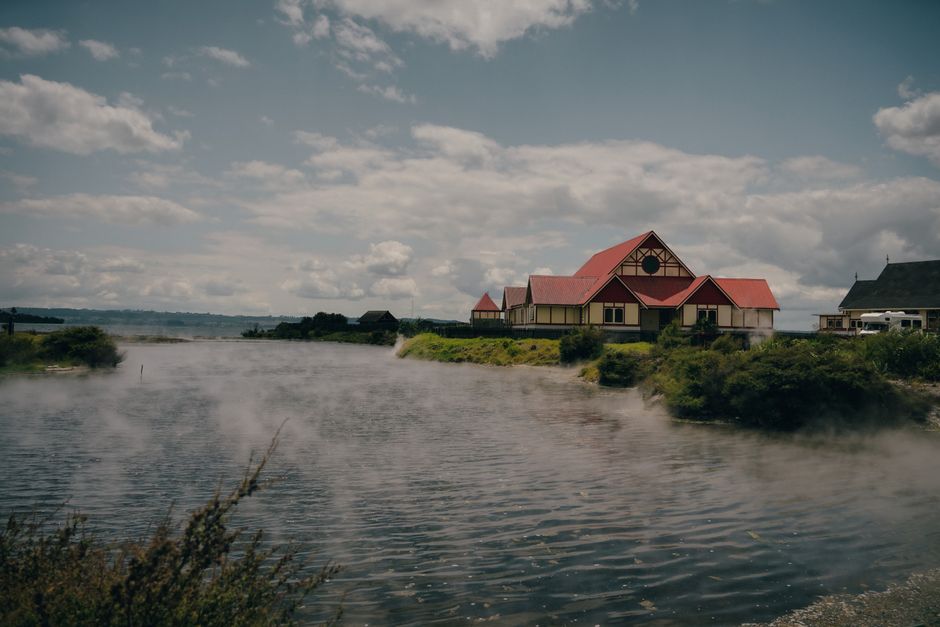
Rotorua is New Zealand’s geothermal capital, a lakeside city of about 58,000 people in the Bay of Plenty region of the North Island, built over one of the most active geothermal fields on Earth. Steam drifts from parks, backyards and roadside drains, hot springs bubble along the lakeshore, and the air carries a faint smell of sulfur. Around the city are erupting geysers, boiling mud pools, brilliantly colored silica terraces and crater lakes, together with the huge redwood forest on its edge, mountain-bike trails, trout-filled lakes and whitewater rafting. Rotorua is also the heartland of Te Arawa, the iwi (tribe) whose ancestors arrived on the Arawa canoe, and it has welcomed visitors to its hot springs since the 1800s. This makes it the best place in the country to experience Māori culture: a guided tour of a living village, carving and weaving, a cultural performance and a hāngī feast cooked in the earth. Hobbiton is about an hour’s drive away. Two or three days are enough for the highlights, and the city works in every season; winter evenings in a hot pool are a local favorite.
Right now in Rotorua
- Wed 6–17°C 42–63°F Partly cloudy
- Thu 11–18°C 52–64°F Partly cloudy
- Fri 11–18°C 51–64°F 2 mm Showers
Weather: MET Norway (CC BY 4.0)
Top tours in Rotorua
See all tours for Rotorua →
From local operators, with prices and reviews; you check availability and book on Viator, our partner. We may earn a commission at no extra cost to you. How we earn money
Rotorua at a glance
- Best months: December to March for warm weather, lakes and biking; any time of year for geothermal sights and hot pools.
- Time needed: two to three days for the geothermal parks, a cultural evening, the redwoods and Hobbiton.
- Getting there: about 3 hours’ drive from Auckland (230 km, 143 miles) and 1 hour from Taupō; Rotorua Airport has flights from Auckland, Wellington and Christchurch.
- Costs (as of October 2026): prices in New Zealand dollars; the Hobbiton Movie Set tour is NZ$130 for adults (about US$73), and many geothermal parks charge NZ$40–90.
- Before you go: entry rules, the NZeTA and visitor levy, and biosecurity are in our New Zealand travel guide.
Rotorua’s areas and who each one suits
City center and Eat Streat
The grid of streets between the lake and Kuirau Park has most of the motels, hotels and restaurants, with Eat Streat, a covered dining strip, at the lakefront end of Tutanekai Street. It is walkable to the Government Gardens, the lake and the free Kuirau Park mud pools. Best for first-timers without a car.
Fenton Street
The long road south from the center is lined with motels, many with private thermal or spa pools, and leads to Whakarewarewa and Te Puia. Good value for families and road-trippers.
The lakefront and Ngongotahā
Lakeside resorts and holiday homes around the shores of Lake Rotorua, and the village of Ngongotahā to the northwest near the Skyline gondola, offer quieter stays with lake views.
Lake Tarawera and the lakes
East of the city, Lake Tarawera, Lake Ōkāreka and the Blue and Green Lakes have lodges, cabins and campgrounds among the forest. Choose these for peace and water sports; you’ll need a car.
Top things to see in Rotorua
Te Puia and Whakarewarewa
On the southern edge of the city, the Te Whakarewarewa geothermal valley is home to Pōhutu, the largest active geyser in the Southern Hemisphere, which erupts many times a day to heights of up to 30 m (100 feet). Te Puia runs guided tours of the valley’s geysers, mud pools and a kiwi enclosure, and is home to the New Zealand Māori Arts and Crafts Institute, where you can watch students learning wood carving, stone carving and weaving. Next door, Whakarewarewa – The Living Māori Village is a community where families of the Tūhourangi Ngāti Wāhiao people still live among the hot springs, cooking food in the steam boxes and bathing in natural pools; guided tours and cultural performances run daily. Both offer evening experiences with a hāngī dinner.
Wai-O-Tapu Thermal Wonderland
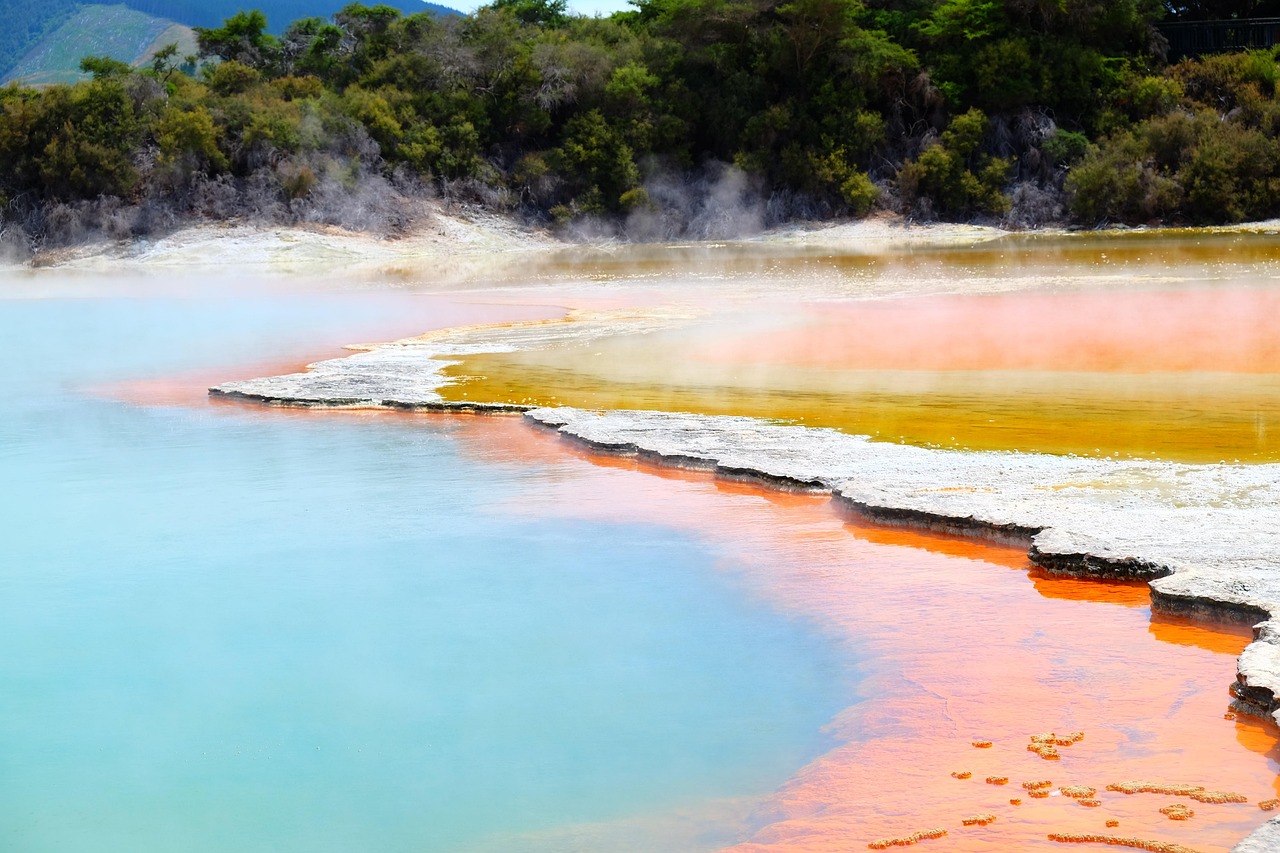
About 30 minutes south on State Highway 5, Wai-O-Tapu has the most colorful geothermal features in the country: the orange-rimmed Champagne Pool, the lime-green Devil’s Bath, sulfur crater walls and silica terraces, along a 3 km (2-mile) walking loop. Nearby, the Lady Knox Geyser is induced to erupt each morning at about 10:15 a.m., and free bubbling mud pools are a short drive away.
Waimangu, Hell’s Gate and other thermal parks
Waimangu Volcanic Valley, created by the 1886 eruption of Mount Tarawera, is the world’s youngest geothermal ecosystem, with a downhill walk past Frying Pan Lake (one of the world’s largest hot springs) and the steaming Inferno Crater to a lake cruise. Hell’s Gate (Tikitere), northeast of the city, has violent mud pools, a hot waterfall and mud baths. Orakei Korako, on the way to Taupō, has terraces and a cave reached by a short boat ride.
Redwoods Whakarewarewa Forest
Five minutes from the center, the forest has a grove of Californian coast redwoods planted more than a century ago, now over 60 m (200 feet) tall. Walking tracks are free; the Redwoods Treewalk suspends a path of bridges between the trees, beautifully lit with lanterns at night. The surrounding forest has one of the world’s best mountain-bike networks, with more than 130 km (80 miles) of trails for every level.
Government Gardens and Kuirau Park
The formal gardens on the lakefront surround the Tudor-style Bath House, home of the Rotorua Museum, which closed in 2016 for earthquake strengthening; check the museum’s website for its reopening. The Blue Baths, a 1930s Spanish Mission-style pool, still welcome swimmers. Kuirau Park, in the city, has free steaming lakes, bubbling mud and a hot-water footbath.
Ōhinemutu village and St Faith’s Church
On the lakefront just north of the center, Ōhinemutu is the original Te Arawa village of Rotorua, still home to Ngāti Whakaue families. Steam rises between the houses and graves, and the carved meeting house Tamatekapua faces the lake. Opposite stands St Faith’s Anglican Church, built in 1914 and decorated inside with Māori carving and tukutuku (woven) panels; a window etched with a figure of Christ wearing a Māori cloak seems to walk on the waters of the lake behind it. Visitors are welcome to walk through respectfully: keep to the paths, don’t enter the marae (meeting grounds) uninvited, and ask before photographing people. Entry to the church is by donation.
Lake Rotorua and the Blue and Green Lakes
Cruise or kayak to Mokoia Island, a wildlife sanctuary in the middle of Lake Rotorua and the setting of the Māori love story of Hinemoa and Tūtānekai. To the east, the Blue Lake (Tikitapu) is a popular swimming lake with a 5.5 km (3.4-mile) walk around it, and the Green Lake (Rotokākahi), beside it, is sacred to local Māori and closed to the public; view it from the lookout.
Other things to do in Rotorua
- Hot pools: the Polynesian Spa on the lakefront has alkaline and acidic pools, and Kerosene Creek and other free natural pools are in the forests south of town (never put your head under in natural hot water; see Safety).
- A cultural evening: several Māori-owned venues offer a welcome ceremony, haka and song, and a hāngī dinner.
- Skyline Rotorua: a gondola up Mount Ngongotahā with lake views, a restaurant and a luge.
- Whitewater rafting: the Kaituna River at Okere Falls has the Tutea Falls, a 7 m (23-foot) drop said to be the highest commercially rafted waterfall in the world.
- Trout fishing: Rotorua’s lakes and streams are famous for rainbow and brown trout; a fishing license is required.
- Te Wairoa, the Buried Village: the excavated remains of a village destroyed by the 1886 Tarawera eruption, with a museum and waterfall walk.
- Wildlife: Paradise Valley Springs and Rainbow Springs have kiwi and native birds.
Food and drink
The hāngī is the meal to try: meat and vegetables, including kūmara (sweet potato), steamed for hours in an earth oven heated with stones, or in a geothermal steam box at Whakarewarewa. Eat Streat on the lakefront has a cluster of restaurants with outdoor heating, and the city has good Indian, Thai and Japanese food. Look for “hāngī pies” and steam-cooked corn sold at the living village.
Day trips from Rotorua
Hobbiton Movie Set
The Shire from The Lord of the Rings and The Hobbit films is on a farm near Matamata, about an hour’s drive northwest. Guided tours of the hobbit holes, the party field and the Green Dragon Inn take about 2.5 hours and cost NZ$130 for adults, NZ$65 for ages 11 to 17 and nothing for children 10 and under, with a NZ$332 family pass. Tours leave from The Shire’s Rest on Buckland Road and from the Matamata information center; booking is essential.
Taupō and Huka Falls
An hour south, Taupō has the thundering Huka Falls, Craters of the Moon, cruises to the Māori rock carvings on New Zealand’s largest lake and, beyond it, the Tongariro Alpine Crossing.
Waitomo Caves
About two hours west, glowworm grottos and black-water rafting; combine with Hobbiton on a day trip or on your way to Auckland.
Tauranga and Mount Maunganui
An hour north on the coast, climb Mauao (Mount Maunganui) for the view and swim at the surf beach below.
Nearby destinations
- Taupo63 km
- Tongariro National Park132 km
- Auckland194 km
Getting there and getting around
By road and air
Rotorua is about 3 hours from Auckland by car via State Highway 1 and 5, 1 hour from Taupō and 1 hour from Tauranga. InterCity coaches link it with Auckland, Wellington and other towns. Rotorua Airport, 10 minutes from the center, has Air New Zealand flights from Auckland, Wellington and Christchurch.
Getting around
The city center is compact and walkable, and local buses (Baybus Cityride) serve the suburbs and some attractions. But the best geothermal parks, the lakes and Hobbiton are outside town, so a car, a tour or a shuttle is the practical option. Many attractions run pickups from hotels.
When to go and how long to stay
Rotorua sits about 280 m (920 feet) above sea level, so it is a little cooler than the coast. Summer (December to February) is warm, with highs around 23 °C (73 °F), ideal for lakes and biking. Autumn (March to May) is mild and settled. Winter (June to August) brings cold nights, often near freezing, with frost and fog, but bright days are common and the steam and hot pools are at their most atmospheric. Spring (September to November) is changeable. Rain is spread through the year.
| Month | Average high | Average low | Rain | Rain days (≥1 mm) |
|---|---|---|---|---|
| Jan | 23 °C (73 °F) | 13 °C (55 °F) | 94 mm (3.7 in) | 8 |
| Feb | 23 °C (74 °F) | 13 °C (56 °F) | 100 mm (4.0 in) | 8 |
| Mar | 21 °C (70 °F) | 11 °C (52 °F) | 100 mm (3.9 in) | 8 |
| Apr | 18 °C (65 °F) | 9 °C (48 °F) | 133 mm (5.2 in) | 9 |
| May | 15 °C (59 °F) | 7 °C (44 °F) | 130 mm (5.1 in) | 10 |
| Jun | 13 °C (55 °F) | 4 °C (40 °F) | 132 mm (5.2 in) | 11 |
| Jul | 12 °C (54 °F) | 4 °C (39 °F) | 137 mm (5.4 in) | 11 |
| Aug | 13 °C (55 °F) | 4 °C (39 °F) | 125 mm (4.9 in) | 12 |
| Sep | 14 °C (58 °F) | 6 °C (42 °F) | 107 mm (4.2 in) | 11 |
| Oct | 16 °C (62 °F) | 7 °C (45 °F) | 93 mm (3.7 in) | 10 |
| Nov | 19 °C (65 °F) | 9 °C (48 °F) | 87 mm (3.4 in) | 9 |
| Dec | 21 °C (69 °F) | 12 °C (53 °F) | 117 mm (4.6 in) | 11 |
| Year | 17 °C (63 °F) | 8 °C (47 °F) | 1,356 mm (53.4 in) | 119 |
Figures are NIWA’s 1991–2020 climate normals for Rotorua. The city records about 1,360 mm (54 in) of rain a year, with rain on about 120 days.
Events worth planning around
- Waitangi Day (6 February, observed Monday 8 February 2027) and Matariki (Friday 25 June 2027), with cultural events across the city.
- Crankworx Rotorua, a big mountain-bike festival in the Whakarewarewa Forest, usually held in autumn.
- The Rotorua Marathon, one of New Zealand’s oldest, around the lake in autumn.
- School holidays in January, April, July and late September, when the family attractions are busiest.
Dates change every year; check the organizers’ sites before you book.
How long to stay: 1, 2 and 4 days
- One day: Te Puia or Whakarewarewa, Kuirau Park, the Redwoods and an evening cultural performance with a hāngī.
- Two days: add Wai-O-Tapu (time it for the Lady Knox Geyser) and a soak at the Polynesian Spa.
- Four days: add Hobbiton, Waimangu or Hell’s Gate, rafting at Okere Falls, mountain biking or the Blue Lake.
Where to stay in Rotorua
- City center: hotels and motels near Eat Streat and the lake.
- Fenton Street: dozens of motels, many with private hot pools; good value.
- Lakefront resorts: larger hotels with lake views and spas.
- Lake Tarawera and Ōkāreka: lodges, cabins and holiday homes in the forest.
- Holiday parks: several with geothermal pools, popular with campervans.
Prices include 15% GST. They peak in the summer and school holidays, but Rotorua has plenty of rooms and is one of the better-value destinations in the North Island.
Typical costs in Rotorua
| Item (as of October 2026) | New Zealand dollars | About US dollars |
|---|---|---|
| Hobbiton Movie Set tour, adult / youth 11–17 | NZ$130 / NZ$65 | US$73 / US$36 |
| Hobbiton family pass (2 adults, 2 youths) | NZ$332 | US$186 |
| Geothermal park entry, adult | about NZ$40–90 | about US$22–50 |
| Cultural evening with hāngī dinner | about NZ$140–250 | about US$80–140 |
| Hot pools entry, adult | about NZ$35–60 | about US$20–34 |
| Casual restaurant main | about NZ$25–38 | about US$14–21 |
| Motel room with spa pool, per night | about NZ$150–250 | about US$85–140 |
The Hobbiton prices are official 2026 figures. Park, cultural evening, hot pool, meal and motel prices are typical ranges from operators and booking sites, not official prices. Conversions use about US$0.56 to NZ$1.
Safety in Rotorua
- Geothermal areas: the ground can be thin and hollow near vents, and the water and mud are often boiling. Stay on marked paths and behind barriers, keep children close, and never touch the water or mud in thermal parks.
- Natural hot pools: never put your head under the water in natural hot springs or rivers. They can contain an amoeba (Naegleria fowleri) that causes a rare but deadly brain infection.
- Hydrogen sulfide: the gas can collect in hollows, drains and enclosed spaces; don’t climb down into vents or sleep in vehicles parked over thermal ground.
- Volcanic activity: GeoNet’s volcanic alert levels for Rotorua and the nearby Okataina caldera (which includes Mount Tarawera) were at 0, no volcanic unrest, in October 2026.
- Lakes and rivers: lakes are deep and cold away from the shore; wear a lifejacket when boating. Use a licensed operator for rafting.
- Driving: drive on the left; watch for logging trucks and fog on winter mornings.
- Car break-ins: don’t leave valuables in cars at forest and lake car parks.
- Emergencies: call 111.
Practical tips for Rotorua
- Time zone: New Zealand Daylight Time (UTC+13) from 27 September 2026 to 4 April 2027.
- The smell: the rotten-egg smell is hydrogen sulfide; most visitors stop noticing it within a day.
- Jewelry: silver can tarnish in the sulfurous air and hot pools; take it off before you soak.
- Book cultural evenings and Hobbiton ahead in summer.
- Free things: Kuirau Park, Government Gardens, the Redwoods walking tracks, the lakefront and the Blue Lake.
- Tipping: not expected.
- More hot-spring towns: if you love Rotorua’s steam and soaking, Japan’s Beppu is a similar onsen town on a geothermal field.
What to pack for Rotorua
Pack a swimsuit and a towel for the hot pools, comfortable walking shoes for the thermal parks, a warm jacket for the evenings (especially in winter), a rain jacket, sunscreen, and old clothes or jewelry you won’t mind getting sulfurous. Mountain bikers can rent bikes and gear in town.
Rotorua travel FAQ
What is the best geothermal park in Rotorua?
For geysers and Māori culture, Te Puia or Whakarewarewa Living Māori Village. For colors, Wai-O-Tapu with the Champagne Pool and Lady Knox Geyser. For a walk through a young volcanic landscape, Waimangu. Many visitors do two.
How far is Hobbiton from Rotorua?
About an hour’s drive, near Matamata. Tours take about 2.5 hours and cost NZ$130 for adults; book ahead.
Why does Rotorua smell?
The sulfur smell comes from hydrogen sulfide gas released by the geothermal field. It is strongest near the lake and thermal areas.
Is it safe to swim in natural hot springs around Rotorua?
Soak only where it is allowed and keep your head above the water: natural hot water can carry a rare but deadly amoeba. Never enter pools in geothermal parks.
When does the Lady Knox Geyser erupt?
It is induced to erupt every morning at about 10:15 a.m. at Wai-O-Tapu, about 30 minutes south of the city.
Where can I see a Māori cultural performance in Rotorua?
At Te Puia, Whakarewarewa Living Māori Village and other Māori-owned venues, most offering evening experiences with a hāngī dinner.
Is Rotorua worth visiting in winter?
Yes. The steam is more dramatic in cold air, the hot pools are at their best, and the main attractions are open year-round. Nights are cold, so pack warm clothes.
How long should I spend in Rotorua?
Two days covers the highlights; three or four let you add Hobbiton, rafting or mountain biking.
Can you visit Rotorua without a car?
Yes, for the city center, Kuirau Park and the Redwoods; tours and shuttles reach Hobbiton, Wai-O-Tapu and the cultural villages.
Is Rotorua on a volcano?
It sits in the Rotorua caldera, formed by a huge eruption about 240,000 years ago. GeoNet’s alert level was 0 (no unrest) in October 2026.
Sources and last review
Researched and last reviewed on 5 October 2026. Hobbiton tour prices and departure points come from Hobbiton Movie Set; volcanic alert levels from GeoNet; climate from NIWA’s 1991–2020 normals for Rotorua; holiday and daylight saving dates from Employment New Zealand and Govt.nz; exchange rates from the European Central Bank; population from Wikidata. Geyser heights, the Lady Knox Geyser time, attraction descriptions, the Rotorua Museum’s status, the amoeba warning (a long-standing Health New Zealand message), distances and drive times, event months, and park, cultural evening, hot pool, meal and motel prices are general references and flagged for checking. Prices and schedules change, so check the official sites before you go. For entry rules, biosecurity and driving, see our New Zealand travel guide.
Plan your trip
Partner links: TravelerCenter may earn a commission if you book, at no extra cost to you.