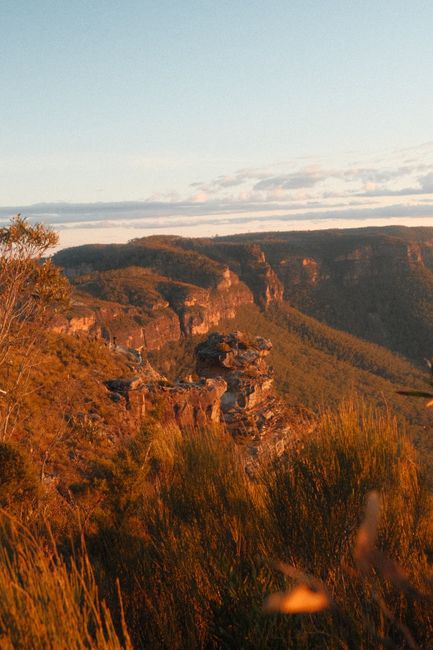
The Blue Mountains, about two hours west of Sydney, are a deeply eroded sandstone plateau of sheer cliffs, forested valleys, waterfalls and lookouts, named for the blue haze given off by millions of eucalyptus trees. They are the country of the Darug and Gundungurra peoples. Most of the area is protected in Blue Mountains National Park, which covers about 2,690 square kilometers (1,040 square miles) and forms the core of the UNESCO-listed Greater Blue Mountains World Heritage Area. A string of villages runs along the ridge-top highway and railway: Wentworth Falls, Leura, Katoomba, Blackheath and Mount Victoria, with art deco guesthouses, cafes and gardens. Katoomba’s Echo Point looks out over the Three Sisters and the Jamison Valley, and next door Scenic World carries visitors down the cliffs on the world’s steepest passenger railway. The mountains make an easy day trip from Sydney by train, but staying a night or two lets you walk the cliff-top tracks at dawn and dusk, when the light is best and the crowds thin. At about 1,000 meters (3,300 feet), the upper mountains are noticeably cooler than Sydney, with crisp winters and occasional snow.
Right now in Blue Mountains (Katoomba)
- Wed5–14°C40–57°FClear
- Thu3–17°C38–63°FClear
- Fri3–21°C37–69°FClear
Top tours in Blue Mountains
See all tours for Blue Mountains →
From local operators, with prices and reviews; you check availability and book on Viator, our partner. We may earn a commission at no extra cost to you. How we earn money
Blue Mountains at a glance
- Best months: March to May for mild, clear days and autumn colors in Leura and Mount Wilson; September to November for spring gardens. Summer is warm but busy and can bring bushfire risk; winter is cold, foggy and atmospheric.
- Time needed: a long day from Sydney for Echo Point and Scenic World; two or three days for the cliff-top walks, Blackheath and the Grose Valley.
- Getting there: trains run from Sydney’s Central Station to Katoomba in about two hours; by car it’s about 1.5 to 2 hours.
- Costs (as of October 2026): the Three Sisters lookouts are free. A Scenic World Day Pass costs from $64 for adults; an adult Opal train fare from Sydney is $10.66 at peak times or $7.46 off-peak.
- Before you go: entry rules (ETA, eVisitor or visa), biosecurity and money are covered in our Australia travel guide.
Blue Mountains towns and who each one suits
Katoomba
The main town and transport hub, with Echo Point, Scenic World, the most hotels and hostels, art deco cafes on Katoomba Street and the start of many walks. Stay here without a car.
Leura
The prettiest village, one station east of Katoomba, with a tree-lined mall of boutiques and cafes, heritage gardens and quieter cliff-top lookouts. It suits couples and garden lovers.
Wentworth Falls
Further east, known for its waterfall and the dramatic National Pass track along a ledge in the cliffs. It’s good for hikers and has a lake and picnic areas.
Blackheath and Mount Victoria
Higher and quieter, Blackheath is the gateway to Govetts Leap and the Grose Valley, with good restaurants and guesthouses. Mount Victoria has a village feel and historic hotels. Both suit walkers who want to escape the day-trip crowds.
Top things to see in the Blue Mountains
Echo Point and the Three Sisters
From the Echo Point lookout in Katoomba, the three weathered sandstone pillars of the Three Sisters rise nearly a kilometer above sea level against the Jamison Valley and Mount Solitary. The Echo Point visitor information center has maps and local information. The easy Three Sisters walk is 0.8 km (0.5 miles) return, takes 25 to 45 minutes and is grade 1. It follows a gently sloping path 400 meters to Oreades lookout, then steps lead 50 meters to Lady Game lookout. A short but very steep flight of stairs leads down to Honeymoon Bridge, which crosses to the first sister. The site is the Three Sisters Aboriginal Place, of special cultural significance to Aboriginal people. In busy summer, weekend and holiday periods there may be a queue for the stairs. Arrive early or late for softer light and fewer people.
The Giant Stairway
For more of a challenge, the Giant Stairway drops about 998 steps from the Three Sisters into the valley. From the bottom, you can follow the Dardanelles Pass loop or continue through rainforest to Scenic World and ride the railway back up. The return climb is hard work, so check your fitness and allow two to three hours.
Scenic World
Built on the site of a 1940s coal mine, Scenic World has welcomed visitors since 1945. Its four rides and walks are the Scenic Railway, the steepest passenger railway in the world, at a 52-degree incline through a cliff tunnel into the rainforest; the Scenic Skyway, a cable car across the gorge with views of Katoomba Falls and the Three Sisters; the Scenic Cableway, an enclosed cable car down into the Jamison Valley; and the Scenic Walkway, an elevated boardwalk through the rainforest past old mining relics. It’s open daily from 8:45 a.m. to 5 p.m. A Day Pass covering all the rides costs from $64 for adults and from $38.40 for children, and an Unlimited Discovery pass from $79. Book online: sessions can sell out in advance.
Wentworth Falls and the National Pass
The Wentworth Falls lookouts give views of the falls plunging into the Jamison Valley. The National Pass, a historic track cut into the cliffs in the early 1900s, is one of Australia’s finest day walks, with stairs, ledges and waterfalls; it is strenuous and should only be attempted in good weather.
Govetts Leap and the Grose Valley
At Blackheath, Govetts Leap lookout looks over the wilderness of the Grose Valley and Bridal Veil Falls. The cliff-top track from Govetts Leap to Evans Lookout is a superb half-day walk.
The Grand Cliff Top Walk
The Grand Cliff Top Walk links Wentworth Falls, Leura and Katoomba along the escarpment edge for about 19 km (12 miles), usually walked over two days with a night in Leura or Katoomba. You can also walk short sections between lookouts and return by train.
Aboriginal culture in the mountains
The Darug and Gundungurra peoples have cared for these valleys for thousands of years, and their stories explain landmarks such as the Three Sisters. Look for hand stencils at Red Hands Cave near Glenbrook, grinding grooves along creeks in the lower mountains, and Aboriginal-guided walks and cultural experiences offered in Katoomba, including at Scenic World. Treat rock art sites with care: don’t touch the art, and keep to boardwalks.
Lookouts without the crowds
Echo Point can be packed by late morning, but dozens of other lookouts line the escarpment. In Leura, Sublime Point and Gordon Falls Reserve are short drives or walks from the village. In Katoomba, Cahills Lookout looks over the Megalong Valley at sunset. Near Blackheath, Evans Lookout and Pulpit Rock face the Grose Valley, and Anvil Rock and the Wind Eroded Cave are reached on a short gravel road. Most have parking and short, easy paths.
Other things to do in the Blue Mountains
- Jenolan Caves: spectacular limestone show caves about 1.5 hours’ drive southwest of Katoomba; book cave tours ahead.
- Megalong Valley: a scenic valley below Blackheath with horse riding, a tea room and farm stays.
- Canyoning and abseiling: licensed operators in Katoomba run guided trips into slot canyons and down cliffs.
- Gardens: Leura’s heritage gardens and Mount Tomah’s Blue Mountains Botanic Garden.
- Glenbrook and the lower mountains: Red Hands Cave and the Euroka campground with its kangaroos; a vehicle fee of $8 per day applies only at attractions in the Glenbrook area.
Food and drink
The mountains are known for cozy cafes, bakeries and long lunches. Try Leura and Blackheath’s restaurants, a “Devonshire tea” of scones, jam and cream in a historic guesthouse, and local craft beer. Tipping is optional.
Day trips and nearby
From Sydney
The Blue Mountains are the classic day trip from Sydney. For an independent day, take an early train to Katoomba, walk to Echo Point, take the Three Sisters walk, ride Scenic World and return via Leura. Tours from Sydney often add wildlife parks and a river cruise on the way back.
Jenolan Caves and Kanangra-Boyd
Beyond Katoomba, the road to Jenolan Caves passes through farmland and forest. Kanangra-Boyd National Park, further south, has the remote Kanangra Walls lookout.
Lithgow and the Glow Worm Tunnel
West of the mountains, Lithgow has industrial heritage, the Glow Worm Tunnel in Wollemi National Park and access to the Wolgan Valley.
Hunter Valley and beyond
For a longer trip, continue to the wine country of the Hunter Valley via the Bells Line of Road, or to the historic towns of Bathurst and Orange.
Getting there and getting around
By train from Sydney
Sydney Trains’ Blue Mountains Line runs from Central Station to Wentworth Falls, Leura, Katoomba, Blackheath and Mount Victoria, about two hours to Katoomba. Tap on and off with an Opal card or a contactless bank card or phone. A trip of more than 65 km costs $10.66 for adults at peak times and $7.46 off-peak, and fares are 30% cheaper on Fridays, weekends, public holidays and outside peak times. Daily caps limit what you pay: $19.30 a day Monday to Thursday and $9.65 on Fridays, weekends and public holidays.
By car
From Sydney, the Great Western Highway (M4 then A32) climbs into the mountains, about 1.5 to 2 hours to Katoomba depending on traffic. Parking at Echo Point and Scenic World fills on weekends and holidays.
Getting around the mountains
Local buses link Katoomba, Leura, Echo Point and Scenic World, and hop-on, hop-off sightseeing buses loop past the main attractions. Many lookouts are also connected by walking tracks. A car is the easiest way to reach Blackheath’s lookouts, Jenolan Caves and the Megalong Valley.
When to go and how long to stay
Katoomba has a cool, temperate mountain climate. Summer (December to February) brings warm days around 23–24 °C (73–76 °F), occasional storms and the busiest crowds. Autumn (March to May) has mild days and the red and gold of introduced trees in Leura and Mount Wilson. Winter (June to August) is cold, with highs around 11–12 °C (51–54 °F), frosty nights and occasional snow; it’s the season of “Christmas in July” celebrations. Spring (September to November) brings blossoms and garden festivals. Mist and fog can roll in at any time and hide the views, so check webcams or the forecast before you go.
| Month | Average high | Average low | Rain | Rain days (≥1 mm) |
|---|---|---|---|---|
| Jan | 24 °C (76 °F) | 14 °C (56 °F) | 148 mm (5.8 in) | 13 |
| Feb | 23 °C (73 °F) | 13 °C (56 °F) | 210 mm (8.3 in) | 12 |
| Mar | 21 °C (69 °F) | 12 °C (53 °F) | 168 mm (6.6 in) | 12 |
| Apr | 18 °C (64 °F) | 9 °C (48 °F) | 87 mm (3.4 in) | 8 |
| May | 14 °C (57 °F) | 6 °C (43 °F) | 80 mm (3.1 in) | 7 |
| Jun | 11 °C (52 °F) | 4 °C (39 °F) | 105 mm (4.1 in) | 8 |
| Jul | 11 °C (51 °F) | 3 °C (37 °F) | 55 mm (2.2 in) | 7 |
| Aug | 12 °C (54 °F) | 3 °C (38 °F) | 66 mm (2.6 in) | 7 |
| Sep | 16 °C (60 °F) | 6 °C (42 °F) | 64 mm (2.5 in) | 7 |
| Oct | 18 °C (65 °F) | 8 °C (46 °F) | 90 mm (3.6 in) | 8 |
| Nov | 21 °C (69 °F) | 10 °C (50 °F) | 132 mm (5.2 in) | 12 |
| Dec | 23 °C (73 °F) | 12 °C (53 °F) | 112 mm (4.4 in) | 11 |
| Year | 18 °C (64 °F) | 8 °C (47 °F) | 1,309 mm (52 in) | 114 |
Figures are the Bureau of Meteorology’s 1991–2020 statistics for Katoomba (Farnells Road), in the upper mountains.
Events worth planning around
- Winter Magic Festival (June): a street festival in Katoomba around the winter solstice.
- Yulefest (June to August): “Christmas in July” dinners at guesthouses.
- Leura Gardens Festival (October): private gardens open to visitors.
Dates vary; check the organizers’ websites.
How long to stay: 1, 2 and 3 days
- One day: Echo Point and the Three Sisters walk, Scenic World and Leura village.
- Two days: add the Grand Cliff Top Walk between Leura and Katoomba or Wentworth Falls, and Govetts Leap at sunset.
- Three days: add the National Pass or Giant Stairway, and Jenolan Caves or the Megalong Valley.
Where to stay in the Blue Mountains
- Katoomba: historic hotels, motels and hostels close to the station and Echo Point.
- Leura: boutique B&Bs, guesthouses and a large resort.
- Blackheath and Medlow Bath: cottages, guesthouses and a grand cliff-top heritage hotel.
- Megalong Valley and Wolgan Valley: farm stays and a luxury eco-resort.
Weekends and school holidays are busiest; weekdays are cheaper and quieter.
Typical costs in the Blue Mountains
| Item (as of October 2026) | Australian dollars | About US dollars |
|---|---|---|
| — | — | — |
| Three Sisters walk and Echo Point lookouts | Free | Free |
| Scenic World Day Pass, adult / child | from $64 / from $38.40 | from $44 / from $26 |
| Opal train fare, Sydney–Katoomba, adult (peak / off-peak) | $10.66 / $7.46 | $7.40 / $5.10 |
| Opal daily cap (Mon–Thu / Fri–Sun) | $19.30 / $9.65 | $13.30 / $6.70 |
| Vehicle fee, Glenbrook area only | $8 per day | $5.50 |
| Jenolan Caves tour, adult | about $50–70 | about $35–50 |
| Mid-range hotel or B&B, per night | about $180–350 | about $125–240 |
Scenic World, Opal and park fees are official; other prices are typical ranges, not official prices. Conversions use about US$0.69 to A$1.
Safety in the Blue Mountains
- Bushfire season: roughly October to March. The 2019–20 fires burned much of the national park. Check NSW Rural Fire Service fire danger ratings and park alerts before walking; tracks close on high-risk days and total fire bans may be in force.
- Cliff edges: stay behind barriers and on marked tracks; sandstone edges can crumble, and falls are a leading cause of rescues.
- Weather and getting lost: mountain weather is colder and changes faster than in Sydney, and fog can roll in quickly. Carry water, a jacket and a charged phone, leave a trip intention with someone, and consider a personal locator beacon on longer walks.
- Stairs and fitness: many walks involve hundreds of steps; the climb out of the valley is much harder than the descent.
- Canyons and creeks: flash floods can occur in canyons after storms; go with a licensed guide.
- Emergencies: call 000 (112 also works from mobile phones).
Practical tips for the Blue Mountains
- Time zone: Australian Eastern Time, the same as Sydney; daylight saving runs from 4 October 2026 to 4 April 2027.
- Start early: Echo Point and Scenic World are busiest from late morning; the first trains from Sydney beat the coaches.
- Park access: the Katoomba area is always open, but individual tracks may close for maintenance, poor weather or fire danger; check NSW National Parks alerts.
- Plugs and money: type I plugs at 230 V; cards accepted almost everywhere.
What to pack for the Blue Mountains
Pack layers even in summer, a waterproof jacket, sturdy walking shoes with good grip for wet stairs, a hat, sunscreen and a water bottle. In winter, bring a warm coat, beanie and gloves.
Blue Mountains travel FAQ
How do I get to the Blue Mountains from Sydney?
Take the train from Central Station to Katoomba, about two hours, paying with Opal or a contactless card, or drive about 1.5 to 2 hours on the Great Western Highway.
How much does it cost to see the Three Sisters?
Nothing. Echo Point lookout and the Three Sisters walk are free.
How long is the Three Sisters walk?
It’s 0.8 km return and takes 25 to 45 minutes, with steep stairs if you continue to Honeymoon Bridge.
How much is Scenic World?
A Day Pass costs from $64 for adults and from $38.40 for children, covering the Railway, Skyway, Cableway and Walkway. Book online.
Is the Scenic Railway the steepest in the world?
Yes. It descends at a 52-degree incline and is the steepest passenger railway in the world.
Is the Blue Mountains a good day trip from Sydney?
Yes, but staying overnight lets you walk at sunrise and sunset and see Blackheath’s lookouts.
Do you need to pay to enter Blue Mountains National Park?
Not in the Katoomba area. A vehicle fee of $8 per day applies only at attractions in the Glenbrook area.
When is the best time to visit the Blue Mountains?
Autumn (March to May) and spring (September to November) for mild weather and clear views.
Does it snow in the Blue Mountains?
Occasionally, in winter, in the upper mountains around Katoomba, Blackheath and Mount Victoria.
Why are the Blue Mountains blue?
Oil released by the eucalyptus forests scatters light, giving the valleys a blue haze.
Plan your trip
Partner links: TravelerCenter may earn a commission if you book, at no extra cost to you.
Sources · last reviewed 5 October 2026
Researched and last reviewed on 5 October 2026. Three Sisters walk details, the Giant Stairway step count, the Aboriginal Place, park opening, the Glenbrook vehicle fee, the Grand Cliff Top Walk and track totals come from NSW National Parks and Wildlife Service; Scenic World’s history, rides, opening hours and pass prices from Scenic World; Opal fares, discounts and daily caps from Transport for NSW; daylight saving dates from the NSW Government; climate from the Bureau of Meteorology’s 1991–2020 statistics for Katoomba (Farnells Road); park area and coordinates from Wikidata. The World Heritage listing, train and drive times, Jenolan Caves, canyoning, festivals, the 2019–20 fires and typical prices are general references and flagged for checking. For entry rules, biosecurity and money, see our Australia travel guide.
Data: Weather: MET Norway (CC BY 4.0) · Rates: ECB · Costs: World Bank ICP and price levels · Wikidata (CC0)