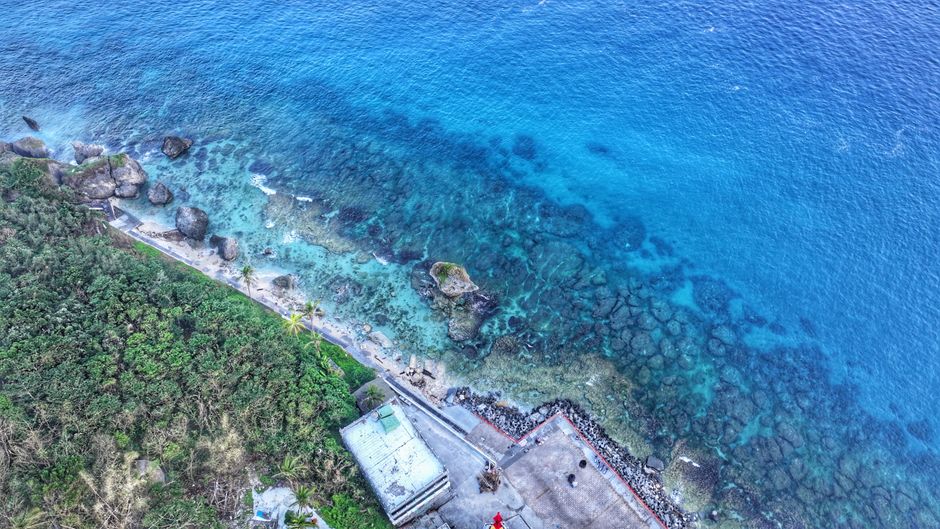
The Northern Mariana Islands, officially the Commonwealth of the Northern Mariana Islands (CNMI), are a US commonwealth of 14 volcanic and limestone islands stretching about 650 km (400 miles) north of Guam in the western Pacific. Almost everyone lives on the three southern islands: Saipan, the capital and main destination, with its long western lagoon, beach hotels and World War II battlefields; Tinian, a quiet farming island that was once the world’s busiest airfield and the launch site of the atomic bomb missions of 1945; and Rota, a green, rural island of cliffs, caves and latte stone quarries. The islands are the home of the Chamorro and Carolinian peoples, with Spanish, German, Japanese and American layers on top. Visitors come for warm, clear water and reefs, easy family beach holidays, diving at the Grotto, golf, and history. About 47,000 people live in the CNMI. Entry follows US rules, plus the Guam–CNMI Visa Waiver Program for travelers from 12 countries and areas. The islands are still recovering from Super Typhoon Sinlaku, which struck Saipan and Tinian in April 2026.
Right now in Northern Mariana Islands
- Wed 25–26°C 77–79°F 8 mm Rain
- Thu 25–28°C 77–83°F 1 mm Light showers
- Fri 26–27°C 78–81°F 5 mm Rain
- Tue 13 Oct Commonwealth Cultural Day
Weather: MET Norway (CC BY 4.0) · Holidays: Nager.Date
Multi-day tours of Northern Mariana Islands
Multi-day tours from local operators. You check dates and book on Viator, our partner; we may earn a commission at no extra cost to you. How we earn money
Northern Mariana Islands at a glance: overview and geography
- Political status: a self-governing commonwealth in political union with the United States since 1978; people born in the CNMI are US citizens. The local name you’ll see everywhere is “the Marianas.”
- Capital: Saipan; the government offices are on Capitol Hill, and the main town and tourist center is Garapan.
- Population and size: about 47,000 people on 464 km² (179 sq miles) of land. Saipan covers about 115 km² (44 sq miles); Tinian and Rota are a little smaller.
- Languages: English, Chamorro and Carolinian are official. Greetings: håfa adai (Chamorro) and tirow (Carolinian). Korean, Japanese and Chinese are common in tourism.
- Currency: the US dollar.
- Time zone: Chamorro Standard Time, UTC+10 all year, the same as Guam.
- Driving: on the right.
- Power: 120 volts with US plugs.
- Emergency number: 911.
The islands
Saipan has a sheltered lagoon along its west coast, where the hotels, the town of Garapan and Micro Beach face Managaha Island; a rugged east coast of cliffs and bays such as Lau Lau and Obyan; and in the north, the Marpi area of World War II memorials and cliffs. Tinian, just 5 km (3 miles) south across the Saipan Channel, is flat and pastoral, with huge wartime runways, white beaches and a single village, San Jose. Rota, about halfway between Tinian and Guam, is the most traditional of the three, with the village of Songsong, rainforest, a natural ocean pool and cliffs. The ten Northern Islands, including active volcanoes such as Anatahan and Pagan, are uninhabited or nearly so and closed to casual visits.
Where to go: Saipan, Tinian and Rota
Saipan
Saipan is where nearly all visitors stay. Garapan has the hotels, restaurants, duty-free shops and nightlife; Managaha Island, a small, sandy islet in the lagoon, is a 15-minute boat ride for snorkeling and beach days; and American Memorial Park, run by the US National Park Service, honors the Americans and Marianas people who died in the 1944 Battle of Saipan. In the north, the Grotto is a collapsed limestone cavern full of blue light, one of the Pacific’s most famous dive sites, and the cliffs of Marpi, Suicide Cliff, Banzai Cliff, the Last Command Post and the Bird Island Lookout, are places of memory where many Japanese soldiers and civilians died at the end of the battle. Mount Tapochau, Saipan’s highest point at 466 m (1,529 feet), has a 360-degree view of the islands.
Tinian
A short flight or boat ride from Saipan, Tinian is green, flat and peaceful. Its North Field, built by the US in 1944–45, was once the busiest airfield in the world; you can drive its vast runways and visit the pits where the atomic bombs dropped on Hiroshima and Nagasaki were loaded onto the B-29s Enola Gay and Bockscar in August 1945, now a National Historic Landmark. In San Jose, the House of Taga preserves the largest latte stones ever raised, linked to the legendary Chamorro chief Taga. Tinian also has Japanese shrines, a blowhole, quiet beaches such as Taga Beach and Tachogna, and good diving. It is easy to see in a day trip, but an overnight stay lets you enjoy its calm.
Rota
Rota, known locally as Luta, sees few tourists and is the best place to experience village life in the Marianas. Swim in the Swimming Hole, a natural pool protected from the ocean by rocks, at Songsong; visit the Taga stone quarry, where giant latte stones lie unfinished; walk to cliffs and seabird colonies on the Sabana plateau; and dive some of the clearest water in Micronesia. Rota has direct flights from Guam as well as from Saipan.
World War II sites across the islands
The Marianas were at the center of the Pacific War. Japan, which had governed the islands since 1914 and settled tens of thousands of people here to grow sugarcane, fortified them heavily. US forces landed on Saipan on 15 June 1944; the battle lasted more than three weeks and killed thousands of American and Japanese soldiers and many local and Japanese civilians, some of whom leaped from the Marpi cliffs rather than surrender. Tinian fell weeks later and was turned into a vast bomber base. Today the sites are quiet and moving:
- American Memorial Park, Saipan: a National Park Service memorial in Garapan with a Court of Honor listing the American dead, a carillon, a visitor center with a museum on the battle (open Tuesdays, Thursdays, Fridays and Saturdays, 9 a.m. to 4 p.m.) and mangroves and beach paths open around the clock.
- Marpi, Saipan: Suicide Cliff, Banzai Cliff, the Last Command Post with its bunker and guns, and peace memorials erected by Japanese and Okinawan families. The Marianas Visitors Authority broke ground in September 2026 on a project to rebuild walkways, viewing platforms and parking at Bird Island Lookout, Suicide Cliff and the Last Command Post, due to be finished in summer 2027, so expect construction at these sites.
- Japanese Jail and other ruins, Saipan: the remains of prewar Japanese buildings and the old sugar industry in Garapan and the south.
- North Field, Tinian: runways, bomb-loading pits and Japanese command buildings; one of the most significant sites of the 20th century.
Island hopping in the Marianas
Saipan, Tinian and Rota are close together but linked mainly by air. Small commuter planes fly from Saipan to Tinian in about 10 minutes, several times a day, and to Rota in about 30 minutes; Rota also has flights to Guam, so you can travel Saipan, Tinian, Rota and Guam in one trip. Boats between Saipan and Tinian have run on and off over the years, with special sailings for festivals such as the Tinian Hot Pepper Festival; ask the Marianas Visitors Authority or your hotel about current service. Day tours from Saipan to Tinian often include the flight, a guide and a car. The Northern Islands, from Farallon de Medinilla to Farallon de Pajaros, are uninhabited or nearly so, volcanically active in places and closed to casual visits.
More to see
- Forbidden Island, Saipan: a steep trail down the east-coast cliffs to a rocky islet, tide pools and a cove; go with a guide, in dry weather and calm seas.
- Lau Lau Bay, Saipan: a wide east-coast bay with snorkeling and shore diving among coral and turtles.
- Kalabera Cave, Saipan: a large cave in the north with ancient rock art, used as a shelter in wartime.
- NMI Museum of History and Culture, Saipan: in a former Japanese hospital in Garapan, with displays on Chamorro and Carolinian culture, shipwreck finds and the war.
- Tinian’s blowhole and Japanese shrines: on the rocky coast and in the countryside around San Jose.
- Rota’s As Matmos cliffs and bird sanctuary: dramatic sea cliffs and nesting seabirds on the north and east coasts.
Saipan Travel Guide
Plan a trip to Saipan: Managaha Island, American Memorial Park, the Grotto, Banzai Cliff, Suicide Cliff, Bird Island and the Last Command Post, Mount…
Best time to visit the Northern Mariana Islands
The Marianas are warm and humid year-round, with highs of 29 to 31 °C (84 to 88 °F). The dry season runs from about December to June, with steady trade winds, the least rain and calm seas on the west coast; February to April is the driest. The wet season runs from about July to November, with heavy showers and the main typhoon risk, though typhoons can occur in any month. According to the National Park Service, the rainy season with the possibility of typhoons is July through November, and the dry season December through June.
| Month | Saipan high / low | Rain | Days with 2.5 mm (0.1 in) or more |
|---|---|---|---|
| Jan | 29 / 24 °C (84 / 75 °F) | 93 mm (3.6 in) | 7 |
| Feb | 29 / 23 °C (84 / 74 °F) | 64 mm (2.5 in) | 6 |
| Mar | 29 / 24 °C (85 / 75 °F) | 50 mm (2.0 in) | 5 |
| Apr | 31 / 25 °C (87 / 77 °F) | 70 mm (2.8 in) | 6 |
| May | 31 / 26 °C (88 / 78 °F) | 79 mm (3.1 in) | 7 |
| Jun | 31 / 26 °C (88 / 79 °F) | 108 mm (4.2 in) | 10 |
| Jul | 31 / 26 °C (88 / 78 °F) | 189 mm (7.4 in) | 15 |
| Aug | 31 / 25 °C (87 / 78 °F) | 327 mm (12.9 in) | 16 |
| Sep | 31 / 25 °C (87 / 77 °F) | 290 mm (11.4 in) | 16 |
| Oct | 30 / 25 °C (87 / 77 °F) | 272 mm (10.7 in) | 17 |
| Nov | 30 / 25 °C (87 / 77 °F) | 132 mm (5.2 in) | 11 |
| Dec | 30 / 25 °C (86 / 76 °F) | 96 mm (3.8 in) | 9 |
Figures are NOAA’s 1991–2020 climate normals for Saipan International Airport: mean daily maximum and minimum temperature, total rainfall and days with at least 2.5 mm (0.1 in) of rain. The airport records about 1,770 mm (70 in) a year, less than Guam. Sea temperatures stay around 27 to 29 °C (81 to 84 °F).
Typhoons and Super Typhoon Sinlaku
The Marianas lie in the western Pacific’s typhoon belt. On the night of 14 April 2026, the eye of Super Typhoon Sinlaku passed over Saipan and Tinian with winds estimated at about 240 km/h (150 mph), causing deaths, widespread damage, power outages and flooding; Super Typhoon Yutu had struck the same islands in October 2018. The Marianas Visitors Authority reported that international flights began resuming in late June 2026 and that the islands were continuing to recover through the summer. As of October 2026, hotels and attractions are reopening in stages; check with your hotel and tour operators before you book. During any typhoon threat, follow the National Weather Service and the CNMI Homeland Security and Emergency Management Office, and your hotel’s instructions.
Crowds and prices through the year
Most visitors come from South Korea, Japan and Hong Kong, so busy periods follow Asian holidays: Lunar New Year, Golden Week, summer school holidays, Chuseok and the Christmas and New Year season. The Marianas are rarely crowded, and air capacity has fallen sharply in recent years, so hotels often offer good value outside those peaks.
Festivals and events
- Tinian Hot Pepper (Pika) Festival: food, music and a fun run celebrating Tinian’s famous donni’ sali hot peppers, usually in February.
- Gineptin Ha’anen Taga and Beef, Beer & Bands festival: a double festival in Tinian on 16 and 17 October 2026, with cooking contests, cultural workshops, dance and music, rescheduled after Super Typhoon Sinlaku.
- Liberation Day (4 July): parades and carnivals in Garapan, marking the release of civilians from wartime internment in 1946.
- Saipan Marathon and Rota events: sports events draw visitors from Asia; check the Marianas Visitors Authority calendar.
- Village fiestas: each village honors its patron saint with Mass, a procession and an open feast.
Public holidays
The CNMI observes US federal holidays, such as New Year’s Day, Martin Luther King Jr. Day, Presidents’ Day, Memorial Day, Independence Day, Labor Day, Veterans Day, Thanksgiving and Christmas, plus local holidays including Commonwealth Covenant Day (24 March), Good Friday, Liberation Day (4 July, celebrated together with US Independence Day), Citizenship Day (4 November), Constitution Day (8 December) and the feast of Our Lady of the Immaculate Conception. Government offices and banks close; hotels, restaurants and tours usually operate.
How long to stay: sample itineraries
4 days: Saipan
A day on Managaha Island, a morning at American Memorial Park and Garapan, a drive north to the Grotto, Bird Island and the Marpi cliffs, and an afternoon at Mount Tapochau and Lau Lau Bay.
6 days: Saipan and Tinian
Add a day trip or overnight to Tinian for North Field, the atomic bomb pits, the House of Taga and quiet beaches, plus a dive or snorkel day.
9 days: all three islands
Add two nights on Rota for the Swimming Hole, the Taga quarry, the cliffs and some of Micronesia’s clearest diving, flying on to Guam.
Where to stay
- Garapan, Saipan: most hotels, from large beach resorts to mid-range and budget options, within walking distance of restaurants, shops, American Memorial Park and the Managaha boats.
- Saipan’s west coast south of Garapan: beach resorts at Susupe, Chalan Kanoa and San Antonio, with family pools and water parks, close to the airport.
- Northern Saipan: a few resorts and golf hotels near Marpi and the Grotto, quieter and best with a car.
- Tinian: small hotels and guesthouses in San Jose.
- Rota: a handful of small resorts and guesthouses near Songsong and the airport.
After Super Typhoon Sinlaku, some properties remained closed or partly open in 2026; confirm that your hotel is fully operating, and ask about repairs, power and water before you book.
Entry, money and costs
Entry rules (last reviewed October 2026)
The CNMI has been under US immigration law since 28 November 2009, and US Customs and Border Protection (CBP) runs its ports of entry. Requirements are the same as for Guam:
- US citizens need proof of citizenship; a passport is simplest, and essential if you travel via Asia.
- Visa Waiver Program citizens can enter with an approved ESTA for up to 90 days (US$40.27 per application on the official ESTA website in October 2026).
- Guam–CNMI Visa Waiver Program: citizens of Australia, Brunei, Hong Kong, Japan, Malaysia, Nauru, New Zealand, Papua New Guinea, Singapore, South Korea, Taiwan and the United Kingdom can visit Guam and/or the CNMI for up to 45 days without a visa, with an approved G-CNMI ETA obtained online before travel (mandatory since 29 November 2024). The ETA is valid for two years or until the passport expires; you need a round-trip ticket within 45 days and an ICAO-compliant, machine-readable passport, and you must travel directly to Guam or the CNMI. Hong Kong SAR and British National (Overseas) passport holders also need a Hong Kong identity card; Taiwan residents need a national identity card and a passport with a re-entry permit.
- Citizens of the People’s Republic of China: under the CNMI Economic Vitality & Security Travel Authorization Program (EVS-TAP), prescreened PRC nationals without a US visa can visit the CNMI only, for up to 14 days, with an approved G-CNMI ETA. They may not travel on to Guam or other parts of the United States. The old discretionary parole for PRC visitors ended on 21 February 2025.
- Everyone else needs a US visa; Canadians need only a passport.
The G-CNMI ETA application includes a selfie and passport scan. CBP’s 2024 rule said there would initially be no fee; the official ETA site’s FAQ now describes a US$4 processing charge plus US$17 on approval, so check the fee when you apply.
Customs
You clear CBP immigration on arrival from abroad, and the CNMI’s own customs on arrival. The CNMI is outside the US customs territory, so when you fly on to Guam, Hawaii or the mainland, your purchases go through customs again; check CBP’s current duty-free allowances before you shop.
Money, taxes and tipping
The CNMI uses the US dollar, and cards are widely accepted on Saipan; carry cash on Tinian and Rota. Hotels add a hotel occupancy tax to room rates. Tipping follows US custom: about 15 to 20% in restaurants unless a service charge is added, and small tips for drivers, guides and hotel staff.
Typical travel costs
| Item (as of October 2026) | Price in US dollars |
|---|---|
| ESTA application | US$40.27 |
| G-CNMI ETA | check the official site (see above) |
| Mid-range hotel room on Saipan, per night | about US$120–250 |
| Managaha Island boat and landing fee package | about US$40–80 |
| Two-tank boat dive or Grotto shore dive | about US$90–160 |
| Rental car, per day | about US$50–80 |
| Flight, Saipan to Tinian, one way | about US$60–90 |
| Casual meal | about US$12–25 |
The ESTA fee is from the official ESTA website. All other prices are typical ranges, not official figures, and may have changed during the typhoon recovery.
Getting there and getting around
Flights
Francisco C. Ada/Saipan International Airport (SPN) is on the south of Saipan, about 15 to 20 minutes from Garapan. The Marianas Visitors Authority reports that, after the 2026 typhoon, United Airlines flies from Guam daily and from Tokyo Narita three times a week (resumed 2 August 2026); Jeju Air flies from Seoul four times a week through March 2027; Hong Kong Airlines resumed flights from Hong Kong in July 2026; and Philippine Airlines announced the return of direct flights from Manila in October 2026. Seasonal charters from Korea also operate. Schedules are thin and change often, so many visitors connect through Guam.
Between the islands
Small commuter planes link Saipan with Tinian (about 10 minutes) and Rota (about 30 minutes), and Rota with Guam. A passenger boat runs between Saipan and Tinian at times, especially for festivals; check schedules locally, as service has been irregular.
On Saipan
There is no comprehensive public bus system. Rent a car to explore; roads are US-style, driving is on the right, and the main road, Beach Road, runs along the west coast. Taxis wait at hotels and the airport, and many hotels and tour companies run shuttles to Garapan and the beaches. Tinian and Rota are best explored by rental car or with a local guide.
Beaches, diving and the sea
Saipan’s west-coast lagoon offers calm, shallow water for families at Micro Beach, Pau Pau Beach and around Managaha; the east coast’s Lau Lau Bay and Obyan Beach are good for snorkeling and diving in calm weather, while Ladder Beach and the northern bays have rough water. Divers come for the Grotto, wrecks from World War II in the lagoon, including aircraft and ships, and the walls of Tinian and Rota, where visibility can exceed 30 m (100 feet). Watch for rip currents near reef channels, swim only in calm conditions and never swim alone.
Marine protected areas and responsible travel
Saipan has several marine conservation areas, including the waters around Managaha Island, Bird Island, Forbidden Island and Lau Lau Bay, where fishing and the collection of shells, coral and marine life are restricted. Managaha charges visitors a landing fee, usually included in boat packages, which supports the island’s upkeep. Don’t stand on coral or feed fish, use reef-safe sunscreen, take your rubbish with you, and leave war relics where they are: removing them is illegal and can be dangerous. Many of the islands’ wartime memorials are also places of mourning for Japanese, Korean, Okinawan, Chamorro, Carolinian and American families, so visit quietly.
Safety, health and connectivity
Safety
The Marianas are generally relaxed for visitors. The main risks are natural.
- Typhoons: most likely from July to November but possible all year; follow official warnings and hotel instructions, and keep plans flexible.
- Rip currents and reefs: strongest near reef gaps and on the east and north coasts; read signs and ask locally.
- The Grotto: waves surge through the openings, and the steps down are steep and slippery; snorkel or dive only in calm conditions, ideally with a guide.
- Cliffs: stay behind barriers at Banzai Cliff, Suicide Cliff and other lookouts.
- World War II ordnance: unexploded munitions are still found in jungles, caves and reefs; never touch or remove relics.
- Cars: don’t leave valuables in parked cars at beaches and viewpoints.
- Sun and heat: use reef-safe sunscreen and drink plenty of water.
Health
The Commonwealth Health Center in Saipan is the main hospital; there are clinics on Tinian and Rota. Serious cases may be transferred to Guam, Hawaii or Asia, so get travel insurance that covers evacuation. Use insect repellent.
Connectivity and power
Mobile service and Wi-Fi are good on Saipan and more limited on Tinian and Rota. US carriers may offer roaming; local prepaid SIM cards are available. Power is 120 volts with US plugs.
Food, culture and things to do
Chamorro and Carolinian culture
The Chamorro people have lived in the Marianas for about 4,000 years; the Carolinians arrived from the Caroline Islands to the south in the 1800s. Both cultures share strong family ties, Catholic faith and village fiestas, alongside traditions of navigation, weaving, dance and chant. The NMI Museum of History and Culture in Garapan tells the islands’ story, from latte stones to the Spanish, German, Japanese and American eras.
The Marianas’ history in brief
Chamorro people settled the Marianas around 4,000 years ago and built the latte stone houses whose pillars still stand on Tinian and Rota. Spain claimed the islands in the 1600s and moved most Chamorros to Guam during its conquest; Carolinian islanders later settled on Saipan. After the Spanish–American War, Spain sold the Northern Marianas to Germany in 1899, while Guam went to the United States. Japan took the islands in 1914 and governed them under a League of Nations mandate, building sugar mills, towns and railways and bringing in many settlers. After the battles of 1944, the islands became part of the US-administered Trust Territory of the Pacific Islands. In 1975 voters approved a covenant to become a commonwealth in political union with the United States, which took effect in 1978, and in 1986 islanders became US citizens. US immigration law replaced local control in 2009.
Food and drink
Try Chamorro red rice, chicken or shrimp kelaguen, barbecue with finadene sauce, apigige’ (coconut and cassava wrapped in banana leaves), titiyas flatbread and fresh tuna sashimi, plus Tinian’s fiery donni’ sali peppers. Garapan has Japanese, Korean, Chinese, Filipino and American restaurants and a lively food scene.
Things to do
Spend a day on Managaha; dive or snorkel the Grotto; explore American Memorial Park and the Marpi memorials; hike Forbidden Island’s steep trail to a hidden cove and tide pools; drive to Mount Tapochau; play golf; kayak and paddleboard in the lagoon; visit Tinian’s North Field and the House of Taga; and swim in Rota’s natural Swimming Hole.
What to pack
Swimwear, a rash guard, reef-safe sunscreen, a hat and sunglasses, water shoes for rocky beaches and the Grotto, hiking shoes for Forbidden Island and Mount Tapochau, a light rain jacket for the wet season, insect repellent and casual summer clothes. US devices need no adapter.
Northern Mariana Islands travel FAQ
Do I need a passport to visit Saipan?
US citizens need proof of citizenship, and a passport is the simplest and is required if you travel via another country. Other visitors need a passport plus an ESTA, a G-CNMI ETA or a US visa, depending on nationality.
What is the Guam–CNMI Visa Waiver Program?
A program for citizens of 12 countries and areas, including Japan, South Korea, Taiwan, Australia, New Zealand and the UK, allowing visits to Guam and the CNMI of up to 45 days without a visa. Since 29 November 2024, travelers must have an approved G-CNMI ETA before flying.
Can Chinese citizens visit Saipan without a visa?
Prescreened PRC nationals can visit the CNMI only, for up to 14 days, under the CNMI EVS-TAP program, with an approved G-CNMI ETA. They cannot travel on to Guam or other parts of the US without a visa.
Has Saipan recovered from Super Typhoon Sinlaku?
Recovery is ongoing. The typhoon struck in April 2026; international flights began resuming in late June, and hotels and attractions are reopening in stages. Check with your hotel and operators before booking.
When is the best time to visit the Northern Mariana Islands?
December to June, the dry season, with February to April the driest months. July to November is wetter and has the highest typhoon risk.
How do I get to Tinian and Rota?
By small commuter plane from Saipan (Tinian about 10 minutes, Rota about 30 minutes), or to Rota directly from Guam. Boats to Tinian run at times; check locally.
Is the CNMI part of the United States?
It is a US commonwealth in political union with the United States. Its people are US citizens, and US immigration law has applied since 2009, but it has its own constitution, government and customs.
What currency is used in the Northern Mariana Islands?
The US dollar. Cards are widely accepted on Saipan; carry cash on Tinian and Rota.
What is the Grotto on Saipan?
A collapsed limestone cavern on Saipan’s northeast coast, connected to the ocean by underwater tunnels and lit with brilliant blue light. It is a famous dive and snorkel site, best visited in calm seas with a guide.
How do I get from Guam to Saipan?
United Airlines flies daily, about 45 minutes. The same ESTA, visa or G-CNMI ETA covers both Guam and the CNMI, except for PRC nationals entering under EVS-TAP.
What time zone is Saipan in?
Chamorro Standard Time, UTC+10, the same as Guam, with no daylight saving.
Can I visit the war memorials on Saipan?
Yes. American Memorial Park in Garapan is open around the clock, with a visitor center and museum open four days a week, and the Marpi cliffs and memorials in the north are free to visit. Some Marpi sites have construction work until summer 2027.
Is Saipan safe for tourists?
Generally yes. The main risks are typhoons, rip currents, slippery cliffs and the Grotto’s surge, unexploded wartime ordnance in the jungle, and break-ins to parked cars.
Sources and last review
Researched and last reviewed on 5 October 2026. The Guam–CNMI Visa Waiver Program, the G-CNMI ETA and CNMI EVS-TAP come from US Customs and Border Protection, the Department of Homeland Security, the Federal Register and the official G-CNMI ETA website; the ESTA fee from the official ESTA website; flights, arrivals, typhoon recovery, Marpi works and festivals from the Marianas Visitors Authority; American Memorial Park and seasons from the National Park Service; climate from NOAA’s 1991–2020 normals for Saipan International Airport; population and area from Wikidata and the National Park Service. Typhoon wind speeds, hotel, tour, dive and transport prices, inter-island transport and some cultural details are general estimates or secondary sources. Prices and rules change, so check official sites before you go.
Plugs and power in Northern Mariana Islands
Northern Mariana Islands uses 110 V, 60 Hz and these plugs (left) and wall sockets (right):
All plug types and voltages by country → · Check what you need to pack →
Plan your trip
Partner links: TravelerCenter may earn a commission if you book, at no extra cost to you.