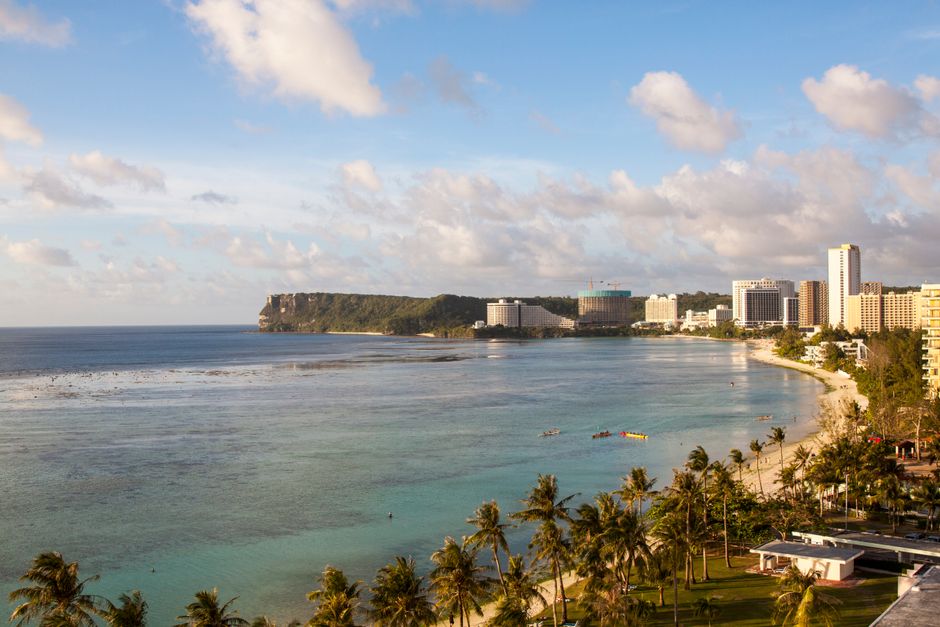
Guam is a US island territory in the western Pacific, the largest and southernmost of the Mariana Islands and, at 544 km² (210 sq miles), the biggest island in Micronesia. It is a short flight from Japan, South Korea, Taiwan and the Philippines and a long one from the US mainland, which makes it both an all-American place, with US dollars, highways, malls and fast food, and a crossroads of Asia and the Pacific. Most visitors stay in Tumon, a crescent of hotels and calm, reef-protected beach on the west coast, and come for sun, snorkeling, duty-free shopping and family holidays. Beyond the hotel strip lies the island of the CHamoru people, who arrived here around 4,000 years ago: latte stone pillars, Spanish-era churches and forts, village fiestas, a Wednesday night market in the capital, Hagåtña, and the battlefields of 1944 preserved in War in the Pacific National Historical Park. About 154,000 people live on Guam. US citizens need no passport when flying from Hawaii, many visitors from Asia and Australia use the Guam–CNMI Visa Waiver Program, and everyone fills in the online Guam Electronic Declaration Form.

Right now in Guam
- Wed 24–30°C 76–85°F 16 mm Heavy rain
- Thu 24–32°C 75–89°F 11 mm Heavy rain
- Fri 25–31°C 76–88°F 19 mm Heavy rain
Weather: MET Norway (CC BY 4.0) · Air quality: OpenAQ
Multi-day tours of Guam
Multi-day tours from local operators. You check dates and book on Viator, our partner; we may earn a commission at no extra cost to you. How we earn money
Guam at a glance: overview and geography
- Political status: an unincorporated territory of the United States since 1898 (apart from Japanese occupation in 1941–44). People born on Guam are US citizens.
- Capital: Hagåtña (formerly Agana), a small historic center on the west coast; most business happens in Tamuning, Tumon and Dededo.
- Population and size: about 154,000 people on an island about 48 km (30 miles) long and 6 to 19 km (4 to 12 miles) wide.
- Languages: English and CHamoru (Chamorro). Håfa adai means hello. Japanese, Korean and Chinese are widely used in tourism.
- Currency: the US dollar. Cards are accepted almost everywhere.
- Time zone: Chamorro Standard Time, UTC+10 all year, with no daylight saving. Guam is a day ahead of the US mainland: “where America’s day begins.”
- Driving: on the right, as in the mainland United States.
- Power: 120 volts, 60 Hz, with US plugs.
- Emergency number: 911.
Guam’s regions
The north is a raised limestone plateau with Andersen Air Force Base, the wildlife refuge at Ritidian Point and the growing suburbs of Dededo and Yigo. The central west coast holds Tumon Bay’s hotels, the airport in Tamuning, the shopping malls, and Hagåtña, the capital. The south is volcanic, hilly and rural, with red-earth ridges, waterfalls, rivers, quiet villages such as Umatac, Merizo and Inarajan, Spanish forts and the island’s highest point, Mount Lamlam.
Where to go: Tumon, Hagåtña and the south
Tumon Bay
Tumon is Guam’s tourist district, a 3 km (2 mile) curve of white sand with most of the island’s big hotels, a lively strip of restaurants, bars and shops along Pale San Vitores Road, and a calm, shallow lagoon inside the reef that is protected as the Tumon Bay Marine Preserve. Ypao Beach Park, at the south end, is the public beach park, and Puntan Dos Amantes (Two Lovers Point), on the cliffs at the north end, has views over the bay and a legend of two young CHamoru lovers.
Hagåtña
Guam’s capital is small and easy to explore on foot. Plaza de España preserves the remains of the Spanish governor’s palace; the Dulce Nombre de Maria Cathedral-Basilica stands beside it; and the modern Guam Museum tells the island’s story from the ancient CHamoru to the present. Latte Stone Park displays a set of the stone pillars that once supported CHamoru houses, and Fort Santa Agueda overlooks the town. On Wednesday evenings, the Chamorro Village Night Market fills with food stalls, crafts, live music and dancing.
War in the Pacific National Historical Park
Run by the US National Park Service, the park commemorates the Pacific campaigns of World War II and protects several sites around the west coast. At Asan Beach, US Marines landed on 21 July 1944 to begin the recapture of Guam from Japanese occupation; pillboxes and guns still stand, and the Asan Bay Overlook above carries memorial walls with the names of those who died, including CHamoru civilians who suffered during the occupation. Other units include the Agat landing beach and Piti guns.
The south: forts, villages and waterfalls
A drive around the southern loop, a day trip from Tumon, takes in the Cetti Bay overlook and its ridges; Umatac, where Ferdinand Magellan’s expedition is said to have landed in 1521, and the cliff-top Fort Nuestra Señora de la Soledad, built by Spain in 1802–19 to protect the Manila galleons; the old Spanish bridge and church at Umatac; Merizo, the jumping-off point for Cocos Island; the natural pools at Inarajan; and Talofofo Falls. Mount Lamlam, at 406 m (1,332 feet), is Guam’s highest point, reached by a steep, unshaded trail.
Ritidian and the north
At the northern tip, the Guam National Wildlife Refuge’s Ritidian Unit protects limestone forest, cave art and a beautiful, wild beach; access depends on refuge opening hours and can be restricted, so check with the US Fish and Wildlife Service before you go. Strong currents make Ritidian unsafe for swimming much of the year.
Piti and the marine preserves
On the west coast south of Hagåtña, the Piti Bomb Holes are deep sinkholes in the reef flat, good for snorkeling at the right tide, and the Fish Eye Marine Park has an underwater observatory at the end of a pier. Guam has five marine preserves, including Tumon Bay, Piti, Achang Reef, Sasa Bay and Pati Point, where fishing is restricted.
Cocos Island
Off the southern tip at Merizo, Cocos Island is a small, flat island with a resort-style beach park, reached by boat for day trips with snorkeling, water sports and picnic areas.
Tumon Travel Guide
Plan a trip to Tumon, Guam: Tumon Bay Marine Preserve snorkeling, Ypao Beach Park, Gun Beach sunsets, Two Lovers Point, the San Vitores shrine,…
Best time to visit Guam
Guam is hot and humid all year, with highs around 30 to 31 °C (86 to 89 °F) and warm nights. The dry season runs from about January to May, with northeast trade winds, the least rain and the calmest beach days; it is the most popular time for visitors. The rainy season runs from about July to November, with frequent heavy showers, higher humidity and the main risk of typhoons, although typhoons can occur in any month.
| Month | Guam high / low | Rain | Days with 2.5 mm (0.1 in) or more |
|---|---|---|---|
| Jan | 30 / 24 °C (86 / 75 °F) | 136 mm (5.3 in) | 11 |
| Feb | 30 / 24 °C (86 / 75 °F) | 105 mm (4.2 in) | 9 |
| Mar | 31 / 24 °C (87 / 76 °F) | 70 mm (2.8 in) | 8 |
| Apr | 31 / 25 °C (88 / 77 °F) | 89 mm (3.5 in) | 8 |
| May | 31 / 25 °C (89 / 78 °F) | 113 mm (4.5 in) | 9 |
| Jun | 32 / 26 °C (89 / 78 °F) | 165 mm (6.5 in) | 14 |
| Jul | 31 / 25 °C (88 / 77 °F) | 311 mm (12.2 in) | 18 |
| Aug | 31 / 25 °C (87 / 77 °F) | 449 mm (17.7 in) | 19 |
| Sep | 31 / 25 °C (87 / 76 °F) | 385 mm (15.2 in) | 19 |
| Oct | 31 / 25 °C (87 / 77 °F) | 323 mm (12.7 in) | 18 |
| Nov | 31 / 25 °C (88 / 77 °F) | 211 mm (8.3 in) | 14 |
| Dec | 30 / 25 °C (87 / 77 °F) | 135 mm (5.3 in) | 12 |
Figures are NOAA’s 1991–2020 climate normals for Guam International Airport: mean daily maximum and minimum temperature, total rainfall and days with at least 2.5 mm (0.1 in) of rain. The airport gets about 2,490 mm (98 in) of rain a year. Sea temperatures stay around 27 to 29 °C (81 to 84 °F).
Typhoons
Guam lies in the busiest tropical cyclone region on Earth. Typhoons are most likely from about July to November but can strike in any month, as Typhoon Mawar did in May 2023, when its eyewall crossed the northern part of the island, and Super Typhoon Sinlaku did in April 2026, when the eye passed over Saipan and Tinian to the north and Guam had damaging gusts and flooding. The island’s buildings are designed for strong winds, and hotels have storm procedures. The National Weather Service office in Guam issues warnings, and the government announces Conditions of Readiness from 4 (normal) to 1 (typhoon imminent). If a typhoon threatens, follow your hotel’s instructions and expect flight cancellations.
Crowds and prices through the year
Guam’s visitors come mainly from South Korea and Japan, so the busiest periods follow their holidays: Lunar New Year, Japanese Golden Week (late April to early May), the Obon holiday and Korean Chuseok (late summer to early fall), and the Christmas and New Year period. Prices for hotels are highest then. The wet months, especially September to November outside Asian holidays, offer the best deals.
Festivals and events
- Liberation Day (21 July): the anniversary of the 1944 landings, with a parade along Marine Corps Drive in Hagåtña, carnivals and family gatherings.
- Mes CHamoru (March): a month of CHamoru language, culture, food and arts events.
- Guam Micronesia Island Fair: a celebration of music, dance and crafts from across Micronesia, organized by the Guam Visitors Bureau.
- Village fiestas: each village celebrates its patron saint with a Mass, procession and an open-house feast; visitors are often welcome.
- Ko’ko’ Road Race: Guam’s half marathon and relay, named after the endangered ko’ko’ bird.
Public holidays
Guam observes US federal holidays, such as New Year’s Day, Memorial Day, Independence Day (4 July), Labor Day, Veterans Day, Thanksgiving and Christmas, plus local holidays including Guam Discovery Day (early March), Liberation Day (21 July), All Souls’ Day (2 November) and Our Lady of Camarin Day (8 December), the feast of Guam’s patron saint, marked with a procession in Hagåtña. Government offices and banks close; malls, restaurants and most attractions stay open, and beaches and parks are busy with family barbecues.
How long to stay: sample itineraries
4 days: Tumon and the highlights
Two beach days in Tumon with snorkeling in the marine preserve and sunset at Two Lovers Point; a morning in Hagåtña (Plaza de España, Guam Museum, Latte Stone Park) and, on a Wednesday, the night market; and a day driving the southern loop to Fort Soledad, Umatac and Inarajan.
7 days: Guam in depth
Add War in the Pacific National Historical Park and the Asan Bay Overlook, a boat trip to Cocos Island or a dolphin-watching cruise, a dive or snorkel at the Piti Bomb Holes, Talofofo Falls and a hike up Mount Lamlam.
10 days: Guam and the Northern Mariana Islands
Combine a week on Guam with three or four days on Saipan, about 45 minutes away by air, for Managaha Island, the Grotto and the World War II sites in the north.
Island hopping from Guam
Guam is the air hub of Micronesia. Short flights link it to Saipan (about 45 minutes), and from there to Tinian and Rota by small plane or ferry; Rota can also be reached directly from Guam. United’s “island hopper” route connects Guam with Chuuk, Pohnpei, Kosrae, Kwajalein and Majuro on the way to Honolulu, a famous multi-stop journey across the Federated States of Micronesia and the Marshall Islands, and United also flies to Palau and Yap. Entry rules for those countries differ; check before you go. There are no regular passenger ferries from Guam to other islands.
Where to stay
- Tumon: nearly all of Guam’s large beachfront hotels and resorts, plus mid-range hotels a block or two inland. It is walkable, close to the malls and the airport, and the best choice for a first visit or a family holiday.
- Tamuning and Upper Tumon: business hotels and cheaper options near the airport and the Micronesia Mall area; you’ll want a car or the trolley.
- Hagåtña: a few hotels near the capital’s historic center and the Wednesday night market.
- The south: limited, small-scale lodging and vacation rentals in quiet villages, best for travelers with a car who want to explore beyond the hotel strip.
Room rates are quoted before the 11% hotel occupancy tax, and many resorts add daily resort fees, so compare total prices.
Entry, money and costs
Entry rules (last reviewed October 2026)
Guam is part of the United States for immigration purposes. Entry requirements are the same as for any US destination, with one extra program for nearby Asian and Pacific countries.
- US citizens flying from Hawaii or the mainland are on a domestic flight. The Guam Visitors Bureau says travelers aged 18 and over need a REAL ID or another valid federal or state photo ID, plus an original or certified copy of their birth certificate; a US passport covers everything. If you route through Japan, Korea or another country, you need a passport.
- Visa Waiver Program countries (such as the UK, Australia, New Zealand, Japan, South Korea and most of the EU) can use an approved ESTA for stays of up to 90 days in the United States, including Guam. The official ESTA site charged US$40.27 per application in October 2026, and an ESTA is valid for up to two years.
- Guam–CNMI Visa Waiver Program: citizens of 12 countries and areas, Australia, Brunei, Hong Kong, Japan, Malaysia, Nauru, New Zealand, Papua New Guinea, Singapore, South Korea, Taiwan and the United Kingdom, can visit Guam and/or the Northern Mariana Islands without a visa for up to 45 days. Since 29 November 2024, they must have an approved G-CNMI Electronic Travel Authorization (ETA), applied for online through US Customs and Border Protection (CBP) with a selfie and passport scan. An approved ETA is valid for two years or until the passport expires, for multiple trips. You need a round-trip ticket leaving within 45 days and an ICAO-compliant machine-readable passport; Hong Kong SAR and British National (Overseas) passport holders also need a Hong Kong identity card, and Taiwan residents need a national identity card and a passport with a re-entry permit. Travel must be direct to Guam or the CNMI; this program does not allow onward travel to Hawaii or the mainland. CBP’s 2024 rule said there would be no fee at first; the ETA site’s own FAQ now describes a US$4 processing charge plus US$17 if approved, so check the amount when you apply.
- Everyone else, including citizens of the Philippines, needs a US visa. Canadians need only a passport.
On arrival from abroad, you go through CBP immigration and then Guam Customs and Quarantine. Passports must generally be valid for six months beyond your stay unless your country has an agreement with the US.
The Guam Electronic Declaration Form
Every arriving passenger, or one family member for a household, must complete the Guam Electronic Declaration Form (Guam EDF), a mandatory customs declaration that, since 4 February 2025, is available only electronically. You can submit it up to 72 hours before arrival, in English. If you can’t do it in advance, kiosks are available in the baggage claim area at Guam International Airport.
Customs when you leave
Guam is outside the US customs territory. When you return to the US mainland or Hawaii, CBP allows a US$1,600 duty-free exemption for goods bought in a US insular possession such as Guam, including up to five liters of alcohol if at least four were bought in Guam and at least one was made there.
Money, taxes and tipping
Guam uses the US dollar, and there is no general sales tax, which makes it popular for shopping. Hotels add an 11% hotel occupancy tax to room rates. Tipping follows US custom: about 15 to 20% in restaurants (check whether a service charge is already included, as it often is for groups), a few dollars for hotel porters and housekeeping, and about 10 to 15% for taxis and tour guides.
Typical travel costs
| Item (as of October 2026) | Price in US dollars |
|---|---|
| ESTA application | US$40.27 |
| Guam Electronic Declaration Form | Free |
| Hotel occupancy tax | 11% of the room rate |
| Mid-range hotel room in Tumon, per night | about US$150–300 |
| Taxi, airport to Tumon | about US$20–30 |
| Rental car, per day | about US$50–90 |
| Snorkel or dolphin-watching tour | about US$50–100 |
| Two-tank boat dive | about US$120–180 |
| Casual meal | about US$15–30 |
| Plate of CHamoru barbecue at the night market | about US$8–15 |
The ESTA fee is from the official ESTA website and the hotel tax from the Guam Department of Revenue and Taxation. Hotel, transport, tour and food prices are typical ranges, not official figures.
Getting there and getting around
Flights and the airport
Antonio B. Won Pat International Airport (GUM) is in Tamuning, about 10 minutes from Tumon’s hotels. Guam is a hub for United Airlines, with flights to Honolulu (about seven to eight hours) for the mainland, and to Tokyo, Osaka, Nagoya, Manila, Palau, Saipan and other Micronesian islands. Korean and Japanese airlines fly from Seoul, Busan and Japanese cities, and there are flights from Taipei and Hong Kong at times. Schedules change often; check the airlines.
Driving
Renting a car is the best way to explore beyond Tumon. Roads are US-style, with speeds of about 35 to 45 mph (55 to 70 km/h) on main roads and lower in villages; Marine Corps Drive is the main artery along the west coast. Visitors can usually drive with a valid license from home for a limited period; check with your rental company, and carry an international driving permit if your license is not in English. Watch for heavy traffic around Tamuning and Dededo at rush hour, and for slick roads after rain.
Buses, trolleys and taxis
Guam’s public bus service is limited. Tourist trolley buses run frequent hop-on, hop-off loops between Tumon’s hotels, the malls, the Chamorro Village and the airport area, with day and multi-day passes. Taxis wait at hotels and the airport and can be called; agree or check the fare before you set off. Many tours include hotel pickup.
Beaches, the sea and safety in the water
Tumon Bay and Ypao Beach Park are calm and shallow inside the reef, good for families and beginner snorkelers. Gun Beach, at the north end of Tumon, has more coral and fish but stronger currents near the reef edge. Ritidian, Tanguisson and many east-coast beaches face rough water and rip currents and are not safe for swimming much of the year. Rip currents and outgoing tides through reef channels are the main danger; the Guam Visitors Bureau’s water-safety guide explains how to recognize and escape them. Never swim near the reef edge or alone, check flags and warning signs, and don’t walk on coral. Guam’s five marine preserves restrict fishing and taking marine life.
Safety, health and connectivity
Safety
The Guam Visitors Bureau describes Guam as safe for families, with little crime affecting visitors. Practical points:
- Child supervision: Guam law forbids leaving children unattended at any time, including in a hotel room or a car.
- Cars: break-ins happen at beaches and viewpoints; don’t leave bags, maps or valuables in sight in your car.
- Night-time: stick to well-lit areas, use crosswalks (traffic on Pale San Vitores Road is busy) and don’t drink and drive.
- Typhoons: follow National Weather Service and Guam Homeland Security announcements and your hotel’s instructions during typhoon conditions.
- Rip currents and reefs: the main water dangers; read warning signs.
- Heat and sun: UV is very strong; the Guam Visitors Bureau recommends coral-safe mineral sunscreen and avoiding midday sun.
- World War II relics: unexploded ordnance is still occasionally found in the jungle and on reefs; never touch or remove war relics.
- Brown tree snakes: an invasive species that wiped out most of Guam’s native forest birds; they are mildly venomous but rarely seen and not dangerous to adults.
Health
Guam has two main hospitals, Guam Memorial Hospital and Guam Regional Medical City, plus urgent-care clinics. Costs are at US levels, so carry travel insurance. Use insect repellent, as mosquitoes are present.
Connectivity and power
Mobile coverage and Wi-Fi are good across Guam; local carriers sell prepaid SIM cards and eSIMs. US mainland plans may roam as domestic on some networks, but check before you travel. Power is 120 volts, 60 Hz, with US plugs; visitors from Japan and Taiwan can usually plug in directly, while Korean and Philippine devices may need an adapter.
Food, culture and things to do
Guam’s history in brief
CHamoru people settled the Marianas around 4,000 years ago, building villages of houses raised on latte stones and sailing fast outrigger canoes. Magellan’s expedition reached the island in 1521, and Spain colonized it from 1668, converting the islanders to Catholicism; war, disease and forced resettlement devastated the population. Guam became a stop on the Manila galleon route between Acapulco and the Philippines. The United States took the island from Spain in 1898, while the rest of the Marianas went to Germany and later Japan. Japan invaded Guam in December 1941 and occupied it until US forces landed in July 1944, a period of forced labor and killings that CHamoru families still remember. After the war Guam became a major US military base, and in 1950 an act of Congress made its people US citizens. Tourism from Japan boomed from the 1960s and made Tumon what it is today.
CHamoru culture
The CHamoru people have lived in the Marianas for about 4,000 years. Their culture has absorbed Spanish Catholicism, American influences and the wider Pacific, but the core value of inafa’maolek, creating harmony and helping one another, remains strong in family and village life. Look for latte stones (the stone pillars of ancient houses), weaving, blacksmithing, dance and chant at cultural centers and events, and the village fiestas that honor patron saints.
Food and drink
CHamoru food is a highlight: red rice colored with achote seeds, chicken or beef kelaguen (chopped meat “cooked” with lemon juice, onion, coconut and hot pepper), barbecue ribs and chicken marinated in soy, vinegar and onion, finadene (a soy, vinegar and chili dipping sauce), kadon pika (spicy chicken stew), tinaktak (meat in coconut milk), lumpia, empanadas, and coconut-based desserts such as titiyas and buñelos. The Wednesday night market at the Chamorro Village is the easiest place to try it. Tumon also has Japanese, Korean, Filipino, American and international restaurants, food courts and a growing coffee scene.
Things to do
Snorkel and paddleboard in Tumon Bay; dive the Blue Hole, the Piti Bomb Holes or the wrecks of Apra Harbor, where a World War I German ship lies beside a World War II Japanese one; watch spinner dolphins on a morning cruise; visit War in the Pacific National Historical Park; drive the southern loop; hike Mount Lamlam or to waterfalls with a guide; take a boat to Cocos Island; shop duty-free in Tumon’s malls; play golf; and catch a sunset at Two Lovers Point.
What to pack
Light summer clothes, swimwear and a rash guard, coral-safe mineral sunscreen, a hat and sunglasses, water shoes, a light rain jacket or umbrella for the wet season, insect repellent, hiking shoes for southern trails, and something a little smarter for evenings in Tumon. US plugs need no adapter for American devices.
Guam travel FAQ
Do US citizens need a passport to go to Guam?
Not if flying directly from Hawaii or the US mainland: the Guam Visitors Bureau says adults need a REAL ID or other valid photo ID plus an original or certified birth certificate. A passport is the simplest proof, and you need one if you travel via Japan, Korea or another country.
What is the Guam–CNMI Visa Waiver Program?
A program letting citizens of 12 countries and areas, including Australia, New Zealand, Japan, South Korea, Taiwan and the UK, visit Guam and the Northern Mariana Islands for up to 45 days without a visa. Since 29 November 2024 they need an approved G-CNMI ETA before travel.
Should I use ESTA or the G-CNMI ETA for Guam?
If you are eligible for both, an ESTA allows up to 90 days and travel to the rest of the US; the G-CNMI ETA allows up to 45 days in Guam and the CNMI only. Choose based on your plans.
What is the Guam Electronic Declaration Form?
A mandatory, electronic-only customs declaration for all arriving passengers, one per family, available from 72 hours before arrival. Kiosks at the airport baggage claim help those who couldn’t complete it in advance.
Is there sales tax on Guam?
No. Guam has no general sales tax, which is why it is popular for shopping. Hotels charge an 11% occupancy tax on room rates.
When is typhoon season on Guam?
Typhoons are most likely from about July to November, but they can occur in any month. Follow National Weather Service warnings and your hotel’s instructions.
What is the best time to visit Guam?
January to May, the dry season, has the least rain and calmest beach days. The wet season from July to November brings more rain and the highest typhoon risk but often lower prices.
Is Guam a US state?
No. Guam is an unincorporated US territory. Its residents are US citizens but don’t vote in presidential elections and have a non-voting delegate in Congress.
What time zone is Guam in?
Chamorro Standard Time, UTC+10, with no daylight saving. It is 14 to 15 hours ahead of US Eastern time.
Can I visit Saipan from Guam?
Yes. Flights take about 45 minutes, and the same ESTA, US visa or G-CNMI ETA covers both. See our Northern Mariana Islands guide.
Do I need to tip on Guam?
Yes, as in the US mainland: about 15 to 20% in restaurants unless a service charge is added, and small tips for porters, housekeeping, drivers and guides.
Is Guam safe for tourists?
Generally yes. The main concerns are rip currents and reefs, typhoons, car break-ins at beaches, traffic on busy roads and Guam’s strict laws on supervising children.
What is CHamoru food?
The cuisine of Guam’s Indigenous people, mixing Pacific, Spanish and Asian influences: red rice, kelaguen, barbecue with finadene sauce, kadon pika and coconut desserts. Try it at the Wednesday night market in Hagåtña.
Sources and last review
Researched and last reviewed on 5 October 2026. Entry rules, the Guam Electronic Declaration Form, safety tips, the night market and historical sites come from the Guam Visitors Bureau; the Guam–CNMI Visa Waiver Program and G-CNMI ETA from US Customs and Border Protection, the Department of Homeland Security and the Federal Register; the ESTA fee from the official ESTA website; the US$1,600 exemption from CBP; War in the Pacific National Historical Park from the National Park Service; the hotel occupancy tax from the Guam Department of Revenue and Taxation; climate from NOAA’s 1991–2020 normals for Guam International Airport; population and area from Wikidata. Hotel, transport, tour and meal prices, flight routes, typhoon history and some cultural details are general estimates or secondary sources. Prices and rules change, so check official sites before you go.
Plugs and power in Guam
Guam uses 110 V, 60 Hz and these plugs (left) and wall sockets (right):
All plug types and voltages by country → · Check what you need to pack →
Plan your trip
Partner links: TravelerCenter may earn a commission if you book, at no extra cost to you.