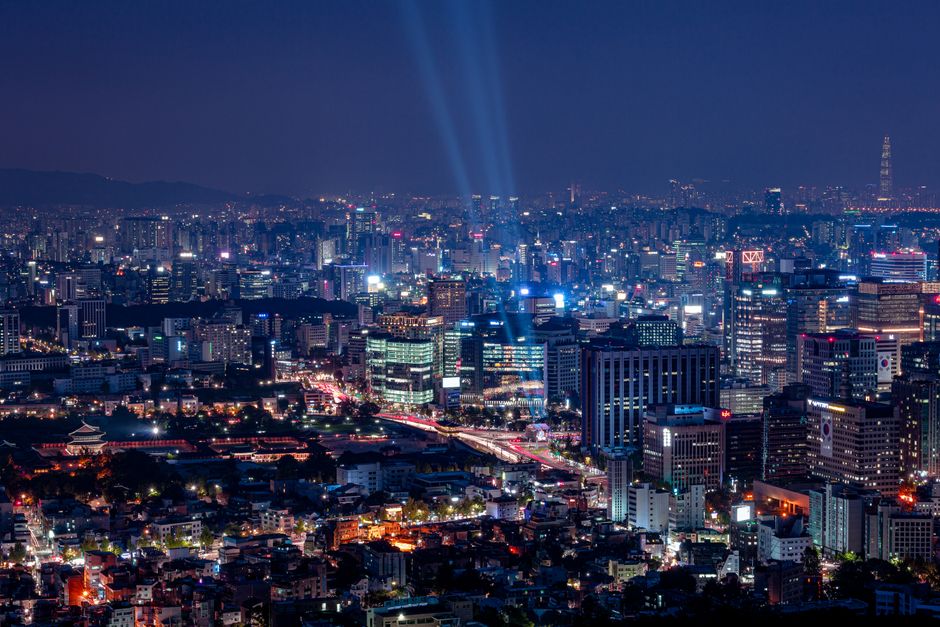
Seoul is one of Asia’s most exciting cities: a capital of almost ten million where five royal palaces from the Joseon dynasty stand between glass towers, hanok houses line the lanes below the mountains, and markets, street-food stalls and cafés stay busy late into the night. Come for Gyeongbokgung and Changdeokgung, the hilltop views from Namsan, the shopping of Myeong-dong and Seongsu, the music and nightlife of Hongdae, the riverside parks along the Han, and hiking on granite peaks inside the city limits. Seoul is also very easy to visit, with a superb subway, English signs everywhere and a strong sense of safety at any hour. The best seasons are spring (April and May) and fall (late September to early November); summers are hot and wet during the jangma rains, and winters cold and dry.
Right now in Seoul
- Wed11–22°C52–72°FClear
- Thu11–24°C51–74°FClear
- Fri12–25°C54–77°FCloudy
- Fri 9 Oct Hangul Day (한글날)
Top tours in Seoul
See all tours for Seoul →
From local operators, with prices and reviews; you check availability and book on Viator, our partner. We may earn a commission at no extra cost to you. How we earn money
Seoul at a glance
- Best for: palaces, hanok neighborhoods, food markets, shopping, K-culture, nightlife and city hikes.
- How long: 3–4 days for the main sights; 5 or more with day trips to the DMZ, Suwon or the mountains.
- Best time: April and May, and October to early November, with highs of about 18–24 °C (64–75 °F); cherry blossoms in the first half of April and fall colors from late October.
- Getting there: about 43 minutes from Incheon International Airport to Seoul Station by the AREX express; about 2.5 hours from Busan by KTX.
- Getting around: subway and buses with a T-money card or the Climate Card, taxis booked with k.ride, and walking; use Naver Map or Kakao Map rather than Google Maps.
- Fees to know: Gyeongbokgung and Changdeokgung cost 3,000 won (about US$2.20), the Secret Garden tour 5,000 won more; entry is free if you wear hanbok.
- Before you go: the K-ETA (and the exemption for 22 countries until December 31, 2026), the e-Arrival card, money and general safety are in our South Korea travel guide; see also our Incheon guide.
Seoul’s areas and where to stay
The Han River divides Seoul. The old city, north of the river, is ringed by mountains and its 600-year-old walls; the south, Gangnam, grew from the 1970s into a district of offices and malls. The subway links everything, so choose a base near a station on lines 1, 2, 3 or 4, or near the AREX.
Jongno and Gwanghwamun
The historic heart, with Gyeongbokgung, Changdeokgung and Jongmyo, Gwanghwamun Square, Insadong’s craft shops and tea houses, the hanok lanes of Bukchon and Ikseon-dong, and Gwangjang Market. The best base for sightseeing.
Myeong-dong and the city center
Seoul’s busiest shopping district, below Namsan and N Seoul Tower, with cosmetics stores, street-food stalls in the evening, Namdaemun Market and Seoul Station nearby.
Hongdae, Yeonnam and Mapo
The area around Hongik University is the city’s youth and nightlife district, with live music, clubs, street performers, vintage shops and cafés; Yeonnam-dong and Mangwon are quieter and leafier. It is on the AREX line from the airport.
Gangnam, Seongsu and Itaewon
South of the river, Gangnam has upscale hotels, COEX and the Bongeunsa temple, and Jamsil the 555-meter (1,821-foot) Lotte World Tower. Seongsu-dong is Seoul’s trendiest area for cafés and pop-up stores, and Itaewon an international district of restaurants and bars near the National Museum.
Top things to see in Seoul
Palaces close one day a week: according to the Korea Heritage Service, Gyeongbokgung and Jongmyo close on Tuesdays, and Changdeokgung, Deoksugung and Changgyeonggung on Mondays (when that day is a public holiday, they close the next working day instead). Visitors wearing hanbok get in free.
Gyeongbokgung Palace
The main palace of the Joseon kings, first built in 1395 and restored after its destruction during the Japanese occupation, with the great throne hall of Geunjeongjeon, the lake pavilion of Gyeonghoeru and the National Folk Museum. According to the Korea Heritage Service, it opens at 9 a.m. and closes at 6 p.m. from March to May and in September and October (last entry 5 p.m.), at 6:30 p.m. in summer and at 5 p.m. from November to February; adult entry is 3,000 won (about US$2.20). The changing of the guard ceremony takes place at the main gate, Gwanghwamun, several times a day.
Changdeokgung Palace and the Secret Garden
Changdeokgung, a UNESCO World Heritage site, blends into the wooded hills more naturally than Gyeongbokgung, and was the kings’ favorite residence. Its Secret Garden (Huwon), a valley of ponds and pavilions, can be seen only on a guided tour: in English at 10:30 and 11:30 a.m. and 2:30 and 3:30 p.m. from March to November (10:30, 11:30 and 2:30 in winter), for 5,000 won (about US$3.70) on top of the 3,000-won palace ticket. Half the places go online from 10 a.m. six days ahead, the rest on the day; spring and fall tours sell out fast. In fall 2026 the palace also hosts the lantern-lit Changdeokgung Moonlight Tour, with English sessions on September 20 and 27 and October 4 and 11, booked through Creatrip.
Jongmyo, Deoksugung and Changgyeonggung
Jongmyo, the royal ancestral shrine and a UNESCO site, is a place of rare calm with the longest wooden hall in Korea; on Mondays, Thursdays and Fridays you can visit only with a timed guided tour, while on weekends, public holidays and Wednesdays you can walk around freely (1,000 won). Deoksugung, next to City Hall, mixes traditional halls and Western-style buildings and stays open until 9 p.m. (1,000 won), as does Changgyeonggung, with its glass greenhouse. The integrated palace ticket, 6,000 won (about US$4.40), covers the four palaces and Jongmyo (but not the Secret Garden) within six months.
Bukchon Hanok Village and Ikseon-dong
Hundreds of traditional tile-roofed houses climb the slopes between Gyeongbokgung and Changdeokgung, with views over the old city. Bukchon is a residential neighborhood, and the Korea Tourism Organization notes that it has been made a special management area; visits to the core residential lanes are limited to daytime hours, and you should keep your voice down and not photograph residents or their doors. Ikseon-dong, south of Changdeokgung, is a smaller warren of hanok cafés and restaurants.
Namsan and N Seoul Tower
N Seoul Tower, on top of Namsan, has a 360-degree observatory; walk up through the park or take the cable car from near Myeong-dong. The view is best at sunset.
Markets and street food
Gwangjang Market, founded in 1905, is Seoul’s great food market, with stalls serving bindaetteok (mung bean pancakes), mayak gimbap, knife-cut noodles and raw beef yukhoe. Myeong-dong fills with street-food carts in the evening; Namdaemun is a huge traditional market; Mangwon Market near Hongdae is a local favorite; and Noryangjin is the city’s fish market, where you can buy fish downstairs and have it prepared upstairs.
More classic sights
- National Museum of Korea: one of the great museums of Asia, with gold Silla crowns, celadon and Buddhist art; free entry.
- Gwanghwamun Square and Cheonggyecheon: the statues of King Sejong and Admiral Yi Sun-sin, and a restored stream with a walking path through downtown.
- Seoul City Hall Sky Observatory: opened in July 2026 on the 8th and 9th floors of City Hall, with free views over Deoksugung and Gwanghwamun, according to the KTO.
- Bongeunsa: a Buddhist temple facing COEX, with a giant standing Buddha and a temple stay program.
Cheong Wa Dae, the former presidential residence, which opened to the public in 2022, has been closed to visitors since August 1, 2025, as it is again the Presidential Office.
Viewpoints
- N Seoul Tower
Parks and gardens
- Cheonggyecheon
Other sights
- Gwangjang Market
Palaces
- Changgyeonggung
- Deoksugung
- Gyeongbokgung
Monuments
- Changdeokgung
- Jongmyo
Historic centres
- Bukchon Hanok Village
Museums
- National Museum of Korea
Other things to do in Seoul
Food and drink
Seoul is a great place to try Korean food at every price. Eat Korean barbecue at a grill table, with pork belly (samgyeopsal) or marinated beef (galbi), and finish with cold noodles or fried rice; try samgyetang (ginseng chicken soup) in summer, kalguksu (knife-cut noodles), dakgalbi (spicy stir-fried chicken), and fried chicken with beer (chimaek). Royal court cuisine and temple food restaurants serve multi-course meals. Many restaurants specialize in a single dish; popular ones take reservations through the Catchtable app. Bars cluster in Itaewon, Euljiro and Seongsu.
Hanbok, K-culture and shopping
Rent a hanbok near Gyeongbokgung to visit the palaces for free. For shopping, head to Myeong-dong and Seongsu for cosmetics, Insadong for crafts and tea, and Dongdaemun for late-night fashion. Shops with “Tax Free” signs refund VAT on purchases of 15,000 won or more, often immediately.
The Han River, parks and hiking
The Han River parks, such as Yeouido and Banpo, have bike paths, picnic lawns and, at Banpo Bridge, a fountain show in the warmer months. Seoul is ringed by mountains: Bukhansan National Park, in the north of the city, has granite peaks reached by steep trails (allow 3 to 5 hours to Baegundae, the summit), and the city wall trail over Bugaksan and Inwangsan gives fine views over the palaces. According to the 2026 forecast published by the KTO, Bukhansan’s fall colors begin around October 23 and peak around November 4. See our hiking and city sightseeing guides.
Festivals
The Lotus Lantern Festival lights up Jongno before Buddha’s Birthday in April or May, and the Seoul International Fireworks Festival fills Yeouido in the fall. Over Seollal and Chuseok the city empties; palaces stay open, but many small restaurants close.
Activities and best months
- City sightseeingGyeongbokgung costs 3,000 won (Changdeokgung 3,000 won plus 5,000 won for the Secret Garden, booked online); an integrated palace ticket is 6,000 won; Gyeongbokgung and Jongmyo close on Tuesdays, the other palaces on Mondays.
Day trips from Seoul
- The DMZ: organized tours from Seoul visit Imjingak, the Third Infiltration Tunnel and Dora Observatory near Paju, about an hour north; bring your passport. Tours to Panmunjom and the Joint Security Area have been suspended since July 2023.
- Suwon: the UNESCO-listed Hwaseong Fortress, with a 5.7 km (3.5-mile) wall walk, about an hour by subway line 1 or 30 minutes by train.
- Incheon: Chinatown, the open-port district and Songdo, under an hour by subway. See our Incheon guide.
- Nami Island and Gapyeong: a tree-lined river island and the Garden of Morning Calm, about an hour by ITX train, best in the fall colors.
- Gangneung: the east coast’s beaches and coffee street, about 2 hours by KTX from Seoul Station. See our Gangneung guide.
Nearby destinations
- Incheon32 km
- Seoraksan National Park140 km
- Gangneung169 km
- Jeonju194 km
- Gyeongju275 km
Getting there and getting around
From Incheon and Gimpo airports
Most international flights land at Incheon International Airport, about 50 km (31 miles) west of the city. According to AREX, its express trains run nonstop to Seoul Station in 43 minutes from Terminal 1 and 51 minutes from Terminal 2, for 13,000 won (about US$9.50); the all-stop trains take about an hour, stop at Hongik University (Hongdae) and Gimpo Airport, and cost 4,750 won from Terminal 1 (5,350 won from Terminal 2) with a transportation card. Airport limousine buses go to most hotel districts. Gimpo Airport, for domestic flights, is about 23 minutes from Seoul Station by AREX.
By train from the rest of Korea
KTX trains leave Seoul Station for Busan (about 2.5 hours), Gyeongju and Daegu, and for Gangneung on the east coast; Yongsan for Jeonju, Gwangju, Mokpo and Yeosu; and Cheongnyangni for Gangneung and Andong. SRT trains to Busan and Mokpo leave from Suseo in Gangnam. Book on the Korail website or app up to a month ahead.
Subway, buses and transportation cards
Seoul’s subway is clean, cheap and signposted in English, running from about 5:30 a.m. to around midnight. Buy a T-money card at a convenience store or station machine and top it up with cash; a ride costs from about 1,550 won (about US$1.10) and includes free transfers between subway and bus within a set time. If you will ride a lot, Seoul’s Climate Card short-term pass gives unlimited rides on the city’s subways and buses for 1 day (5,000 won), 2 days (8,000 won), 3 days (10,000 won), 5 days (15,000 won) or 7 days (20,000 won), plus 3,000 won for the card. According to the KTO, since October 1, 2026 it has been valid only within Seoul (not on the Sinbundang Line or GTX express lines), and it can only be bought and loaded with cash or Korean-issued cards. The tourist Mpass, from 15,000 won for a day, covers up to 20 rides a day including the all-stop AREX.
Taxis, bikes and maps
Taxis are cheap by world standards: the base fare is 4,800 won (about US$3.50) for the first 2 km (1.2 miles), with a surcharge from 10 p.m. to 4 a.m. Book them with k.ride or Uber, which take foreign cards and translate your destination. For directions, use Naver Map or Kakao Map, which give walking and transit routes with exit numbers; Google Maps does not give reliable walking directions in Korea. See our cycling guide.
When to go and how long to stay
Seoul has a continental climate with big seasonal swings. The table uses the 1991–2020 normals of the Korea Meteorological Administration (KMA) for its Seoul station, as submitted to the World Meteorological Organization: average daily highs and lows, total rain and days with at least 1 mm of rain.
| Month | Average high / low | Rain (days with 1 mm or more) | What to expect |
|---|---|---|---|
| January | 2 °C (36 °F) / −6 °C (22 °F) | 17 mm (0.7 in), 3 days | Freezing nights; dry, bright and quiet; winter sales |
| February | 5 °C (41 °F) / −3 °C (26 °F) | 28 mm (1.1 in), 3 days | Coldest stretch ends; Lunar New Year some years |
| March | 11 °C (52 °F) / 2 °C (35 °F) | 37 mm (1.5 in), 5 days | Spring arrives; fine-dust days possible |
| April | 18 °C (64 °F) / 8 °C (46 °F) | 73 mm (2.9 in), 7 days | Cherry blossoms in the first half of the month; palace night openings |
| May | 24 °C (74 °F) / 14 °C (56 °F) | 104 mm (4.1 in), 7 days | The best month: warm, sunny and green; Lotus Lantern Festival |
| June | 28 °C (82 °F) / 19 °C (66 °F) | 130 mm (5.1 in), 8 days | Warm and humid; jangma rains usually start around June 25 |
| July | 29 °C (84 °F) / 22 °C (72 °F) | 414 mm (16.3 in), 13 days | The wettest month, with heavy downpours |
| August | 30 °C (86 °F) / 23 °C (73 °F) | 348 mm (13.7 in), 12 days | Hot and humid; the busiest month for domestic travel |
| September | 26 °C (79 °F) / 18 °C (64 °F) | 142 mm (5.6 in), 7 days | Clearing skies; Chuseok in some years |
| October | 20 °C (68 °F) / 11 °C (51 °F) | 52 mm (2.1 in), 5 days | Crisp and clear; fall colors from late in the month |
| November | 12 °C (53 °F) / 4 °C (38 °F) | 51 mm (2.0 in), 6 days | Peak ginkgo and maple colors early in the month; first frosts |
| December | 4 °C (40 °F) / −3 °C (26 °F) | 23 mm (0.9 in), 4 days | Cold and dry; Christmas lights and markets |
Seoul gets about 1,420 mm (56 in) of rain a year, more than half of it in July and August. According to the KMA, the jangma monsoon normally reaches the central region around June 25 and lasts about a month, with heavy downpours that can flood riverside roads and close the Han River parks; typhoons are possible from July to September. January nights average −6 °C (22 °F).
Weather month by month
Cherry blossoms and fall colors: in 2026, the KTO’s forecast (from the private forecaster Weather i) put Seoul’s first cherry blossoms on April 3, with full bloom about a week later; Yeouido’s Yunjung-ro, Seokchon Lake and the Han River parks are the favorite spots. In the fall, the ginkgo trees and maples in the palaces, Namsan and Seoul Forest turn from late October to mid-November.
Crowds: the palaces are busiest on spring and fall weekends; go at opening time.
3 days in Seoul
Day one, Gyeongbokgung at 9 a.m. (with the guard ceremony), Bukchon, lunch in Insadong, and Changdeokgung with the Secret Garden in the afternoon; dinner at Gwangjang Market. Day two, the National Museum of Korea, Namsan and N Seoul Tower at sunset, and Myeong-dong in the evening. Day three, Seongsu’s cafés and shops, the Han River, and Hongdae’s music and nightlife.
5 days with day trips
Add a DMZ tour and a day in Suwon or Incheon, or a morning hike on Bukhansan followed by the Lotte World Tower and Gangnam.
Where to stay in Seoul
- Jongno and Insadong: the best base for palaces and old Seoul, with hanok guesthouses and boutique hotels.
- Myeong-dong and the city center: central, with every type of hotel and easy airport access via Seoul Station.
- Hongdae: lively and good value, on the AREX line from the airport; noisy at night.
- Gangnam and Jamsil: business and luxury hotels south of the river, best for shopping and SRT trains.
A night in a hanok guesthouse, with ondol heated floors and sliding paper doors, is a memorable experience; rooms are small and bathrooms sometimes shared. Seoul has no hotel tax; prices include 10% VAT.
What a trip to Seoul costs
Prices are approximate, for October 2026, converted at about 1,365 won to the US dollar.
| Item | Typical cost |
|---|---|
| Subway or bus ride with T-money | from about 1,550 won (about US$1.10) |
| AREX express, Incheon Airport to Seoul Station | 13,000 won (about US$9.50) |
| Gyeongbokgung or Changdeokgung entry | 3,000 won (about US$2.20) |
| Bibimbap or noodle lunch | 10,000–15,000 won (about US$7.30–11) |
| Korean barbecue dinner, per person | 20,000–40,000 won (about US$15–29) |
| Coffee in a café | 5,000–7,000 won (about US$3.70–5) |
| Mid-range hotel double, per night | 120,000–250,000 won (about US$88–183) |
| Hanok guesthouse double, per night | 90,000–200,000 won (about US$66–147) |
Practical tips for Seoul
- Exits matter: subway stations have many numbered exits; Naver Map tells you which one to use.
- Cards: almost everything takes foreign cards, but keep some cash for markets and to top up T-money.
- Palace days: check the closing day: Tuesday for Gyeongbokgung and Jongmyo, Monday for the others.
- Book ahead: the Secret Garden, popular restaurants and K-pop events sell out.
- Help in English: call the 1330 Korea Travel Helpline.
Safety
Seoul is very safe, day and night. The main things to watch are the weather and crowds. Summer downpours during jangma can flood underpasses and riverside roads, and the Han River parks close during heavy rain warnings; Korean phones receive emergency text alerts. Heat in late July and August is oppressive, and fine dust can reduce air quality on some spring days; check the forecast and wear a KF94 mask if needed. At packed events, such as Halloween weekend in Itaewon and Hongdae, follow police directions and avoid narrow alleys. In an emergency, call 112 for the police or 119 for an ambulance or fire; say “English, please” for an interpreter.
What to pack for Seoul
Walking shoes that slip on and off easily, a compact umbrella, light clothes for summer and a warm coat, hat and gloves from December to February. Korea uses 220 V and round two-pin plugs; bring a power bank for your phone.
What to pack
- City walking shoesLisbon and Porto are steep, with polished limestone cobbles that get slippery, so grippy soles matter.
- Day packs and anti-theft bagsA small zipped or anti-theft bag makes crowded trams and viewpoints less stressful.
- Rain jacketsFrom October to April Porto and Lisbon see rain on roughly a third of days.
- Travel adapters and convertersPortugal uses Type C and F sockets at 230 V, so most visitors from outside Europe need an adapter.
Seoul travel FAQ
How many days do I need in Seoul?
Three to four days for the main sights; five or more with the DMZ, Suwon or a hike on Bukhansan.
Which palace should I visit in Seoul?
Gyeongbokgung for size and the guard ceremony, and Changdeokgung with its Secret Garden for beauty. The integrated ticket, 6,000 won, covers four palaces and Jongmyo within six months.
Which day are Seoul’s palaces closed?
Gyeongbokgung and Jongmyo close on Tuesdays; Changdeokgung, Deoksugung and Changgyeonggung close on Mondays. If that day is a public holiday, they open and close the next working day.
Is entry to the palaces free in hanbok?
Yes. Visitors wearing hanbok enter the royal palaces and Jongmyo free; the Secret Garden tour still needs a ticket.
How do I get from Incheon Airport to Seoul?
Take the AREX express to Seoul Station (43 minutes from Terminal 1, 13,000 won), the cheaper all-stop AREX (about an hour), or an airport limousine bus to your hotel area.
What is the Climate Card in Seoul?
A Seoul city transit pass with unlimited subway and bus rides for 1 to 7 days, from 5,000 won a day plus 3,000 won for the card. Since October 1, 2026 it works only within Seoul.
Can I use Google Maps in Seoul?
For transit, partly, but walking and driving directions are limited. Use Naver Map or Kakao Map, which show routes, subway exits and opening hours in English.
When do the cherry blossoms bloom in Seoul?
Usually in the first half of April. In 2026, the forecast put the first blossoms on April 3, with full bloom about a week later.
Can I visit the Blue House (Cheong Wa Dae)?
No. Cheong Wa Dae has been closed to visitors since August 1, 2025, because it has become the Presidential Office again.
Is Seoul safe at night?
Yes, Seoul is one of the safest big cities in the world. Take normal care in crowds.
Plan your trip
Partner links: TravelerCenter may earn a commission if you book, at no extra cost to you.
🇰🇷 Useful Korean phrases for Seoul
All 38 Korean phrases: restaurant, hotel, emergencies, romance (printable) →
Sources · last reviewed 4 October 2026
Researched and last reviewed on 4 October 2026. Palace fees, hours, closing days, the integrated ticket and Secret Garden tours: the Korea Heritage Service; AREX fares and times: the Airport Railroad; the Climate Card, Mpass, taxi fares, k.ride, the Changdeokgung Moonlight Tour, the City Hall Sky Observatory, Cheong Wa Dae’s closure, Bukchon’s special management area, airport transportation, DMZ attractions and the 2026 cherry blossom and fall foliage forecasts (from Weather i): the Korea Tourism Organization (KTO); Panmunjom tours: the official Panmunjom tour website; climate normals and jangma dates: the Korea Meteorological Administration (KMA), via the World Meteorological Organization; exchange rate: the US Federal Reserve. Journey times, Bukchon’s visiting hours, hike durations, subway fares, sight descriptions and typical prices are general references or estimates, flagged for checking. Prices and hours change, so check the official sites before you go. For entry rules, money and general safety, see our South Korea travel guide.
Also: royal.khs.go.kr · KMA normals 1991–2020, Seoul (climate)
Data: Weather: MET Norway (CC BY 4.0) · Air quality: OpenAQ · Rates: ECB · Holidays: Nager.Date · Costs: World Bank ICP and price levels · © OpenStreetMap contributors (ODBL) · Wikidata (CC0)