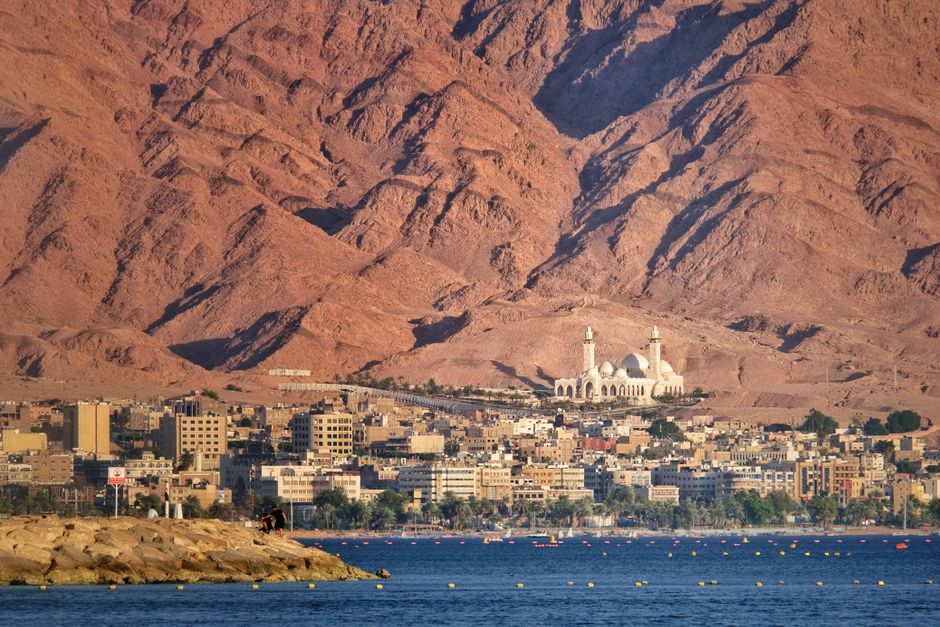
Aqaba, Jordan’s only city on the sea, sits at the northern tip of the Gulf of Aqaba, an arm of the Red Sea framed by bare, rose-colored mountains, with the Sinai coast visible across the water. It has been a port since ancient times: the early Islamic town of Ayla, the Mamluk castle that guarded the pilgrimage route, and modern docks and a cruise terminal all stand along its shore. Today Aqaba is a relaxed resort and the center of the Aqaba Special Economic Zone, run by its own authority (ASEZA), with lower taxes, duty-free shopping and a free visa for many visitors who arrive here directly. Its biggest draw lies underwater: the Aqaba Marine Reserve, Jordan’s first marine reserve, protects about 7 km (4 miles) of coast with more than 150 species of hard coral and more than 500 species of fish, a sunken cargo ship and a scuttled military aircraft, and in 2026 it was added to UNESCO’s World Heritage List. Above water, there are public and hotel beaches, the castle and museum, fresh seafood in the old town, and the new marina developments of Ayla and Tala Bay. Wadi Rum is less than an hour away and Petra about two hours, so Aqaba is the natural end point of a loop through southern Jordan. Aqaba has a hot desert climate: winters are mild and sunny, with average highs of about 20–22 °C (68–72 °F), and summers are very hot, with average highs near 39 °C (102 °F).
Right now in Aqaba
- Wed21–30°C70–86°FMostly clear
- Thu22–31°C72–88°FClear
- Fri24–31°C75–88°FMostly clear
Top tours in Aqaba
See all tours for Aqaba →
From local operators, with prices and reviews; you check availability and book on Viator, our partner. We may earn a commission at no extra cost to you. How we earn money
Aqaba at a glance
- Best months: March to May and September to November, which Visit Aqaba recommends as the most pleasant; winter is mild and sunny, while summer is very hot.
- Time needed: two days for snorkeling, the castle and the old town; four days with diving and a trip to Wadi Rum; a week with Petra.
- Getting there: King Hussein International Airport (AQJ) is close to the city. Visitors arriving at Aqaba’s airport or port can get a free ASEZA visa if they leave within a month.
- Costs (as of October 2026): Aqaba Castle costs JOD 3 (about US$4) for foreign visitors and is included in the Jordan Pass; a shore snorkel is free from public beaches, and guided dives start at about JOD 30–40.
- Before you go: visas, the Jordan Pass, money and laws are covered in our Jordan travel guide.
Aqaba areas and who each one suits
The city center and old town
Around the Arab Revolt Plaza, Aqaba Castle and the Sharif Hussein bin Ali Mosque, the compact center has souqs, seafood restaurants, juice bars, budget and mid-range hotels and the public city beaches along the corniche. Good for travelers who want local life and easy walks.
The north beach hotels
Along the northern shore, international resort hotels have private beaches, pools and restaurants within walking distance of the center. Good for couples and families who want comfort and convenience.
Ayla
A large new development west of the center, built around lagoons and a marina, with hotels, apartments, restaurants, an 18-hole golf course and a cable wake park. Good for golfers, families and those who want a modern resort setting.
The South Beach and the Marine Reserve
South of the port, the coast road runs past the Aqaba Marine Reserve’s four beaches, Coral, Yamaniyah, Blue and Palm, with dive centers, dive resorts and snorkel spots right off the shore. The best base for divers and snorkelers, about 15–20 minutes from the center.
Tala Bay
Near the Saudi border at the southern end of the coast, Tala Bay is a gated resort community with beach hotels, a marina and dive sites close by. Quiet and self-contained.
Where to stay in Aqaba
- City center: budget and mid-range hotels close to the castle, souqs and seafood restaurants.
- North beach: international resort hotels with private beaches.
- Ayla: modern hotels and apartments around the marina and golf course.
- South Beach: dive resorts and guesthouses near the Marine Reserve.
- Tala Bay: all-inclusive and family resorts.
Winter weekends and Eid holidays are busy with Jordanian and regional visitors, so book ahead.
Top things to see in Aqaba
The Aqaba Marine Reserve
Declared Jordan’s first marine reserve in December 2020 after decades of protection as a marine park, the reserve runs about 7 km (4 miles) along the southern coast, from the passenger port to the Royal Diving Club. ASEZA says it is home to more than 157 species of hard corals, 512 species of fish, sea turtles and seagrass meadows, with water visibility of up to 100 m (330 feet) and more than 30 dive sites, at the northernmost limit of coral reefs in the world. In 2025 it was added to the IUCN Green List of well-managed protected areas, and in 2026 UNESCO added it to the World Heritage List. Snorkel straight off the beaches or join a boat trip.
Wrecks and the underwater museum
Aqaba’s most famous dives include the Cedar Pride, a cargo ship scuttled for divers in November 1985 that lies on its side across two reefs, and a C-130 Hercules military transport aircraft sunk in November 2017. The underwater military museum off the shore displays 19 pieces of decommissioned hardware, including tanks, an ambulance, a crane and a helicopter, arranged on the seabed for divers and snorkelers.
The Japanese Garden
One of the prettiest coral sites in Aqaba, at shallow depths suited to snorkelers and new divers, with hawksbill turtles, barracuda and schools of reef fish among coral formations.
Aqaba Castle
Built under the Mamluk Sultan Qansuh al-Ghawri in the early 16th century, the fort guarded the coast and served as a caravanserai on the pilgrimage route; it was later restored under the Ottomans and bears the Hashemite coat of arms over its gate. Entry is included in the Jordan Pass and is JOD 3 otherwise.
Aqaba Archaeological Museum
Next to the castle, the house built in 1917 for Sharif Hussein bin Ali in Hijazi style is now the city’s archaeological museum, with finds from Ayla and the region. It’s included in the Jordan Pass.
Islamic Ayla
In the city center, the excavated walls, gates and streets of Ayla, founded around 650 AD, show the layout of one of the earliest Islamic towns.
The Arab Revolt Plaza and the Sharif Hussein bin Ali Mosque
The large seafront plaza by the castle has a giant flagpole and views over the beach. Nearby, the white Sharif Hussein bin Ali Mosque has the largest dome of any mosque in Jordan; visitors may walk in quietly outside prayer times, dressed modestly.
Other things to do in Aqaba
- Diving courses: many licensed dive centers on the South Beach offer try-dives, PADI courses and boat dives.
- Glass-bottom boats and boat trips: short trips over the reefs leave from the city beaches and marinas.
- Aqaba Aquarium: at the Marine Science Station, a look at Red Sea marine life without getting wet.
- Aqaba Bird Observatory: run by the Royal Society for the Conservation of Nature, best during the spring and autumn migrations between Africa, Europe and Asia.
- Golf and water sports: the 18-hole, par-72 Ayla golf course designed by Greg Norman, and the 442 m (1,450-foot) Ayla cable wake park.
- Shopping: duty-free shopping in the economic zone, spice and sweet shops in the souq, and Dead Sea cosmetics.
- Snorkeling for a Clean Sea: an experience listed by the Jordan Tourism Board that combines snorkeling with collecting rubbish from the reefs.
Food and drink
Aqaba is Jordan’s seafood city. Try sayadieh, fish cooked with spiced rice, onions and pine nuts, grilled fish and shrimp chosen by weight in old-town restaurants, and Jordanian staples such as mansaf and falafel. Sweet shops sell knafeh and baklava, and juice bars line the center. Alcohol is served in licensed hotels, bars and restaurants, and the economic zone’s lower taxes make it cheaper than in Amman; drinking on the street is illegal.
Day trips from Aqaba
Wadi Rum
About 66 km (41 miles) north, or just under an hour by car, Wadi Rum’s red dunes and sandstone mountains are best with a night in a Bedouin camp. See our Wadi Rum guide.
Petra
About two hours north by car or bus, Petra is possible as a long day trip, but it deserves at least two days. See our Petra guide.
Sinai by ferry
Ferries and speedboats cross the gulf to Taba and Nuweiba in Egypt’s Sinai; check schedules with the operators and Egypt’s entry rules. See our Dahab and Sharm El Sheikh guides.
Eilat
Across the Wadi Araba border crossing, about 10 minutes from the city, lies the Israeli resort of Eilat. Crossing rules are strict and the border can close at short notice; check its status before you go. See our Eilat guide.
Nearby destinations
- Eilat6 km
- Wadi Rum40 km
- Petra (Wadi Musa)99 km
- Dahab125 km
- Sharm El Sheikh199 km
- Jerusalem251 km
- El Gouna272 km
- Hurghada279 km
Getting there and getting around
King Hussein International Airport (AQJ)
Aqaba’s airport, about 15 minutes north of the center, has flights from Amman (about 45 minutes) on Royal Jordanian, year-round services on Turkish Airlines, and seasonal winter flights from Europe on low-cost airlines such as easyJet, Wizz Air and Ryanair. Since early 2026, regional tensions have led to periodic airspace closures across the Middle East, so flights can be delayed, rerouted or canceled at short notice; check your flight with the airline before you travel.
The ASEZA free visa
When you enter Jordan at Aqaba’s airport or seaport, you can receive a free visa from the Aqaba Special Economic Zone Authority, with no obligations as long as you leave within a month from the same entry point. If you arrive elsewhere in Jordan and are heading to Aqaba, you can claim the free visa by declaring Aqaba as your destination, but you must register at the ASEZA visa office in Aqaba within 48 hours, or you may have to pay for the visa and a fine of JOD 1.5 per unregistered day. The free visa isn’t available at the Wadi Araba crossing. To stay longer than a month, extend it at the ASEZA office. Some nationalities need a visa in advance; check the rules before you travel.
By road and land border
The Desert Highway links Aqaba with Amman in about four hours, passing the turnoffs for Wadi Rum and Petra. JETT and public buses connect Aqaba with Amman, Petra and Wadi Rum. The Wadi Araba (Yitzhak Rabin) crossing to Eilat is about 10 minutes away; Jordan Pass holders of non-restricted nationalities can get a visa on arrival there, but others need a visa in advance. The Al-Durra crossing to Saudi Arabia, on the coast south of the city, is open 24 hours. A departure tax of JOD 10 applies at land borders.
By sea
Aqaba’s cruise terminal receives cruise ships from Europe, the US and the Gulf, and ferries and speedboats link Aqaba with Taba and Nuweiba in Sinai.
Getting around
Aqaba’s green taxis are cheap; agree the fare or use the meter. Shared taxis and buses serve the city, and shuttles run to the South Beach and public beaches. The center is walkable, but you’ll need a taxi or car for the South Beach and Tala Bay.
When to go and how long to stay
Spring (March to May) and autumn (September to November) are the most pleasant times, with warm days and warm sea. Winter (December to February) is mild and sunny, with average highs of about 20–22 °C (68–72 °F), making Aqaba Jordan’s winter sun destination. Summer (June to August) is very hot, with average highs near 39 °C (102 °F) and temperatures that can pass 40 °C (104 °F), so dive early and rest at midday. Rain is rare, about 32 mm (1.2 in) a year.
| Month | Average high / low | Rain (rain days) | What to expect |
|---|---|---|---|
| January | 20 °C (69 °F) / 9 °C (48 °F) | 5 mm (0.2 in), 2 days | Mild and sunny |
| February | 22 °C (72 °F) / 10 °C (50 °F) | 5 mm (0.2 in), 1 day | Mild, sunny; good |
| March | 26 °C (78 °F) / 13 °C (55 °F) | 5 mm (0.2 in), 2 days | Warm; excellent |
| April | 31 °C (87 °F) / 17 °C (63 °F) | 3 mm (0.1 in), 1 day | Warm to hot; excellent |
| May | 35 °C (95 °F) / 21 °C (69 °F) | 1 mm (under 0.1 in), 0 days | Hot; good diving |
| June | 38 °C (101 °F) / 24 °C (74 °F) | under 1 mm, 0 days | Very hot |
| July | 39 °C (103 °F) / 25 °C (77 °F) | under 1 mm, 0 days | Very hot; dive early |
| August | 39 °C (102 °F) / 25 °C (78 °F) | under 1 mm, 0 days | Very hot; dive early |
| September | 36 °C (98 °F) / 23 °C (74 °F) | under 1 mm, 0 days | Hot; warm sea |
| October | 33 °C (91 °F) / 20 °C (68 °F) | 2 mm (0.1 in), 1 day | Warm; excellent |
| November | 27 °C (81 °F) / 15 °C (59 °F) | 3 mm (0.1 in), 1 day | Warm; excellent |
| December | 22 °C (71 °F) / 10 °C (51 °F) | 8 mm (0.3 in), 2 days | Mild; winter sun |
The figures are the average daily highs and lows, monthly rainfall and rain days that the Jordan Meteorological Department publishes for Aqaba through the World Meteorological Organization’s World Weather Information Service.
Events worth planning around
- Bird migration: spring and autumn at the Aqaba Bird Observatory.
- Winter season: European charter and low-cost flights and the busiest months for Jordanian visitors escaping the cold.
- Eid holidays: hotels and beaches fill with families.
- Ramadan: in 2027 expected from about 8 February to 9 March; resort hotels keep serving guests.
Visit Aqaba publishes a calendar of events; dates change each year.
How long to stay: 2, 4 and 7 days
- Two days: snorkeling at the Marine Reserve, the castle, museum and Ayla ruins, and a seafood dinner in the old town.
- Four days: add boat dives on the Cedar Pride and C-130, and a night in Wadi Rum.
- Seven days: add two nights in Petra, or a few days of diving courses.
Typical costs in Aqaba
Prices are approximate, for October 2026, converted at about US$1.41 per dinar.
| Item | Typical cost |
|---|---|
| Aqaba Castle | JOD 3 (about US$4); included in the Jordan Pass |
| Aqaba Archaeological Museum | included in the Jordan Pass |
| Guided shore or boat dive | about JOD 30–45 (about US$42–64) |
| Snorkel gear rental, per day | about JOD 5–10 (about US$7–14) |
| Glass-bottom boat trip, 1 hour | about JOD 10–20 (about US$14–28) |
| Taxi from the airport to the center | about JOD 7–10 (about US$10–14) |
| Seafood dinner in the old town | about JOD 10–20 (about US$14–28) |
| Mid-range beach hotel double, per night | about JOD 70–140 (about US$100–200) |
The castle fee is from the Jordan Tourism Board; other prices are typical ranges.
Safety in Aqaba
Aqaba is a calm, friendly resort town with low crime. The main risks for visitors are the heat, the sea and the regional situation.
- Heat: from May to September, temperatures commonly reach 35–40 °C (95–104 °F). Drink plenty of water, wear a hat and avoid the midday sun.
- Sea safety: dive and snorkel with accredited operators, never alone, and watch for boat traffic. Don’t touch coral, stand on reefs or feed fish, and wear reef shoes to avoid sea urchins and stonefish. Follow lifeguards at public beaches.
- Sun: the sun reflects strongly off the water; use reef-safe, high-SPF sunscreen and cover up when snorkeling.
- Dress codes: swimwear is fine at hotel beaches and pools; at public city beaches, many local women swim in modest clothing, so cover up when away from the water.
- Border crossings: the Wadi Araba crossing to Eilat can close at short notice; check its status before you travel.
- Flight disruptions: since early 2026, regional tensions have led to periodic airspace closures across the Middle East, and flights can be delayed or canceled at short notice. Check your flight with the airline, and follow instructions from the local authorities, including official emergency alerts.
- Emergencies: call 911 for police, ambulance and fire. Aqaba has good medical facilities, as do Amman’s hospitals.
Practical tips for Aqaba
- Time zone: UTC+3 all year.
- Weekend: Friday and Saturday, when beaches and restaurants are busiest.
- Money: ATMs are common in the center; cards are accepted in hotels and larger restaurants.
- Visa registration: if you claimed the free ASEZA visa elsewhere, register at the ASEZA office in Aqaba within 48 hours.
What to pack for Aqaba
Pack swimwear and a cover-up, reef shoes, a mask and snorkel if you have them, a rash guard or long-sleeved swim shirt for sun protection, reef-safe sunscreen, a hat and sunglasses. Add light clothes that cover shoulders and knees for town, a warm layer for Wadi Rum nights and winter evenings, and a plug adapter.
Aqaba travel FAQ
Do I need a visa to visit Aqaba?
Visitors arriving at Aqaba’s airport or seaport can receive a free ASEZA visa if they leave within a month. Some nationalities need a visa in advance, and the free visa isn’t issued at the Wadi Araba crossing.
What is the Aqaba Special Economic Zone?
A zone covering Aqaba run by its own authority, ASEZA, with lower taxes, duty-free shopping and its own free visa for visitors who arrive directly.
Is Aqaba good for snorkeling?
Yes. The Aqaba Marine Reserve has coral reefs right off its public beaches, with more than 150 species of hard coral and hundreds of species of fish.
What are the best dive sites in Aqaba?
The Cedar Pride wreck, the C-130 aircraft, the underwater military museum and the Japanese Garden coral site.
When is the best time to visit Aqaba?
March to May and September to November. Winter is mild and sunny; summer is very hot.
How far is Wadi Rum from Aqaba?
About 66 km (41 miles), just under an hour by car.
Can I visit Petra on a day trip from Aqaba?
Yes, it’s about two hours each way, but Petra deserves at least two days if you can spare them.
Can I cross from Aqaba to Eilat?
There is a land crossing at Wadi Araba about 10 minutes from the city, but it can close at short notice; check its status and visa rules before you travel.
Is alcohol available in Aqaba?
Yes, in licensed hotels, bars and restaurants. Drinking on the street is illegal.
Is Aqaba part of the Jordan Pass?
Aqaba Castle and the Aqaba Archaeological Museum are included in the Jordan Pass.
Plan your trip
Partner links: TravelerCenter may earn a commission if you book, at no extra cost to you.
🇪🇬 Useful Arabic phrases for Aqaba
All 38 Arabic phrases: restaurant, hotel, emergencies, romance (printable) →
Sources · last reviewed 5 October 2026
Researched and last reviewed on 5 October 2026. The free ASEZA visa, its registration rule and fine, the economic zone, airport airlines, land and sea access, best months and the Marine Reserve’s history, size, species, beaches, dive sites, visibility and IUCN Green List status come from the Aqaba Special Economic Zone Authority and its Visit Aqaba website; the Marine Reserve’s 2026 World Heritage listing from UNESCO; Aqaba Castle, the Arab Revolt Plaza, the Sharif Hussein bin Ali Mosque, Islamic Ayla, the archaeological museum, the dive sites and underwater museum, the aquarium, bird observatory, golf course, wake park and snorkeling experience from the Jordan Tourism Board; Jordan Pass coverage from the Ministry of Tourism and Antiquities; border crossings, departure tax, dive safety and emergency numbers from GOV.UK’s Jordan travel information (updated 10 September 2026); airspace disruption from the European Union Aviation Safety Agency; climate averages from the Jordan Meteorological Department via the World Meteorological Organization; population from Wikidata. Areas of the city, Tala Bay, seafood dishes, alcohol prices, events, Ramadan 2027 dates, distances and all dive, boat, taxi, meal and hotel prices are general references or estimates and flagged for checking. For entry rules and money, see our Jordan travel guide.
Data: Weather: MET Norway (CC BY 4.0) · Sea temperature: NOAA CoastWatch · Rates: ECB · Costs: World Bank ICP and price levels · Wikidata (CC0)