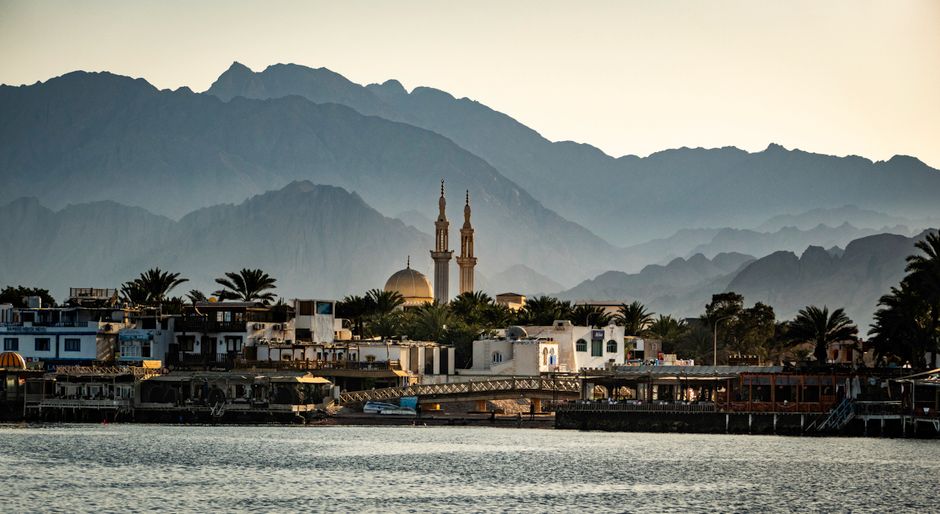
Dahab, a small town on the Gulf of Aqaba coast of South Sinai, about 90 km (56 miles) north of Sharm El Sheikh, is the laid-back counterpoint to the big resorts. Its name means “gold” in Arabic, after the color of its sand. Once a Bedouin fishing village and a 1980s hippie stop, it is now a small town of low-rise hotels, dive centers and cafés with floor cushions lining a seafront promenade, where you can step off the walkway straight onto a coral reef. Dahab is one of the world’s great places to dive and freedive: the famous Blue Hole, a deep sinkhole in the reef north of town, the Canyon, the Lighthouse reef and the Eel Garden are all reached from the shore, without a boat. Steady winds make the Lagoon in the south of town a top spot for windsurfing and kitesurfing, and the red mountains behind the coast are a base for camel treks, the coastal walk to Ras Abu Galum and the night climb of Mount Sinai for sunrise. Dahab has no airport: most visitors fly into Sharm El Sheikh, and the free 15-day Sinai entry stamp covers a stay here. The sea is good all year, and spring and autumn are the most comfortable seasons.
Right now in Dahab
- Wed 23–33°C 74–91°F Mostly clear
- Thu 25–34°C 76–92°F Clear
- Fri 28–34°C 82–93°F Mostly clear
- Today Armed Forces Day (عيد القوات المسلحة)
Weather: MET Norway (CC BY 4.0) · Sea temperature: NOAA CoastWatch · Holidays: Nager.Date
Top tours in Dahab
See all tours for Dahab →
From local operators, with prices and reviews; you check availability and book on Viator, our partner. We may earn a commission at no extra cost to you. How we earn money
Dahab at a glance
- Best for: shore diving and freediving, snorkeling, windsurfing and kitesurfing, Mount Sinai, hiking and a relaxed, independent atmosphere.
- How long: 4–7 days; many divers and freedivers stay for weeks.
- Best time: March to May and October to November; winter is sunny but cool at night, and summer is very hot.
- Getting there: fly into Sharm El Sheikh (SSH), about 1–1.5 hours away by road, or take a bus from Cairo.
- Getting around: on foot along the promenade, and by taxi or pickup truck to the dive sites.
- Good to know: the free Sinai stamp covers Dahab for up to 15 days; the Blue Hole’s deep arch is for technical divers only.
- Before you go: visas, money and general safety are in our Egypt travel guide.
Dahab areas and who each one suits
Dahab stretches for a few kilometers along the coast, from the Lagoon peninsula in the south to the Bedouin village of Assala in the north. The heart of town is a car-free seafront promenade.
Masbat and Mashraba
The center of Dahab is the promenade through Masbat (also called the Lighthouse area) and Mashraba, packed with dive centers, cafés, small hotels and souvenir shops. The Lighthouse reef in Masbat and the reefs off Mashraba are right in front of the cafés. This is the best area for a first visit, with everything on foot.
Assala
North of the center, Assala is the old Bedouin village, quieter and more local, with guesthouses, apartments for long stays, the Eel Garden reef and a more residential feel.
The Lagoon (Laguna)
South of the center, the sandy peninsula around the Lagoon has larger resort hotels with private beaches and the windsurfing and kitesurfing centers, thanks to the flat, shallow water and steady wind. It is best for water sports and families.
Where to stay in Dahab
- Masbat and Mashraba: small hotels, camps and guesthouses steps from the promenade and reefs.
- Assala: quiet guesthouses and long-stay apartments.
- The Lagoon: beach resorts and water sports centers.
Dahab has some of the best-value accommodation in Egypt, from simple dive camps to boutique hotels, and many dive centers offer packages with rooms.
Top things to see in Dahab
The Blue Hole
The Blue Hole, about 8 km (5 miles) north of town, is a deep, nearly circular sinkhole in the reef, more than 100 m (330 ft) deep, separated from the open sea by a shallow saddle and, at about 55 m (180 ft), by a rock arch. For snorkelers and recreational divers, the rim of the Blue Hole and the reef wall outside are spectacular, with clear water, coral and fish. The classic dive starts at the Bells, a crack in the reef just to the north, and drifts along the wall to the Blue Hole. The arch is a different matter: it is far beyond recreational diving limits, and many divers have died trying to swim through it on air, as the memorial plaques on the shore record. It is reachable only by trained technical divers with appropriate gas mixtures. The Blue Hole is also a world-famous freediving site. Cafés on the shore rent gear, and there is a small fee to enter the area.
The Canyon
North of town, the Canyon is a narrow crack in the reef that divers enter from the shallows and descend inside to about 30 m (100 ft), with shafts of light from above and bubbles trickling through the coral; snorkelers can watch from the surface.
The Lighthouse, Eel Garden and town reefs
The town reefs are perfect for easy shore dives and snorkeling. The Lighthouse in Masbat has a sloping reef with coral, fish and a sandy entry, used by dive schools for training. The Eel Garden in Assala is a sandy slope where hundreds of garden eels sway out of the sand. Other sites, such as Three Pools, the Islands and Golden Blocks, are short drives south. See our snorkeling guide.
Diving and freediving
Dahab has dozens of dive centers offering try-dives, courses and guided shore dives, and is one of the world’s main training centers for freediving, with schools and coaches all year. Because the dives are from the shore, prices are lower than at boat-based resorts. See our diving guide.
Windsurfing and kitesurfing
The Lagoon has flat water in a shallow, sandy bay, with steady side-shore winds, ideal for learning; the outer edge has waves for experienced riders. Several centers rent equipment and teach windsurfing, kitesurfing and wing foiling.
Ras Abu Galum
North of the Blue Hole, the coast becomes the Ras Abu Galum protected area, where mountains drop straight into the sea and there is no road. You can walk the coastal path from the Blue Hole (about 1.5–2 hours to the Bedouin settlement), ride a camel, or go by boat or jeep, and snorkel at quiet reefs such as the Blue Lagoon.
Camel and desert trips
Bedouin guides offer camel rides, jeep trips to the Colored Canyon near Nuweiba and Wadi Gnai, and evenings in desert camps with tea, dinner and stars.
From fishing village to dive town
Dahab grew around the Bedouin settlement of Assala, where the Mzeina tribe fished and grazed camels. In the 1980s, backpackers and divers discovered its reefs, and camps of palm huts appeared along the shore. The town has grown since, but it has kept its low-rise, informal character and close ties to Bedouin culture.
Other things to do in Dahab
Food and drink
The promenade is lined with seafront restaurants where you choose fresh fish, calamari and prawns, and with cafés serving Egyptian and Bedouin dishes, pizza, salads, smoothies and good coffee on cushions by the water. Bedouin tea with sage or mint is everywhere. Some restaurants and hotels serve beer; there are fewer bars than in Sharm.
Yoga and wellness
Rooftop studios and resorts offer daily yoga classes, retreats and massage, and many long-term visitors combine yoga with freediving.
Day trips from Dahab
Mount Sinai and St Catherine’s Monastery
Mount Sinai (2,285 m, 7,497 ft) is about 2 hours by road. Most trips leave Dahab around 11 p.m. for the 2.5–3 hour night climb by the camel path, reaching the summit for sunrise, then visit the 6th-century St Catherine’s Monastery, a UNESCO World Heritage Site, before returning by midday. The summit is very cold before dawn, even in summer.
Nuweiba and the Colored Canyon
Nuweiba, about 70 km (43 miles) north, is a quiet coastal town with beach camps and the ferry port to Aqaba in Jordan; the Colored Canyon nearby is a narrow gorge of multicolored sandstone.
Sharm El Sheikh and Ras Mohammed
Sharm El Sheikh is about 1–1.5 hours south, with boat trips to Ras Mohammed and the Strait of Tiran; see our Sharm El Sheikh guide.
Desert canyons
Jeep and hiking trips with Bedouin guides lead into the wadis of the high mountains around St Catherine, with gardens, springs and rock formations. See our hiking guide.
Nearby destinations
- Sharm El Sheikh74 km
- Eilat125 km
- Aqaba125 km
- El Gouna148 km
- Wadi Rum150 km
- Hurghada153 km
- Petra (Wadi Musa)224 km
Getting there and getting around
Flights
There is no airport in Dahab. Sharm El Sheikh International (SSH) is about 85 km (53 miles) south; a taxi or pre-booked transfer takes about 1–1.5 hours. If you fly into Sharm and stay only in the South Sinai resorts, including Dahab, for up to 15 days, you receive the free Sinai entry stamp; to travel elsewhere in Egypt, buy a visa on arrival or an e-visa. See our Egypt travel guide.
By road
Buses run to Cairo in about 8–10 hours via the Suez Canal tunnel, and to Sharm El Sheikh, Nuweiba and St Catherine. The roads pass police checkpoints, where passports are checked.
Getting around
Dahab’s center is walkable along the promenade. Taxis and pickup trucks take divers to the Blue Hole, the Canyon and the southern sites; agree the fare first. Bicycles are useful for short trips.
When to go and how long to stay
Dahab has the same dry, sunny climate as Sharm El Sheikh, with breezier afternoons from the north wind. Winter (December to February) has warm days around 22–24 °C (72–75 °F) but cool evenings, and nights in the desert are cold. Spring (March to May) and autumn (October and November) are the best seasons for diving and hiking. Summer (June to September) is hot, with highs around 38 °C (100 °F), but the sea is warmest. Dahab has no long-term climate station of its own, so the table uses the 1991–2020 climate normals for the Sharm El Sheikh airport station of the Egyptian Meteorological Authority (EMA), about 60 km (37 miles) to the south-southwest, as published by the World Meteorological Organization (WMO): average daily highs and lows, total precipitation, and days with at least 1 mm of rain. Dahab is usually windier and slightly milder in summer.
| Month | Average high / low | Rain (days with 1 mm or more) | What to expect |
|---|---|---|---|
| January | 22 °C (72 °F) / 14 °C (57 °F) | 3 mm (0.1 in), 0 days | Sunny; cool evenings; cold Sinai summit |
| February | 24 °C (74 °F) / 15 °C (58 °F) | under 1 mm, 0 days | Sunny; coolest sea |
| March | 26 °C (80 °F) / 17 °C (63 °F) | 2 mm (under 0.1 in), 0 days | Warming; good diving |
| April | 30 °C (87 °F) / 21 °C (69 °F) | under 1 mm, 0 days | Warm; excellent hiking |
| May | 35 °C (94 °F) / 24 °C (76 °F) | 0 mm (under 0.1 in), 0 days | Hot; calm mornings |
| June | 38 °C (100 °F) / 27 °C (81 °F) | under 1 mm, 0 days | Very hot; windy afternoons |
| July | 38 °C (101 °F) / 28 °C (83 °F) | under 1 mm, 0 days | Very hot; busy |
| August | 38 °C (101 °F) / 29 °C (84 °F) | under 1 mm, 0 days | Very hot; warmest sea |
| September | 36 °C (97 °F) / 27 °C (81 °F) | under 1 mm, 0 days | Hot; warm sea |
| October | 32 °C (90 °F) / 24 °C (75 °F) | 2 mm (under 0.1 in), 0 days | Warm; excellent |
| November | 28 °C (82 °F) / 20 °C (67 °F) | 2 mm (under 0.1 in), 0 days | Warm; very good |
| December | 24 °C (75 °F) / 16 °C (60 °F) | 1 mm (under 0.1 in), 0 days | Mild; holiday crowds |
Rain is rare, about 10 mm (0.4 in) a year, but occasional winter storms in the mountains cause flash floods in the wadis.
Events worth planning around
Dahab hosts freediving competitions and training camps, and Egyptian holidays, especially Eid and the October and winter holidays, bring crowds from Cairo. Christmas and New Year are popular with European visitors.
How long to stay: 3, 5 and 7 days
- 3 days: the Blue Hole and the Canyon, a day at the Lighthouse and the Lagoon, and the Mount Sinai night trip.
- 5 days: add Ras Abu Galum, more diving or a windsurf course, and a desert evening.
- 7 days: add a day in Sharm El Sheikh for Ras Mohammed, the Colored Canyon, or an open-water or freediving course.
Typical costs in Dahab
Prices are approximate, for October 2026, converted at about EGP 52.3 to the US dollar.
| Item | Typical cost |
|---|---|
| Guided shore dive with equipment | about US$30–45 |
| Open-water diving course | about US$300–450 |
| Snorkel gear rental for a day | EGP 150–300 (about US$2.90–5.70) |
| Taxi from the center to the Blue Hole | EGP 200–400 (about US$3.80–7.65) |
| Mount Sinai night trip | about US$25–50 |
| Fish dinner on the promenade | EGP 500–1,200 (about US$9.50–23) |
| Taxi transfer from Sharm El Sheikh airport | about US$30–50 |
| Guesthouse or small hotel double, per night | EGP 1,200–3,500 (about US$23–67) |
Safety in Dahab
Dahab is relaxed and friendly, and the main risks are in the water. The Blue Hole arch has killed many recreational divers: dive within your training and depth limits, never try the arch without technical training and gas, and use a reputable dive center. Freediving is safest with a certified instructor and a buddy, never alone. Currents can be strong at sites north of town and at Ras Abu Galum, and entry and exit points over the reef can be tricky in waves. Watch for sea urchins, lionfish and stonefish at the reef edge, and wear water shoes. Sharks are rarely seen near the shore; follow any local closures. The sun is strong, and the Mount Sinai summit is very cold before dawn. On the coastal walk to Ras Abu Galum, carry plenty of water and avoid the midday heat. The road from Sharm passes police checkpoints; carry your passport. Travel north of the Nuweiba–St Catherine road into central Sinai is restricted, and North Sinai is a closed military zone not open to tourism. Trips into the mountains run with licensed operators and Bedouin guides. In an emergency, call 122 for the police, 123 for an ambulance and 126 for the tourist police.
Practical tips for Dahab
- Bring cash and a card: ATMs are in the center, but small cafés and taxis prefer cash.
- Book dive centers with good reviews: check that they are licensed, with oxygen and well-maintained equipment.
- Respect Bedouin culture: dress modestly away from the beach, and ask before photographing people.
- Stay hydrated: shore diving in the heat is tiring.
- Plan your entry stamp: if you might travel to Cairo or Luxor, get a full visa on arrival.
- Don’t feed fish or touch coral.
What to pack for Dahab
Swimwear and a rash guard, reef-safe sunscreen, water shoes or dive boots, a mask and snorkel, a windproof jacket for breezy evenings, warm layers, gloves and a hat for Mount Sinai, sturdy shoes for the mountain and coastal paths, a headlamp, and modest clothes for the monastery. See our water shoes, wetsuits and hiking shoes guides.
Dahab travel FAQ
Is the Blue Hole in Dahab dangerous?
The surface and the reef rim are safe for snorkelers and divers within normal limits. The deep arch at about 55 m (180 ft) is extremely dangerous and has caused many deaths; it is only for trained technical divers.
Can I snorkel at the Blue Hole?
Yes. Snorkeling around the rim and along the reef wall is one of the highlights of Dahab; wear fins and stay close to the reef.
Do I need a visa for Dahab?
If you fly into Sharm El Sheikh and stay only in the South Sinai resorts, including Dahab, for up to 15 days, you receive a free entry stamp. Otherwise, buy a visa on arrival or an e-visa.
How do I get from Sharm El Sheikh airport to Dahab?
By taxi, private transfer or bus, about 1–1.5 hours.
Is Dahab good for beginner divers?
Yes. The Lighthouse and other shore sites have easy entries and calm, shallow reefs, and many dive centers teach open-water courses.
Can I climb Mount Sinai from Dahab?
Yes. Night trips leave Dahab around 11 p.m. to reach the summit for sunrise, then visit St Catherine’s Monastery.
What is the best time to visit Dahab?
March to May and October to November; winter is sunny but cool at night, and summer is very hot.
Is Dahab good for kitesurfing?
Yes. The Lagoon has flat, shallow water and steady wind, with several kite and windsurf centers.
How long should I stay in Dahab?
At least 3–4 days; a week allows diving, a Mount Sinai trip and Ras Abu Galum.
Is Dahab quieter than Sharm El Sheikh?
Yes. Dahab is a small, low-rise town with a relaxed, independent atmosphere, few big resorts and little nightlife.
Sources and last review
Researched and last reviewed on 5 October 2026. Visas and the e-visa: the Egypt e-Visa Portal; the free Sinai stamp, restricted areas in central and North Sinai: the UK government’s factual entry and safety pages, used for practical facts only; climate normals: the Egyptian Meteorological Authority via the World Meteorological Organization’s 1991–2020 normals (Sharm El Sheikh airport station, used as the nearest station); the exchange rate: the Central Bank of Egypt. Blue Hole depths and history, dive sites, Ras Abu Galum, transport times, the Blue Hole entry fee and typical prices are general references or estimates, flagged for checking. Prices and rules change, so check locally before you go. For visas, money and general safety, see our Egypt travel guide.
Plan your trip
Partner links: TravelerCenter may earn a commission if you book, at no extra cost to you.
🇪🇬 Useful Arabic phrases for Dahab
All 38 Arabic phrases: restaurant, hotel, emergencies, romance (printable) →