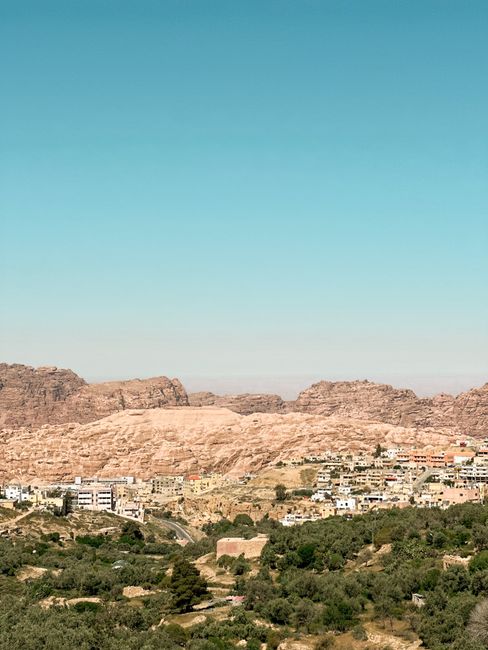
Petra, the “Rose City” of the Nabataeans, lies hidden in a basin of pink, red and ochre sandstone mountains in southern Jordan, about three hours’ drive south of Amman. More than 2,000 years ago, this Arab trading people carved tombs, temples, a theatre and an ingenious system of dams and water channels into the rock, and grew rich on caravans carrying incense, spices and silk. The city later became a Roman provincial town and a Byzantine bishopric, then was largely forgotten by the outside world for centuries. Today it is Jordan’s most visited attraction, a UNESCO World Heritage Site since 1985 and one of the New Seven Wonders of the World. The classic approach is on foot through the Siq, a narrow, winding gorge more than a kilometer long, which opens suddenly onto the carved facade of the Treasury. Beyond it, trails lead to royal tombs, a colonnaded street, high places of sacrifice and the huge Monastery, reached by about 800 rock-cut steps. All visitors stay in Wadi Musa, the town at the park’s entrance, which has hotels for every budget, restaurants, cooking classes and the Petra Visitor Center. Give it at least two full days: one is enough for the Main Trail and the Treasury, but the Monastery, the High Place of Sacrifice and Little Petra need more time and energy.
Right now in Petra (Wadi Musa) (Wadi Musa)
- Wed 11–22°C 52–72°F Clear
- Thu 15–25°C 59–78°F Clear
- Fri 18–26°C 64–78°F 1 mm Clear
Weather: MET Norway (CC BY 4.0)
Top tours in Petra (Wadi Musa)
See all tours for Petra (Wadi Musa) →
From local operators, with prices and reviews; you check availability and book on Viator, our partner. We may earn a commission at no extra cost to you. How we earn money
Petra at a glance
- Best months: March to May and September to November, when the Petra Development and Tourism Region Authority (PDTRA) says the weather is mild. Summer middays are hot; winter can be cold, wet and occasionally snowy.
- Time needed: one day for the Main Trail to Qasr al-Bint; two days to add the Monastery and the High Place of Sacrifice; three days for Little Petra, the back trail and longer hikes.
- Tickets (as of October 2026): JOD 50 (about US$71) for one day, JOD 55 for two days and JOD 60 for three days if you’re staying overnight in Jordan; JOD 90 for visitors on a day trip without an overnight stay. The Jordan Pass includes Petra.
- Opening hours: 6 a.m. to 6 p.m. in summer (2 March to 1 October 2026) and 6:30 a.m. to 5 p.m. in winter (2 October 2026 to 1 March 2027).
- Before you go: visas, the Jordan Pass, money and laws are covered in our Jordan travel guide.
Wadi Musa and Petra: areas and who each one suits
Wadi Musa town center
The town climbs a hillside above the park, with its main square, local restaurants, bakeries and budget hotels around the Musa Spring and the central roundabout. It’s a 2–3 km (1–2 miles) walk or a short taxi ride down to the park entrance, and suits travelers on a budget who don’t mind a taxi each morning.
Tourism Street and the Visitor Center
The road leading down to the Petra Visitor Center is lined with mid-range and upscale hotels, cafes, souvenir shops and the Petra Museum. Staying here means you can walk to the gate at dawn and come back for a rest at midday, which is the most convenient arrangement for most visitors.
Taybeh and the scenic road
Higher up, along the road south toward Taybeh, a handful of hotels have sweeping views over the Petra mountains and the Wadi Araba beyond, at the cost of a drive to the entrance.
Al-Baydha and Little Petra
About 8 km (5 miles) north, the Bedouin community of Al-Baydha has camps and cave-style lodgings near Little Petra (Siq al-Barid), a good choice for a quieter night and for the back trail to the Monastery.
Where to stay in Wadi Musa
- Near the Visitor Center: the most convenient choice, from mid-range hotels to five-star properties within a few minutes’ walk of the gate.
- Town center: budget hotels and hostels, local food and lower prices; take a taxi to the park.
- Taybeh road: view hotels for a relaxed stay if you have a car.
- Little Petra and Al-Baydha: Bedouin camps with dinners, music and stargazing.
You can’t stay overnight inside the archaeological park. Book well ahead for March to May and October to November, when Wadi Musa is at its busiest.
Top things to see in Petra
The Siq and the Treasury
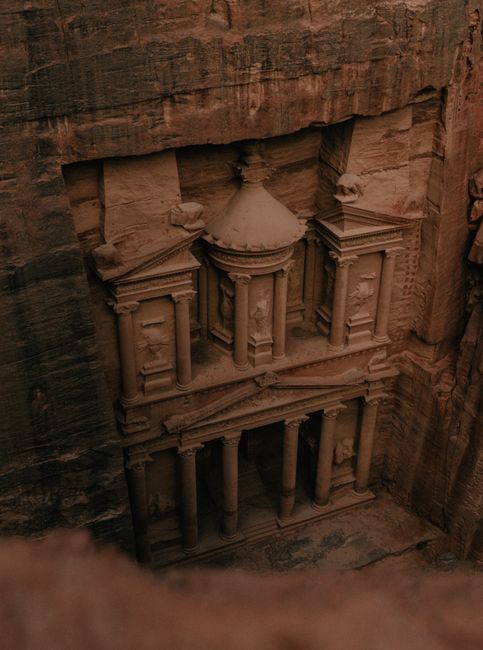
The Main Trail starts at the Visitor Center and passes the Djinn Blocks and the Obelisk Tomb before entering the Siq, a narrow natural gorge more than a kilometer long with remains of the channels that carried water into the city. It ends at the Treasury (Al-Khazneh), Petra’s most famous facade, carved deep into the cliff. Arrive at opening time to see it before the crowds, and come back in the late afternoon when the light warms the stone. The walk from the Visitor Center to the Treasury takes up to an hour.
The Street of Facades, the Theatre and the Royal Tombs
Beyond the Treasury, the valley widens past rows of tombs to the rock-cut Theatre and the Royal Tombs, a line of grand facades including the Urn Tomb, the Silk Tomb with its striped stone, the Corinthian Tomb and the Palace Tomb.
The Colonnaded Street and Qasr al-Bint
The Main Trail ends at Qasr al-Bint, a freestanding temple at the end of the Roman colonnaded street. This is the heart of the ancient city, with the Great Temple and the Petra Church and its Byzantine mosaics nearby, two restaurants and museums. The PDTRA puts the Main Trail at 3.9 km (2.4 miles) one way, about 1.5 to 1.75 hours of walking without stops.
The Monastery (Ad-Deir)
From Qasr al-Bint, the Ad-Deir trail climbs about 800 steps over roughly 1.6 km (1 mile) past the Lion Triclinium to the Monastery, a facade even larger than the Treasury, carved into a mountaintop. It needs moderate fitness but isn’t dangerous; the PDTRA suggests walking it in the late afternoon, when the sun lights the facade.
The High Place of Sacrifice
A steep trail of rock-cut steps near the Theatre climbs to a mountaintop altar with panoramic views, then descends past the Lion Fountain and the Garden Tomb into Wadi Farasa. It’s a good half-day walk with fewer people than the Monastery.
Al-Khubtha and the Treasury viewpoints
The Al-Khubtha trail climbs behind the Royal Tombs to a high viewpoint looking down on the Treasury. The PDTRA rates it as hard and says it takes about four to five hours as part of a full loop. A separate paid viewpoint opposite the Treasury costs JOD 15.
Little Petra (Siq al-Barid)
About 8 km (5 miles) north of Wadi Musa, Little Petra is a small canyon with carved buildings, cisterns and a rare painted ceiling, thought to have been a caravan stop. It’s free to visit, and its ticket office for the back trail keeps shorter hours than the main gate.
The back trail to the Monastery
The PDTRA’s 7 km (4.3-mile) Back Trail starts at Siq al-Barid in Al-Baydha, crosses farmland and rugged hills past the Neolithic village of Al-Baydha, and ends with a climb up the back steps to the Monastery, taking about 3.25 to 3.5 hours. It’s a quieter way into Petra; a local guide is recommended, and Jordan Pass holders must show their pass at the ticket office before starting. A 4×4 transfer from the Cultural Village to the start of the Monastery trail costs JOD 5 per person and runs daily from 7:30 a.m. to 3 p.m.
Petra by Night
Launched in 1998 and redesigned in May 2025, Petra by Night is a guided group walk along a path of about 2,000 candles through the Siq to the Treasury, where the facade is lit with projection mapping, music and narration. It runs from Sunday to Thursday, 8:30 p.m. to about 10:30 p.m., and costs JOD 30; children under 10 go free. You need a valid daytime ticket or a Jordan Pass to buy a ticket, flash photography and drones aren’t allowed, and you should arrive 10 minutes early.
Other things to do in Petra and Wadi Musa
- Longer hikes: the PDTRA lists more than two dozen marked trails, from short walks to all-day routes such as Jabal Harun, a steep 7 km (4.3-mile) climb to the mountaintop shrine traditionally linked to Aaron, and Umm el-Biyara. Many longer trails require a licensed guide.
- Petra Museum: on Tourism Street, about three minutes’ walk from the gate, the museum’s five halls display about 280 artifacts on Nabataean life and history; the Jordan Tourism Board lists it as open daily from 8:30 a.m. to 7:30 p.m. Entry to the Petra Archaeological and Nabataean museums is included with your Petra ticket.
- Cooking class: Petra Kitchen runs evening cooking workshops where you prepare and eat a Jordanian meal, priced at JOD 35 per person.
- Bedouin dinner and stargazing: the Baidha Tourism Association’s camp near Little Petra offers a traditional dinner with music and stargazing for JOD 5 per person, listed by the PDTRA.
- Crafts at the Shaqilah Centre: short workshops in silver, pottery, stone carving, food and henna, from JOD 1.50 to 3, daily from 8 a.m. to 3 p.m.
Food and drink
Wadi Musa’s restaurants range from simple falafel and shawarma shops in the town center to hotel buffets near the gate. Try mansaf, lamb in a fermented yogurt sauce over rice, maqluba, an upside-down rice dish, and zarb, Bedouin barbecue cooked underground, often served at camps around Little Petra. Inside the park, there are restaurants near Qasr al-Bint and tea stalls along the trails, but bring water and snacks. Alcohol is served in some hotel bars and a few licensed restaurants.
Guides, animals and transport inside the park
Licensed tour guides can be booked at the Visitor Center: the PDTRA lists JOD 50 for the Main Trail and JOD 100 for the Main Trail plus the High Place or the Monastery, with guides speaking more than ten languages. Golf carts run between the Visitor Center and the Treasury (JOD 15 one way, JOD 25 return) and between the Theatre and Qasr al-Bint (JOD 10 one way, JOD 15 return) from 7 a.m. to 6 p.m.; they don’t need advance booking. Use only licensed transport confirmed at the Visitor Center, and think twice before riding a donkey or camel up the steep steps.
Day trips and nearby
Wadi Rum
About 1.5 hours south, Wadi Rum’s red dunes and sandstone mountains are best with an overnight stay in a Bedouin camp. See our Wadi Rum guide.
Shobak Castle and Dana
North along the King’s Highway, Shobak Castle, a 12th-century crusader-era fortress on a hilltop, is about 40 minutes away, and the Dana Biosphere Reserve, with hiking trails and an eco-lodge, about an hour.
Aqaba and the Red Sea
About two hours south by bus or car, Aqaba has coral reefs, beaches and a free-visa economic zone. See our Aqaba guide.
Karak and the Dead Sea
Karak Castle is about two hours north on the King’s Highway, and the Dead Sea about three hours, for a scenic route back toward Amman. See our Amman guide.
Nearby destinations
Getting there and getting around
From Amman
The drive takes about three hours on the Desert Highway or four on the more scenic King’s Highway; follow the brown tourist signs. JETT buses leave Amman’s Abdali station at about 6:30 a.m. and return from Petra at about 5 p.m.; book online. Public minibuses leave Amman’s southern bus station between about 9 a.m. and 4 p.m. and return from Petra between 6 a.m. and 1 p.m. A taxi from Queen Alia International Airport goes directly to Petra.
From Aqaba, Wadi Rum and the borders
Public buses from Aqaba take about two hours. Taxis and private transfers link Wadi Musa with Aqaba, Wadi Rum and the Wadi Araba border crossing; your hotel can arrange them. King Hussein International Airport in Aqaba is the closest airport.
Getting around
Wadi Musa is spread out on a hillside: walk from Tourism Street to the gate, and take a taxi from the town center or Taybeh. Inside the park, everything is on foot except the golf carts and licensed animals; wear good shoes, as many trails are steep rock-cut steps and loose sand.
When to go and how long to stay
Spring (March to May) and autumn (September to November) are the best seasons, with warm days and cool nights. Summer is dry, with hot middays in the open valley; start at dawn, rest at midday and return in the late afternoon. Winter brings cold mornings, rain and occasional snow, and flash floods are possible from November to March, when the park may close the Siq. Petra has no station with published World Meteorological Organization normals, so the table shows the Jordan Meteorological Department’s averages for Amman, at a similar altitude on the plateau, as a guide; Petra’s sheltered valley floor is often a little warmer by day.
| Month | Average high / low | Rain (rain days) | What to expect |
|---|---|---|---|
| January | 12 °C (54 °F) / 4 °C (38 °F) | 63 mm (2.5 in), 11 days | Cold; possible rain or snow |
| February | 14 °C (57 °F) / 4 °C (40 °F) | 62 mm (2.4 in), 11 days | Cold, wet spells |
| March | 17 °C (63 °F) / 6 °C (43 °F) | 43 mm (1.7 in), 8 days | Cool; flowers start; good |
| April | 23 °C (73 °F) / 10 °C (49 °F) | 14 mm (0.5 in), 4 days | Mild; excellent |
| May | 28 °C (82 °F) / 14 °C (56 °F) | 3 mm (0.1 in), 2 days | Warm; excellent |
| June | 31 °C (87 °F) / 17 °C (62 °F) | under 1 mm, 0 days | Hot middays; start early |
| July | 32 °C (90 °F) / 18 °C (65 °F) | under 1 mm, 0 days | Hot; dawn starts |
| August | 32 °C (90 °F) / 19 °C (65 °F) | under 1 mm, 0 days | Hot; dawn starts |
| September | 31 °C (87 °F) / 17 °C (62 °F) | under 1 mm, 0 days | Warm; very good |
| October | 27 °C (81 °F) / 14 °C (57 °F) | 7 mm (0.3 in), 2 days | Pleasant; excellent |
| November | 20 °C (69 °F) / 9 °C (49 °F) | 28 mm (1.1 in), 5 days | Cool; flood risk begins |
| December | 14 °C (58 °F) / 5 °C (41 °F) | 49 mm (1.9 in), 8 days | Cold nights; quiet |
The figures are the average daily highs and lows, monthly rainfall and number of rain days that the Jordan Meteorological Department publishes for Amman through the World Meteorological Organization’s World Weather Information Service.
Events worth planning around
- Petra by Night: Sunday to Thursday evenings, all year.
- Spring and autumn peaks: the busiest months for tour groups; book hotels early.
- Ramadan: in 2027 expected from about 8 February to 9 March; restaurants in town change their hours, but the park stays open.
How long to stay: 1, 2 and 3 days
- One day: the Siq, the Treasury, the Theatre, the Royal Tombs and the Colonnaded Street to Qasr al-Bint, with Petra by Night if it’s a Sunday to Thursday.
- Two days: add the Monastery and the High Place of Sacrifice, or the Al-Khubtha viewpoint over the Treasury.
- Three days: add Little Petra and the back trail, a longer hike such as Jabal Harun, the Petra Museum and a cooking class.
Typical costs in Petra
Prices are for October 2026, converted at about US$1.41 per dinar. Park and service prices are the PDTRA’s.
| Item | Typical cost |
|---|---|
| Petra, one / two / three days (staying in Jordan) | JOD 50 / 55 / 60 (about US$71 / 78 / 85) |
| Petra, one day without an overnight stay in Jordan | JOD 90 (about US$127) |
| Jordan Pass (includes the visa fee and Petra) | JOD 70–80 (about US$99–113) |
| Petra by Night | JOD 30 (about US$42) |
| Golf cart, Visitor Center to the Treasury, one way / return | JOD 15 / 25 (about US$21 / 35) |
| Licensed guide, Main Trail / Main Trail plus Monastery | JOD 50 / 100 (about US$71 / 141) |
| Petra Kitchen cooking class | JOD 35 (about US$50) |
| Dinner in a local restaurant | about JOD 5–12 (about US$7–17) |
| Mid-range hotel double near the gate, per night | about JOD 50–110 (about US$70–155) |
Daytime admission is free for children under 12, and residents of Jordan pay reduced prices. Payment at the Visitor Center is in cash in dinars or by Visa card.
Safety in Petra
Petra is safe for visitors, and the tourist police and park rangers patrol the main trails. The main risks come from the terrain, the heat and the weather.
- Heat: from June to September, the open valley floor gets very hot by midday. Start at opening time, carry plenty of water, wear a hat and sunscreen, and rest in the shade.
- Flash floods: from November to March, heavy rain can send flash floods through the Siq and the wadis. The park closes trails when floods are expected; check the forecast, follow rangers’ instructions and never enter a wadi during or just after heavy rain.
- Steps and cliffs: the trails to the Monastery and the high places are steep, uneven and unfenced in places. Wear shoes with good grip, keep off the monuments, and stick to the marked trails unless you have a licensed guide.
- Park hours: leave the park before closing time. Staying inside after hours isn’t allowed and can lead to arrest.
- Winter cold: mornings and evenings can be near freezing from December to February, and snow occasionally closes roads.
- Animals: if you ride a donkey, horse or camel, use licensed handlers at the Visitor Center and dismount on steep steps.
- Touts and antiquities: check prices at the Visitor Center before agreeing to extra services, and don’t buy rocks, coins or “antiquities.”
- Dress codes: wear light clothes that cover shoulders and knees, out of respect for the local community.
- Emergencies: find the nearest tourist police officer or ranger, or call the tourist police office at the Visitor Center on +962 3 2156487. For police, ambulance and fire, call 911.
Practical tips for Petra
- Tickets: buy at the Visitor Center or online through the PDTRA’s Petra Pass system. Multi-day tickets must be used on consecutive days, and the Jordan Pass can only be scanned at the Visitor Center gate.
- Timing: arrive at opening time for the Treasury without crowds, take a long midday break, and return in the late afternoon for the Monastery.
- Drones: prohibited without special permission.
- Money: ATMs are in Wadi Musa town; carry small notes for tea, water and tips inside the park.
What to pack for Petra
Pack sturdy walking shoes with good grip, light breathable clothes that cover shoulders and knees, a hat, sunglasses, sunscreen and a refillable water bottle. Add a warm fleece and a waterproof jacket from November to March, a small backpack for snacks and water, a flashlight for walking back to town after Petra by Night, and a wide-angle lens for the narrow Siq.
Petra travel FAQ
How much is the ticket to Petra?
JOD 50 for one day, JOD 55 for two consecutive days and JOD 60 for three if you’re staying overnight in Jordan; JOD 90 for a one-day visit without an overnight stay. The Jordan Pass includes Petra.
What are Petra’s opening hours?
6 a.m. to 6 p.m. in summer (2 March to 1 October 2026) and 6:30 a.m. to 5 p.m. in winter (2 October 2026 to 1 March 2027).
How many days do I need in Petra?
Two days lets you see the Treasury, the Royal Tombs, the Monastery and the High Place of Sacrifice without rushing. Three days adds Little Petra and longer hikes.
How long is the walk to the Treasury?
Up to about an hour from the Visitor Center through the Siq. The whole Main Trail to Qasr al-Bint is 3.9 km (2.4 miles) one way.
How many steps are there to the Monastery?
About 800, over roughly 1.6 km (1 mile) from Qasr al-Bint. It needs moderate fitness and takes about an hour each way.
When does Petra by Night run?
Sunday to Thursday from 8:30 to about 10:30 p.m. Tickets cost JOD 30, and you also need a daytime ticket or a Jordan Pass.
Is Petra by Night included in the Jordan Pass?
No, you buy a separate ticket.
Can I stay overnight inside Petra?
No. Overnight stays in the park aren’t permitted; stay in Wadi Musa or at a camp near Little Petra.
What is the best time of year to visit Petra?
March to May and September to November, when the weather is mild.
How do I get from Amman to Petra?
Drive about three hours on the Desert Highway, or take the JETT bus from Abdali station at about 6:30 a.m.
Sources and last review
Researched and last reviewed on 5 October 2026. Ticket prices, opening hours, golf carts, guides, the viewpoint fee, the 4×4 transfer, payment methods, trail lengths, the Back Trail, Jabal Harun, the Monastery steps, emergency contacts, park rules, getting to Petra, cooking classes, the Bedouin dinner and the Shaqilah Centre come from the Petra Development and Tourism Region Authority (visitpetra.jo); Petra by Night’s schedule, price and rules from the PDTRA and the Petra by Night operator; the Jordan Pass from the Ministry of Tourism and Antiquities; the Petra Museum and Al-Khubtha trail from the Jordan Tourism Board; the World Heritage listing from UNESCO; park-hours enforcement, flash floods and emergency numbers from GOV.UK’s Jordan travel information (updated 10 September 2026); climate averages for Amman from the Jordan Meteorological Department via the World Meteorological Organization; coordinates from Wikidata. Areas of Wadi Musa, Little Petra opening and entry, food, drive times to nearby sites, snow closures, Ramadan 2027 dates, meal and hotel prices are general references and flagged for checking. For entry rules and money, see our Jordan travel guide.
Plan your trip
Partner links: TravelerCenter may earn a commission if you book, at no extra cost to you.
🇪🇬 Useful Arabic phrases for Petra (Wadi Musa)
All 38 Arabic phrases: restaurant, hotel, emergencies, romance (printable) →