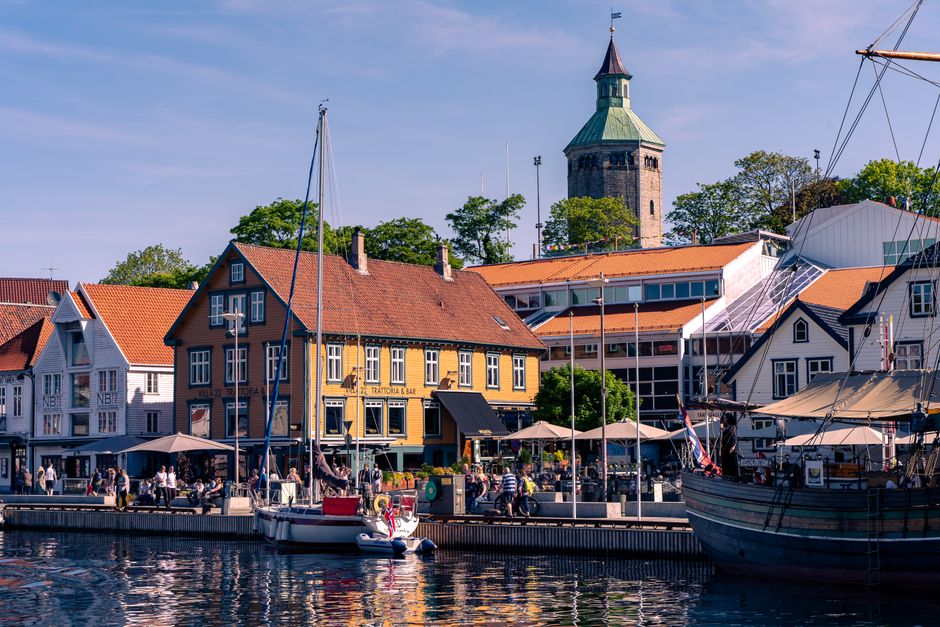
Stavanger is Norway’s oil capital and one of its most relaxed and attractive cities: a harbour lined with white and red wooden warehouses, a medieval cathedral, the cobbled lanes of Old Stavanger with its 18th- and 19th-century white wooden houses, and streets painted in bright colours. It is also the gateway to the Lysefjord, a narrow, 42 km fjord walled by granite cliffs, and to two of Norway’s most famous hikes: Preikestolen (Pulpit Rock), a flat-topped ledge 604 m above the water, and Kjerag, with its boulder wedged in a crack. You come to wander the old town and the harbour, learn about the North Sea oil adventure at the Petroleum Museum, cruise the Lysefjord and hike to the Pulpit Rock. Give it two days for the city and a fjord cruise, three or four to add the big hikes.
Right now in Stavanger
- Wed9–12°C48–54°F8 mm rain
- Thu9–12°C48–54°FClear
- Fri8–10°C46–50°F7 mm rain
Top tours in Stavanger
See all tours for Stavanger →
From local operators, with prices and reviews; you check availability and book on Viator, our partner. We may earn a commission at no extra cost to you. How we earn money
Stavanger at a glance
- Best for: the Preikestolen and Kjerag hikes, Lysefjord cruises, wooden old-town streets, food and harbour life, museums and the beaches of Jæren.
- How long: 2 days for the city and a Lysefjord cruise; 3–4 days to add Preikestolen, Kjerag or a drive through Ryfylke.
- Best time: May to September for hiking and boat trips; June to August for the longest days and the most cruise departures. Kjerag is a summer-only hike.
- Getting in: Stavanger Airport Sola is about 15 km from the centre; trains run from Oslo along the south coast, and there are buses and coastal roads from Bergen.
- Getting around: the centre is small and walkable; Kolumbus runs buses, local boats and ferries in the region. Preikestolen is about 45 minutes by road through the Ryfast tunnels.
- Before you go: Norway uses the Norwegian krone (NOK), cards are accepted almost everywhere and Norway is in the Schengen area.
Stavanger, area by area
Vågen harbour and the centre
The inner harbour, Vågen, is the heart of the city, lined on its east side by old warehouses (sjøhus) now full of restaurants and bars, with fjord-cruise boats leaving from the quays. Behind it are the cathedral, the Breiavatnet pond and the pedestrian shopping streets, all within ten minutes’ walk.
Old Stavanger (Gamle Stavanger)
On the west side of the harbour, Old Stavanger is a quiet, car-free area of about 170 white wooden houses from the 18th and 19th centuries, with flower boxes, picket fences and cobbled lanes. People still live here, so keep your voice down. The Norwegian Canning Museum is in an old sardine factory at its heart.
Øvre Holmegate and the east side
Øvre Holmegate, better known as Fargegaten (“the colour street”), is a short lane of houses painted in vivid pinks, yellows and greens, lined with cafés and bars. The streets around it, and the Storhaug district to the east, are full of large street-art murals, many from the Nuart festival.
Hafrsfjord, Sola and Jæren
South-west of the centre, the Sverd i fjell monument stands by the Hafrsfjord, and beyond the airport the flat, windswept Jæren coast has long sandy beaches such as Sola, Solastranden and Orrestranden, popular for walks, kitesurfing and summer swims in cool water.
Top things to see in Stavanger
Prices below are as of October 2026 and in Norwegian kroner.
The Norwegian Petroleum Museum
Built to look like an oil platform at the edge of the harbour, the Petroleum Museum (Norsk Oljemuseum) tells the story of how oil found in the North Sea in 1969 transformed Norway, with real equipment, diving bells, a disaster film and an escape chute for children. From 1 September to 31 May it opens Monday to Saturday 10:00–16:00 and Sunday 10:00–18:00; from 1 June to 31 August daily 10:00–19:00. Tickets cost NOK 180 for adults, NOK 60 for children aged 4–16 and NOK 420 for a family.
Stavanger Cathedral
Begun in the early 1100s, when the city was founded as a bishop’s seat, Stavanger Cathedral is Norway’s oldest cathedral still in its original medieval form, a mix of Romanesque nave and Gothic choir. It opens to visitors Monday to Saturday from 10:00 to 15:00 (and on Sundays for services), but closes at times for rehearsals and weddings; entry costs NOK 75, payable by card.
The Canning Museum and the MUST museums
Stavanger was once Norway’s sardine-canning capital, and the Norwegian Canning Museum in Old Stavanger shows how it was done, with old machines and, on some days, sprats smoked in the original ovens. It belongs to the MUST group of museums, which also includes the Stavanger Museum, the Maritime Museum, the Stavanger Art Museum, two historic manor houses and Utstein Abbey on an island north of the city. As of October 2026, one adult ticket (NOK 170) covers all the MUST museums that are open on the same day, and under-18s and students go free.
Sverd i fjell (Swords in Rock)
Three giant bronze swords, about 10 m tall, stand planted in the rock beside the Hafrsfjord, where Harald Fairhair is said to have won the battle that united Norway in about 872. The monument, by Fritz Røed, was unveiled in 1983. It is free and always open, about 6 km from the centre by bus or bike.
Valberg Tower and the harbour viewpoints
The old fire-watch tower of Valbergtårnet, on a rise above the east side of the harbour, gives a view over the rooftops and harbour. The Geopark, a playground made of recycled oil-industry parts beside the Petroleum Museum, is fun for children.
Churches and cathedrals
- Stavanger Cathedral
Historic centres
- Gamle Stavanger
Museums
- Ledaal
- Norwegian Petroleum Museum
- Stavanger Museum
Other sights
- Sverd i fjell
Viewpoints
- Preikestolen
Preikestolen (Pulpit Rock)
Preikestolen is a square granite platform about 25 m by 25 m, jutting out 604 m above the Lysefjord, and one of Norway’s most famous sights. The path starts at the Preikestolen Fjellstue mountain lodge, where there is a large car park with automatic payment, toilets and tourist information. The regional tourist board describes the hike as about 6 km there and back, with about 350 m of height difference, taking around 4 hours in total; with breaks and the climb up and down the rocky steps, many people take 4–5 hours. The path is well built, with stone steps and some steep, rocky sections, and is fine for fit walkers and older children in good shoes.
- Season: April to October. From late autumn to spring the path can be icy and snowy, and the tourist board recommends going in winter only with a professional guide; guided winter and sunrise hikes are offered.
- Getting there: since the Ryfast tunnels opened, the drive from Stavanger takes about 45 minutes, with no ferry. Seasonal hikers’ buses run from the bus terminal in the centre to the car park in the main season; check the current operator and timetable through the tourist office or Kolumbus.
- Avoid the crowds: start before 09:00 or after about 15:00 in summer (it stays light until late), and avoid days when several cruise ships are in port.
- Safety: there are no railings on the edge. Stay well back, especially in wind or rain, keep children close and never fly a drone over people.
The Lysefjord, Kjerag and Flørli
The Lysefjord runs 42 km inland from near Stavanger to Lysebotn, between granite walls up to about 1,000 m high, with waterfalls pouring down in early summer. Sightseeing cruises leave from Stavanger’s harbour and sail into the fjord past the Pulpit Rock (seen from below), the Hengjane waterfall and Vagabond’s Cave, then return; Rødne’s silent electric catamaran trip takes about 3–3.5 hours and costs NOK 890 as of October 2026. Cruises are frequent in summer and fewer, or not running, from autumn to spring, so check departures before you plan around one. You can also see the fjord from the local car and passenger ferry that links Lauvvik, Forsand and Lysebotn.
Kjerag, near Lysebotn at the head of the fjord, is a harder, longer hike than Preikestolen: steep, exposed sections with chains up three ridges to a high plateau, where Kjeragbolten, a boulder wedged in a crack about 1,000 m above the fjord, is a famous photo spot. It is a summer hike, roughly June to September, when the mountain road to the Øygardstøl car park is open; allow 5–6 hours return and go only in good weather. Flørli, a tiny hamlet on the fjord reached only by boat, has a wooden staircase of 4,444 steps beside an old hydropower pipe, one of the longest in the world.
For more on Norway’s great walks, see our hiking guide, and for fjord cruises our boat trips page.
Eat and drink like a local
Stavanger is one of Norway’s food cities, with fine seafood, Michelin-recognised restaurants and the Gladmat food festival in summer (check the 2027 dates). Try fish soup and fresh prawns from the boats in the harbour in summer, the Fisketorget fish market and restaurant on Vågen, and waffles with brown cheese. Eating out is expensive; lunch menus, bakeries and food halls are better value.
Getting to Stavanger
By air. Stavanger Airport Sola has frequent flights from Oslo (about 50 minutes) and Bergen, and direct flights from a range of European cities. The Flybussen airport coach and Kolumbus local buses run to the centre in about 30 minutes.
By train. Go-Ahead Nordic runs trains on the Sørlandet line from Oslo via Kristiansand to Stavanger, about 8 hours. There is no railway between Bergen and Stavanger.
By road and sea. From Bergen, the E39 coastal road with two ferry crossings takes about 4.5–5 hours, by car or by express bus. Ferries from Denmark sail to Stavanger on some routes; check current schedules. Many cruise ships call in summer.
Getting around Stavanger
The centre, Old Stavanger and the harbour are all within walking distance. Kolumbus runs the region’s buses, express boats and ferries; buy tickets in the Kolumbus app. City bikes and e-scooters are available for longer hops, for example out to Sverd i fjell. A car is useful for Preikestolen, Kjerag and the Ryfylke region, but the Ryfast tunnels and city roads have tolls, collected automatically by number-plate camera (hire cars pass the charges on to you).
When to go and how long to stay
Stavanger has a mild, wet maritime climate: winters are rarely below freezing in the city and summers are cool to pleasantly warm. The table uses MET Norway’s 1991–2020 climate normals for Stavanger Airport Sola, as submitted to the World Meteorological Organization: average daily highs and lows, rain per month and days with at least 1 mm.
| Season | Average daily high | Average night low | Rain per month | What it’s like |
|---|---|---|---|---|
| Winter (Dec–Feb) | 4.6–5.6 °C | -0.4 to 0.6 °C | 100–132 mm | Mild, wet and windy, short days; snow more likely on the mountains than in town |
| Spring (Mar–May) | 6.5 °C rising to 13.8 °C | 0.9–6.8 °C | 81 falling to 62 mm | The driest time of year; Preikestolen season starts in April, waterfalls swell in May |
| Summer (Jun–Aug) | 16.3–19.0 °C | 9.9–12.7 °C | 67–127 mm | Long, light days, all boats and hikes running; busiest with cruise ships |
| Autumn (Sep–Nov) | 16.1 °C falling to 8.0 °C | 10.3 falling to 3.0 °C | 132–148 mm | Wettest season, autumn colours, fewer crowds; Kjerag closes in September or October |
Sola gets about 1,260 mm of rain a year, falling on about 165 days, and the mountains inland, including the Lysefjord, are much wetter. October is the wettest month and April and May the driest. Always pack a waterproof, and keep a spare day for the big hikes in case of rain or fog.
Stavanger in 2 days
Day 1: Old Stavanger and the Canning Museum, the cathedral, Fargegaten and the harbour, then the Petroleum Museum. Day 2: a morning Lysefjord cruise and an afternoon at Sverd i fjell or on the Sola beaches, with dinner on Vågen.
Stavanger in 4 days
Add a full day for Preikestolen (start early), and in summer a day for Kjerag or the Flørli stairs by boat, or a drive through Ryfylke’s fjords and villages.
Weather month by month
Where to stay in Stavanger
- Around Vågen harbour: the most central, with harbour views and restaurants on the doorstep; can be noisy on weekend nights.
- Near the station and Breiavatnet: handy for buses, trains and the airport coach, a few minutes’ walk from the harbour.
- Storhaug and the east side: apartments and smaller hotels near Fargegaten and the street art.
- Preikestolen and Ryfylke: the mountain lodge at the trailhead, cabins and campsites near the fjord, for an early start on the hike.
As a business city, Stavanger’s hotels are often cheaper at weekends and in July than on weekdays, the opposite of many tourist towns. They fill up during big oil-industry conferences, so check dates before you book.
Practical tips for Stavanger
- Check the cruise calendar: on days with several ships in port, the old town, the harbour and Preikestolen are much busier.
- Start hikes early: parking at Preikestolen fills up on summer mornings, and you will have the rock to yourself only before about 09:00.
- Bring a picnic: there are no shops on the trails; fill your water bottle before you set off.
- Know the tolls: road tolls are automatic; with a hire car they are charged afterwards, so check the rental terms.
- Pay by card: cash is rarely needed, though you have a right to pay cash in shops.
- Check the weather on yr.no: fog and rain can hide the views; move your hike to the clearest day.
What to pack for Stavanger
A good rain jacket is essential at any time of year, with a warm layer for the boat deck and the mountain tops, where it is windy and several degrees colder. For Preikestolen and Kjerag, wear proper hiking shoes with good grip (the rock is slippery when wet), and carry water, snacks, a hat and gloves. Comfortable shoes for the cobbled old town, and a swimsuit for a brave summer dip, complete the list. Norway uses type C and F plugs; see our travel adapters guide.
Stavanger travel FAQ
How long is the Preikestolen hike?
About 6 km there and back, with about 350 m of height difference, according to the regional tourist board; allow around 4 hours, or 4–5 hours with breaks. The path is rocky and steep in places but well built.
Can you hike Preikestolen in winter?
The main season is April to October. In snow and ice the path is slippery and the days are short, so the tourist board recommends going only with a professional guide; several companies run guided winter hikes with spikes or snowshoes.
How do I get from Stavanger to Preikestolen without a car?
In the main season, hikers’ buses run from the bus terminal in the centre to the Preikestolen car park, about 45 minutes through the Ryfast tunnels. Out of season, join a guided tour with transport. Check the current timetable with the tourist office or Kolumbus.
Is a Lysefjord cruise worth it?
Yes, if you want to see the fjord and the Pulpit Rock from below without hiking. Rødne’s silent electric catamaran trip takes about 3–3.5 hours and costs NOK 890 as of October 2026; departures are frequent in summer and limited or paused in winter.
When can you hike Kjerag?
Roughly June to September, while the mountain road to the Øygardstøl car park is open and the snow has gone. It is a demanding 5–6-hour hike with chains on steep slabs; go only in dry, clear weather.
How much is the Petroleum Museum?
As of October 2026, NOK 180 for adults, NOK 60 for children aged 4–16 and NOK 420 for a family. It is open daily, until 16:00 on most days outside summer (18:00 on Sundays) and until 19:00 in June, July and August.
Can you visit Stavanger Cathedral?
Yes, Monday to Saturday from 10:00 to 15:00, for NOK 75, unless a rehearsal, wedding or event is on. It is free to attend services.
How do I get from Stavanger Airport to the city?
The Flybussen airport coach and Kolumbus local buses take about 30 minutes to the centre; a taxi takes about 20 minutes.
Can you take the train from Bergen to Stavanger?
No, there is no railway between them. Take the express bus or drive the E39 (about 4.5–5 hours with ferries), or fly in under an hour. Trains do run from Oslo to Stavanger, in about 8 hours.
How many days do you need in Stavanger?
Two days for the city and a fjord cruise; three or four if you want to hike Preikestolen and Kjerag, with a spare day for bad weather.
Plan your trip
Partner links: TravelerCenter may earn a commission if you book, at no extra cost to you.
🇳🇴 Useful Norwegian phrases for Stavanger
All 38 Norwegian phrases: restaurant, hotel, emergencies, romance (printable) →
Sources · last reviewed 4 October 2026
Researched and last reviewed on 4 October 2026. Preikestolen hike facts, season and winter advice: Region Stavanger & Ryfylke (the regional tourist board); the Petroleum Museum: norskolje.museum.no; Stavanger Cathedral: the cathedral parish; the MUST museums and the Canning Museum: museumstavanger.no; Lysefjord cruise: Rødne; climate: MET Norway 1991–2020 normals for Stavanger Airport Sola (WMO collection). Bus services to Preikestolen, airport transport times, train and road journey times, Kjerag season and hike times come partly from general knowledge or secondary sources and are flagged for checking. Prices, timetables and rules change, so check the official links before you go.
Also: MET Norway normals 1991–2020, Sola (Stavanger airport) (climate)
Data: Weather: MET Norway (CC BY 4.0) · Sea temperature: NOAA CoastWatch · Rates: ECB · Costs: World Bank ICP and price levels · © OpenStreetMap contributors (ODBL) · Wikidata (CC0)