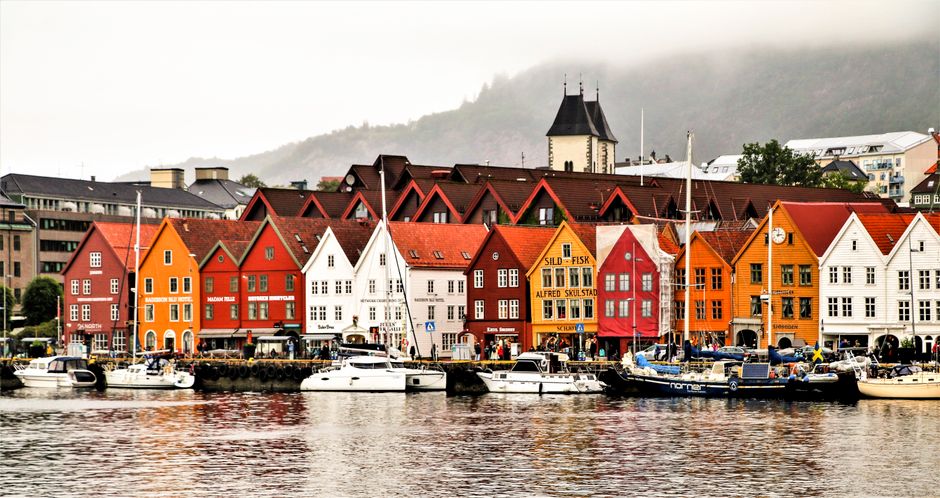
Bergen is Norway’s second city and the gateway to the western fjords: a harbour town of steep wooden houses ringed by seven mountains, with the gabled merchant houses of Bryggen lining the quay. It was a hub of the Hanseatic League for four centuries, and the old wharf is now a UNESCO World Heritage Site. You come to wander Bryggen’s leaning alleys, ride the Fløibanen funicular or the Ulriken cable car for a view of the city and the islands, eat seafood by the Fish Market, hear Grieg at his villa at Troldhaugen, and set off by boat or train into the fjords. Bring a rain jacket: Bergen is famously wet. Give it two days for the city and three or four with a fjord trip.
Right now in Bergen
- Wed 9–11°C 48–52°F 4 mm Rain
- Thu 7–12°C 44–53°F Clear
- Fri 5–9°C 41–48°F 10 mm Rain
Weather: MET Norway (CC BY 4.0) · Sea temperature: NOAA CoastWatch · Rates: ECB
Top tours in Bergen
See all tours for Bergen →
From local operators, with prices and reviews; you check availability and book on Viator, our partner. We may earn a commission at no extra cost to you. How we earn money
Bergen at a glance
- Best for: the Bryggen wharf, mountain views and walks straight from the city, seafood, music and art, and fjord trips by boat and train.
- How long: 2 days for Bryggen, Fløyen, the Fish Market, Bergenhus and KODE; 3–4 days to add Ulriken, Troldhaugen and a fjord cruise or Norway in a Nutshell.
- Best time: May to early September for the longest days, the driest spells and the full range of fjord trips; December for Christmas lights and the gingerbread town.
- Getting in: the Bergen Line from Oslo takes about 6 hours 30 minutes to 7 hours 30 minutes; the Bybanen light rail runs to Bergen Airport, Flesland, in about 45 minutes.
- Getting around: the centre is walkable; buses and the light rail cover the rest. As of October 2026, the Bergen Card costs from NOK 400 for 24 hours and includes buses, the light rail and the airport line.
- Good to know: Norway uses the krone (NOK) and type C/F plugs, is in the Schengen area and is almost cashless. Many cruise ships call in summer, so Bryggen is calmest early and late in the day.
Bergen, area by area
The heart of Bergen wraps around the Vågen harbour. Bryggen runs along its north side, with the fortress at the end; the Fish Market and Torget square sit at its head; and the streets of the modern centre climb south towards the lake, Lille Lungegårdsvann, the railway station and the KODE art museums. The funicular to Fløyen leaves from a street just behind the Fish Market.
Bryggen and Bergenhus
The wooden wharf, its museums and restaurants, and the medieval fortress beyond. Best for: first visits and atmospheric evenings by the water.
Torget, the centre and the lake
The Fish Market, the shopping streets, the Festplassen square by the lake, and the KODE museums along its shore; the bus and railway stations are a 10-minute walk away. Best for: hotels close to everything.
Nordnes and Sandviken
Two older neighbourhoods of narrow lanes and white-painted wooden houses on either side of the harbour: Nordnes, on its peninsula with the Bergen Aquarium and a seaside park, and Sandviken, north of Bryggen. Best for: quiet strolls and photos of the “real” old Bergen.
Top things to see in Bergen
Prices and hours below were checked on the official sites in October 2026. Many are included in or discounted with the Bergen Card. Check before you go, as they change.
Bryggen, the Hanseatic wharf
From the 14th to the 18th century, German merchants of the Hanseatic League ran the trade in dried cod from northern Norway from this quay, living and working in long rows of wooden buildings. Fire has destroyed Bryggen many times; the 60 or so buildings you see today were mostly rebuilt after the fire of 1702, on medieval plots and in medieval style, and they were added to the UNESCO World Heritage list in 1979. Walk the narrow passages between the buildings, where workshops, galleries and cafés now fill the old storerooms. Bryggens Museum, at the far end, displays the medieval town found under the wharf after a fire in 1955, including runic inscriptions on wooden sticks. The Hanseatic Museum tells the merchants’ story in the Schøtstuene assembly rooms; its main building, Finnegården, has been closed for a long restoration, so check what is open when you visit.
Fløyen and the Fløibanen funicular
The Fløibanen funicular climbs from the centre to Mount Fløyen, 320 metres up, in about six minutes, for the classic view of the harbour, the city and the islands beyond. At the top there are a restaurant and café, a play area, a lake with canoes in summer and easy forest trails; many people walk back down in 30 to 45 minutes. It runs daily from 08:00 to 00:00. Fares as of October 2026: in low season (1 January to 31 March and 1 October to 31 December), adults pay NOK 80 one way and NOK 145 return, children aged 4 to 15 NOK 45 and NOK 70, and seniors NOK 50 and NOK 100. In high season (1 April to 30 September), adults pay NOK 105–120 one way and NOK 200–220 return, with the lower price when you buy in the app, online or at the ticket machine. Queues can be long on summer cruise days; go early or in the evening.
Mount Ulriken and the cable car
Ulriken, at 643 metres the highest of Bergen’s seven mountains, is reached by the Ulriken643 cable car in about five minutes, with views over the city, the fjords and the coast. Experienced walkers can hike the “Vidden” ridge path across the plateau from Ulriken to Fløyen in five to six hours in clear weather. As of October 2026, a return ticket costs NOK 435 for adults and NOK 180 for children aged 4 to 16, and one way NOK 255 and NOK 120. From 1 October 2026 to 30 March 2027 it runs 09:00–19:00 on Tuesday, Wednesday and Sunday and 09:00–23:00 from Thursday to Saturday, and is closed on Mondays, over Christmas and New Year and in the first two weeks of January (reopening on 13 January). A shuttle bus runs from the city centre; the Bergen Card gives 10% off.
The Fish Market
Fish has been sold at Torget, at the head of the harbour, since the Middle Ages. Today the glass-fronted Mathallen hall on the quay is open all year, with fishmongers and small seafood restaurants, and outdoor stalls set up in the summer season. Expect tourist prices for the ready-made dishes; for fish soup or a shrimp sandwich it is still a fine place to sit and watch the harbour.
Bergenhus Fortress
At the mouth of the harbour, Bergenhus is one of Norway’s oldest and best-preserved fortresses. Its centrepiece, Håkon’s Hall, a stone royal banqueting hall built in the 1260s when Bergen was the capital of Norway, stands beside the Rosenkrantz Tower, a 16th-century residence and defence tower. The grounds are free to walk; the hall and tower are run by the Bergen City Museum and charge entry, with shorter hours out of season.
KODE art museums
KODE is one of the largest art and design museums in the Nordic countries, spread over four buildings along the lake in the centre, plus three composers’ homes outside town. Rasmus Meyer’s Collection has a major group of Edvard Munch paintings and Norwegian painting from the 1800s, including J.C. Dahl and Nikolai Astrup. As of October 2026, the main buildings open Wednesday to Friday 11:00–18:00 and Saturday and Sunday 11:00–16:00 in the low season (15 September to 18 May), with longer hours in summer; one ticket covers all the city buildings. Entry is included with the Bergen Card.
Troldhaugen, Edvard Grieg’s home
Norway’s best-loved composer lived for 22 years at Troldhaugen, a painted wooden villa on a lake south of the city, now part of KODE. You can see the house, his composing hut by the water, the graves of Grieg and his wife Nina in the rock face, and a museum; in summer, short lunchtime piano concerts are held in the Troldsalen concert hall, built into the hillside. Take the Bybanen light rail towards the airport to Hop and walk about 20 minutes. The Bergen Card includes or discounts entry; opening hours are reduced in winter, so check KODE’s site.
Historic centres
- Bryggen
Castles and forts
- Bergenhus Fortress
Peaks and mountains
- Fløyen
- Ulriken
Museums
- Fantoft Stave Church
- Gamlehaugen
- Troldhaugen
Fjord trips from Bergen
Bergen lies between the Sognefjord to the north and the Hardangerfjord to the south, and there are fjord trips from the city every day of the year. See our boat trips guide for tips on choosing a cruise.
Mostraumen fjord cruise
The easiest real fjord trip from the city is Rodne’s round trip to the Osterfjord and the narrow Mostraumen strait, where steep cliffs and waterfalls close in on the boat. It takes 3 to 3 hours 30 minutes with no stops ashore, leaving from Zachariasbryggen by the Fish Market. As of October 2026, it costs NOK 890 for adults and NOK 445 for children aged 4 to 15 (NOK 940 and NOK 470 in 2027). It runs all year: daily at 10:00 and 14:00 in September and October, at 10:00 from November to March, and up to three times a day in July and August. Rodne also sails along the Hardangerfjord to Rosendal, about two hours each way, every day of the year.
Norway in a Nutshell
Fjord Tours’ Norway in a Nutshell is a self-guided package that strings together public trains, boats and buses: the Bergen Line to Myrdal, the Flåm Railway down to Flåm, an electric fjord cruise on the UNESCO-listed Nærøyfjord to Gudvangen, and a bus through the Nærøydalen valley to Voss and back to Bergen (or on to Oslo). It runs all year; as a day round trip from Bergen it takes about 12 hours. As of October 2026, prices start from NOK 2,698, varying with the season and the route. You can do the same trip yourself by booking each leg separately, which is cheaper only if you plan carefully.
By express boat to the Sognefjord and Flåm
From April to October, Norled’s express boat leaves Bergen at 08:00 for Flåm, about 5 hours 30 minutes away along the Sognefjord, Norway’s longest and deepest fjord, returning from Flåm at 15:30. As of October 2026, an adult single costs NOK 1,295. It makes a scenic way in or out of Flåm on a Nutshell-style round trip.
Activities and best months
- City sightseeingBryggen, the UNESCO-listed Hanseatic wharf with about 600,000 visitors a year, has shops, restaurants and craft workshops inside its old wooden buildings; next to it is the Fish Market with seafood stalls open in summer. · source
- HikingThe Fløibanen funicular climbs from the city to the top of Mount Fløyen in 6 minutes; many visitors ride up and walk back down to the centre, about 40 minutes. Mount Ulriken is another of the city mountains. · source
The Flåm Railway and the Bergen Line
The Bergen Line between Oslo and Bergen is one of Europe’s great train rides, crossing the Hardangervidda plateau at Finse, 1,237 metres above sea level. Vy runs 6–7 trains a day each way; the journey takes about 6 hours 30 minutes to 7 hours 30 minutes. Book early for cheaper fares and a window seat on the left side heading west.
At Myrdal, about two hours from Bergen, the Flåm Railway (Flåmsbana) branches off and drops about 865 metres to Flåm on the Aurlandsfjord in about an hour, through 20 tunnels, with a five-minute stop at the Kjosfossen waterfall. It runs every day, all year. As of October 2026, Vy lists adult one-way tickets from NOK 399; prices vary by season and demand and are highest from May to September, and children aged 6 to 17 pay half. Summer trains can sell out, and seats cannot be reserved. See our Flåm guide for the full details.
The coastal voyage from Bergen
Bergen is the southern end of the Norwegian coastal route to Kirkenes near the Russian border. Hurtigruten and Havila Voyages both sail it all year from Bergen, calling at 34 ports, including Ålesund, Trondheim, the Lofoten Islands and Tromsø. The full round trip takes 12 days, northbound to Kirkenes about 7 days, and you can also book shorter sections as a port-to-port passenger. In winter it is one of the most comfortable ways to look for the Northern Lights, which are visible in the north from roughly September to early April.
Nearby destinations
- Flåm111 km
- Stavanger160 km
- Geirangerfjord211 km
Getting to Bergen
By air. Bergen Airport, Flesland, is about 20 km south of the city, with flights across Norway and Europe. Bybanen light rail line 1 runs from the airport to the centre (Byparken) in about 45 minutes on an ordinary Skyss ticket, and is free with the Bergen Card; the Flybussen airport coach is faster but costs more.
By train. The Bergen Line from Oslo arrives at Bergen station, a short walk from the centre. By sea. Hurtigruten and Havila ships arrive from the north, and an overnight ferry links Bergen with Denmark. By car. The E16 from Oslo via Flåm and Voss and the E39 along the coast both reach Bergen; city-centre parking is expensive, and the city has toll stations (paid automatically through AutoPASS).
Getting around Bergen and the Bergen Card
Walk in the centre, where most sights are within 15 minutes of each other. Skyss runs the buses and Bybanen; buy tickets in the Skyss app before boarding. The Bergen Card gives free travel on the light rail and buses in the city and the Vestland region, including to and from the airport, plus free or reduced entry to museums and sights such as Bryggens Museum, the Hanseatic Museum, KODE, Troldhaugen and the Bergen Aquarium, and discounts on Fløibanen, Ulriken, fjord cruises and parking. As of October 2026, it costs NOK 400, 500, 600 and 700 for 24, 48, 72 and 96 hours for adults, and NOK 100, 125, 150 and 175 for children aged 3 to 15. Buy it online or at the Tourist Information Centre at the Fish Market.
When to go: Bergen and the rain
Moist Atlantic air rises against Bergen’s mountains, so the city gets about 2,500 mm of rain a year, three times as much as Oslo, on about 200 days. Winters are mild for Norway, with little lasting snow in the city. The driest months are April to June. The table uses MET Norway’s 1991–2020 climate normals for Bergen-Florida, in the city centre (official sunshine figures for this station were not available).
| Season | Average daily high / low | Rain per month | Days with rain | What it’s like |
|---|---|---|---|---|
| Winter (Dec–Feb) | 4.7–5.3 °C / 0.1–1.0 °C | 209–290 mm | 18–19 | Mild, wet and dark; Christmas lights and the gingerbread town |
| Spring (Mar–May) | 6.9 °C rising to 15.0 °C / 1.3–6.9 °C | 202 falling to 109 mm | 13–18 | Getting drier and lighter; May is one of the best months |
| Summer (Jun–Aug) | 17.7–19.6 °C / 10.1–12.4 °C | 132–208 mm | 13–17 | Mild, long days; all fjord trips running; busiest with cruise ships |
| Autumn (Sep–Nov) | 16.1 °C falling to 7.6 °C / 9.9–3.1 °C | 249–275 mm | 17–19 | The wettest season; big waterfalls, autumn colours, fewer visitors |
The average temperature is 8.4 °C. Locals say there is no bad weather, only bad clothing: with a good jacket and boots, a rainy day on the fjords can be dramatic, and the waterfalls are at their best after heavy rain.
Bergen in 2 days
Day 1: Bryggen and Bryggens Museum early, Bergenhus, lunch at the Fish Market, then Fløibanen up to Fløyen and a walk down through the forest. Day 2: KODE in the morning, the Mostraumen fjord cruise or Ulriken in the afternoon, and dinner in a Bryggen restaurant.
Bergen in 4 days
Add Troldhaugen and the Nordnes peninsula on day 3, and a full day on Norway in a Nutshell, with the Flåm Railway and the Nærøyfjord, on day 4. Or stay a night in Flåm and come back by express boat.
Weather month by month
Averages from MET Norway normals 1991–2020, Bergen – Florida · Last reviewed 4 Oct 2026
Where to stay in Bergen
- Bryggen and the harbour: historic hotels on the wharf and the quays; the most atmospheric and the most expensive.
- Torget and the centre: modern hotels between the Fish Market and the lake, close to the funicular and the light rail.
- Near the station: practical for early trains and Norway in a Nutshell departures.
- Nordnes and Sandviken: apartments in old wooden houses, a short walk from the centre.
Book well ahead for June to August. Many hotels include a large breakfast buffet, which helps with Norway’s restaurant prices.
Practical tips for Bergen
- Check the cruise calendar: on days with several big ships, Bryggen and the funicular are crowded from mid-morning to mid-afternoon; go early or late.
- Buy tickets in apps: Fløibanen is cheaper in its app in high season, and Skyss tickets must be bought before boarding.
- Book the Flåm Railway early for July and August, whether alone or in Norway in a Nutshell.
- Walk the mountains: marked trails start right from the centre; see our hiking guide, and check the weather before you go above the tree line.
- Pay by card: cash is rarely needed.
What to pack for Bergen
A proper waterproof rain jacket with a hood (umbrellas struggle in the wind), waterproof shoes or hiking shoes for Fløyen and Ulriken, warm layers for the boat deck even in summer, and a hat and gloves from October to April. Bring a plug adapter for type C/F sockets if you need one.
What to pack
- City walking shoesLisbon and Porto are steep, with polished limestone cobbles that get slippery, so grippy soles matter.
- Day packs and anti-theft bagsA small zipped or anti-theft bag makes crowded trams and viewpoints less stressful.
- Fleeces and warm layersSummits like Pico do Areeiro averaged about 11 °C over 2024, so a fleece is needed even in summer.
- HeadlampsLevada routes such as PR1 and PR9 pass through long, dark, wet tunnels.
- Hiking shoes and bootsMadeira's levadas and the Azores' crater rims are wet, rocky and slippery, so grippy shoes matter more than anywhere else in Portugal.
- Rain jacketsFrom October to April Porto and Lisbon see rain on roughly a third of days.
- Travel adapters and convertersPortugal uses Type C and F sockets at 230 V, so most visitors from outside Europe need an adapter.
- Trekking polesLong stone staircases and steep descents on Madeira's peaks and the Azores' crater rims are easier on the knees with poles.
- Water bottles and hydration packsAlgarve and Alentejo trails are hot and exposed with few refill points.
Bergen travel FAQ
How much is the Fløibanen funicular in 2026?
As of October 2026, from October to March adults pay NOK 80 one way and NOK 145 return. From April to September adults pay NOK 105–120 one way and NOK 200–220 return, with the lower price in the app, online or at the machine.
Fløyen or Ulriken: which is better?
Fløyen is closer, cheaper and easier, with the classic view over the harbour and family-friendly trails. Ulriken is higher, wilder and more expensive (NOK 435 return for adults as of October 2026), with a wider view of the fjords. With time and good weather, hike between them.
Is the Bergen Card worth it?
Often, if you visit two or three museums and use the light rail to the airport. As of October 2026, it costs NOK 400 for 24 hours and NOK 500 for 48 hours for adults, and includes buses, Bybanen and several museums, with discounts on Fløibanen and Ulriken.
Does it always rain in Bergen?
Often. Bergen averages about 2,500 mm of rain on about 200 days a year (MET Norway, 1991–2020). April to June are the driest months; October to January the wettest.
Why is Bryggen a World Heritage Site?
Because it preserves the layout and wooden building tradition of a Hanseatic trading post that dominated the North Sea fish trade for four centuries. It was listed by UNESCO in 1979.
How do I get from Bergen Airport to the city?
Take the Bybanen light rail, line 1, to the centre in about 45 minutes on a normal Skyss ticket (free with the Bergen Card), or the faster Flybussen airport coach.
Can you do Norway in a Nutshell as a day trip from Bergen?
Yes. The round trip by train to Myrdal, the Flåm Railway, the Nærøyfjord cruise and the bus via Voss takes about 12 hours. As of October 2026, prices start from NOK 2,698.
What is the best fjord cruise from Bergen?
For a short trip, Rodne’s Mostraumen cruise (3 to 3 hours 30 minutes, NOK 890 for adults as of October 2026, all year). For the famous narrow Nærøyfjord, go to Flåm by train or express boat.
How long is the train from Oslo to Bergen?
About 6 hours 30 minutes to 7 hours 30 minutes on the Bergen Line, with 6–7 departures a day. Change at Myrdal for the Flåm Railway.
Can you take Hurtigruten from Bergen?
Yes. Hurtigruten and Havila Voyages sail from Bergen all year along the coast to Kirkenes, calling at 34 ports; the round trip takes 12 days, and shorter port-to-port sections are possible.
How many days do you need in Bergen?
Two days for the city and its mountains; three or four to add a fjord cruise or Norway in a Nutshell.
Sources
- © OpenStreetMap contributors · ODbL · fetched 4 Oct 2026
- Wikidata · CC0 · fetched 4 Oct 2026
Sources and last review
Researched and last reviewed on 4 October 2026. Fløibanen fares and hours: Fløyen; Ulriken: Ulriken643; KODE hours: KODE; the Bergen Card: Visit Bergen and Visit Norway; the Mostraumen cruise: Rodne; the express boat: Norled; Norway in a Nutshell: Fjord Tours; the Bergen Line and the Flåm Railway: Vy and Flåmsbana; the coastal voyage: Hurtigruten and Havila Voyages; climate: MET Norway 1991–2020 normals for Bergen-Florida (WMO collection). The status of the Hanseatic Museum, KODE and Troldhaugen ticket prices and the Nutshell round-trip length are flagged for checking. Prices, timetables and rules change, so check the official links before you go.
Plan your trip
Partner links: TravelerCenter may earn a commission if you book, at no extra cost to you.
🇳🇴 Useful Norwegian phrases for Bergen
All 38 Norwegian phrases: restaurant, hotel, emergencies, romance (printable) →