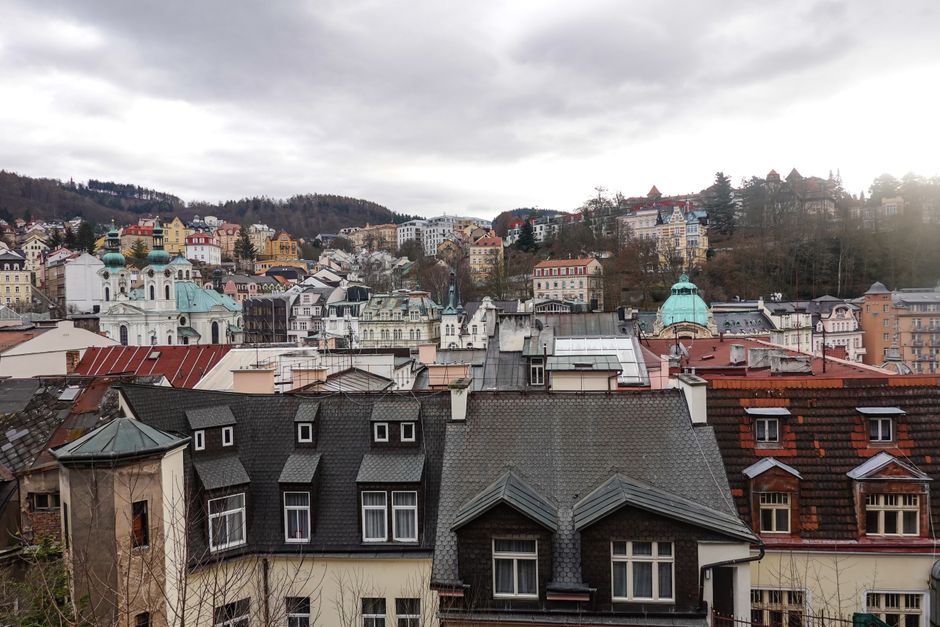
Karlovy Vary, the old Carlsbad, is the grandest of Europe’s historic spa towns: a narrow, wooded valley lined with pastel Belle Époque hotels, colonnades and bathhouses, where hot mineral springs rise from the ground and visitors stroll from one fountain to the next sipping warm, salty water from spouted porcelain cups. Emperors, Goethe, Beethoven and Tsar Peter the Great came to take the cure; today it is a UNESCO World Heritage Site as one of the Great Spa Towns of Europe, and every July it hosts the Karlovy Vary International Film Festival. It is about two hours from Prague by bus. One day covers the colonnades and the views; stay two or three to try a spa treatment and visit Mariánské Lázně or Loket.
Right now in Karlovy Vary
- Wed 9–22°C 47–71°F Mostly clear
- Thu 10–19°C 50–67°F 6 mm Rain
- Fri 7–12°C 44–54°F Cloudy
Weather: MET Norway (CC BY 4.0) · Rates: ECB
Top tours in Karlovy Vary
See all tours for Karlovy Vary →
From local operators, with prices and reviews; you check availability and book on Viator, our partner. We may earn a commission at no extra cost to you. How we earn money
Karlovy Vary at a glance
- Best for: spa architecture, mineral springs and spa treatments, the film festival, walks in the wooded hills.
- How long: 1 day for the colonnades; 2–3 days with a spa treatment and trips to Loket and Mariánské Lázně.
- Best time: May to September; early July for the film festival (2–10 July 2027), when hotels are full and prices high.
- Getting in: FlixBus and RegioJet buses from Prague take about 2 hours; trains are slower.
- Free to visit: all the colonnades and drinking springs. As of October 2026, the Hot Spring Colonnade opens daily from 6:30.
- Before you go: entry rules, money and trains are in our Czech Republic travel guide.
Karlovy Vary, area by area
The spa quarter
The heart of town follows the little Teplá river upstream from the Hot Spring Colonnade, past the Mill and Market colonnades, to the grand hotels of the Grandhotel Pupp. Traffic is restricted, and the riverside promenade is lined with cafés, porcelain shops and wafer stalls. Best for: the springs, sightseeing and classic spa hotels.
The forested hills
Steep wooded slopes rise on both sides of the valley, with promenades, lookout towers, chapels and the Diana tower, reached by funicular. Best for: walks and views.
The modern town
Downstream, around the confluence of the Teplá and the Ohře, is the newer commercial centre, with the bus and train stations, shops and the Becherovka factory. Best for: arrivals, cheaper hotels and shopping.
The springs and colonnades
Karlovy Vary has around 15 springs used for drinking, ranging from about 14 °C to the 73 °C of the Vřídlo. The water is rich in minerals and has been prescribed for digestive problems since the 16th century. All the drinking fountains in the colonnades are free.
How to drink the water. Buy a spa cup (lázeňský pohárek), a small porcelain cup with a spout built into the handle, from one of the many shops; it lets you sip the hot water without burning your lips. Take small sips: the water is warm and salty, and in quantity it is a laxative. Spa guests drink set amounts from specific springs prescribed by their doctor; for a taste, try a few springs of different temperatures. Information boards give each spring’s temperature.
The Hot Spring Colonnade (Vřídelní kolonáda)
The town’s most famous spring, the Vřídlo, shoots up to 12 m high inside a modern glass-and-concrete colonnade, at 73 °C. The main hall reopened in 2022 after seven years of repairs, and the geyser once again spouts indoors, with three drinking fountains at different temperatures. As of October 2026, it opens daily 6:30–19:00 from March to October and 6:30–18:00 from November to February. Work to rebuild the hot-spring pipes started in summer 2026 and is due to last until about April 2027, so expect occasional short interruptions to the supply.
The Mill Colonnade (Mlýnská kolonáda)
The largest and most photographed colonnade, a neo-Renaissance hall of 124 Corinthian columns built in 1871–1881 by Josef Zítek, architect of Prague’s National Theatre. Twelve statues on the roof represent the months, and six springs flow inside, from about 45 °C to 65 °C.
The Market Colonnade (Tržní kolonáda)
A delicate white wooden colonnade of 1883 by the Viennese architects Fellner and Helmer, with the Charles IV spring, named after the king who, legend says, discovered the hot springs while hunting in the 14th century and founded the town.
The Park and Castle colonnades
The cast-iron Park Colonnade (Sadová kolonáda), also by Fellner and Helmer, stands in the Dvořák Gardens, with the Snake Spring flowing from a snake’s mouth. The Castle Colonnade, beside the Castle Tower, has an Art Nouveau style.
Top things to see in Karlovy Vary
The Grandhotel Pupp and the spa promenade
The vast Grandhotel Pupp, founded in the 18th century, is the town’s most famous hotel and the centre of the film festival. Have coffee and cake in its café, then walk along Stará louka, the elegant riverside street of boutiques and cafés.
The Diana lookout and funicular
A funicular climbs from behind the Grandhotel Pupp to the Diana lookout tower, with views over the valley, a restaurant and a butterfly house. The ride takes about six minutes. The funicular is normally open year-round but closes for maintenance in some periods (it was closed from 1 to 25 September 2026), so check before you go.
Becherovka
Becherovka, a herbal liqueur made to a secret recipe since 1807, is Karlovy Vary’s “13th spring”. The Jan Becher Museum in the original factory offers tours with tastings (as of October 2026, from 290 Kč for the basic tour, Tuesday to Sunday); booking ahead is required, and groups are limited to ten people.
The Church of St Mary Magdalene and the Orthodox Church
Kilian Ignaz Dientzenhofer’s baroque church of St Mary Magdalene stands above the Hot Spring Colonnade. The Russian Orthodox Church of Sts Peter and Paul, with its golden onion domes, recalls the town’s many Russian visitors of the 19th century.
Moser glass and porcelain
The Moser glassworks, founded here in 1857, makes luxury crystal; its museum and factory tour are in the outskirts. Karlovy Vary porcelain and the round, thin spa wafers (oplatky) are the classic souvenirs.
Other sights
- Hot Spring Colonnade
- Mill Colonnade
- Park Colonnade
Monuments
- Goethe Lookout Tower
- Market Colonnade
Viewpoints
- Charles IV Lookout
- Diana Lookout Tower
Taking the cure: spa stays and treatments
Karlovy Vary’s spa hotels offer everything from a single massage or mineral bath to week-long medical cure programmes, which start with a consultation with a spa doctor and include a drinking plan, baths, wraps and physiotherapy. Many hotels sell day packages to non-residents. Some public spa houses and hotel pools also sell single treatments or day entry; ask at the tourist information centre. Book treatments in advance, especially at weekends, and tell the spa about any health conditions: some treatments are not suitable during pregnancy or with heart problems.
The Karlovy Vary International Film Festival
The KVIFF is one of the oldest film festivals in the world and the biggest in Central Europe, with competition screenings, stars on the red carpet at the Hotel Thermal and a young, buzzy crowd. The 60th edition took place on 3–11 July 2026, and the 61st festival runs from 2 to 10 July 2027. Anyone can attend: festival passes go on sale in spring, and individual tickets for screenings are released online each day. Book accommodation months ahead, or stay in Loket or a nearby village.
Activities and best months
- City sightseeingThe spa town's sights are its colonnades over the hot springs: the stone Mill Colonnade (1871-1881, by Josef Zítek), the cast-iron Park Colonnade, the carved wooden Market Colonnade (1882-1883, by Fellner and Helmer) and the Art Nouveau Castle Colonnade (1910-1912). · source
- HikingThe town publishes marked spa walks into the forest park around it, for example from the Post Court across the Teplá to Beethoven's Arbour and along Mickiewicz's Path, or up Dvořák's Foot Path and the Afternoon Path above the town. · source
Day trips from Karlovy Vary
- Loket: a castle town in a tight bend of the Ohře river, 20 minutes away, known as “little Karlovy Vary” for its looks rather than its springs. A riverside path leads there through the Svatošské skály rocks.
- Mariánské Lázně (Marienbad): the greener, quieter sister spa, with a cast-iron colonnade, a singing fountain and a park landscape, about an hour away. It is also part of the Great Spa Towns of Europe.
- Františkovy Lázně: a small yellow-and-white Empire-style spa town near Cheb, the third member of the spa triangle.
- Plzeň: the home of Pilsner Urquell, about 1 hour 30 minutes away.
Nearby destinations
- Dresden110 km
- Prague111 km
- Bohemian Switzerland118 km
- Saxon Switzerland125 km
- Leipzig128 km
- Nuremberg155 km
- Český Krumlov189 km
- Rothenburg ob der Tauber215 km
A short history of the spa
According to legend, King Charles IV of Bohemia found the hot springs in the 14th century when one of his hunting dogs fell into a pool of boiling water while chasing a stag; the town that grew up there was named Karlsbad, “Charles’s Bath”, after him. At first, patients bathed in the water for hours at a time; from the 16th century, doctors began to prescribe drinking it. By the 18th and 19th centuries, Carlsbad was one of the great meeting places of European society, visited by Peter the Great, Goethe, Beethoven, Chopin and Karl Marx, and most of the hotels and colonnades you see today date from that golden age. After 1945 the German-speaking population was expelled and the spas were nationalised, but the town kept its role as a health resort, and its hotels have been restored since 1989. In 2021 it was inscribed on the UNESCO World Heritage List together with ten other spa towns in seven countries as the Great Spa Towns of Europe.
Walks above the valley
Karlovy Vary is surrounded by more than 100 km of marked forest promenades laid out for spa guests, with benches, pavilions and lookouts. From the Grandhotel Pupp, paths climb to the Deer Jump (Jelení skok) rock, with its chamois statue and view over the town, and to the Diana lookout tower. Longer walks follow the Teplá valley upstream or lead across the hills to Loket. See our hiking guide.
Getting to Karlovy Vary
By bus. The best way from Prague: FlixBus and RegioJet coaches run several times an hour at busy times, taking about 2 hours from Prague’s Florenc station or from Zličín and the airport area. Karlovy Vary’s main bus terminal is near the centre.
By train. Trains from Prague are slow (more than three hours, often with a change), but the line from Cheb and the scenic local lines are pleasant.
By car. The D6 road from Prague takes about 1 hour 45 minutes. Park in the car parks outside the spa zone, which has restricted traffic.
Getting around Karlovy Vary
The spa quarter is about 2 km long and best on foot; local buses run along the valley and up to the hotels on the hills.
When to go and how long to stay
Karlovy Vary lies in a sheltered valley at about 400 m, with mild summers and cold, snowy winters. The table uses the Czech Hydrometeorological Institute’s 1991–2020 averages for the Karlovy Vary airport station, which is higher than the spa valley and a little cooler.
| Season | Average high | Average low | Rain per month | What it’s like |
|---|---|---|---|---|
| Winter (Dec–Feb) | 1–2 °C | −5 to −4 °C | 28–41 mm | Cold, often snowy; the steam rising from the springs is magical; quieter spa breaks |
| Spring (Mar–May) | 7 °C rising to 17 °C | −2 °C rising to 6 °C | 30–57 mm | Fresh green woods, start of the main spa season on 1 May |
| Summer (Jun–Aug) | 21–23 °C | 9–11 °C | 67–71 mm | Pleasant and green, the busiest time and the film festival in early July |
| Autumn (Sep–Nov) | 17 °C falling to 5 °C | 7 °C falling to 0 °C | 39–55 mm | Golden forests, good walking weather in September and October |
The station records about 570 mm of rain a year.
Karlovy Vary in 1 day
Arrive in the morning, walk from the Hot Spring Colonnade along the springs to the Grandhotel Pupp with your spa cup, ride the funicular to the Diana lookout, and finish with a Becherovka tour or coffee on Stará louka.
Karlovy Vary in 3 days
Add a spa treatment, the walk to Loket, and a day in Mariánské Lázně.
Weather month by month
Averages from ČHMÚ normals 1991–2020, Karlovy Vary (airport) · Last reviewed 4 Oct 2026
Where to stay in Karlovy Vary
- The spa quarter: historic hotels and spa resorts along the Teplá, from grand to simple; many offer treatment packages.
- The hills: villa hotels with views, a short walk or bus ride above the colonnades.
- The modern town: cheaper hotels near the bus and train stations.
Karlovy Vary charges an accommodation fee per person per night, added to the bill. Book far ahead for the film festival.
Practical tips for Karlovy Vary
- Buy a spa cup: it is the authentic way to taste the springs and makes a good souvenir.
- Go easy on the water: a few sips from each spring is plenty.
- Check the funicular: it can close for maintenance.
- Book the festival early: accommodation sells out months before July.
- Respect spa guests: the colonnades are places for quiet strolling.
What to pack for Karlovy Vary
Comfortable shoes for the promenades and hill paths, a swimsuit for pools and spa treatments, layers for cool valley evenings, and a warm coat, hat and gloves in winter. Smart-casual clothes are welcome in the grand hotels and at festival screenings.
What to pack
- City walking shoesLisbon and Porto are steep, with polished limestone cobbles that get slippery, so grippy soles matter.
- Day packs and anti-theft bagsA small zipped or anti-theft bag makes crowded trams and viewpoints less stressful.
- Fleeces and warm layersSummits like Pico do Areeiro averaged about 11 °C over 2024, so a fleece is needed even in summer.
- HeadlampsLevada routes such as PR1 and PR9 pass through long, dark, wet tunnels.
- Hiking shoes and bootsMadeira's levadas and the Azores' crater rims are wet, rocky and slippery, so grippy shoes matter more than anywhere else in Portugal.
- Rain jacketsFrom October to April Porto and Lisbon see rain on roughly a third of days.
- Travel adapters and convertersPortugal uses Type C and F sockets at 230 V, so most visitors from outside Europe need an adapter.
- Trekking polesLong stone staircases and steep descents on Madeira's peaks and the Azores' crater rims are easier on the knees with poles.
- Water bottles and hydration packsAlgarve and Alentejo trails are hot and exposed with few refill points.
Karlovy Vary travel FAQ
Is it free to drink the water in Karlovy Vary?
Yes. All the drinking fountains in the colonnades are free. Buy a porcelain spa cup to drink from, and take small sips; the water is warm, salty and mildly laxative.
Is the Hot Spring Colonnade open?
Yes. The Vřídlo geyser spouts inside the Hot Spring Colonnade again, open daily from 6:30 to 19:00 (to 18:00 from November to February) as of October 2026. Pipe works until about April 2027 may cause short interruptions.
When is the Karlovy Vary Film Festival in 2027?
The 61st Karlovy Vary International Film Festival runs from 2 to 10 July 2027. Anyone can buy a festival pass or individual tickets.
How do I get from Prague to Karlovy Vary?
By bus: FlixBus and RegioJet take about 2 hours. The train is much slower.
Is Karlovy Vary worth a day trip from Prague?
Yes, it works well as a day trip, with about four hours of travel there and back. Stay overnight to try a spa treatment or visit Loket.
What is a spa cup?
A small porcelain cup with a spout in the handle, used to sip the hot mineral water. You can buy one in shops all over the spa quarter.
What should I buy in Karlovy Vary?
Becherovka liqueur, spa wafers (oplatky), Karlovy Vary porcelain and spa cups, and Moser glass.
What is near Karlovy Vary?
The castle town of Loket, the spa towns of Mariánské Lázně and Františkovy Lázně, and Plzeň for beer.
How hot are the springs in Karlovy Vary?
They range from about 14 °C to 73 °C. The hottest, the Vřídlo, spouts up to 12 m high inside the Hot Spring Colonnade.
What is the most famous colonnade in Karlovy Vary?
The Mill Colonnade, a neo-Renaissance hall of 124 columns from the 1870s, is the largest and most photographed; the Hot Spring Colonnade, with the Vřídlo geyser, is the most famous spring.
Sources
- © OpenStreetMap contributors · ODbL · fetched 4 Oct 2026
- Wikidata · CC0 · fetched 4 Oct 2026
Sources and last review
Researched and last reviewed on 4 October 2026. Colonnades, springs and hours: the City of Karlovy Vary (karlovyvary.cz and mmkv.cz); the Becherovka museum: the city’s tourist site; KVIFF dates: kviff.com and the City of Karlovy Vary; the Great Spa Towns of Europe: CzechTourism; climate: Czech Hydrometeorological Institute 1991–2020 averages for Karlovy Vary airport via secondary sources. The spring-pipe works, the Diana funicular’s closure and hours, and bus times come partly from secondary sources and are flagged for checking. Prices and timetables change, so check the official links before you go. For entry rules and money, see our Czech Republic travel guide; for the capital, our Prague guide.
Plan your trip
Partner links: TravelerCenter may earn a commission if you book, at no extra cost to you.
🇨🇿 Useful Czech phrases for Karlovy Vary
All 38 Czech phrases: restaurant, hotel, emergencies, romance (printable) →