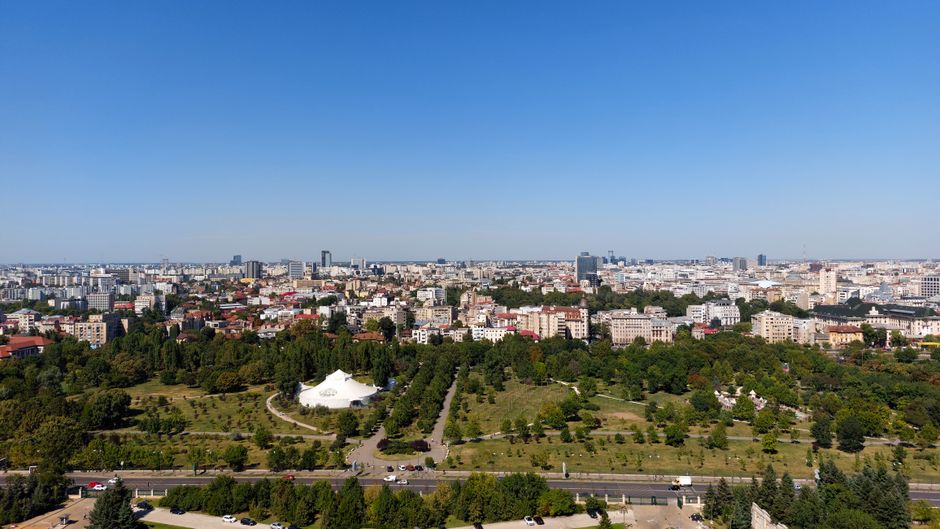
Bucharest is Romania’s big, busy, surprising capital: Belle Époque mansions and Orthodox churches side by side with communist-era boulevards, leafy parks and lakes, and a lively Old Town of cafés and bars. Its most famous sight is the colossal Palace of the Parliament, one of the largest administrative buildings in the world, which you can tour with a passport or ID card. Add the Romanian Athenaeum concert hall, the open-air Village Museum, the tiny Stavropoleos Monastery and long walks along Calea Victoriei, and you have two or three full days. Prices are lower than in most EU capitals, the food scene is good, and trains run from here to Transylvania and the Black Sea.
Right now in Bucharest
- Wed 10–24°C 50–76°F Partly cloudy
- Thu 10–25°C 50–77°F Partly cloudy
- Fri 13–27°C 56–80°F Partly cloudy
Weather: MET Norway (CC BY 4.0) · Rates: ECB
Top tours in Bucharest
See all tours for Bucharest →
From local operators, with prices and reviews; you check availability and book on Viator, our partner. We may earn a commission at no extra cost to you. How we earn money
Bucharest at a glance
- Best for: 20th-century history, grand architecture of every era, museums, parks, food and nightlife, and as the starting point for Transylvania.
- How long: 2 days for the Palace of the Parliament, the Old Town, the Athenaeum and the Village Museum; 3–4 days to add more museums and a day trip to Sinaia’s Peleș Castle or Snagov.
- Best time: May, June, September and early October, when it is warm but not baking; July and August often go above 30 °C. December brings Christmas markets and lights.
- Getting in: Henri Coandă International Airport (OTP) at Otopeni is about 17 km north, linked by express bus 100 and by train to the main station, Gara de Nord.
- Getting around: five metro lines, buses, trams and trolleybuses. As of October 2026, a single metro ride costs 7 lei, and a 120-minute ticket valid on the metro and surface transport costs 9 lei.
- Before you go: Romania uses the leu (RON), not the euro, and has been a full Schengen member since 1 January 2025. Country-wide entry rules, money and driving are covered on our Romania country page.
Bucharest, area by area
Bucharest is spread out on flat land on both sides of the small Dâmbovița river. The historic centre is compact, but the city is big (about 1.7 million people), so you will use the metro or taxis between areas. The main north–south axis is Calea Victoriei, the elegant 19th-century avenue that runs from the river to Piața Victoriei.
The Old Town (Centrul Vechi)
The pedestrian lanes around Lipscani, Smârdan and Covaci streets were the merchants’ quarter of the old princely city. Today they are packed with restaurants, cafés and bars, alongside restored inns, banks and churches: the Stavropoleos Monastery, the ruins of the Old Princely Court (Curtea Veche), Hanul lui Manuc and the Cărturești Carusel bookshop. Best for: first visits and nightlife; it is noisy at weekends.
Calea Victoriei, Piața Revoluției and the Athenaeum
North of the Old Town, Calea Victoriei passes the CEC Palace, the National Museum of Romanian History, the Romanian Athenaeum, the former Royal Palace (now the National Museum of Art of Romania) and Revolution Square, where Nicolae Ceaușescu made his last speech in December 1989. Best for: central hotels, museums and evening walks.
The Palace of the Parliament and Unirii
South-west of the centre, the Palace of the Parliament sits at the end of the wide Bulevardul Unirii, built in the 1980s after a large part of the historic city was demolished. The area around Piața Unirii is a major metro and bus hub. Best for: transport links and good-value hotels.
The north: Herăstrău, Kiseleff and Dorobanți
Șoseaua Kiseleff, a tree-lined boulevard, leads past the Arcul de Triumf to King Michael I Park (still widely called Herăstrău), with its lake and the Village Museum. The villa districts of Primăverii, Dorobanți and Floreasca nearby have embassies, restaurants and cafés. Best for: quieter stays, parks and dining.
Top things to see in Bucharest
Prices and hours below were checked on the official sites in October 2026. They change, so check before you go. Many museums close on Mondays.
Palace of the Parliament
Ceaușescu’s “People’s House”, begun in 1984 and still unfinished when he fell in 1989, is a vast building of marble halls, crystal chandeliers and endless corridors, now home to both chambers of the Romanian Parliament and a conference centre. It is one of the heaviest and largest administrative buildings in the world, and the guided tour shows only a small part of it. To build it and the boulevard in front, much of the old Uranus district, with churches, a monastery and thousands of homes, was demolished.
Tours and tickets. Visits are by guided tour only. As of October 2026, the standard tour costs 85 lei for adults, 55 lei for students aged 19 to 26 with a student card and 40 lei for children aged 7 to 18, according to the palace’s visitor centre. Tours run daily from 09:00 to 17:00, except when official events close the building. Individual visitors and groups of up to nine are asked to book by phone at least 24 hours ahead, and larger groups by email at least three days ahead; tickets are paid on the day at the visitor entrance on Strada Izvor. Bring a valid physical passport or national ID card: you are let in about 15 minutes before your tour only after your ID is checked, and copies or photos on a phone are not accepted. There is airport-style security, and professional photography and filming need paid permission. The palace also houses the National Museum of Contemporary Art (MNAC), which has its own entrance and tickets.
The Old Town and Stavropoleos Monastery
Walk the Old Town in daylight to see the architecture, and come back in the evening for its bars and terraces. Don’t miss the Stavropoleos Monastery (1724), a small church with a carved stone portico and a courtyard of old tombstones, still home to a community of nuns who sing Byzantine chant; entry is free, but dress modestly and keep quiet. Nearby, the Old Princely Court has the remains of the palace of the Wallachian princes, including Vlad III, the “Impaler”, and the old Hanul lui Manuc inn is a good place for Romanian food.
Romanian Athenaeum
This domed concert hall of 1888, paid for partly by a public subscription (“give a leu for the Athenaeum”), is the home of the George Enescu Philharmonic and the city’s best-loved building. Inside, a fresco of Romanian history circles the main hall. You can visit outside rehearsal and concert times, following a monthly schedule published by the Philharmonic. As of October 2026, a visit ticket costs 15 lei, bought in cash at the artists’ entrance on Strada Benjamin Franklin 1 or at the box office; a visit takes 30 to 45 minutes. Better still, buy a ticket for a concert.
National Village Museum “Dimitrie Gusti”
One of the oldest open-air museums in Europe (1936), the Village Museum gathers more than 300 farmhouses, windmills, churches and workshops from every region of Romania under the trees by Herăstrău lake: wooden churches from Maramureș, thatched houses from the Danube Delta, and half-sunken houses from Oltenia. As of October 2026, tickets cost 40 lei for adults, 20 lei for pensioners and 10 lei for students, with half price on Mondays and Tuesdays, when most houses are closed for maintenance. From November to March it opens daily 09:00–17:00, with longer hours in summer; ticket sales end an hour before closing.
Revolution Square and the museums of Calea Victoriei
Revolution Square is where the 1989 revolution came to a head: the former Communist Party headquarters, from whose balcony Ceaușescu fled by helicopter, faces the Memorial of Rebirth. On the same square, the former Royal Palace houses the National Museum of Art of Romania, with Romanian medieval art, icons and European paintings. Further south on Calea Victoriei, the National Museum of Romanian History keeps the national treasure and a full cast of Trajan’s Column. Check each museum’s site for current hours and partial closures for renovation.
Parks and the Arcul de Triumf
Bucharest has excellent parks: Cișmigiu Gardens (1847) in the centre, with rowing boats in summer and skating in winter; King Michael I Park (Herăstrău), around a large lake in the north; and Carol Park, with its monumental mausoleum. On Kiseleff, the Arcul de Triumf, rebuilt in stone in 1936, honours Romania’s soldiers of the First World War.
Palaces
- Palace of the Parliament
Museums
- National Museum of Art of Romania
- National Museum of Romanian History
- National Village Museum "Dimitrie Gusti"
Monasteries and convents
- Stavropoleos Monastery
Monuments
- Arcul de Triumf
- Romanian Athenaeum
Communist Bucharest and the 1989 revolution
Much of what you see in Bucharest was shaped by the 42 years of communist rule that ended in December 1989, when Romania was the only Eastern Bloc country where the regime fell by force. Besides the Palace of the Parliament and Revolution Square, look for the bullet marks still visible on some buildings around Piața Universității, the long “Victory of Socialism” boulevard (now Bulevardul Unirii), and the churches that were moved on rails to hide them behind apartment blocks, such as Mihai Vodă. Several local companies run walking tours of communist Bucharest, and Ceaușescu’s former residence, the Primăverii Palace, can be visited on guided tours booked in advance.
Food, cafés and nights out
Eat Romanian classics such as sarmale (cabbage rolls with polenta and sour cream), ciorbă (sour soups, especially tripe and meatball), mici (grilled minced-meat rolls) and papanași (fried doughnuts with sour cream and jam). The big beer halls and restaurants of the Old Town are lively but touristy; the neighbourhoods around Piața Amzei, Dorobanți and Cotroceni have good modern restaurants and specialty coffee. Bucharest’s nightlife runs late, from Old Town bars to concerts and clubs. Romanian wines, from Dealu Mare and Dobrogea, are good value; see our wine tasting guide.
Activities and best months
- City sightseeingThe National Village Museum 'Dimitrie Gusti' on Șoseaua Kiseleff 28-30, by Herăstrău lake, is open every day without booking: 40 lei for adults, 20 lei for pensioners and 10 lei for students, half price on Mondays and Tuesdays when most of the houses are closed for maintenance; ticket sales end an hour before closing, and guides in English, French or Russian can be booked 72 hours ahead. · source
- CultureThe Romanian Athenaeum is the home of the George Enescu Philharmonic: concerts through the season, and visits to the hall outside rehearsal and concert times on a monthly schedule published by the Philharmonic. · source
Day trips from Bucharest
- Sinaia and Peleș Castle: about 1 hour 30 minutes north by train, the Neo-Renaissance summer palace of Romania’s kings is the country’s most visited castle. As of October 2026, it is closed on Mondays and Tuesdays, and closed entirely from 2 November to 1 December 2026 for cleaning and conservation; adult tickets cost 100 lei.
- Brașov: about 2 hours 30 minutes by train on the fastest services; worth at least a night.
- Snagov: a monastery on an island in Snagov lake, about 40 km north, where Vlad III is said to be buried.
- Mogoșoaia Palace: a Brâncovenesc-style palace of 1702 with gardens on a lake, just north-west of the city.
- The Black Sea and the Danube Delta: Constanța is about 2 hours by train; Tulcea, the gateway to the delta, is about 4 hours 30 minutes by road.
Nearby destinations
- Brașov143 km
- Varna198 km
- Sibiu217 km
- Sighișoara225 km
- Sunny Beach231 km
- Plovdiv275 km
- Danube Delta282 km
- Sofia294 km
Getting to Bucharest
By air. Henri Coandă International Airport (OTP), at Otopeni, is Romania’s main airport, with flights across Europe and to the Middle East. Express bus 100 runs around the clock from in front of the terminal to Piața Unirii via Piața Victoriei, Piața Romană and Universitate (about 40–60 minutes depending on traffic); as of October 2026 it costs the standard surface fare of 3 lei, paid by tapping a bank card on the validator or with an STB card. Trains run from the airport station, reached by a walkway from the terminal, to Gara de Nord in about 20–25 minutes, roughly every 40 minutes to an hour; tickets cost a few lei. Taxis should be ordered at the touch-screen kiosks in the arrivals hall or through a ride-hailing app; ignore drivers who approach you inside.
By train. Gara de Nord, on metro lines M1 and M4, is the hub of the railway network, with trains to Brașov, Sibiu, Cluj-Napoca, Constanța and international services towards Budapest and Vienna. Book on the CFR Călători site or app.
By car. The A1 motorway links Bucharest with Pitești and the west, the A2 with the Black Sea and the A3 with Ploiești. You need a rovinieta (road vignette) to drive outside the city; city traffic is heavy and parking in the centre is hard.
Getting around Bucharest
The metro (Metrorex) has five lines and is the fastest way across the city. As of October 2026, after a fare rise on 1 May 2026, a single metro journey costs 7 lei, and a 120-minute integrated ticket valid on the metro and on buses, trams and trolleybuses costs 9 lei. Surface transport (STB) costs 3 lei for 90 minutes on buses, trams and trolleybuses. You can tap a contactless bank card on the metro gates and on bus and tram validators, or load an STB or metro card at machines and ticket offices. Check the current fares on the STB and Metrorex sites, as both have changed recently.
Taxis are cheap by EU standards if you use the official meter rates or a ride-hailing app (Bolt, Uber and local apps); avoid unmarked cars. Much of the centre is walkable, though crossing the big boulevards can mean long detours to pedestrian crossings or underpasses.
When to go and how long to stay
Bucharest has a continental climate: hot, sunny summers, cold winters with occasional snow and icy winds, and short, pleasant springs and autumns. The table uses the 1991–2020 climate normals of Romania’s National Meteorological Administration for Bucharest-Băneasa, in the north of the city, as published in the World Meteorological Organization’s collection.
| Season | Average high | Average low | Rain per month | What it’s like |
|---|---|---|---|---|
| Winter (Dec–Feb) | 3–6 °C | −5 to −3 °C | 33–47 mm | Cold, grey days, sometimes snow and freezing wind; Christmas markets |
| Spring (Mar–May) | 12 °C rising to 24 °C | 0 °C rising to 10 °C | 42–70 mm | Parks in blossom; warm and pleasant by May |
| Summer (Jun–Aug) | 28–31 °C | 14–16 °C | 49–83 mm | Hot and sunny, with thunderstorms; terraces and open-air concerts |
| Autumn (Sep–Nov) | 25 °C falling to 11 °C | 11 °C falling to 1 °C | 44–61 mm | Warm and golden in September and early October; Enescu Festival in odd years |
Bucharest gets about 650 mm of rain a year and more than 2,100 hours of sunshine. Heatwaves above 35 °C are common in July and August; sightsee early and late, and use the parks and air-conditioned museums in the afternoon.
Bucharest in 2 days
Day 1: the Palace of the Parliament on a booked morning tour, then the Old Town, Stavropoleos and the Old Princely Court, and dinner in a traditional restaurant. Day 2: Calea Victoriei from the History Museum to Revolution Square, the Athenaeum, lunch near Piața Amzei, and the afternoon at the Village Museum and Herăstrău lake.
Bucharest in 4 days
Add a day at the National Museum of Art and a communist-history walk or the Primăverii Palace, and a day trip to Sinaia and Peleș Castle (not on Mondays or Tuesdays, and not from 2 November to 1 December 2026), or go on to Brașov by train.
Weather month by month
Averages from ANM normals 1991–2020, Bucharest-Băneasa · Last reviewed 4 Oct 2026
Festivals and events
The George Enescu International Festival, one of Europe’s great classical music festivals, takes place in odd-numbered years; its 28th edition runs from 27 August to 26 September 2027, with concerts at the Athenaeum, the Palace Hall and elsewhere. The city’s main Christmas market fills Piața Constituției in front of the Palace of the Parliament from about late November to the end of December; the 2026 dates had not been announced at the time of writing.
Where to stay in Bucharest
- Old Town and Universitate: walkable to everything, with many hotels and apartments, but noisy late at night at weekends.
- Calea Victoriei and Piața Romană: central, with grand hotels and good transport; a good balance for most visitors.
- Dorobanți, Floreasca and Herăstrău: quieter and greener, with smart hotels and restaurants; use the metro or taxis.
- Near Gara de Nord: handy for early trains, but not the most attractive area.
Since 2026, Bucharest charges a flat local tourist tax of 10 lei per person per night on paid accommodation, normally added to the bill.
Practical tips for Bucharest
- Book the Palace of the Parliament at least a day ahead and carry your passport or ID card.
- Use official taxis or apps: unlicensed drivers at the airport and Gara de Nord overcharge.
- Mind the traffic: drivers do not always give way to pedestrians; cross at lights where you can.
- Pickpockets: take care on crowded buses, on the metro and in the Old Town at night.
- Pay by card: cards are accepted almost everywhere; carry some lei for markets and small churches.
- Emergencies: call 112.
What to pack for Bucharest
Light clothes, sunscreen and a hat for hot summers; a warm coat, hat and gloves for winter, when wind and frost can be harsh; comfortable shoes for long walks on uneven pavements; and a scarf or long trousers for visiting Orthodox churches. Bring your passport or national ID card for the Palace of the Parliament, and a plug adapter for type F sockets if you need one: see our guide to travel adapters.
What to pack
- City walking shoesLisbon and Porto are steep, with polished limestone cobbles that get slippery, so grippy soles matter.
- Day packs and anti-theft bagsA small zipped or anti-theft bag makes crowded trams and viewpoints less stressful.
- Rain jacketsFrom October to April Porto and Lisbon see rain on roughly a third of days.
- Travel adapters and convertersPortugal uses Type C and F sockets at 230 V, so most visitors from outside Europe need an adapter.
Bucharest travel FAQ
How much does it cost to visit the Palace of the Parliament?
As of October 2026, the standard guided tour costs 85 lei for adults, 55 lei for students aged 19 to 26 and 40 lei for children aged 7 to 18. Visits are by guided tour only.
Do I need to book the Palace of the Parliament tour?
Yes. Individuals and small groups are asked to book by phone at least 24 hours ahead, and groups of ten or more by email at least three days ahead. Bring a valid physical passport or ID card, which is checked before entry.
How do I get from Bucharest airport to the city centre?
Express bus 100 runs 24 hours a day to Piața Unirii for 3 lei, and trains run from the airport station to Gara de Nord in about 20–25 minutes. For a taxi, use the kiosks in arrivals or a ride-hailing app.
How much is a metro ticket in Bucharest?
As of October 2026, a single metro ride costs 7 lei and a 120-minute ticket valid on the metro, buses and trams costs 9 lei. You can tap a contactless bank card at the gates.
Can you visit the Romanian Athenaeum?
Yes, outside rehearsals and concerts, following the Philharmonic’s monthly schedule. As of October 2026, a visit costs 15 lei, paid in cash at the artists’ entrance on Strada Benjamin Franklin 1.
Is Bucharest worth visiting?
Yes, for its mix of architecture, its 20th-century history, its museums, parks and food, and its low prices. Two or three days is enough for most visitors before heading to Transylvania.
Is Bucharest safe?
Generally, yes. Watch for pickpockets on public transport and in the Old Town, use licensed taxis or apps, and take care crossing busy roads.
Can I visit Peleș Castle as a day trip from Bucharest?
Yes. Sinaia is about 1 hour 30 minutes by train. Remember that Peleș is closed on Mondays and Tuesdays and from 2 November to 1 December 2026.
When is the George Enescu Festival?
It takes place every two years; the next edition runs from 27 August to 26 September 2027.
How many days do you need in Bucharest?
Two days covers the main sights; three or four let you add more museums and a day trip to Sinaia or Snagov.
Sources
- © OpenStreetMap contributors · ODbL · fetched 4 Oct 2026
- Wikidata · CC0 · fetched 4 Oct 2026
Sources and last review
Researched and last reviewed on 4 October 2026. Palace of the Parliament tours, prices and ID rules: the Palace’s International Conference Centre (cic.cdep.ro); the Athenaeum: the George Enescu Philharmonic; the Village Museum: the museum’s ticket page; Peleș Castle: the Peleș National Museum; metro and surface fares: Metrorex and STB, with the 1 May 2026 metro fare rise confirmed in the press; the airport bus and train: STB and CFR Călători; the Enescu Festival 2027 dates: AGERPRES, Romania’s national news agency; climate: Romania’s National Meteorological Administration 1991–2020 normals in the WMO collection. The tourist tax, airport train frequency and fare, contactless payment on all lines, the Primăverii Palace tours and journey times come partly from secondary sources and are flagged for checking. Prices, timetables and rules change, so check the official sites before you go.
Plan your trip
Partner links: TravelerCenter may earn a commission if you book, at no extra cost to you.
🇷🇴 Useful Romanian phrases for Bucharest
All 38 Romanian phrases: restaurant, hotel, emergencies, romance (printable) →