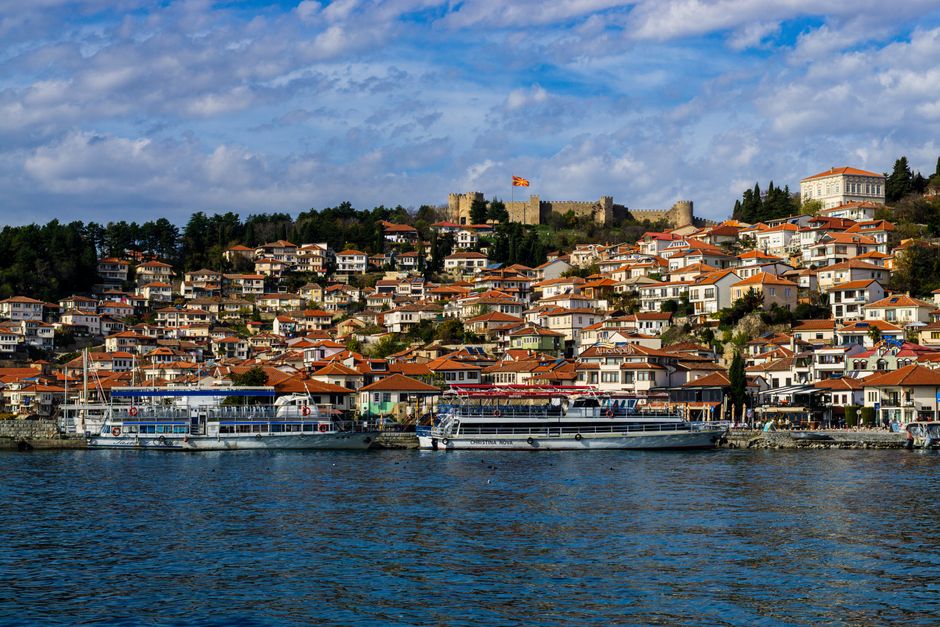
Ohrid is North Macedonia’s most beautiful town and its favourite summer escape. Its old quarter climbs a hill above one of Europe’s oldest and deepest lakes, a maze of whitewashed Ottoman-era houses, cobbled lanes and Byzantine churches, with a medieval fortress on top and the little church of St John at Kaneo perched on a cliff above the clear blue water. Ohrid was a great centre of Slavic learning in the Middle Ages, and the town and lake together are a UNESCO World Heritage Site for both their culture and their nature. You come to see the frescoes, walk the walls of Samuel’s Fortress, swim from pebble beaches, take a boat to the monastery of St Naum and the springs of the Black Drim, and hike in Galičica National Park between Ohrid and Prespa. Give it two or three days, a week with the lake and the mountains.
Right now in Ohrid
- Wed12–21°C54–70°FPartly cloudy
- Thu13–21°C56–70°FPartly cloudy
- Fri16–18°C61–65°F8 mm rain
- Sun 11 Oct Revolution Day (Ден на востанието, Den na vostanieto)
Top tours in Ohrid
See all tours for Ohrid →
From local operators, with prices and reviews; you check availability and book on Viator, our partner. We may earn a commission at no extra cost to you. How we earn money
Ohrid at a glance
- Best for: Byzantine churches and frescoes, a lakeside old town, swimming and boat trips, hiking in Galičica, and good-value summer holidays.
- How long: 2 days for the old town, the churches and a boat; 4–5 days to add St Naum, Galičica, Prespa and Struga.
- Best time: June and September for swimming without the crowds; July and August are the busiest; spring and autumn are lovely for sightseeing.
- Getting in: buses from Skopje take about three to three and a half hours; Ohrid Airport has mostly seasonal flights.
- Getting around: the old town is walkable but steep; boats and buses run along the lake in summer.
- Before you go: North Macedonia uses the denar, but euros are often accepted in Ohrid. Entry rules and registration are covered on our North Macedonia country page.
Ohrid, area by area
Ohrid spreads along the north-east shore of the lake. The historic town is compact; the beaches and hotels stretch south along the shore towards St Naum.
The old town (Varoš) and the hill
The old quarter climbs from the harbour up to Samuel’s Fortress, with the ancient theatre, St Sophia, the Church of St Clement (Holy Mother Perivlepta), Plaošnik and dozens of smaller churches, and the path down to St John at Kaneo. Best for: atmosphere, sights and views.
The harbour and the town centre
Below the old town, the lakeside quay, the pedestrian street Sv. Kliment Ohridski with its shops and cafés, the old plane tree (Činar) and the bazaar. Best for: cafés, boats and evening strolls.
The south shore beaches
South of town, a road runs along the lake past hotels and beaches at Gorica, Lagadin, Peštani and Trpejca, the last a pretty fishing village, to the monastery of St Naum near the Albanian border, about 30 km away. Best for: swimming and lakeside stays.
Galičica and Prespa
Behind the shore, the mountains of Galičica National Park separate Lake Ohrid from Lake Prespa, with a panoramic road over the pass. Best for: hiking, views and quiet villages.
Top things to see in Ohrid
Prices and hours below were checked in October 2026, on official sites where available. They change, so check before you go.
Samuel’s Fortress
The walls and 18 towers of the fortress crown the hill above the old town. Built on older foundations, the fortress takes its name from Tsar Samuel, who ruled a medieval empire from Ohrid around the year 1000. Walk the ramparts for the best views over the lake and the roofs. As of October 2026, entry costs 150 denars for foreign visitors (60 denars for children and students); from 1 October to 30 April it opens 09:00–15:30, and from 1 May to 30 September 09:00–16:30; it is closed on Mondays.
The Church of St John at Kaneo
Ohrid’s most photographed spot: a small 13th-century church on a rocky headland above the lake, reached by a path from the old town or along a boardwalk from the beach below. Inside are fragments of medieval frescoes. Visitors report an entry fee of about 150 denars, cash only. Come at sunset for the view.
Plaošnik and the Church of Sts Clement and Panteleimon
On a terrace below the fortress, St Clement of Ohrid founded a monastery and school in the late 9th century, one of the first centres of Slavic literacy, where his disciples helped spread the Cyrillic alphabet. The church, rebuilt in 2002 on its original foundations, holds his tomb; around it are the remains of early Christian basilicas with fine floor mosaics. A small entry fee is charged.
St Sophia Cathedral
The 11th-century cathedral of the Archbishopric of Ohrid holds some of the most important Byzantine frescoes in the Balkans. During Ottoman rule it was turned into a mosque and the frescoes were whitewashed, which helped preserve them. In summer it hosts concerts of the Ohrid Summer Festival. A small entry fee is charged.
The Church of St Clement (Holy Mother Perivlepta) and the icon gallery
Built in 1295, this church near the upper gate is decorated with frescoes by the painters Michael and Eutychios, among the finest of their time, and an adjoining gallery displays some of the most valuable medieval icons in the country.
The ancient theatre
A Hellenistic theatre from about 200 BC, later used by the Romans for gladiator fights, sits between St Clement’s church and the fortress. It is free to see and is used for concerts and performances in summer.
The Bay of Bones (Museum on Water)
At Gradište, about 15 km south of town, archaeologists have reconstructed part of a Bronze and Iron Age village built on wooden piles over the lake, with a small museum. As of October 2026, tickets from the Institute and Museum of Ohrid cost 150 denars for foreign visitors; it opens 09:00–15:30 from 1 October to 30 April and 09:00–16:30 from 1 May to 30 September, closed on Mondays. Glass-bottomed boats and diving trips operate there in summer.
The monastery of St Naum
At the southern tip of the lake, near the Albanian border, the monastery founded by St Naum in about 900 stands on a headland above the springs of the Black Drim, where clear water bubbles up into green pools. Rowing boats take visitors around the springs (about €5 a person, as reported in 2026), and peacocks roam the grounds. Boats from Ohrid harbour run there from May to September: the Armada company’s day cruise costs €20 (1,200 denars) return as of October 2026, with about seven hours for the round trip including time at the monastery. Buses and taxis also go there.
Swimming, boats and the lake
Lake Ohrid is clean, clear and deep, and its water is usually warm enough for swimming from about mid-June to mid-September. Town beaches are pebbly and busy; for more space, head south to Gorica, Lagadin, Peštani, Trpejca or the coves around St Naum, many with beach bars and loungers to rent. Few beaches have lifeguards, so swim within your depth. Boats, from small taxi-boats on the quay to larger cruise boats, run along the coast in season, and there are kayaks and pedalos to rent. The lake’s unique wildlife includes the endemic Ohrid trout (letnica), which is endangered; fishing is restricted, especially during the winter spawning season, so you may prefer other fish such as carp or eel when you eat out.
UNESCO has expressed concern about uncontrolled building and pollution around the lake. In 2025 and again in July 2026, the World Heritage Committee decided not to put the site on its List of World Heritage in Danger, instead asking North Macedonia and Albania to complete corrective measures.
Around Ohrid: Galičica, Prespa, Struga and Albania
- Galičica National Park: the mountain between Ohrid and Prespa, with a panoramic road over the pass and hiking trails to the Magaro peak (2,254 m). As of October 2026, the park’s day ticket costs 100 denars per visitor over 7, plus 150 denars per car, valid through 2027; Magaro and the island of Golem Grad have separate 300-denar tickets.
- Lake Prespa: higher and wilder than Ohrid, shared with Albania and Greece, known for its apple orchards, pelicans and the abandoned island of Golem Grad, reached by boat from Konjsko or Stenje.
- Struga: 15 km west, where the Black Drim leaves the lake, a riverside town known for its poetry festival in August.
- Vevčani: a mountain village near Struga with springs and the famous masked carnival on 13–14 January.
- Bitola: about an hour and a quarter east, with its elegant Širok Sokak and the Roman ruins of Heraclea.
- Albania: across the border, Pogradec is on the other side of the lake, and Tirana is about three hours away.
Nearby destinations
Getting there and getting around
By air. Ohrid St Paul the Apostle Airport (OHD) is about 10 km north of town, with mostly seasonal flights, including Wizz Air routes to Germany, Switzerland and Poland, Air Serbia to Belgrade, Austrian to Vienna and Turkish Airlines to Istanbul. Take a taxi into town. Many visitors fly into Skopje instead: as of October 2026, Skopje Airport’s official taxis charge a fixed 7,800 denars (€130) to Ohrid, or take the bus. By bus. Buses run frequently from Skopje (about three to three and a half hours, roughly 850–950 denars) and from Bitola (about an hour and a quarter), and there are buses to Struga and, via Struga, to Tirana. Ohrid’s bus station is on the edge of town, about 20 minutes’ walk from the harbour. By car. From Skopje, the motorway runs to Gostivar, then the road continues via Kičevo through the mountains; tolls total less than 100 denars.
Getting around. The old town is best explored on foot, but it is hilly, with steep cobbled lanes and steps. Taxis are cheap; in summer, local buses and minibuses run along the lake shore towards St Naum, and boats link the harbour with the beaches and the monastery.
When to go and how long to stay
At about 700 metres, Ohrid is cooler than Skopje in summer, when the lake breeze keeps the heat bearable, and cold in winter. The table uses the averages for Ohrid published by the WMO’s World Weather Information Service, from North Macedonia’s Hydrometeorological Service (temperature period not stated; rainfall 1971–2000).
| Season | Average daily high | Average nightly low | Rain per month | What it’s like |
|---|---|---|---|---|
| Winter (Dec–Feb) | 6.2–7.6 °C | −1.5 to 0.0 °C | 54–71 mm | Cold and quiet, with occasional snow; many lakeside places close |
| Spring (Mar–May) | 11.0 °C rising to 20.4 °C | 1.2 °C rising to 8.7 °C | 56–57 mm | Fresh and green, good for sightseeing and walks; the lake is still cold |
| Summer (Jun–Aug) | 24.8–27.7 °C | 12.0–14.2 °C | 30–34 mm | Warm, sunny and dry, perfect for swimming; crowded in July and August |
| Autumn (Sep–Nov) | 23.6 °C falling to 11.6 °C | 11.2 °C falling to 3.1 °C | 48–91 mm | Warm water in September, then quieter and wetter from October |
Ohrid gets about 660 mm of rain a year, most of it from October to January.
Ohrid in 2 days
Day 1: the old town from the top down: Samuel’s Fortress, Plaošnik, the ancient theatre and St Clement’s church, then the path to St John at Kaneo, and dinner by the harbour. Day 2: St Sophia in the morning, then a boat to St Naum and the springs of the Black Drim, stopping at the Bay of Bones on the way back by road.
Ohrid in 4 days
Add a day in Galičica National Park, with the drive or hike over the pass and lunch by Lake Prespa, and a beach day at Trpejca or Peštani, with an evening in Struga.
Where to stay in Ohrid
- The old town: guesthouses and small hotels in traditional houses, many with lake views; atmospheric, but steep and with limited car access.
- Near the harbour and centre: hotels and apartments close to the quay, restaurants and buses.
- South along the shore: resort hotels and apartments at Gorica, Lagadin and Peštani, with private beaches; best with a car.
- Struga or St Naum: quieter bases at either end of the Macedonian shore.
Hotels and guesthouses add a small tourist tax per person per night. Book well ahead for July and August, and for the Ohrid Summer Festival (traditionally 12 July to 20 August).
Practical tips for Ohrid
- Mondays: Samuel’s Fortress and the Bay of Bones close on Mondays.
- Carry cash: denars (or small euro notes) for church entry fees, boats and small cafés.
- Wear good shoes: the old town’s lanes and steps are steep and slippery.
- Dress for churches: cover shoulders and knees in churches and monasteries.
- Respect fire bans: in hot summers, access to Galičica’s forests can be restricted, and lighting fires is forbidden.
- Visit early or late in summer: Kaneo and the fortress are busiest at midday.
What to pack for Ohrid
A swimsuit, sunscreen, a hat and water shoes for pebble beaches; comfortable shoes with grip for the steep cobbled lanes; a light fleece for cool evenings by the lake; hiking shoes for Galičica; a light rain jacket outside summer; a scarf to cover shoulders in churches; and a type F travel adapter if you come from the UK, North America or Australia.
Ohrid travel FAQ
How much is Samuel’s Fortress in Ohrid?
As of October 2026, 150 denars for foreign visitors and 60 denars for children and students. It opens 09:00–15:30 from October to April and 09:00–16:30 from May to September, and closes on Mondays.
How do I get from Skopje to Ohrid?
By bus in about three to three and a half hours (roughly 850–950 denars), by car in about three hours, or by taxi from Skopje Airport at a fixed 7,800 denars (€130). There is no train.
Can you swim in Lake Ohrid?
Yes, from about mid-June to mid-September. The water is clean and clear; the best beaches are south of town, from Gorica to Trpejca and St Naum.
How do I get to St Naum from Ohrid?
By boat from Ohrid harbour from May to September (about €20 return on a day cruise as of October 2026), or by bus, minibus or taxi along the lake road, about 30 km.
How much is Galičica National Park?
As of October 2026, 100 denars per visitor over 7, plus 150 denars for a car, for a day. The Magaro peak and the island of Golem Grad have separate 300-denar tickets.
Is Ohrid on UNESCO’s danger list?
No. In 2025 and again in July 2026, UNESCO’s World Heritage Committee decided not to list the Ohrid region as “in danger”, but it asked North Macedonia and Albania to tackle building and pollution problems.
How many days do you need in Ohrid?
Two days for the old town, the churches and a boat trip; four or five to add St Naum, Galičica, Prespa and beach days.
Can I eat Ohrid trout?
The endemic Ohrid trout is endangered and fishing it is restricted, so it is best avoided; local menus offer other lake fish such as carp and eel.
Is Ohrid worth visiting out of season?
Yes, for the churches, the old town and quiet walks, though the lake is too cold for swimming, boats run less often and many beach places close from October to May.
Plan your trip
Partner links: TravelerCenter may earn a commission if you book, at no extra cost to you.
🇲🇰 Useful Macedonian phrases for Ohrid
All 38 Macedonian phrases: restaurant, hotel, emergencies, romance (printable) →
Sources · last reviewed 4 October 2026
Researched and last reviewed on 4 October 2026. Samuel’s Fortress and the Museum on Water: the Institute and Museum of Ohrid; St Naum boat cruise: Armada; Galičica National Park tickets: the national park; Skopje Airport taxi fares: Skopje International Airport; the 2025 UNESCO decision: UNESCO; climate: the WMO World Weather Information Service (data from UHMR). Church entry fees, the July 2026 UNESCO decision, the Ohrid trout rules, the rowing boats at St Naum, airport routes and bus times and fares come from press reports or secondary sources and are flagged for checking. Prices, timetables and rules change, so check the official sites before you go.
Data: Weather: MET Norway (CC BY 4.0) · Air quality: OpenAQ · Rates: ECB · Holidays: Nager.Date · Costs: World Bank ICP and price levels · Wikidata (CC0)