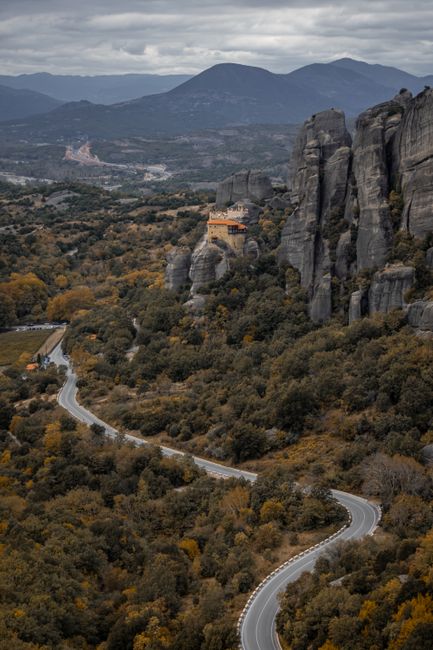
Meteora is one of the most extraordinary places in Europe: a cluster of giant sandstone and conglomerate pillars rising up to 400 metres above the plain of Thessaly, with medieval monasteries perched on their summits as if they had grown there. Hermits first lived in the caves here around the 11th century; monks built the monasteries from the 14th century, hauling up materials and people in nets and baskets. Today six monasteries still house monks and nuns and welcome visitors, linked by a scenic road and by old footpaths through the rocks. The whole area has been a UNESCO World Heritage Site since 1988. You come to visit two or three monasteries, walk the trails, watch the sunset turn the rocks gold, and eat well in the small towns at their feet, Kalambaka and Kastraki. Give it at least one night, ideally two.
Right now in Meteora (Kalambaka)
- Wed 10–24°C 49–75°F Partly cloudy
- Thu 9–25°C 49–76°F Mostly clear
- Fri 16–25°C 61–76°F Partly cloudy
Weather: MET Norway (CC BY 4.0) · Rates: ECB
Top tours in Meteora
See all tours for Meteora →
From local operators, with prices and reviews; you check availability and book on Viator, our partner. We may earn a commission at no extra cost to you. How we earn money
Meteora at a glance
- Best for: jaw-dropping scenery, Byzantine monasteries and frescoes, photography, hiking and rock climbing.
- How long: 1 night for the monasteries and a sunset, 2 nights to add hiking at a relaxed pace.
- Best time: April to June and September to October; summers are hot and crowded at midday, winters cold with shorter monastery hours and more closed days.
- Getting in: by train or bus from Athens (about 4½–5 hours) or Thessaloniki (about 3–4 hours) to Kalambaka, or by car.
- Plan around closures: each monastery closes on a different day of the week; check the table below.
- Before you go: entry rules, money and transport around the country are in our Greece travel guide.
Kalambaka and Kastraki: where to base yourself
Kalambaka
The town at the foot of the rocks, with the railway station, the bus stops, supermarkets and most hotels and restaurants. Its Byzantine cathedral, the Church of the Dormition, has fine frescoes. Kalambaka (also spelled Kalabaka) is the practical choice if you arrive by public transport. Best for: convenience and choice.
Kastraki
A village about 2 km away, tucked right under the pillars, with family-run guesthouses, tavernas with rock views, a campsite and trailheads on the doorstep. It is quieter and more atmospheric, and an easy walk to Kalambaka. Best for: hikers, couples and photographers.
The monasteries of Meteora
Of more than twenty monasteries built on the rocks, six are active and open to visitors: four for monks and two (Roussanou and St Stephen) for nuns. They are places of worship first, and they set their own hours and closing days, which change between summer (roughly April to October) and winter (November to March). Each charges a small entrance fee, reported at €5 per person per monastery as of October 2026, payable in cash at the door; children usually enter free. Hours and closing days below come from the Municipality of Meteora and the monasteries’ own pages, and can change at short notice for feast days.
| Monastery | Usually closed (summer) | Usually closed (winter) | Typical hours |
|---|---|---|---|
| Great Meteoron (Megalo Meteoro) | Tuesday | Tuesday, Wednesday and Thursday | 9:30–15:00 in summer, 9:30–14:00 in winter |
| Varlaam | Friday | Friday (reported: also Thursday) | 9:00–16:00 in summer, 9:00–15:00 in winter |
| Roussanou (nunnery) | Wednesday | Wednesday | 9:30–16:30 in summer, 9:30–14:00 in winter |
| Holy Trinity (Agia Triada) | Thursday | Thursday | About 9:00–16:30 in summer, 10:00–16:00 in winter |
| St Stephen (Agios Stefanos, nunnery) | Monday | Monday | About 9:00–13:20 and 15:30–17:30 in summer, with a midday break all year |
| St Nicholas Anapafsas | Reported: Friday | Reported: Friday | About 9:00–17:00 |
So on any day of the week, at least four monasteries are open. In winter, plan carefully: from Tuesday to Thursday the Great Meteoron is shut. The Great Meteoron also closes for its feast days around 5–7 August and 30 September–1 October, and for the whole of February.
Great Meteoron
The largest and highest monastery, founded in the 14th century by St Athanasios the Meteorite on the “Broad Rock”. Climb about 300 steps (cut into the rock and through a tunnel) to see the frescoed church of the Transfiguration, the old kitchen, the ossuary with monks’ skulls, a museum of manuscripts and icons, and the winch tower once used to haul up supplies. Go early: it is the most visited.
Varlaam
Facing the Great Meteoron across a ravine, Varlaam has some of the finest 16th-century frescoes in Meteora, a giant old wine barrel and a restored rope-and-net winch you can see in its tower. Fewer steps than its neighbour, and lovely gardens.
Roussanou
A nunnery that seems to grow out of its narrow rock, reached by a short path and a bridge. It is small, with a beautifully frescoed church, and one of the easiest to visit. The view of it from the road is one of the classic Meteora photos.
Holy Trinity
The most dramatic perch of all, on an isolated pillar reached by about 140 steps cut into the rock; it starred in the 1981 James Bond film For Your Eyes Only. A footpath also climbs to it from Kalambaka. The view from its rear terrace over Kalambaka and the Pinios valley is superb.
St Stephen
The only monastery with no stairs to climb: a bridge from the road leads straight in, so it is the best choice for visitors with limited mobility. The nuns keep it immaculate, and it looks down directly onto Kalambaka; the viewpoint nearby is a favourite for sunset.
St Nicholas Anapafsas
The first monastery you reach from Kastraki, small and built on several levels on a narrow rock, with 16th-century frescoes by the Cretan painter Theophanis Strelitzas and a little rooftop terrace. A short steep path leads up from the road.
Dress code and visiting rules
The dress code is strict and enforced at the door. Men must wear long trousers (no shorts or Bermudas) and shirts with sleeves; women must cover their shoulders and wear a skirt below the knee rather than trousers. Most monasteries lend wrap-around skirts at the entrance, but bring your own to be sure. Keep your voice low, don’t photograph inside the churches (most forbid it), and don’t step past ropes. Bring cash for the entrance fees and small donations.
Monuments
- Monastery of Great Meteoron
- Monastery of St Nicholas Anapafsas
- Monastery of St Stephen (Meteora)
- Monastery of the Holy Trinity (Meteora)
- Roussanou Monastery
- Varlaam Monastery
Other sights
- Ypapanti Monastery
Hiking, sunset spots and other things to do
The old monks’ footpaths
Before the road was built, monks and villagers walked between the monasteries on footpaths through the forest and the rocks, and many are still marked and walkable. Popular routes include the path from Kalambaka up to Holy Trinity and St Stephen (about 45–60 minutes uphill), and the path from Kastraki up to the Great Meteoron and Varlaam (about an hour). A full loop linking several monasteries takes half a day. Trails are steep in places, with little shade, so start early, carry water and wear proper shoes. Local guides lead sunset hikes and walks to the hermits’ caves, such as the Badovas caves near Kastraki. See our hiking guide.
Sunset viewpoints
The best-known sunset spots are the rock platform called Psaropetra near Roussanou and Varlaam, the viewpoint near St Stephen over Kalambaka, and the “Sunset Rock” ledge reached by a short path off the main road. Arrive 30–45 minutes early in summer, when tour buses fill the lay-bys, and take a torch for the walk back.
Rock climbing and tours
Meteora is a classic climbing destination, with multi-pitch routes on the conglomerate towers; climbing near active monasteries is restricted, so go with a local guide. Half-day minibus tours from Kalambaka cover three or four monasteries and the viewpoints, useful if you don’t have a car, and day tours run from Athens and Thessaloniki, though they are long. See our sightseeing guide.
Nearby
Trikala, 20 km away, is a pleasant riverside town with an Ottoman fortress and a Christmas theme park in December. Further west, the road climbs through the Pindus mountains to Metsovo, a stone village known for cheese and wine, and on to the Zagori villages and Ioannina in Epirus.
Activities and best months
- City sightseeingSix monasteries are open to visitors: Great Meteoron, Varlaam, Roussanou, Holy Trinity, St Stephen and St Nicholas Anapafsas, each closed one day a week (two or three in winter); entry €5 each in cash; modest dress (skirts below the knee, covered shoulders, long trousers for men). · source
- HikingOld monks' footpaths link the monasteries: the path to Ypapanti Monastery has wide views over Kalambaka, and a trail joins St Nicholas Anapafsas with Varlaam and Great Meteoron; guided half-day walks start from Kalambaka and Kastraki (about 7 km, easy). · source
Getting to Meteora
By train from Athens. Kalambaka is the end of a branch line from the main Athens–Thessaloniki railway. Hellenic Train normally runs one direct train a day from Athens to Kalambaka (about 4½–5 hours), plus connections changing at Palaiofarsalos. Since storm damage in 2023 and the upgrade works that followed, parts of this route have often been covered by replacement buses, and timetables change at short notice. As of October 2026, check the current service on the Hellenic Train website or app before you plan around it.
By bus. KTEL Trikala runs buses from Athens’ Liosion terminal to Trikala (about 4–5 hours), with frequent local buses on to Kalambaka (about 30 minutes). From Thessaloniki, KTEL buses also run via Trikala, about 3–3½ hours in total. Private transfers and day tours also run from both cities.
By car. About 350 km from Athens (4 hours via the motorway and Lamia or Larissa) and 230 km from Thessaloniki (about 2½–3 hours). The E65 motorway now reaches the Trikala area. A car makes it easy to combine Meteora with Delphi and the Pindus mountains.
Getting around Meteora
- On foot: the footpaths are the most beautiful way between the monasteries; combine walking up with a taxi or bus down.
- Local bus: a seasonal bus runs from Kalambaka via Kastraki up to the Great Meteoron a few times a day; check the times locally.
- Taxi: taxis wait in Kalambaka’s main square and can drop you at the top for a walk down.
- Car or scooter: the 17 km loop road links all the monasteries; parking near the Great Meteoron and Varlaam fills by late morning in summer.
When to go and how long to stay
Meteora lies inland at the edge of the Thessaly plain, so it has a continental touch: summers are hot, often above 33 °C in July and August, and winters are cold, with frost and occasional snow on the rocks. Spring brings green fields, wildflowers and the best hiking weather; autumn has clear light and fewer coaches. Mist sometimes wraps the pillars on autumn and winter mornings, which can be magical. Monasteries keep shorter hours and close more days in winter, and many are shut on Easter Sunday morning and on their own feast days.
Meteora in 1 day
Morning: the Great Meteoron at opening time, then Varlaam next door. Midday: lunch in Kastraki. Afternoon: Roussanou and St Stephen (or Holy Trinity if you have energy for the steps), then a sunset viewpoint. Check that your chosen day is not a closing day for the big two.
Meteora in 2 days
Spread the monasteries over two mornings, walk the Kastraki–Great Meteoron and Kalambaka–Holy Trinity paths, visit St Nicholas Anapafsas and the hermits’ caves, and see the sunset from two different viewpoints.
Weather month by month
Averages from HNMS normals 1981–2010, Trikala; rain: HNMS averages 1955–2010, Larisa · Last reviewed 4 Oct 2026
Where to stay and eat
Kalambaka has the widest choice of hotels, from simple rooms to spa hotels with rock views; Kastraki has small guesthouses and a campsite. Book ahead for Easter, summer weekends and October holidays. Every stay pays Greece’s climate resilience fee per room per night (see our Greece guide). Tavernas serve the hearty food of Thessaly: grilled meats, slow-cooked goat and lamb, pies with wild greens, local feta and tsipouro. Wines from nearby Meteora and Metsovo are worth a try.
Practical tips for Meteora
- Check closing days: each monastery closes one or more days a week, and more in winter.
- Bring cash: entrance fees are paid at the door.
- Dress for the monasteries: long trousers for men, a long skirt for women, shoulders covered.
- Go early or late: coach tours crowd the monasteries from about 10:00 to 13:00.
- Respect fire rules: in summer, forest areas can be closed on high fire-risk days, and no fires or cigarettes on the trails.
- Check the train: confirm the Athens–Kalambaka service and any replacement bus before travelling.
What to pack for Meteora
Long trousers or a long skirt and a top that covers your shoulders for the monasteries, shoes with good grip for steps and trails, a sun hat, sunscreen and water in summer, a torch for walks back from sunset, cash for fees, and warm, waterproof layers from November to March.
What to pack
- City walking shoesLisbon and Porto are steep, with polished limestone cobbles that get slippery, so grippy soles matter.
- Day packs and anti-theft bagsA small zipped or anti-theft bag makes crowded trams and viewpoints less stressful.
- Fleeces and warm layersSummits like Pico do Areeiro averaged about 11 °C over 2024, so a fleece is needed even in summer.
- HeadlampsLevada routes such as PR1 and PR9 pass through long, dark, wet tunnels.
- Hiking shoes and bootsMadeira's levadas and the Azores' crater rims are wet, rocky and slippery, so grippy shoes matter more than anywhere else in Portugal.
- Rain jacketsFrom October to April Porto and Lisbon see rain on roughly a third of days.
- Travel adapters and convertersPortugal uses Type C and F sockets at 230 V, so most visitors from outside Europe need an adapter.
- Trekking polesLong stone staircases and steep descents on Madeira's peaks and the Azores' crater rims are easier on the knees with poles.
- Water bottles and hydration packsAlgarve and Alentejo trails are hot and exposed with few refill points.
Meteora travel FAQ
Which Meteora monasteries are open on which days?
In summer the usual closing days are Tuesday for the Great Meteoron, Wednesday for Roussanou, Thursday for Holy Trinity, Monday for St Stephen and Friday for Varlaam (and, reportedly, St Nicholas). In winter the Great Meteoron also closes on Wednesday and Thursday. Check before you go, as days can change.
How much does it cost to visit the Meteora monasteries?
Each monastery charges its own entrance fee, reported at €5 per person as of October 2026, paid in cash at the door. Children usually enter free.
What is the dress code at Meteora?
Men need long trousers and sleeved shirts; women need a skirt below the knee and covered shoulders. Most monasteries lend wrap skirts, but bring your own.
How do I get from Athens to Meteora?
By Hellenic Train to Kalambaka (normally about 4½–5 hours, direct or changing at Palaiofarsalos; check for replacement buses), by KTEL bus to Trikala and on to Kalambaka, or by car in about 4 hours.
Can I visit Meteora as a day trip from Athens?
It is possible on an organised tour, but it means 8–10 hours of travel. Stay at least one night in Kalambaka or Kastraki to see the sunset and the monasteries without rushing.
Which Meteora monastery is the best?
The Great Meteoron is the largest, with a museum; Varlaam has the finest frescoes; Holy Trinity has the most dramatic setting; and St Stephen needs no stairs. With limited time, see the Great Meteoron and Varlaam, then one more.
Can you hike between the Meteora monasteries?
Yes. Marked footpaths link Kalambaka and Kastraki with the monasteries, about 45–60 minutes uphill each. Start early, carry water and check fire-risk closures in summer.
Where is the best sunset at Meteora?
Psaropetra near Roussanou, the viewpoint by St Stephen above Kalambaka, and the “Sunset Rock” ledge off the main road. Arrive early in summer.
Should I stay in Kalambaka or Kastraki?
Kalambaka for transport links and choice of hotels and restaurants; Kastraki for a quieter village right under the rocks and close to the trails.
When is the best time to visit Meteora?
April to June and September to October, for mild weather, green or golden landscapes and longer monastery hours than in winter. Summer is hot and busy at midday, and in winter the monasteries close more days.
Is Meteora suitable for people with limited mobility?
Partly. St Stephen’s nunnery is reached by a bridge with no stairs, and the viewpoints along the road are easy. The other monasteries involve from a few dozen to about 300 steps.
Nearby destinations
- Lefkada139 km
- Corfu151 km
- Thessaloniki152 km
- Albanian Riviera164 km
- Skiathos168 km
- Ohrid171 km
- Berat180 km
- Kefalonia186 km
Sources
- © OpenStreetMap contributors · ODbL · fetched 4 Oct 2026
- Wikidata · CC0 · fetched 4 Oct 2026
Sources and last review
Researched and last reviewed on 4 October 2026. Monastery hours and closing days: the Municipality of Meteora and the Holy Monastery of Great Meteoron; dress code: the Great Meteoron. The €5 entrance fee, the winter closing days of Varlaam and the closing day of St Nicholas Anapafsas come from secondary sources, and the October 2026 status of the Athens–Kalambaka train is not confirmed; both are flagged for checking. Hours and rules change, especially around feast days, so check before you go. For entry rules, money and ferries, see our Greece travel guide.
Plan your trip
Partner links: TravelerCenter may earn a commission if you book, at no extra cost to you.
🇬🇷 Useful Greek phrases for Meteora
All 38 Greek phrases: restaurant, hotel, emergencies, romance (printable) →