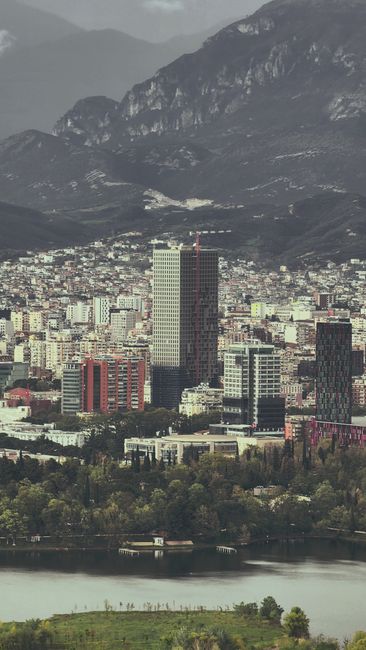
Tirana is Albania’s capital and its liveliest city: a place of brightly painted apartment blocks, packed cafés, new towers and old Ottoman mosques, spread across a plain below the green wall of Mount Dajti. For half a century it was the closed capital of one of the world’s most isolated dictatorships, and the city tells that story vividly in its bunker museums, the Pyramid and the House of Leaves. Today it is young, friendly and full of energy, with a huge pedestrian square, the former communist elite district of Blloku turned into a bar and restaurant quarter, and a cable car up the mountain. Most visitors fly in here, so give it two days before heading to the coast or to Berat; three or four with day trips to Kruja and Durrës. It is good to visit all year, but best in spring and autumn.
Right now in Tirana
- Wed 16–26°C 60–79°F Partly cloudy
- Thu 15–24°C 58–75°F 3 mm Showers
- Fri 18–21°C 65–70°F 35 mm Heavy rain
Weather: MET Norway (CC BY 4.0)
Top tours in Tirana
See all tours for Tirana →
From local operators, with prices and reviews; you check availability and book on Viator, our partner. We may earn a commission at no extra cost to you. How we earn money
Tirana at a glance
- Best months: April–June and September–October. Mean temperatures run from about 18 °C in May to 24 °C in July (German weather service, DWD, Tirana airport, 1961–1990), but recent summers have been hotter, with afternoons often above 35 °C.
- Days needed: 2 for the centre, the bunker museums and Dajti; 3–4 with day trips to Kruja, Durrës or Lake Bovilla.
- Getting there: Tirana International Airport (TIA) is 17 km north-west of the city; an airport bus runs every hour, day and night, for 400 lek.
- Getting around: the centre is walkable and flat; city buses, taxis and ride apps for the rest; intercity buses leave from the South and North Bus Terminal.
- Budget level: one of the cheapest capitals in Europe for food and drink, though hotels in the centre are no longer bargain-priced. See our Albania guide for money and entry rules.
Tirana’s neighbourhoods and who each one suits
- Skanderbeg Square and the centre: the vast pedestrian square, the Opera, the mosque and the clock tower, with museums, hotels and the airport bus a few minutes away. Ideal for a first visit.
- Blloku: once closed to ordinary Albanians because the communist leadership lived here, now the city’s busiest district for cafés, cocktail bars, restaurants and nightlife. Fun, central and noisy at weekends.
- Pazari i Ri (New Bazaar): a restored market square just east of the centre, with fruit and vegetable stalls, traditional restaurants and small guesthouses. Characterful and good value.
- Around the Grand Park: quieter streets south of the centre, near the artificial lake, the university and green walking paths. Good for families and longer stays.
- Towards Mount Dajti: the eastern edge of the city, near the cable car and Bunk’Art 1, with mountain views but a longer trip into town.
Top things to see in Tirana
Prices and hours below are as of October 2026. Tickets are sold in lek (about 92 lek to the euro on 2 October 2026). Some prices come from published reports and are flagged in our sources.
Skanderbeg Square and the Et’hem Bey Mosque
The heart of Tirana is Skanderbeg Square, a huge, almost car-free space paved in stone from all over Albania, with the equestrian statue of the national hero Skanderbeg at one end and fountains for children to play in. Around it stand the Palace of Culture with the Opera and Ballet Theatre, government ministries in Italian-era style, and the Et’hem Bey Mosque, a small, beautifully painted mosque from the late 18th and early 19th centuries that survived the communist ban on religion. Next to it rises the Clock Tower, which you can sometimes climb for a view over the square. The National History Museum, with its famous socialist-realist mosaic on the façade, is closed for reconstruction until 2028, according to the Ministry of Culture’s announcement reported in the press; you can still see the mosaic from the square.
Bunk’Art 1 and Bunk’Art 2
Tirana’s two bunker museums are its most memorable sights. Bunk’Art 2, just off Skanderbeg Square opposite the City Hall, is a bunker built for the Ministry of the Interior, and its corridors tell the story of the communist secret police, the Sigurimi, and its victims. Bunk’Art 1, on the eastern edge of the city near the Dajti cable car, is a vast nuclear shelter built for Enver Hoxha and the party leadership, with about a hundred rooms on several floors covering Albania’s 20th-century history and contemporary art. Both are open every day, according to Bunk’Art’s official site: Bunk’Art 1 from 09:30 to 17:30 and Bunk’Art 2 from 09:30 to 18:30. Tickets are reported at 900 lek each in 2026, or about 1,300 lek for a combined ticket to both; check at the door. Allow one to two hours for Bunk’Art 1 and an hour for Bunk’Art 2. They stay cool in summer, making them a good midday escape.
The House of Leaves and the Pyramid
The House of Leaves, a creeper-covered villa that was once a doctor’s clinic, became the secret police’s surveillance centre; today it is a powerful museum of state spying, full of bugging devices, files and testimony. The Pyramid of Tirana, built in 1988 as a museum to Enver Hoxha and later left to decay, has been rebuilt as a youth technology centre with bright boxes stacked around it and steps up its sloping sides; climb to the top for the view, and to understand how the city reclaims its past. Nearby, a bunker and a piece of the Berlin Wall form the small Postbllok memorial at the entrance to Blloku.
The Dajti Ekspres cable car and Mount Dajti
The Dajti Ekspres, billed as the longest cable car in the Balkans, climbs from the eastern edge of the city to Mount Dajti National Park in about 15–20 minutes, with the whole plain of Tirana unrolling below you. At the top there are restaurants, a hotel, an adventure park, mini golf and walking trails through beech and pine forest. According to its official site it runs every day except Tuesday, from 09:00 to 18:30 on weekdays and to 19:00 at weekends; a return ticket is reported at about 1,500 lek in 2026 (fares are sold only at the ticket window), and the line can stop in high wind. Bunk’Art 1 is a few minutes’ walk from the lower station, so combine the two.
The Grand Park, Blloku and the New Bazaar
South of the centre, the Grand Park wraps around an artificial lake with a loop path of about 4 km, popular with joggers, families and couples at sunset. Walk back through Blloku, where you can see the outside of Enver Hoxha’s former villa, then up the main boulevard past the Pyramid. On the other side of the centre, the New Bazaar (Pazari i Ri) is the place for fruit, honey, cheese and raki, and for traditional restaurants. Look out also for the Orthodox Resurrection Cathedral, the Catholic St Paul’s Cathedral, the Ottoman Tanners’ Bridge and the pedestrian lanes inside the old walls of Tirana Castle, now lined with cafés.
Food, cafés and nightlife
Tirana is a great place to eat cheaply and well. Try tavë kosi (baked lamb and yoghurt), fërgesë (peppers, tomatoes and cheese), grilled qofte, stuffed vegetables and byrek from a bakery for breakfast. Traditional restaurants cluster around the New Bazaar, and grill houses are everywhere. Coffee is a ritual, and the city has thousands of cafés; sit outside and watch Tirana go by. In the evening, Blloku fills with bars, cocktail lounges and clubs, and the summer outdoor scene runs late. Albanian wines from Berat, Përmet and the north are worth trying; see our wine tasting guide. Smoking is still common in bars, even though it is restricted indoors.
Day trips from Tirana
- Kruja: about an hour north, the mountain stronghold where Skanderbeg held off the Ottomans, with a castle, the Skanderbeg Museum, an ethnographic museum in an old merchant’s house and a cobbled bazaar of handicrafts.
- Durrës: 45 minutes to an hour west, with its Roman amphitheatre, archaeological museum and long beach. See our Durrës guide.
- Lake Bovilla: a turquoise reservoir among cliffs north-east of the city, with a popular short hike to the Gamti viewpoint. The road is rough in places.
- Petrela castle: a small hilltop castle 20 minutes south, with a restaurant and wide views.
- Berat: about two to two and a half hours south; better as an overnight stay than a day trip. See our Berat guide.
For walks in the hills, see our hiking guide, and for more ideas in the city, our city sightseeing guide.
Nearby destinations
Getting there and getting around
From the airport
Tirana International Airport Nënë Tereza (TIA), at Rinas, is 17 km from the city and Albania’s main gateway, with direct flights from much of Europe. According to the airport’s official site, an airport bus runs between the terminal and central Tirana every full hour, 24 hours a day, for 400 lek (or €4); in town it stops behind the Palace of Culture (the Opera), and the trip takes 30–40 minutes. A second bus links the airport with the South and North Bus Terminal from 07:00 to 18:00 for 300 lek, handy if you are heading straight on to another city. The official airport taxi to the centre takes 20–25 minutes and costs about 2,200 lek. There is no train: the new rail link to the airport is still being built, with services expected in 2027.
Buses to the rest of Albania
Intercity buses and furgons leave from the South and North Bus Terminal on the western side of the city, on the road towards Durrës. From there, buses run to Durrës (about an hour), Berat (about two and a half hours), Shkodër, Vlorë, Gjirokastër and Sarandë. Timetables are informal; ask at the terminal or your hotel the day before, and expect fewer departures in the afternoon. A taxi to the terminal from the centre is quick and inexpensive. International buses run to Kosovo, North Macedonia, Montenegro and Greece.
In the city
Central Tirana is easy on foot: Skanderbeg Square, Blloku, the Pyramid and the New Bazaar are all within 20 minutes’ walk of each other. City buses are very cheap; you pay the conductor on board. Taxis are plentiful and inexpensive; agree the fare first or ask for the meter, or use a ride-hailing app. Traffic is heavy at rush hour. Driving in the city is stressful and parking is hard, so pick up a hire car on the way out.
When to go and how long to stay
Tirana has a Mediterranean climate with a continental edge: hot, dry summers and mild, wet winters, with snow only on the mountains above the city. Spring and autumn are the best seasons for walking around, with mild days and outdoor café life. July and August are hot, often above 35 °C in the afternoon, and many residents leave for the coast. Winters are cool and rainy but rarely freezing, and the city stays lively, with Christmas lights and markets in December. Independence Day on 28 November fills the square with flags and concerts.
| Season | Mean temperature | Days with rain a month | What it’s like |
|---|---|---|---|
| Spring (Mar–May) | 10–18 °C | 9–10 | Mild and green; the best time for walking and day trips. |
| Summer (Jun–Aug) | 22–24 °C | 3–5 | Hot and dry, with afternoon highs of 31 °C or more; quieter as locals head to the beach. |
| Autumn (Sep–Nov) | 21 °C falling to 12 °C | 5–12 | September and October are lovely; November turns wet. |
| Winter (Dec–Feb) | 7–8 °C | 9–12 | Cool, rainy and cloudy; snow on Mount Dajti; festive in December. |
Figures are the German weather service’s (DWD) 1961–1990 climate table for Tirana airport, with days of at least 1 mm of rain. They are mean temperatures over day and night: the average afternoon high in July and August was about 31 °C. Recent decades have been warmer, with summer means about 1.5 °C higher in 1991–2020 records. Tirana gets about 1,270 mm of rain a year, most of it from October to April, and about 11 hours of sunshine a day in July.
2 days in Tirana
Day 1: Skanderbeg Square, the Et’hem Bey Mosque and the Clock Tower, Bunk’Art 2, lunch at the New Bazaar, the House of Leaves and the Pyramid, and dinner in Blloku. Day 2: Bunk’Art 1 in the morning, the Dajti Ekspres up the mountain for lunch with a view, and a sunset walk in the Grand Park.
4 days in Tirana
Add a day in Kruja, with its castle and bazaar, and a day in Durrës for the amphitheatre and the beach, or a hike at Lake Bovilla. Then head south to Berat and the Riviera, or north to Shkodër and the Albanian Alps.
Where to stay in Tirana
- First visit: a hotel near Skanderbeg Square, close to the sights and the airport bus.
- Nightlife and restaurants: Blloku, but ask for a quiet room.
- Character and value: guesthouses and small hotels around the New Bazaar.
- Families and longer stays: apartments near the Grand Park.
- Early flight: hotels near the airport at Rinas.
Albania has no national tourist tax; Tirana’s small local tax on hotel stays is normally included in the room price.
Practical tips for Tirana
- Crossing the road: traffic is fast and drivers do not always stop at crossings; cross with the locals.
- Money: cards work in most hotels, supermarkets and many restaurants; carry lek for taxis, buses, markets and small cafés.
- Tuesdays: the Dajti Ekspres is closed; plan the mountain for another day.
- Heat: visit the bunker museums at midday in summer; they stay cool.
- Air quality: traffic pollution can be high on still winter days; take it easy if you have asthma.
- Pickpockets: watch your bag on crowded buses and at the bus terminal.
- Emergencies: call 112; 127 for an ambulance.
What to pack for Tirana
For summer, pack light, breathable clothes, a sun hat, sunglasses, sunscreen and a refillable water bottle. Comfortable walking shoes are essential, and hiking shoes help on Mount Dajti and at Lake Bovilla. Bring a light jacket for the mountain, which is several degrees cooler than the city, and a scarf to cover shoulders in mosques and churches. In spring, autumn and winter, pack a rain jacket or umbrella and a warm layer. Plugs are the European two-pin type; bring a travel adapter if you need one.
Tirana travel FAQ
How do I get from Tirana airport to the city?
Take the airport bus, which leaves every full hour, 24 hours a day, for 400 lek and takes 30–40 minutes to the stop behind the Opera. The official taxi costs about 2,200 lek and takes 20–25 minutes.
How many days do you need in Tirana?
Two days for the centre, the bunker museums and Mount Dajti; three or four with day trips to Kruja, Durrës or Lake Bovilla.
What is the difference between Bunk’Art 1 and Bunk’Art 2?
Bunk’Art 1 is Enver Hoxha’s huge nuclear shelter on the edge of the city, covering Albania’s 20th-century history. Bunk’Art 2 is a smaller bunker in the centre about the secret police and its victims. If you only have time for one, Bunk’Art 1 is bigger; Bunk’Art 2 is easier to reach.
What are the opening hours of Bunk’Art?
Both are open daily: Bunk’Art 1 from 09:30 to 17:30 and Bunk’Art 2 from 09:30 to 18:30, according to the official site. Tickets are reported at 900 lek each, or about 1,300 lek for both.
When does the Dajti cable car run?
Every day except Tuesday, from 09:00 to 18:30 on weekdays and to 19:00 at weekends. The ride takes about 15–20 minutes, and it can stop in strong wind.
Is the National History Museum open?
No. It closed in March 2024 for a major reconstruction and is due to reopen in 2028. The mosaic on its façade can still be seen from Skanderbeg Square.
Is there a train from Tirana to Durrës?
Not as of October 2026. The line is being rebuilt with a branch to the airport, and services are expected in 2027. Buses take about an hour.
Is Tirana safe?
Yes. Crime against visitors is rare. Watch for pickpockets in crowds and on buses, and take care crossing busy roads.
Is Tirana worth visiting?
Yes, for a day or two. It is not a classic beauty, but its communist history, café life, food and friendly energy make it one of the most interesting capitals in the Balkans.
Can I pay in euros in Tirana?
Sometimes, in hotels and tourist businesses, but the currency is the lek and paying in lek is usually cheaper. Cash machines are everywhere in the centre.
Sources and last review
Researched and last reviewed on 4 October 2026. Airport transport comes from Tirana International Airport’s official site; Bunk’Art hours from Bunk’Art’s official site; Dajti Ekspres hours from the operator’s site; climate from the German weather service (DWD) for Tirana airport; the exchange rate from the Bank of Albania. The National History Museum closure, the railway timetable and ticket prices not shown on official sites come from published reports and are flagged for checking. Prices, timetables and rules change, so check the official sites before you travel.
Plan your trip
Partner links: TravelerCenter may earn a commission if you book, at no extra cost to you.
🇦🇱 Useful Albanian phrases for Tirana
All 38 Albanian phrases: restaurant, hotel, emergencies, romance (printable) →