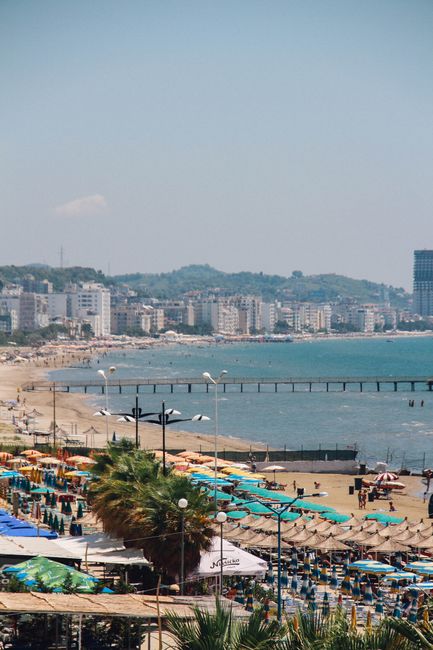
Durrës is Albania’s main port and one of the oldest cities on the Adriatic, founded by Greek colonists more than 2,600 years ago and later the Roman port of Dyrrachium, where the Via Egnatia set off across the Balkans towards Constantinople. Today it is a busy, unpretentious seaside city: a huge Roman amphitheatre sits among apartment blocks in the middle of town, Byzantine walls and a Venetian tower guard the old centre, a long promenade runs along the bay, and a sandy beach stretches for kilometres to the south, lined with hotels. It is only 40 minutes from Tirana’s airport and the arrival point for ferries from Italy, which makes it an easy first or last stop. It is not the prettiest coast in Albania, but it is lively, cheap and full of history. Give it one or two days; June and September are best for the beach.
Right now in Durrës
- Wed 15–24°C 59–74°F Partly cloudy
- Thu 17–24°C 63–74°F 3 mm Light rain
- Fri 18–22°C 65–71°F 33 mm Heavy showers
Weather: MET Norway (CC BY 4.0) · Sea temperature: NOAA CoastWatch
Top tours in Durrës
See all tours for Durrës →
From local operators, with prices and reviews; you check availability and book on Viator, our partner. We may earn a commission at no extra cost to you. How we earn money
Durrës at a glance
- Best months: June and September for the beach; April–May and October for sightseeing. July and August are hot and very busy, when much of Albania and Kosovo seems to be on holiday here.
- Days needed: 1 for the amphitheatre, the museum and the old walls; 2–3 with beach time or a trip to the Cape of Rodon.
- Getting there: buses from Tirana take about an hour; a direct bus from Tirana airport costs 600 lek; overnight ferries arrive from Bari and Ancona.
- Getting around: the old centre and the promenade are walkable; city buses and taxis run along the beach strip to Golem.
- Budget level: good value, with plenty of mid-range hotels and cheap seafood. See our Albania guide for money and entry rules.
Durrës’s areas and who each one suits
- The old centre: around the amphitheatre, the Venetian tower and the port, with the museum, cafés and restaurants. Best for a short city break and for ferry travellers.
- The promenade and the city beach: just south of the port, a long seafront walk with hotels, bars and the main city beach. Lively in the evening; good for couples and friends.
- Plazh (Durrës beach) and Shkëmbi i Kavajës: the long sandy strip south-east of the city, a wall of hotels, beach clubs and apartments facing shallow water. Built for families and beach holidays.
- Golem: further south along the same bay, newer resorts and wider sand; calmer but further from the old town.
- Currila and the hill: north-west of the port, a smaller beach and the hill with King Zog’s former villa and views over the bay. Quieter.
Durrës’s history in brief
Greek settlers from Corinth and Corcyra (Corfu) founded Epidamnos here in the 7th century BC. Under Rome, as Dyrrachium, it became one of the great ports of the Adriatic, facing Brindisi across the strait of Otranto, and the start of the Via Egnatia; Julius Caesar and Pompey fought here in 48 BC. The Byzantines walled it, Normans, Venetians and Ottomans fought over it, and in 1914–1920 it briefly served as Albania’s first capital. Durrës was hit hard by the earthquake of 26 November 2019, which killed 51 people across Albania; much has been rebuilt, but you will still see scars and new construction. Its long history is the reason ancient ruins turn up in basements, car parks and building sites all over town.
Top things to see in Durrës
Prices and hours below are as of October 2026. Tickets are sold in lek (about 92 lek to the euro on 2 October 2026). Most of them come from published reports and are flagged in our sources.
The Roman amphitheatre
Built in the 2nd century AD, the amphitheatre of Durrës was one of the largest in the Balkans, with room for many thousands of spectators. It was forgotten for centuries, built over by houses, and only rediscovered in the 1960s; about half of it has been excavated, and the rest still lies under the streets and homes around it. Walk through the vaulted corridors into the arena, and look for the small Byzantine chapel built into the stands, with rare wall mosaics of saints. How to visit (as of October 2026): tickets are reported at 300 lek, bought at the booth by the entrance, with no booking needed. Opening hours are reported as about 09:00–19:00 from April to October and 09:00–17:00 in winter. Allow an hour.
The Archaeological Museum
On the seafront near the port, Albania’s largest archaeological museum displays finds from Epidamnos and Dyrrachium: Greek and Roman sculpture, funerary stelae, mosaics, coins, pottery and small objects of everyday life. It reopened in 2026 after renovation, with redesigned halls, according to press and travel reports. Tickets are reported at around 400 lek for adults, with reductions for students and seniors; in the cooler months it is usually closed on Mondays and closes in the afternoon. Allow an hour or two, and combine it with the amphitheatre, about 400 m away.
The Venetian Tower, the walls and the forum
The round Venetian Tower by the port, part of the medieval defences, now has a café and bar where you can sit above the traffic. From it, stretches of the 5th-century Byzantine walls, built under Emperor Anastasius I, who was born in Dyrrachium, run up towards the amphitheatre. In the centre, near the Great Mosque, the columns of a round Roman macellum (market hall) lie in a sunken square, and Roman baths have been excavated behind the Aleksandër Moisiu theatre. Look out too for the Fatih Mosque, the oldest in the city, and the views of the bay from the hill of the former royal villa of King Zog.
Beaches and swimming
The Durrës coast is the opposite of the rocky Riviera: a long, gently shelving sandy beach that runs for more than 10 km from the city south-east past Shkëmbi i Kavajës to Golem, with shallow, calm water that warms up early in the season. It is ideal for small children, but it is also busy and backed by a nearly continuous line of hotels, beach clubs and restaurants; much of the sand is set with loungers and umbrellas, which you rent by the day, and a share of the shore is kept free by national rules. The water is clearer further from the port and from the river mouths, and the sea can be murky after storms. For more dramatic scenery, drive an hour north to the Cape of Rodon, with Skanderbeg’s ruined castle by the sea, a small church and quieter beaches. See our beaches guide.
- Safety: swim inside the marked zones, use licensed operators for jet skis and boats, and watch children closely where lifeguards are absent.
- Water quality: avoid swimming near the port, outfalls and river mouths, especially after heavy rain.
- Evening walk: the promenade is at its best at sunset, when families come out for the xhiro.
Day trips from Durrës
- Tirana: about an hour by bus or car for the bunker museums, Skanderbeg Square and the Dajti cable car. See our Tirana guide.
- Kruja: about an hour inland, Skanderbeg’s castle town with its museum and bazaar.
- The Cape of Rodon: a headland with a ruined castle, a church and quiet coves, about an hour north.
- Berat: about two hours south-east, better with an overnight stay. See our Berat guide.
- Apollonia: the Greek and Roman city near Fier, about an hour and a half south.
For more ideas, see our city sightseeing guide and our boat trips guide.
Nearby destinations
- Tirana31 km
- Berat80 km
- Ohrid116 km
- Budva119 km
- Kotor136 km
- Albanian Riviera141 km
- Herceg Novi147 km
- Prizren148 km
Getting there and getting around
From Tirana and the airport
Durrës is about 35 km west of Tirana on the motorway. Buses run frequently from Tirana’s South and North Bus Terminal and take about an hour. From Tirana International Airport, about 30 km away, a direct bus to Durrës runs several times a day for 600 lek, according to the airport’s official site, and taxis take about 40 minutes. There are no trains: the Tirana–Durrës railway is being rebuilt with a new branch to the airport, and as of October 2026 passenger services are expected to start in 2027.
Ferries from Italy
Durrës is Albania’s main ferry port and the easiest way to bring a car from Italy. Adria Ferries sails to Durrës from Ancona, Bari and Trieste, and GNV and Ventouris also run from Bari. The Bari crossing is overnight and takes about 9–10 hours; Ancona and Trieste take most of a day or a night and a day. Book cabins early for July and August, when many Albanians abroad come home for the summer. The ferry terminal is next to the old centre. When you sail to Italy, non-EU travellers are registered in the EU’s Entry/Exit System on arrival in the Italian port, so allow time.
Getting around
The old centre, the port, the amphitheatre and the museum are all within a 15-minute walk. City buses run from the centre along the beach road to Plazh and Golem, and taxis are inexpensive; agree the fare first. Traffic along the beach strip is heavy in summer, and parking near the sand is scarce. Buses to Vlorë, Berat, Shkodër and the south leave from the city’s bus station near the railway station.
When to go and how long to stay
Durrës has a Mediterranean climate: hot, dry summers and mild, wet winters, a little gentler than Tirana’s thanks to the sea. The shallow Adriatic warms early, so swimming is pleasant from about June to September. July and August are hot, crowded and noisy, with beach clubs and bars open late; June and September are calmer and cheaper. From November to March the beach hotels are quiet or closed, but the city and its sights stay open, and it is a pleasant base for Tirana and Kruja.
| Season | Mean temperature | Days with rain a month | What it’s like |
|---|---|---|---|
| Spring (Mar–May) | 10–18 °C | 9–10 | Mild and fresh; good for sightseeing; sea still cool. |
| Summer (Jun–Aug) | 22–24 °C | 3–5 | Hot and sunny; warm, shallow sea; peak crowds in July and August. |
| Autumn (Sep–Nov) | 21 °C falling to 12 °C | 5–12 | September is ideal for the beach; storms and rain from late October. |
| Winter (Dec–Feb) | 7–8 °C | 9–12 | Mild, wet and windy; beach resorts quiet; city sights open. |
Albania does not publish station climate normals online, so the figures are the nearest official long-term record: the German weather service’s (DWD) 1961–1990 climate table for Tirana airport, about 30 km inland. Durrës, on the coast, is usually a little milder in winter and slightly less hot on summer afternoons, and recent decades have been warmer everywhere. They are mean temperatures over day and night, with days of at least 1 mm of rain.
1 day in Durrës
Morning: the amphitheatre and the Byzantine walls, then the Archaeological Museum. Lunch: seafood near the port. Afternoon: a drink at the Venetian Tower and a swim off the city beach. Evening: the xhiro along the promenade at sunset.
2–3 days in Durrës
Add a beach day at Golem or Shkëmbi i Kavajës, a trip to the Cape of Rodon, and an afternoon in Kruja or Tirana. Then head south to Berat and the Albanian Riviera, or catch the overnight ferry to Italy.
Where to stay in Durrës
- Ferry travellers and history lovers: the old centre, near the port and the amphitheatre.
- Couples: a sea-view hotel on the promenade.
- Families on a beach holiday: Plazh, Shkëmbi i Kavajës or Golem, with pools and shallow water.
- Quiet: Currila or the resorts at the far end of Golem.
Albania has no national tourist tax; any small local tax on hotel stays is normally included in the room price. Prices on the beach strip rise sharply in July and August.
Practical tips for Durrës
- Ferries: check in early, and have your passport or EU ID card ready for the border.
- Cash: carry lek for loungers, buses and small restaurants.
- Traffic: the beach road is congested in summer; allow extra time to reach the airport or the port.
- Heat: visit the amphitheatre early or late in July and August; there is little shade.
- Pickpockets: take care on crowded beaches and buses.
- Emergencies: call 112; 127 for an ambulance.
What to pack for Durrës
For summer, pack light clothes, a sun hat, sunglasses, high-factor sunscreen, a swimsuit and a beach towel; the sand gets hot, so flip-flops or water shoes help. Bring comfortable walking shoes for the ruins and the old walls, a scarf to cover shoulders in mosques and churches, and insect repellent for summer evenings. In spring, autumn and winter, add a rain jacket and a warm layer for the sea wind. Plugs are the European two-pin type; bring a travel adapter if you need one.
Durrës travel FAQ
Is Durrës worth visiting?
Yes, for a day or two. The Roman amphitheatre, the museum and the walls are among Albania’s best ancient sights, and the long sandy beach suits families. For dramatic scenery and clear water, head to the Riviera.
How much is the Durrës amphitheatre?
Tickets are reported at 300 lek in 2026, bought at the entrance. It is open daily, with longer hours from April to October.
How do I get from Tirana airport to Durrës?
A direct bus runs several times a day for 600 lek, according to the airport, and taxis take about 40 minutes. From central Tirana, buses take about an hour.
Is there a train from Durrës to Tirana?
Not as of October 2026. The line is being rebuilt with a branch to Tirana airport, and passenger services are expected in 2027.
Which ferries go from Durrës to Italy?
Adria Ferries sails to Ancona, Bari and Trieste, and GNV and Ventouris also sail to Bari. The Bari crossing is overnight, about 9–10 hours.
Is the beach in Durrës good?
It is long, sandy and shallow, which suits children, but it is built-up and busy, and the water is less clear than on the Riviera. Golem and the beaches near the Cape of Rodon are quieter.
Is the Durrës Archaeological Museum open?
Yes. It reopened in 2026 after renovation, according to press reports. It usually closes on Mondays outside summer; check the hours before you go.
Should I stay in Durrës or Tirana?
Stay in Tirana for city life, museums and restaurants; stay in Durrës for the beach, the ferries and a calmer seaside base. They are an hour apart, so you can easily visit one from the other.
When is the sea warm enough to swim in Durrës?
From about June to September. The shallow Adriatic warms earlier than the deep Ionian Sea on the Riviera, and it is warmest in August.
How do I get from Durrës to the Albanian Riviera?
By car, drive south on the motorway past Fier to Vlorë, about two hours, then over the Llogara Pass or through the tunnel to Dhërmi and Himarë. Buses run to Vlorë and, in summer, on to the Riviera villages and Sarandë.
Sources and last review
Researched and last reviewed on 4 October 2026. Airport buses come from Tirana International Airport’s official site; ferry routes from Adria Ferries; climate from the German weather service (DWD) for Tirana airport, the nearest official record; the exchange rate from the Bank of Albania; entry and EES rules from the European Commission. Ticket prices and hours for the amphitheatre and the museum, the museum’s reopening, the other ferry operators and crossing times, and the railway timetable come from published reports and are flagged for checking. Prices, timetables and rules change, so check the official sites before you travel.
Plan your trip
Partner links: TravelerCenter may earn a commission if you book, at no extra cost to you.
🇦🇱 Useful Albanian phrases for Durrës
All 38 Albanian phrases: restaurant, hotel, emergencies, romance (printable) →