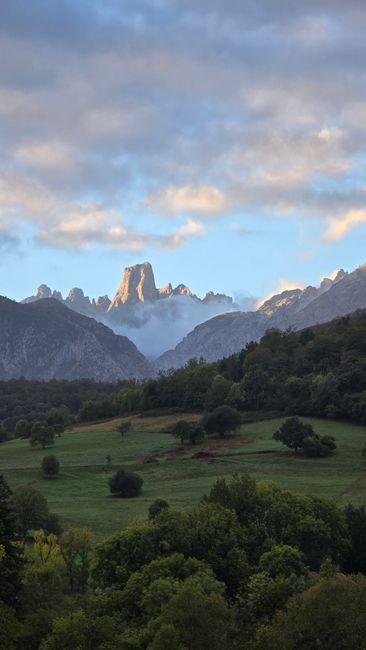
The Picos de Europa are a small, fierce range of limestone peaks just 20–30 km from the Bay of Biscay, shared by Asturias, Cantabria and Castile and León. Spain’s first national park was created here in 1918, and today the Picos de Europa National Park covers about 67,000 hectares of jagged grey summits, deep gorges, beech woods, high summer pastures and stone villages where blue Cabrales cheese still ripens in caves. Walk the Cares gorge, ride the Fuente Dé cable car or the Bulnes funicular, and visit Covadonga and its glacial lakes. It is about 2½–3 hours by road from Bilbao, and the best months are June and September.
Right now in Picos de Europa
- Wed 3–5°C 37–42°F 34 mm Heavy rain
- Thu -1–3°C 30–37°F 12 mm Sleet
- Fri -2–5°C 29–40°F Mostly clear
- Mon 12 Oct National Day of Spain (Fiesta Nacional de España)
Weather: MET Norway (CC BY 4.0) · Rates: ECB · Holidays: Nager.Date
Top tours in Picos de Europa
See all tours for Picos de Europa →
From local operators, with prices and reviews; you check availability and book on Viator, our partner. We may earn a commission at no extra cost to you. How we earn money
Picos de Europa at a glance
- Best for: mountain walking and gorges, lakes and viewpoints, cable car and funicular rides, canoeing on the Sella, cheese, cider and mountain villages.
- How long: 3 days for Covadonga, the Cares and Fuente Dé; 5–7 days to walk properly and see all three sides of the range.
- Best time: June and September for walking; July and August are busiest. Snow covers the high peaks from late autumn to spring.
- Getting there: Asturias airport, Santander airport or Bilbao, then about 1–3 hours by road; ALSA coaches reach Cangas de Onís and Arenas de Cabrales.
- Getting around: a car is almost essential, but use the park-and-ride buses to the Lakes of Covadonga on regulated days.
- Before you go: entry rules, money, trains and general safety are on our Spain travel guide.
Picos de Europa’s areas and who each one suits
The range has three limestone massifs, separated by deep river gorges: the Western massif (Cornión), above Covadonga and the lakes; the Central massif (Urrieles), the highest and wildest, with Torre Cerredo (about 2,650 m) and the Naranjo de Bulnes; and the smaller Eastern massif (Ándara).
Cangas de Onís and Covadonga (Asturias)
The busiest gateway, on the north-west side. Cangas de Onís, the first capital of the kingdom of Asturias, is a lively market town on the Sella with plenty of hotels, cider bars and canoe hire nearby. It is the base for Covadonga, the Lakes buses and the Sella. Good for first-timers, families and anyone without a car.
Arenas de Cabrales and the Cares (Asturias)
Arenas is a small town at the foot of the central massif, the home of Cabrales cheese, 6 km from Poncebos, where the Cares gorge walk and the Bulnes funicular begin. Best for hikers; Sotres, higher up, suits serious walkers.
Potes and the Liébana valley (Cantabria)
On the sunny south-eastern side, Potes is a pretty stone town of bridges and towers where two rivers meet. It is the base for the Fuente Dé cable car, 23 km up the valley, and for the monastery of Santo Toribio. It suits couples, food lovers and gentler walkers.
Valdeón and Sajambre (Castile and León)
The quiet southern valleys in León province, reached over mountain passes. Posada de Valdeón has a park visitor centre, and from Caín at the head of the valley you can walk the Cares from the “other” end. Few hotels, few crowds.
Top things to see in the Picos de Europa
Prices and hours below were checked on the official sites in October 2026, unless we say otherwise; check again before you go. Mountain transport closes in high wind, storms and snow, and a closure does not normally entitle you to a refund, so check the operator’s page on the morning of your trip.
Covadonga and the Lakes of Covadonga
Covadonga is where, by tradition, the Asturian leader Pelayo beat a Moorish army in the 8th century, starting the Christian Reconquest. The Holy Cave, a chapel in the cliff, holds the Virgin of Covadonga and Pelayo’s tomb; below stands a late 19th-century pink stone basilica. A steep road climbs 12 km from here to the glacial lakes of Enol and Ercina, at about 1,100 m. On regulated days the road from Covadonga to the Lakes is closed to private cars 24 hours a day, and you go up by bus. In 2026 the regulated periods set by the park and the Principality of Asturias are 28 March–12 April, 18–19 April, 25 April–3 May and May weekends, 1 June–18 October (except 6 June, 25 July and 8 September), the remaining October weekends, 1–2 November and 1–8 December. Outside these dates you can drive up. Allow half a day; the circular walk between the lakes takes about an hour.
The Cares Route
The most famous walk in the Picos follows a path cut into the cliffs of the Cares gorge between Poncebos (Asturias) and Caín (León): about 12 km each way, with a steady climb at the Poncebos end and then a mostly level path, often hundreds of metres above the river, through tunnels and over bridges. Most people walk in from one end and turn back; a taxi back from the far end is a long drive round the mountains. The path has unfenced drops. The park warns that rockfall is a constant risk, higher during and after heavy rain or strong wind, and the path is sometimes closed for a few days after a fall; check the park’s alerts before you set out. Dogs must be on a fixed lead no longer than 1.2 m (extending leads are banned), and bicycles are not allowed.
Fuente Dé cable car
At the head of the Liébana valley, run by the Government of Cantabria’s company Cantur, the cable car climbs 753 m in under four minutes to a viewing balcony at 1,823 m, on the edge of the central massif. From the top, an easy track leads towards the Áliva pastures. As of October 2026 a return ticket costs €20 for adults (€13 one way) and €8 for children aged 4–12 in low season, and €30 (€17 one way) and €15 in high season, which covers 1 July–30 September, Easter week and national holidays and long weekends, such as 12 October and early December; under-4s are free. From 14 September to 18 October it runs Monday to Friday 10:00–18:00 and at weekends 9:00–18:00; from 19 October to the end of the year it closes at 17:00, with the last ascent 15 minutes before closing. It closes for a few days of maintenance each year (in 2026 on 4 and 5 October) and on 24, 25 and 31 December and 1 and 6 January. Online tickets must be bought at least a day ahead.
Bulnes funicular and the Naranjo de Bulnes
Bulnes is a stone hamlet with no road, reached either on foot from Poncebos (a steep path; ALSA estimates about 1 hour 15 minutes going down) or by a funicular that runs inside the mountain for 2.2 km and takes about 7 minutes. The funicular is run by ALSA. As of October 2026 a return ticket costs €22.16 (€17.61 one way), and €6.71 for children aged 4–12 (€4.32 one way). In high season, which in 2026 runs to 12 October and again on 5–8 December, it runs every 30 minutes from 10:00 to 22:00; for the rest of the year, from 10:00 to 19:00, with an extra 8:30 departure on school days. From the upper part of the village, a 10-minute walk brings you to a view of the Naranjo de Bulnes (Picu Urriellu, 2,519 m), the sheer, orange-tinted rock tower that is the symbol of the Picos. Climbing it is for experienced climbers only.
Potes and Santo Toribio de Liébana
Potes’ old quarter of stone houses, wooden balconies and medieval bridges centres on the 15th-century Torre del Infantado. Three kilometres away, the monastery of Santo Toribio de Liébana keeps what is said to be the largest surviving piece of the True Cross, the Lignum Crucis, which makes it one of the Catholic Church’s holy places of pilgrimage, with its own Holy Year whenever 16 April falls on a Sunday (the next one is 2028). The monastery church is free to visit outside service times.
More to see
- Cangas de Onís bridge: the steep, high-arched stone bridge over the Sella, known as the “Roman bridge” though it is medieval, with a copy of the Victory Cross hanging beneath it.
- Cabrales cheese caves: in Arenas de Cabrales a show cave explains how the strong blue cheese is matured in natural limestone caves, with tastings.
- Desfiladero de la Hermida: a 20 km gorge on the road from Panes to Potes, the main road into Liébana from the coast.
- Romanesque churches: Santa María de Lebeña in Liébana, a 10th-century Mozarabic church, is one of the finest in northern Spain.
Other things to do in the Picos de Europa
Hiking
Besides the Cares, good day walks include the Lakes of Covadonga circuit, the Áliva track from the top of Fuente Dé, Pandébano to the Vega de Urriellu below the Naranjo, and the Ruta de la Reconquista from the Lakes towards the Vega de Ario. The park publishes GPS tracks of its signed paths, and mountain refuges offer bunks on longer routes. Tell someone your route and turn back if the fog comes in. See our hiking guide.
Canoeing down the Sella
From Arriondas, near Cangas de Onís, dozens of companies rent canoes for a gentle paddle down the Sella towards Ribadesella, usually 7–15 km with a minibus back. It suits families and beginners. On the first Saturday of August (8 August in 2026) the river hosts the International Descent of the Sella, a canoe race and huge party.
Cheese, cider and mountain food
On the Asturian side, try Cabrales and other local blue cheeses, fabada bean stew and cider poured from a height in a sidrería. In Liébana the dish is cocido lebaniego, a chickpea stew, and orujo, a local grape spirit. Liébana also makes small amounts of wine; see our wine tasting guide.
Day trips and onward travel
The coast: Ribadesella, Llanes and San Vicente de la Barquera
The sea is only 30–45 minutes north. Ribadesella has the Tito Bustillo cave with prehistoric paintings and a fine beach; Llanes has a medieval centre and dozens of small beaches; San Vicente de la Barquera is a fishing town with a castle and views back to the peaks.
Oviedo, Santander and Bilbao
Oviedo, with its pre-Romanesque churches, is about an hour from Cangas de Onís. Santander, Cantabria’s elegant seaside capital, is about 2 hours from Potes. Bilbao, with the Guggenheim, is roughly 2½–3 hours from either side.
Nearby destinations
- Bilbao154 km
- San Sebastián232 km
- Segovia258 km
- Salamanca259 km
- Biarritz267 km
Getting there and getting around
By air
Asturias airport (OVD), near Avilés, is the closest for Cangas de Onís and Arenas de Cabrales, roughly 1½ hours away by road. Santander airport is the most convenient for Potes and Liébana, about 2 hours by road through the Hermida gorge. Bilbao airport has the most international flights and is roughly 3 hours from the Picos.
Buses
ALSA coaches link Oviedo and Gijón with Cangas de Onís and Arenas de Cabrales, and buses run from Santander to Potes, but services are few, especially outside summer. In summer the Asturian transport consortium has also run local buses from Arenas to Poncebos, Tielve and Sotres. Check timetables with ALSA and the Consorcio de Transportes de Asturias for your dates.
The park-and-ride bus to the Lakes of Covadonga
On regulated days ALSA runs the official Lakes bus. You park at one of five car parks between Cangas de Onís and Covadonga (Cangas bus station, El Bosque, Muñigo, El Repelao or Covadonga), each €3 per vehicle per day as of October 2026, and take the bus line for your car park. The return ticket costs €9 for adults and €3.50 for children aged 4–11, and younger children travel free. From Cangas de Onís the first bus leaves at 8:00 and the trip takes about 50 minutes; the operator recommends at least 2½ hours at the Lakes, and your ticket gives a fixed return time. Most buses stop at Covadonga on the way down, with a free shuttle back to your car park. Tickets are limited, so buy them online in advance at the official Lakes bus site; car parks can take up to an hour to find a space on the busiest days.
Driving
Roads into the Picos are narrow and winding. Motor vehicles may only use public roads and a few signed tracks inside the park, and access to Collado de Pandébano above Sotres has been regulated on busy days. You may not sleep in your vehicle inside the national park.
When to go and how long to stay
The Picos have a wet, mild Atlantic climate in the valleys and a true mountain climate on the peaks, with sudden thick fog, storms and, in winter, heavy snow. There is no long-term weather station inside the range, so the table uses AEMET’s 1991–2020 climate normals for Oviedo, at 336 m and about 60 km west of Cangas de Onís: average daily highs and lows, and days with at least 1 mm of rain. Temperatures fall by roughly 6 °C for every 1,000 m you climb, so the Lakes (about 1,100 m) are around 5 °C cooler than Oviedo and the top of Fuente Dé (1,823 m) about 10 °C cooler, with wind on top. Liébana, sheltered by the mountains, is usually drier and sunnier than the Asturian side.
| Season | Average high / low | Rainy days per month | What it’s like | Good for |
|---|---|---|---|---|
| Winter (Dec–Feb) | 12–13 °C / 5 °C in Oviedo | 10–12 | Cool and damp in the valleys; snow on the peaks and some high roads | Quiet villages, cheese and cider, winter landscapes |
| Spring (Mar–May) | 15–19 °C / 6–10 °C | 11–12 | Green and changeable; snow lingers high up into May | Low walks, Covadonga, the Hermida gorge |
| Summer (Jun–Aug) | 21–24 °C / 13–15 °C | 7–9 | Warm, the driest season, but fog and storms on the peaks; busiest | High walks, the Cares, the Sella by canoe |
| Autumn (Sep–Nov) | 22 °C falling to 14 °C / 13 °C falling to 7 °C | 8–14 | Settled September, beech woods turning in October, wet November | Walking, Fuente Dé, autumn colour |
Oviedo averages about 1,030 mm of rain a year on about 125 days, with November the wettest month. These are long-term averages; the mountains are wetter and colder, so plan for rain and check the forecast every day.
Events worth planning around
- 25 July: the Fiesta del Pastor, the shepherds’ festival at the Vega de Enol near the Lakes.
- First Saturday of August: the International Descent of the Sella, Arriondas to Ribadesella; the area is packed, so book well ahead.
- 8 September: the feast of the Virgin of Covadonga, Asturias’ regional day.
- November: the Orujo festival in Potes.
How long to stay: 3, 5 and 7 days
3 days: base yourself in Cangas de Onís or Arenas de Cabrales. Day 1, Covadonga and the Lakes by bus. Day 2, the Cares from Poncebos and back, or the Bulnes funicular and the walk to the Naranjo viewpoint. Day 3, drive round through the Hermida gorge to Potes and take the Fuente Dé cable car.
5 days: add two nights in Potes for Santo Toribio, Lebeña and the Áliva walk from Fuente Dé. 7 days: add a canoe on the Sella, a day on the coast at Llanes or Ribadesella, and a long walk to the Vega de Urriellu or through Valdeón.
Where to stay in the Picos de Europa and the tourist tax
- Cangas de Onís: the most choice, restaurants and the Lakes buses; good for a first visit.
- Arenas de Cabrales: small hotels close to the Cares and Bulnes.
- Potes and the Liébana villages: charming stone hotels and rural houses for Fuente Dé and gentler walks.
- Mountain refuges and Bulnes: simple bunks for walkers; book in advance.
- Posada de Valdeón: a few quiet guesthouses on the León side.
As of October 2026 there is no tourist tax anywhere in the Picos de Europa. In June 2026 the Government of Asturias approved a bill that would let town councils choose to charge a tourist tax of €0.50–3 per person per night in high season (June to September and Easter), but it was still going through the regional parliament, and no Picos town had applied one. Cantabria and Castile and León have no tourist tax.
Practical tips for the Picos de Europa
- Book the Lakes bus: on regulated days private cars cannot drive up, and bus seats are limited.
- No drones: the park bans drones and other flying devices for visitors.
- Camping: no camping in the park, except bivouacking above 1,600 m, with the tent up no earlier than an hour before sunset and down within an hour of sunrise.
- Water: the park advises against drinking from springs in the lower areas where cattle graze; carry enough water.
- Respect the rules: no swimming in the lakes and rivers inside the park, dogs on a lead, and gates closed behind you.
- Phones: mobile coverage is patchy, but 112 often works where your network does not.
- Emergencies: call 112.
What to pack for the Picos de Europa
Pack walking boots with good grip, as limestone paths are rough and slippery when wet, and walking poles for the steep descents. Bring a waterproof jacket and a warm layer even in August: fog and cold come quickly at altitude. Add sun protection, a head torch and a whistle, and enough water, as springs are scarce higher up. In winter the high ground needs crampons and an ice axe. For the Sella, pack clothes and shoes that can get wet.
Picos de Europa travel FAQ
Where are the Picos de Europa?
In northern Spain, about 20–30 km inland from the Bay of Biscay, where Asturias, Cantabria and León province meet, roughly between Oviedo and Santander.
Can I drive to the Lakes of Covadonga?
Not on regulated days, when private cars are banned 24 hours a day. In 2026 these include 1 June–18 October (except 6 June, 25 July and 8 September), the remaining October weekends, 1–2 November and 1–8 December. Use the park-and-ride bus from Cangas de Onís or Covadonga: €9 return for adults as of October 2026.
How long does the Cares Route take?
It is about 12 km each way between Poncebos and Caín. Allow 3–4 hours one way, or 6–8 hours to walk there and back, plus stops. Many people walk part of it from Poncebos and turn back.
How much is the Fuente Dé cable car?
As of October 2026, €20 return for adults in low season and €30 in high season (July to September, Easter and national holidays and long weekends); children aged 4–12 pay €8 or €15. It closes at 18:00 until 18 October, then at 17:00.
How do I get to Bulnes?
There is no road. Take the funicular from Poncebos (about 7 minutes; €22.16 return as of October 2026) or walk up the steep path from Poncebos.
Can I fly a drone or camp in the Picos de Europa?
No drones: the national park bans them for visitors. Camping is not allowed either, except bivouacking overnight above 1,600 m; use campsites in the valleys.
Is there a tourist tax in the Picos de Europa?
No, not as of October 2026. Asturias is debating a law that would let town councils add one, but none applies yet; Cantabria and Castile and León have none.
What is the best time to visit the Picos de Europa?
June and September, for long days, fewer crowds and the best chance of dry weather for walking. October brings autumn colour but shorter days and the first snows on the peaks.
Sources and last review
Researched and last reviewed on 4 October 2026. Lakes of Covadonga access dates, park rules (drones, camping, water, dogs) and Cares safety notices: the Picos de Europa National Park and the Principality of Asturias; Lakes bus and car park prices: the official Bus Lagos de Covadonga site run by ALSA; Fuente Dé prices, hours and closures: Cantur, Government of Cantabria; Bulnes funicular: ALSA; climate: AEMET 1991–2020 normals for Oviedo, as published by the WMO. The Asturian tourist tax bill comes from regional press reports, and driving times, bus routes and event dates come from secondary sources; these are flagged for checking. Prices, hours and timetables change, so check the official sites before you go. For entry rules, money and general safety, see our Spain travel guide.
Plan your trip
Partner links: TravelerCenter may earn a commission if you book, at no extra cost to you.
🇪🇸 Useful Spanish phrases for Picos de Europa
All 38 Spanish phrases: restaurant, hotel, emergencies, romance (printable) →