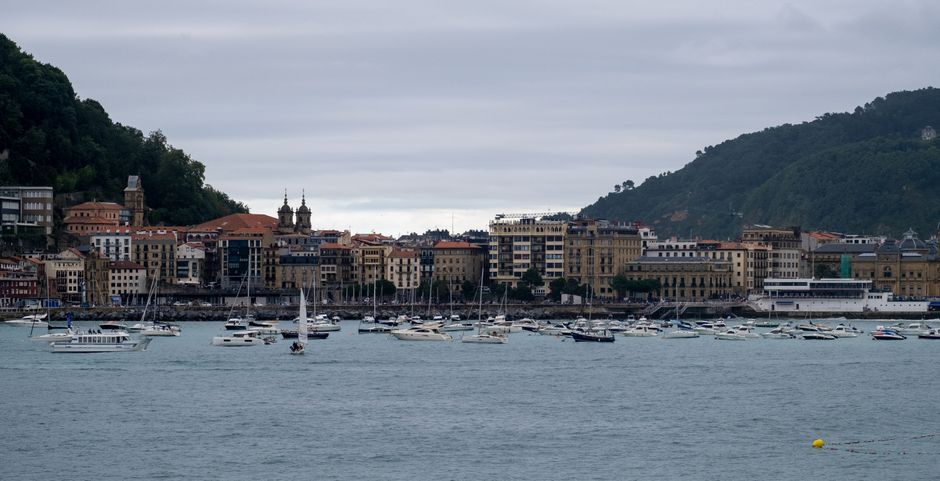
San Sebastián (Donostia in Basque) is a small seaside city on Spain’s Basque coast, wrapped around the shell-shaped bay of La Concha between two green hills. You come to swim and surf right in town, hop between pintxo bars in the Old Town, ride an old funicular up Monte Igueldo for the view, and eat superbly at every price level. It is flat along the water, easy to walk and close to France. Give it three days, or five with trips along the coast.
Right now in San Sebastián
- Wed 17–21°C 63–69°F 35 mm Heavy rain
- Thu 15–17°C 60–63°F 15 mm Showers
- Fri 12–17°C 53–63°F Clear
- Mon 12 Oct National Day of Spain (Fiesta Nacional de España)
Weather: MET Norway (CC BY 4.0) · Sea temperature: NOAA CoastWatch · Air quality: OpenAQ · Rates: ECB · Holidays: Nager.Date
Top tours in San Sebastián
See all tours for San Sebastián →
From local operators, with prices and reviews; you check availability and book on Viator, our partner. We may earn a commission at no extra cost to you. How we earn money
San Sebastián at a glance
- Best for: pintxos, city beaches, surfing, coastal walks, cider houses, fishing villages and France next door.
- How long: 3 days for the city, 5 with Pasaia, Getaria and Bilbao, a week to add the French Basque coast.
- Best time: June and September for beach weather with fewer crowds; mid-January to April for cider house season.
- Getting in: the small local airport, Bilbao airport with an hourly direct coach, or by train from Madrid or via Hendaye in France.
- Tourist tax: none as of October 2026; a city tax is due to start on 1 January 2027.
- Before you go: entry rules, money and general safety are on our Spain travel guide.
San Sebastián’s neighbourhoods
Monte Urgull and the Old Town close the eastern end of the bay, Monte Igueldo the western end, and the Urumea river separates the centre from Gros. Signs are in Basque and Spanish, so most places have two names.
Parte Vieja (Old Town)
A tight grid of narrow streets between the port and the foot of Urgull, and the heart of pintxo culture, with a bar in almost every doorway. Santa María basilica, the arcaded Plaza de la Constitución and San Telmo museum are here. Best for food lovers and short stays; expect noise until late.
Centro / Área Romántica
The elegant 19th-century grid between the Old Town and the Buen Pastor cathedral, with the main shops, San Martín market and the promenade above La Concha. Flat, central and calmer at night: the easiest base for a first visit.
Gros
Across the river around the Kursaal and Zurriola beach: younger and more relaxed, with surf shops and a pintxo scene used mostly by locals. Ideal for surfers, and close to the railway station.
Antiguo and Ondarreta
The western end of the bay, below Miramar Palace and Monte Igueldo, with calm Ondarreta beach, the Peine del Viento and neighbourhood bars. Quieter and greener, about half an hour’s walk along the bay to the Old Town.
Amara
A residential district south of the centre with the Anoeta stadium, where Real Sociedad plays, and Euskotren’s Amara station. Hotels are often cheaper, and it is handy if you arrive by train from France.
Igeldo
The rural area on and behind Monte Igueldo: farms, country roads, sea views, a few hotels and a campsite. For drivers who want quiet nights more than nightlife.
Top things to see in San Sebastián
Prices and hours below were checked on the official sites in October 2026. They change, so check before you go.
La Concha
One of Europe’s best-loved city beaches: a long curve of pale sand sheltered by Santa Clara island, so the water is usually calm. The white railings of the promenade are the city’s symbol. Walk the whole bay at sunset and swim out to the floating platforms in summer.
Ondarreta and the Peine del Viento
Ondarreta is the smaller, family-friendly beach at the western end. At the end of its promenade, Eduardo Chillida’s iron sculptures, the Peine del Viento (Comb of the Wind), grip the rocks, and on rough days waves blast up through holes in the paving. Free, open at all hours.
Zurriola
The open-ocean beach in Gros, facing the Atlantic swell, is the surf beach and the liveliest sand in town, backed by Rafael Moneo’s glass Kursaal cubes. Swimmers share it with surfers, so stay in the flagged bathing area.
Monte Igueldo funicular
The classic view of the bay. A wooden funicular climbs from the end of Ondarreta to an old-fashioned hilltop amusement park dating from 1912, with a small roller coaster along the cliff edge. As of October 2026 a return ticket is €5.50 for adults and €2.50 for children up to 7, including entry to the park; a single is €4. Walking or driving up, entry is €3 per person, and rides are paid separately. Hours vary by date; check the official site.
Monte Urgull
The wooded hill behind the Old Town was the city’s fortress. Free paths climb past old gun batteries and the English Cemetery to the Castillo de la Mota and its large statue of Christ, with views over the bay and the open sea. The castle holds a small history exhibition run by San Telmo, with seasonal hours.
San Telmo Museoa
The museum of Basque society fills a 16th-century convent with a modern extension; its cloister and the church with José María Sert’s huge murals are highlights. As of October 2026 it opens Tuesday to Sunday, 10:00–20:00 from April to October and 10:00–19:00 from November to March. Tickets are €10 (reduced €4), and entry is free for everyone on Tuesdays and for under-25s.
Basilica of Santa María del Coro
The baroque facade closes the end of Calle Mayor, lined up with the Buen Pastor cathedral at the other end of the city. Inside is the Virgin of the Choir, the city’s patron. The Basque tourism board lists visiting hours of 10:30–13:00 and 16:00–19:00 daily.
Miramar Palace
The English-style royal summer palace, opened in 1893, sits between La Concha and Ondarreta. Its lawns are a free public park with one of the best views of the bay, open 8:00–19:30 in winter and 8:00–21:00 in summer (as of October 2026).
Tabakalera
A vast former tobacco factory by the station, now a centre for contemporary culture with exhibitions, a cinema, cafés and a rooftop terrace looking over the city. Free to wander and a good rainy-day stop.
Aquarium
At the end of the fishing port, with a maritime museum and a walk-through tunnel under an ocean tank of sharks and rays. As of October 2026 it opens 10:00–20:00 daily in July, August and Easter week; otherwise 10:00–19:00 on weekdays and 10:00–20:00 at weekends, closed Mondays from October to March (except long weekends) and on 1 and 20 January and 25 December. A ticket on the official online shop is €16.
Peaks and mountains
- Mount Ulia
- Urdaburu
- Urgull
Beaches
- La Concha Beach
- Ondarreta Beach
Parks and gardens
- Park of Nurseries of Ulia
Other sights
- Igeldo Lighthouse
Pintxos: how San Sebastián eats
Pintxos are the Basque take on tapas: small bites, often on bread and pierced with a stick. Going out for pintxos is how locals meet before lunch and dinner, and how you will eat best for the least money. The local rule, repeated by the city’s tourism office: visit several bars and have one or two pintxos in each.
Counter pintxos and hot pintxos
Cold pintxos line the counter: in some bars you take a plate and help yourself, in others you point and staff serve you, so watch the locals or ask. Hot pintxos are cooked to order from a blackboard behind the bar. They are often each bar’s speciality, so order them first; the kitchen takes a few minutes.
Bar etiquette and paying
- Stand and squeeze in. Pintxos are eaten standing. Order, then step back so others can reach the counter.
- Pay when you leave. Tell the staff what you had, pintxos and drinks, and pay then. It works on trust, so keep count.
- Prices are per piece, shown on labels or the blackboard; hot pintxos cost more. If nothing is shown, ask first.
- Keep moving. This is the txikiteo: the custom of going from bar to bar for a small glass (txikito) of wine and a bite in each.
- Timing: bars fill from about 13:00 and again from about 20:00. Many close one day a week.
What to eat and drink
Start with a gilda, the city’s classic: an anchovy, a pickled guindilla pepper and an olive on a stick, salty and sharp. Then look for Cantabrian anchovies, salt cod, txangurro (spider crab), txipirones (baby squid), grilled mushrooms, croquetas, tortilla and Idiazabal sheep’s cheese. To drink, order txakoli, the young, lightly sparkling white wine of the Basque coast, poured from a height; a zurito is a small beer. The Old Town has the classic bars, Gros a more local scene, and the official tourism site has a guide by neighbourhood.
Cider houses and txotx season
From mid-January to late April, locals head to the cider houses (sagardotegiak) for txotx season. When someone shouts “Txotx!”, a barrel tap is opened and everyone queues with a glass to catch the new cider. The traditional set meal is salt cod omelette, cod with peppers, a big grilled T-bone steak, then cheese with quince and walnuts, at long shared tables. Most cider houses are just south of the city in Astigarraga, Hernani, Urnieta and Usurbil, and some open all year. Book at weekends in season, and don’t drive afterwards.
Michelin dining, honestly
The area has one of the world’s highest densities of Michelin stars. The city’s tourism office lists three three-star restaurants: Arzak, Akelarre on Monte Igueldo, and Martín Berasategui in nearby Lasarte-Oria, plus several with one or two stars. A tasting menu there is a long, expensive event booked weeks or months ahead. You do not need one to eat brilliantly here. Stars change yearly, so check the current Michelin Guide.
Surfing, walks and the water
Surf at Zurriola
Zurriola is a sandy beach break in the middle of town, with surf schools in Gros renting boards and wetsuits and running classes all year. Summer usually brings small waves for beginners; autumn to spring brings bigger swell for experienced surfers and cold water, so a full wetsuit is needed much of the year. In summer, swimmers have priority in the bathing zone. More spots are in our surfing guide.
Walk over Monte Ulía to Pasaia
The best walk from the city climbs from the end of Zurriola over Monte Ulía along the cliffs to Pasai San Pedro. It is a stage of the GR 121 coastal path and part of the Camino del Norte to Santiago, so you will meet pilgrims. Gipuzkoa’s provincial council lists the Pasai San Pedro–Donostia stage as 10.8 km and about 3 hours 25 minutes, with some 330 m of climbing, and rates it difficult for its rough, steep sections. Wear proper shoes and skip it in heavy rain. From San Pedro, a small boat crosses to Pasai Donibane for lunch. See our hiking page for more walks.
Paddle, swim and watch the regattas
On calm summer days, La Concha is ideal for paddleboarding and kayaking, with rentals on the beach and in the port, and small boats cross to Santa Clara island for a swim and picnic. In September the bay hosts the La Concha rowing regatta, when the whole seafront cheers on the traditional trainera crews.
Activities and best months
- Beaches and swimmingThree city beaches, La Concha, Ondarreta and Zurriola, with full services; busiest in summer but used all year. · source
- Boat tripsThe official tourist office sells boat trips across the bay to Santa Clara island and boat tours along the Zumaia flysch cliffs. · source
- SurfingZurriola beach in the Gros district is the city's surf beach ('waves, surf and youngsters'); the official tourist office also sells surf days. · source
Day trips from San Sebastián
Hondarribia
On the French border, with a walled hilltop old town of stone palaces, the castle of Carlos V and the colourful fishermen’s quarter of La Marina, full of pintxo bars. A small boat crosses the bay to Hendaye. Lurraldebus buses link it with San Sebastián.
Pasaia
Just east of the city, a deep, fjord-like harbour hides Pasai Donibane, a one-street fishing village that Victor Hugo wrote about with admiration. Cross by boat from Pasai San Pedro, eat on the waterfront and visit Albaola, a boatyard building a replica 16th-century Basque whaling ship.
Getaria and Zarautz
West along the coast, Zarautz has a long surf beach, and a seaside path leads to Getaria, known for grilled fish and txakoli. Vineyards climb the hills above the sea, and family wineries offer tours and tastings, best booked ahead. Lurraldebus buses serve both towns. See our wine tasting guide.
Bilbao and the Guggenheim
An easy day out by coach. Frank Gehry’s Guggenheim is the draw, but Bilbao’s old town and riverside deserve an afternoon. As of October 2026 the museum opens Tuesday to Sunday, 10:00–19:00 (longer in summer), and adult tickets are €18, €9 for students and over-65s, free for under-18s.
Saint-Jean-de-Luz and Biarritz
The French Basque coast starts just past Hendaye. Saint-Jean-de-Luz is a pretty port with a sheltered beach; Biarritz is the grand old surf resort. Take Euskotren to Hendaye, then a French regional train. There are no routine border checks, but carry your ID.
Nearby destinations
- Biarritz39 km
- Bilbao78 km
- Lourdes159 km
- Arcachon Bay167 km
- Bordeaux202 km
- Zaragoza206 km
- Picos de Europa232 km
- Toulouse278 km
Getting to San Sebastián
San Sebastián airport (EAS). The small local airport is in Hondarribia, east of the city, mostly with domestic flights. Lurraldebus buses link it with Hondarribia, Irun, Pasaia and San Sebastián; fares depend on the zones crossed.
Bilbao airport (BIO). The region’s main airport. As of October 2026, Lurraldebus line DO04 runs direct to San Sebastián about every hour from 7:45 to 22:45 (from 6:45 at weekends) plus one at midnight, and back from 5:00 to 21:00, with an extra 4:15 departure. Bizkaibus line A3247 runs into Bilbao every 15 minutes.
Biarritz airport (BIQ). Across the border in France, with low-cost flights; take a taxi or transfer, or go via Hendaye and Euskotren.
By train. Renfe trains arrive at San Sebastián-Donostia station, next to the bus station. The new Basque high-speed network (the “Basque Y”) is still under construction as of October 2026, so trains from Madrid take roughly five to six hours, and from Barcelona longer. From France, trains end at Hendaye, where Euskotren’s E2 line (the “Topo”) starts. On the winter 2026 timetable it runs every 15 minutes on weekdays and every 30 minutes at weekends, reaching Amara in about 40 minutes.
Getting around San Sebastián
- Walking: compact and flat along the bay; the Old Town to Ondarreta takes about half an hour.
- Dbus city buses: as of October 2026 a single ticket is €1.95, in cash or by contactless bank card, and a night ticket €2.65. QR tickets bought online give unlimited travel for 24 hours (€6.40) or 48 hours (€10.60).
- dBizi bike share: stations across town and bike lanes along the river and bay. A 30-day occasional pass is €6, then €0.45 for the first 30 minutes on a standard bike or €0.95 on an e-bike (as of October 2026).
- Driving: not needed in town, where parking is scarce. A car helps for cider houses and wineries, with a designated driver.
When to go and how long to stay
The climate is mild, green and wet: rarely hot, rarely cold, with rain possible in any month. The table uses AEMET’s 1991–2020 normals for the Igeldo observatory on Monte Igueldo (250 m above sea level): average daily highs and lows and days with at least 1 mm of rain.
| Season | Average high / low | Rainy days per month | What it’s like |
|---|---|---|---|
| Spring (Mar–May) | 14–18 °C / 8–11 °C | 12–13 | Fresh and green with showers; cider season until April |
| Summer (Jun–Aug) | 20–23 °C / 14–17 °C | 10–11 | Warm, rarely hot; beach season, Jazzaldia, Semana Grande; busiest |
| Autumn (Sep–Nov) | 21 °C falling to 14 °C / 15 °C falling to 9 °C | 11 in Sep–Oct, 14 in Nov | Lovely September and the film festival; rain builds; best surf |
| Winter (Dec–Feb) | 11–12 °C / 6–7 °C | 12–14 | Cool and wet, quiet and cheaper; Tamborrada; txotx from mid-January |
Igeldo records about 1,570 mm of rain a year, and November is the wettest month (about 200 mm). Even in July and August about one day in three brings some rain, so keep a museum or pintxo crawl up your sleeve.
- Tamborrada (20 January): on San Sebastián Day the city drums for 24 hours from midnight, with costumed companies marching through the streets. Free.
- Jazzaldia (July): concerts at the Kursaal and theatres plus free shows on Zurriola beach. The 62nd edition runs from 21 to 25 July 2027.
- Semana Grande (August): always the week of 15 August (8–15 August in 2026), with the International Fireworks Competition over the bay and free concerts. 2027 dates were not yet published in October 2026.
- Film Festival (September): the 74th edition ran from 18 to 27 September 2026; the 75th is in September 2027, dates not yet announced. Hotels book up early.
San Sebastián in 3 days
Day 1: the Old Town, Santa María and La Bretxa market, a climb up Urgull and San Telmo, then pintxos. Day 2: walk La Concha to Ondarreta and the Peine del Viento, ride up Monte Igueldo, and spend the afternoon on the beach. Day 3: a surf lesson at Zurriola, pintxos in Gros, the Aquarium or Tabakalera, and sunset in the Miramar gardens.
San Sebastián in 5 days
Add the Ulía walk to Pasaia with lunch in Pasai Donibane, and a day in Zarautz and Getaria with a txakoli tasting. In season, spend an evening at a cider house.
San Sebastián in a week
Add Bilbao and the Guggenheim, Hondarribia, and a day on the French coast at Saint-Jean-de-Luz and Biarritz.
Weather month by month
Averages from AEMET normals 1991–2020, San Sebastián, Igueldo · Last reviewed 4 Oct 2026
Where to stay in San Sebastián
- Parte Vieja: pintxo bars on your doorstep; lively and noisy at night.
- Centro: the best all-round base, flat and minutes from beach and Old Town.
- Gros: for surfers and a local feel, near the station.
- Antiguo / Ondarreta: calm and leafy, by the family beach and the funicular.
- Amara: often better value, handy for Euskotren.
- Igeldo: quiet and views, for drivers.
Rooms are pricey by Spanish standards and sell out in summer and during the film festival, so book early.
Costs, local rules and practical tips
Tourist tax from 2027. As of October 2026 there is none. Gipuzkoa’s Norma Foral 3/2026, passed in June 2026, lets towns tax tourist stays from 1 January 2027, and the city council has given its own tax initial approval for that date. As reported when the council approved its proposal, rates should range from €1.25 per person per night in agritourism stays to €6.50 in five-star hotels and tourist flats, for up to six nights, with under-18s exempt. Final rates depend on the ordinance’s definitive approval, so check with your accommodation for 2027 stays.
Costs. Hotels are the big expense; much of the best is free: the beaches, the promenade, Urgull, the Miramar gardens, the Peine del Viento and San Telmo on Tuesdays. Pintxos are priced one by one, so a night of bar-hopping costs what you choose to eat.
- Eat on local time: lunch from about 13:30, dinner from about 20:30.
- Book ahead: starred restaurants, weekend cider house tables in season, and summer accommodation.
- Mondays: San Telmo closes, and so does the Aquarium from October to March.
- Respect the sea: swim at lifeguarded beaches and follow the flags.
- Language: Basque and Spanish are both official; “kaixo” is hello and “eskerrik asko” thank you.
- Time zone: mainland Spain time (CET/CEST), the same as France.
What to pack for San Sebastián
Pack for changeable Atlantic weather in any season: a waterproof jacket, a warm layer for evenings and shoes for wet pavements and hill trails. In summer add swimwear, a towel, sunscreen and sunglasses. Surf schools provide wetsuits. Leave room for a tin of anchovies or a bottle of txakoli.
What to pack
- Day packs and anti-theft bagsCarries water, towel and sunscreen down the long stairways to Algarve coves.
- Dry bags and phone pouchesProtects phones and cameras from sand and spray on beaches reached by ferry or steep paths.
- Fleeces and warm layersIt is cooler at sea than on land, especially on morning whale-watching trips.
- Quick-dry beach towelsA sand-shedding quick-dry towel packs small for beach days and lido visits.
- Rain jacketsA windproof, waterproof shell keeps you warm on open boats, where wind and spray cool you quickly.
- Reef-friendly sunscreenSummer UV is strong on Portuguese beaches and there is little shade below the cliffs.
- Surf accessories (boots, leashes, wax)Neoprene boots keep feet warm in winter and protect them on rock and reef breaks.
- Water shoesRocky coves, lava pools and weever fish in shallow sand make water shoes useful.
- WetsuitsOn the west and north coasts the sea stays around 16–18 °C even in summer, so a thin suit helps for long swims.
San Sebastián travel FAQ
How many days do you need in San Sebastián?
Three days covers the beaches, Old Town, Urgull, Igueldo and plenty of pintxos. Five adds Pasaia and Getaria; a week adds Bilbao and the French coast.
What is the best time to visit San Sebastián?
June and September, with average highs of about 20–21 °C and fewer crowds than July and August. Mid-January to April is cider season; late September brings the film festival. Rain is possible all year.
How do pintxo bars work?
Cold pintxos sit on the counter; hot ones are cooked to order from the blackboard. Order a drink and one or two pintxos, tell the staff what you had when you leave, pay, and move on.
Is there a tourist tax in San Sebastián?
Not as of October 2026. A tax is due from 1 January 2027, with proposed rates of €1.25 to €6.50 per person per night by type of accommodation, for up to six nights, and under-18s exempt.
How do I get from Bilbao airport to San Sebastián?
Take Lurraldebus line DO04 from outside arrivals, roughly hourly from 7:45 to 22:45 (6:45 at weekends) plus one at midnight, as of October 2026.
Can you swim at La Concha?
Yes. La Concha and Ondarreta are sheltered and usually calm, with lifeguards in season. Zurriola has surf, so swim in the marked area. The Atlantic stays cool even in August.
Is San Sebastián good for learning to surf?
Yes. Zurriola is a sandy beach break with surf schools open all year. Summer waves suit beginners best.
How much is the Monte Igueldo funicular?
As of October 2026, €5.50 return for adults and €2.50 for children up to 7, including park entry. Rides cost extra.
When is cider house season?
From about mid-January to late April, mostly in Astigarraga, Hernani, Urnieta and Usurbil. Some cider houses serve meals all year.
When is the San Sebastián Film Festival?
Every September. The 74th edition ran from 18 to 27 September 2026; the 75th, in September 2027, had no dates yet in October 2026.
Can I visit France from San Sebastián?
Easily. Euskotren’s E2 reaches Hendaye in about 40 minutes, with French trains on to Saint-Jean-de-Luz and Biarritz. If San Sebastián whets your appetite for Atlantic food cities, Porto pairs well on a longer trip.
Sources
- © OpenStreetMap contributors · ODbL · fetched 3 Oct 2026
- Wikidata · CC0 · fetched 3 Oct 2026
Sources and last review
Researched and last reviewed on 3 October 2026. Climate: AEMET 1991–2020 normals for Donostia / San Sebastián, Igeldo; tourist tax: Gipuzkoa Provincial Council (Norma Foral 3/2026) and reports on the city council’s ordinance; transport: Dbus, dBizi, Euskotren, Lurraldebus, Bizkaibus and Aena; prices and hours: Monte Igueldo, San Telmo Museoa, the Aquarium, Guggenheim Bilbao, the city parks service and the Basque tourism board; walks: Gipuzkoa Natura; food, cider and events: San Sebastián Turismoa, Jazzaldia and the film festival. Prices, timetables and rules change, so check the official links before you travel. For entry rules, money and general safety, see our Spain travel guide.
Plan your trip
Partner links: TravelerCenter may earn a commission if you book, at no extra cost to you.
🇪🇸 Useful Spanish phrases for San Sebastián
All 38 Spanish phrases: restaurant, hotel, emergencies, romance (printable) →