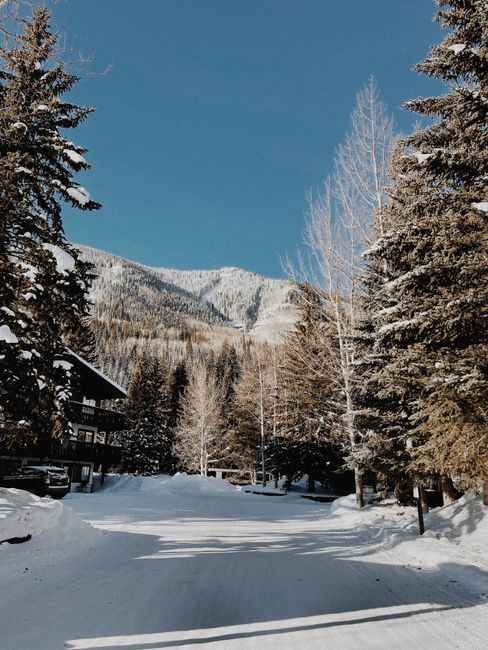
Vail is a purpose-built Alpine-style resort town in Colorado’s Gore Creek valley, about 100 miles (160 km) west of Denver on Interstate 70. It grew up around Vail Mountain, which opened in 1962 and is one of the largest single ski mountains in North America, famous for its long groomed runs on the front side and the wide-open Back Bowls and Blue Sky Basin behind. The town itself is a string of car-free pedestrian villages, Vail Village and Lionshead, with covered bridges, heated walkways, chalets, ski shops and restaurants, linked by a free bus. Winter is the main event, with the 2026/27 season due to open on November 13, 2026; summer brings hiking, mountain biking, gondola rides, alpine gardens and music festivals at 8,000 feet. Vail sits high, so take the altitude seriously, and expect mountain prices.
Right now in Vail
- Wed2–20°C36–67°F1 mm rain
- Thu2–18°C36–64°FClear
- Fri3–17°C37–63°F1 mm rain
- Mon 12 Oct Columbus Day · regional holiday in Colorado
Top tours in Vail
See all tours for Vail →
From local operators, with prices and reviews; you check availability and book on Viator, our partner. We may earn a commission at no extra cost to you. How we earn money
Vail at a glance
- Best for: skiing and snowboarding, the Back Bowls, a walkable car-free village, summer hiking and mountain biking, wildflowers and fall color.
- How long: a long weekend for a taste; 5 to 7 days for a proper ski week or a summer stay with day trips.
- Best time: January to March for snow; late December and Presidents’ Day weekend are the busiest. July and August for hiking and festivals; mid- to late September for golden aspens.
- Getting there: about 100 miles (160 km) on Interstate 70 from Denver, or fly into Eagle County Regional Airport, about 35 miles (56 km) west. Bustang buses from Denver Union Station stop in Vail.
- Getting around: on foot and on the free town buses; you don’t need a car once you’re in Vail.
- Before you go: entry rules, ESTA, money, tipping and driving are in our United States travel guide.
Skiing in Vail: the 2026/27 season
Vail Resorts, which owns and runs the mountain, has announced that Vail Mountain is scheduled to open on Friday, November 13, 2026, conditions permitting; nearby Beaver Creek is due to open on November 25. As of October 2026 the company had not published a closing date for 2026/27; in recent seasons Vail has usually closed in mid-April, so check before booking a spring trip. Early-season terrain is limited to a few runs on the front side served by snowmaking, and the Back Bowls and Blue Sky Basin open later, once natural snow allows, usually from December.
- The front side: long, groomed blue and black runs above Vail Village and Lionshead, reached by Gondola One from Vail Village and the Eagle Bahn Gondola from Lionshead. Beginners have gentle terrain at the top of the mountain and near Golden Peak.
- The Back Bowls: a series of huge, treeless south-facing bowls, from Sun Down to Siberia, that are Vail’s signature for powder days.
- Blue Sky Basin: a more remote area of gladed trees and natural terrain beyond the bowls, best for confident skiers.
- Ski school and rentals: group and private lessons for all ages start from the village bases; book early for holiday weeks.
Lift tickets and the Epic Pass
Vail is on the Epic Pass, Vail Resorts’ season pass. When the company announced its 2026/27 opening dates, the full adult Epic Pass cost $1,119, with that lowest fall price available until September 7, 2026; prices rise as the season approaches and pass sales normally end in early December. Restricted passes such as the Epic Local Pass and the Epic Day Pass are blacked out at Vail on the published peak dates for 2026/27: November 27–28 and December 26–31, 2026, and January 16 and February 13–14, 2027. Single-day lift tickets bought at the window are among the most expensive in the country and vary by date; buying an Epic Day Pass of 1 to 7 days online, before the season, is much cheaper. Prices change often, so check Vail’s and Epic’s official sites before you buy.
Vail’s villages and who each one suits
Vail Village
The original heart of Vail, built in the 1960s to look like a Tyrolean village, with cobbled lanes, clock tower, Gore Creek running through the middle and the Covered Bridge as its symbol. Gondola One lifts you straight up the mountain from the top of Bridge Street. It has the most famous hotels, the liveliest après-ski and the highest prices. Best for couples and anyone who wants to be in the middle of it all.
Lionshead
A short walk or bus ride west, Lionshead is a second, slightly newer pedestrian village built around the Eagle Bahn Gondola, with large condo hotels, an ice rink and family-friendly restaurants. It is usually a little calmer and better value than Vail Village and very convenient for families with ski school.
Golden Peak, Cascade Village and East and West Vail
Golden Peak, just east of Vail Village, is home to the ski and snowboard school, race training and a lift into the mountain. Cascade Village, west of Lionshead, has its own lift. East Vail and West Vail are mainly residential, with condos and rentals, a supermarket and a few restaurants; they are cheaper and quieter but depend on the free bus.
Top things to see and do in Vail
Ride the gondola in summer
From late spring to early fall, the gondolas carry hikers, bikers and sightseers up to Eagle’s Nest and Mid-Vail at about 10,000 feet (3,050 m), with wide views of the Gore Range and the Mount of the Holy Cross, trails for all levels, a mountain coaster and other activities, and restaurants. Summer operating dates, hours and prices vary by year, so check the resort’s site. Riding up and hiking down is an easy way to see the mountain without the steep climb.
Betty Ford Alpine Gardens
In Ford Park, an easy walk east of Vail Village, these gardens are among the highest botanical gardens in North America, with alpine plants, rock gardens, a waterfall and a small education center. They are at their best from June to August; entry is free, though donations are welcome.
Colorado Snowsports Museum
In the Vail Village parking structure, this museum tells the story of skiing in Colorado, from miners on wooden skis to Olympic champions, and of the 10th Mountain Division, the World War II ski troops who trained at nearby Camp Hale and later helped found the state’s ski industry.
Gore Creek and the village walks
The paved Gore Valley Trail follows the creek through town, linking East Vail, Vail Village, Lionshead and West Vail for walking and cycling. Gore Creek is also a trout stream, popular for fly fishing right in town in summer and fall with guides from local shops.
Other things to do in Vail
- Hiking: Booth Falls and Booth Lake in East Vail, Pitkin Lake and the trails on Vail Mountain are favorites; start early in summer, as afternoon thunderstorms are common. See our hiking guide.
- Cycling: the paved Vail Pass bike path climbs from East Vail toward Vail Pass and Frisco; mountain bikers ride the lift-served trails in summer. See our cycling guide.
- Winter beyond skiing: snowshoeing, cross-country skiing, ice skating in Lionshead and at Dobson Arena, sleigh rides and snowmobile tours.
- Music and festivals: summer brings classical music festivals, jazz and free concerts at the Gerald R. Ford Amphitheater in Ford Park; winter has après-ski concerts and end-of-season parties. Dates are announced each spring.
- Rafting: in late spring and summer, outfitters run trips on the Eagle and Colorado rivers within an hour’s drive.
Day trips from Vail
- Beaver Creek: a smaller, more upscale resort village about 10 miles (16 km) west near Avon, also on the Epic Pass.
- Minturn and Camp Hale: the old railroad town of Minturn is just south of Vail; beyond it, US 24 climbs over Tennessee Pass past Camp Hale, now a national monument honoring the 10th Mountain Division, to the mining town of Leadville.
- Breckenridge and Summit County: over Vail Pass, about 40 miles (64 km) east, with Frisco, Keystone and the historic main street of Breckenridge.
- Glenwood Springs: about 60 miles (97 km) west through Glenwood Canyon, known for its hot springs pools.
- Aspen: about 100 miles (160 km) away via Glenwood Springs, or shorter over Independence Pass in summer only; see our Aspen travel guide.
Nearby destinations
- Aspen63 km
- Rocky Mountain National Park98 km
- Denver119 km
- Arches National Park292 km
- Moab299 km
Getting there and getting around
By air
Eagle County Regional Airport (EGE), about 35 miles (56 km) west of Vail, has seasonal nonstop flights from several US hubs, more in winter. Denver International Airport (DEN) has far more flights and is about 120 miles (193 km) away, usually 2–2½ hours by car without snow or traffic; see our Denver travel guide. Shared-ride shuttles and private cars run from both airports to Vail hotels.
By bus from Denver
Colorado’s state-run Bustang West Line links Denver Union Station and the Federal Center light rail station with the Vail Transportation Center (241 South Frontage Road East, next to Vail Village) several times a day, continuing to Avon, Glenwood Springs and Grand Junction. As of October 2026 a one-way adult fare from Denver to Vail is $17, $8.50 for children aged 2–11 and $12.75 for seniors 65+ and riders with disabilities. From Denver International Airport, take the A Line train to Union Station first.
Driving I-70 and Vail Pass in winter
From Denver, Interstate 70 climbs through the Eisenhower Tunnel at over 11,000 feet and then over Vail Pass (10,662 ft, 3,250 m) before dropping into Vail. In winter storms the Colorado Department of Transportation (CDOT) enforces its Traction Law: every vehicle needs tires with at least 3/16-inch tread plus four- or all-wheel drive with mud-and-snow tires, winter tires with the mountain-snowflake symbol, all-weather tires, or chains or another approved traction device. Fines start at $100 plus a $33 surcharge, and rise to $500 plus $157 if your car blocks the road. In severe storms a chain law requires chains or an approved device on every vehicle, and the pass can close for hours. Most rental cars have all-season tires, so ask for an AWD or 4WD vehicle with suitable tires, and check COtrip.org before leaving. Weekend ski traffic between Denver and the mountains is heavy on Saturday mornings and Sunday afternoons.
Getting around Vail
The Town of Vail runs free buses all year, with a frequent in-town shuttle between Lionshead, Vail Village and Golden Peak and outlying routes to East and West Vail; ECO Transit buses (paid) run down the valley to Avon, Beaver Creek and Eagle. Vail Village and Lionshead are pedestrian-only. Drivers park in the town’s large public parking structures at Vail Village and Lionshead; rates vary by season and are higher in winter, so check the town’s parking page before you go.
When to go and how long to stay
At 8,150 feet (2,480 m) in the village, Vail has long, snowy winters, a short muddy spring, warm sunny summers with cool nights and afternoon storms, and a brief, beautiful fall. The table uses NOAA’s 1991–2020 climate normals for the Vail weather station in town: average daily highs and lows and days with at least 0.1 inch (2.5 mm) of rain or melted snow. The mountain is colder and snowier than the village.
| Season | Average high / low | Wet days per month | What it’s like | Good for |
|---|---|---|---|---|
| Winter (Dec–Feb) | 28–33 °F (−2 to 1 °C) / 7–9 °F (−14 to −13 °C) | 6–7 | Cold, sunny between storms; 28–36 in (70–90 cm) of snow a month in town | Skiing, snowshoeing, holidays in the village |
| Spring (Mar–May) | 42–60 °F (6–16 °C) / 17–31 °F (−8 to −1 °C) | 6–6.5 | Spring skiing in March and early April, then a quiet, muddy “shoulder” season | Sunny spring skiing, lower prices |
| Summer (Jun–Aug) | 71–77 °F (22–25 °C) / 36–42 °F (2–6 °C) | 4.5–6.5 | Warm days, chilly nights, frequent afternoon thunderstorms in July and August | Hiking, biking, gondola rides, festivals |
| Fall (Sep–Nov) | 67 °F falling to 38 °F (19 to 3 °C) / 34 °F falling to 15 °F (1 to −9 °C) | 5–6 | Golden aspens in September, first snow in October, quiet November until opening day | Leaf peeping, hiking, deals |
The Vail station records about 189 inches (480 cm) of snow and 22.4 inches (570 mm) of precipitation a year in town; the upper mountain gets considerably more.
Altitude
Vail Village is at about 8,150 feet (2,480 m) and the top of the mountain at more than 11,000 feet (3,350 m). Many visitors coming from sea level feel headaches, poor sleep or shortness of breath on the first day or two. Drink plenty of water, go easy on alcohol, take it slow on your first day, and consider a night in Denver on the way up. Seek medical help for severe headache, confusion or breathlessness at rest. The sun is strong at altitude, even in winter.
How long to stay: 3, 5 and 7 days
3 days (winter): one day on the front side to warm up, one in the Back Bowls and Blue Sky Basin if they’re open, and one at Beaver Creek or a mix of skiing and village time. 5 days: add a lesson or a guided day to find the best snow, and an afternoon off for skating or the Snowsports Museum. 7 days: a full ski week, with a day at Breckenridge or Keystone. Summer: 3–4 days for a gondola day, a hike to Booth Falls, the Vail Pass bike path and a drive to Leadville and Camp Hale or Glenwood Springs.
Where to stay in Vail and the lodging taxes
- Vail Village: the classic choice, luxury hotels and lodges steps from Gondola One and the après-ski bars.
- Lionshead: large condo hotels and family apartments next to the Eagle Bahn Gondola, usually slightly better value.
- East and West Vail: condos and rentals on the free bus routes, cheaper but less convenient.
- Avon, Edwards and Eagle: down the valley, with chain hotels and more affordable rentals, 10–30 miles (16–48 km) away by car or ECO Transit bus.
Book holiday weeks and February months ahead; many lodgings require minimum stays in peak season, and prices drop in the spring and fall shoulder seasons, when some hotels and restaurants close. Room rates are quoted before tax. According to the Colorado Department of Revenue, the sales tax rate in the Town of Vail is 9.4% as of the July–December 2026 rate table: 2.9% state, 1% Eagle County, 4.5% town, 0.5% mass transit and 0.5% rural transportation authority. On top of that, lodging in town pays the 1.4% Vail Local Marketing District lodging tax, according to the Town of Vail, for about 10.8% in total. Many hotels and condos also add nightly resort, parking or cleaning fees, so check the full price before you book.
Practical tips for Vail
- Buy passes early: Epic Day Passes bought before the season cost far less than window tickets.
- Avoid peak dates: restricted passes don’t work over Thanksgiving weekend, Christmas–New Year, Martin Luther King Jr. Day weekend and Presidents’ Day weekend.
- Safety on the mountain: stay within your ability, obey closures and slow zones, and never go beyond the ski area boundary without avalanche training and equipment; backcountry avalanche forecasts come from the Colorado Avalanche Information Center. In summer, get off high ground before afternoon lightning.
- Wildlife: keep your distance from moose, which are common around Vail and can be aggressive; black bears visit town in summer, so use bear-proof bins.
- Tipping: 18–22% at sit-down restaurants; ski instructors and valets are usually tipped too. More in our United States travel guide.
- Time zone: Colorado uses Mountain Time with daylight saving time. Emergencies: call 911; ski patrol handles accidents on the mountain.
What to pack for Vail
In winter, bring warm base layers, a fleece or down mid-layer, a waterproof ski jacket and pants, warm gloves or mittens, a neck gaiter, ski socks, goggles and a helmet (or rent one), plus boots with good grip for icy village streets. In summer, pack layers for cold mornings, a rain jacket for afternoon storms, hiking shoes, a sun hat and high-factor sunscreen. Year-round, bring lip balm with SPF, sunglasses, a refillable water bottle and moisturizer, as the air is very dry.
Vail travel FAQ
When does Vail open for the 2026/27 ski season?
Vail Resorts has scheduled Vail Mountain to open on Friday, November 13, 2026, conditions permitting. A closing date for 2026/27 had not been published as of October 2026; Vail usually closes in mid-April.
Is Vail on the Epic Pass or the Ikon Pass?
The Epic Pass. Vail is owned by Vail Resorts, and the Epic Pass, Epic Local Pass and Epic Day Pass are valid there, with blackout dates on restricted passes. The Ikon Pass is not valid at Vail.
What are the Epic Pass blackout dates at Vail for 2026/27?
Restricted passes are not valid at Vail on November 27–28 and December 26–31, 2026, and on January 16 and February 13–14, 2027. The full Epic Pass has no blackout dates.
How far is Vail from Denver airport?
About 120 miles (193 km), usually 2–2½ hours by car on Interstate 70 in good conditions and much longer in snowstorms or weekend traffic. Eagle County Regional Airport is only about 35 miles (56 km) away.
Can I get to Vail without a car?
Yes. Take airport shuttles from Denver or Eagle, or the Bustang bus from Denver Union Station ($17 one way for adults as of October 2026). In town, free buses link the villages, and you can walk to the lifts.
Do I need snow tires to drive to Vail?
When CDOT activates the Traction Law, you need 3/16-inch tread plus AWD or 4WD with mud-and-snow tires, winter or all-weather tires, or chains or an approved device. Fines start at $100 plus a $33 surcharge.
What is the hotel tax in Vail?
About 10.8%: the 9.4% combined sales tax in the Town of Vail (state, county, town and transit) plus the 1.4% Vail Local Marketing District lodging tax, as of October 2026. Resort and parking fees may be extra.
Will the altitude in Vail affect me?
It might. The village is at about 8,150 feet (2,480 m). Drink plenty of water, limit alcohol, take the first day gently, and see a doctor if symptoms are severe or get worse.
Is Vail worth visiting in summer?
Yes. The gondolas carry hikers and bikers up the mountain, the alpine gardens bloom and music festivals fill Ford Park, with warm days and cool nights. Start outdoor plans early, before afternoon thunderstorms.
Plan your trip
Partner links: TravelerCenter may earn a commission if you book, at no extra cost to you.
Sources · last reviewed 4 October 2026
Researched and last reviewed on 4 October 2026. Opening dates for Vail and Beaver Creek and Epic Pass prices: Vail Resorts’ August 2026 announcement; peak restricted dates: Epic Pass; sales tax rates: the Colorado Department of Revenue’s July–December 2026 rate table; the Vail lodging tax: the Town of Vail; Bustang fares and stops: the Colorado Department of Transportation’s Bustang service; Traction and chain laws: CDOT; climate: NOAA’s 1991–2020 normals for the Vail station. The closing date, summer gondola dates, parking rates, mountain statistics, driving times and some village details are general references flagged for checking. Prices and dates change, so check the official sites before you travel. For entry rules, tipping and driving, see our United States travel guide.
Data: Weather: MET Norway (CC BY 4.0) · Air quality: OpenAQ · Rates: ECB · Holidays: Nager.Date · Costs: World Bank ICP and price levels · Wikidata (CC0)