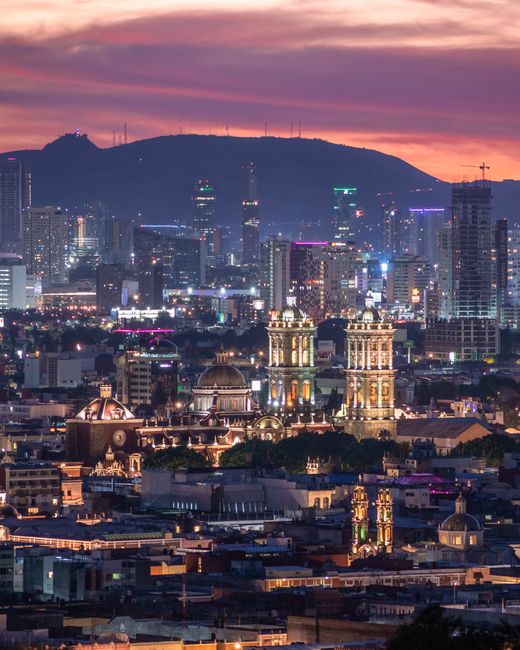
Puebla, capital of the state of the same name, is one of Mexico’s great colonial cities, about two hours east of Mexico City in a high valley watched over by the volcanoes Popocatépetl, Iztaccíhuatl and La Malinche. Founded by the Spanish in 1531, it has a historic center of more than a thousand listed buildings, many covered in red brick and painted talavera tiles, which UNESCO lists as a World Heritage Site. It is also the home of mole poblano and chiles en nogada, and next door lies Cholula, with the largest pyramid base in the world crowned by a golden church. Puebla is pleasant all year; the dry months from November to April have the clearest views of the volcanoes.
Right now in Heroica Puebla de Zaragoza
- Tue 14–21°C 56–69°F 19 mm Heavy rain
- Wed 13–20°C 55–69°F 19 mm Heavy rain
- Thu 13–20°C 55–67°F 24 mm Heavy rain
Weather: MET Norway (CC BY 4.0) · Rates: ECB
Top tours in Heroica Puebla de Zaragoza
See all tours for Heroica Puebla de Zaragoza →
From local operators, with prices and reviews; you check availability and book on Viator, our partner. We may earn a commission at no extra cost to you. How we earn money
Puebla at a glance
- Best for: baroque churches and colonial architecture, food, talavera pottery, museums, and the pyramid and churches of Cholula.
- How long: 2 days for the center and Cholula; 4–5 days to add Africam Safari, Atlixco, Tonantzintla and a volcano viewpoint.
- Best time: October to April, with dry, sunny days of 22–27 °C (72–81 °F) and cool nights; August and September for chiles en nogada. May to September brings afternoon storms.
- Getting there: about two hours by road from Mexico City; ADO buses run straight from Mexico City airport (AICM). Puebla also has its own airport (PBC).
- Getting around: walk the center; taxis, ride-hailing apps and local buses to Cholula and the suburbs.
- Before you go: entry rules, money and general safety are in our Mexico travel guide; to combine Puebla with the capital, see our Mexico City guide, and for another food city, our Oaxaca guide.
Puebla’s areas: where things are
The historic center is laid out in a neat grid around the zócalo, and most sights are within a 15-minute walk. Cholula, really two towns, San Pedro and San Andrés, lies about 10 km (6 miles) west, and the modern Angelópolis district, with malls and the Museo Internacional del Barroco, is to the south-west.
The historic center
Around the zócalo, arcaded buildings face the cathedral, and the streets around it are lined with churches, mansions with tiled facades, museums and restaurants. This is where to stay and spend most of your time.
Barrio del Artista and Los Sapos
North-east of the zócalo, the Barrio del Artista is a small square of artists’ studios, and the Callejón de los Sapos and Plazuela de los Sapos have antique shops, cafés and a weekend flea market. Nearby, the Calle de los Dulces (6 Oriente) is lined with shops selling camotes and other traditional sweets.
Los Fuertes
On a hill north-east of the center, the forts of Loreto and Guadalupe mark the site of the Battle of Puebla on May 5, 1862, when Mexican troops defeated a French army, the origin of Cinco de Mayo. Today the area has museums, gardens and viewpoints.
Cholula
Cholula is a separate town with its own lively main square, bars popular with students, and, it is said, a church for every day of the year. Its Great Pyramid is the reason most visitors come.
Top things to see in Puebla
Prices and hours below were checked on the official sites in October 2026, unless we say otherwise; check again before you go.
The cathedral and the zócalo
Puebla’s cathedral, built from the mid-16th to the mid-17th century, has the tallest bell towers of any colonial cathedral in Mexico and an interior full of onyx, gold leaf and carved wood. Entry is free outside services. The zócalo in front, shaded by trees, is the city’s living room.
Capilla del Rosario (Templo de Santo Domingo)
Inside the church of Santo Domingo, three blocks north of the zócalo, the Rosary Chapel, completed in 1690, is one of the masterpieces of Mexican baroque: every surface of its dome and walls is covered in gilded plaster, angels and saints. Visit outside Mass, and be respectful of worshippers.
Biblioteca Palafoxiana
Founded in 1646 by Bishop Juan de Palafox, this library, on the upper floor of the Casa de la Cultura beside the cathedral, is often described as the first public library in the Americas. Its long hall of carved wooden shelves holds tens of thousands of old books and is part of UNESCO’s Memory of the World register. A small entry fee is charged.
Museo Amparo
One of Mexico’s best museums, set in two colonial buildings, with a superb collection of pre-Hispanic art, colonial painting and contemporary exhibitions, plus a rooftop café with views of the cathedral. According to the museum, it opens Wednesday to Monday, 10 a.m. to 6 p.m. (closed Tuesday); general admission costs MXN 85 (about US$4.70), and entry is free on Sundays and public holidays, for Puebla residents, students and teachers, children under 13 and seniors over 65.
Talavera and the Great Pyramid of Cholula
Talavera, tin-glazed pottery painted mostly in blue and white, has been made in Puebla since the 16th century, and UNESCO lists the craft, shared with Talavera de la Reina and El Puente del Arzobispo in Spain, as intangible cultural heritage. Several workshops in the center, such as Uriarte, offer tours. In Cholula, the Great Pyramid (Tlachihualtépetl) is an enormous, partly excavated platform now covered by a hill with the church of Nuestra Señora de los Remedios on top. According to the National Institute of Anthropology and History (INAH), the archaeological zone opens Wednesday to Sunday, 9 a.m. to 5 p.m.; entry costs MXN 210 (about US$11.50), or MXN 105 for Mexicans and foreign residents, as of 2026, and includes the site museum. The tunnels inside the pyramid are closed to the public. The climb to the church is free and gives views of Popocatépetl on clear mornings.
More to see
- Museo Internacional del Barroco: a striking white building by Japanese architect Toyo Ito, in the Angelópolis area, devoted to the baroque in art, music and architecture.
- Templo de San Francisco: a church with a tiled facade and the mummified body of the Blessed Sebastián de Aparicio.
- Casa del Alfeñique: an 18th-century mansion with an ornate white plasterwork facade, now a museum.
- Estrella de Puebla: a big observation wheel in the Angelópolis area with views of the city and volcanoes.
Museums
- Amparo Museum
- Biblioteca Palafoxiana
Churches and cathedrals
- Puebla Cathedral
Protected areas
- Historic Centre of Puebla
Archaeological sites
- Great Pyramid of Cholula
Activities and best months
- City sightseeingINAH's Cholula archaeological zone (the great pyramid) next to Puebla is open Wednesday to Sunday 9:00-17:00, MXN 210 for foreigners, with a site museum; the tunnels are closed to the public. · source
Other things to do in Puebla
Food: mole, chiles en nogada and street snacks
Puebla is one of Mexico’s food capitals. Mole poblano, a dark, rich sauce of chilies, spices, nuts and chocolate, is served with turkey or chicken all year. In August and September, restaurants serve chiles en nogada: poblano chilies stuffed with meat and fruit, covered in walnut sauce and pomegranate seeds, in the green, white and red of the flag. Try cemitas (big sesame sandwiches), chalupas, molotes and tacos árabes, a local cousin of al pastor, and look for camote and other sweets on the Calle de los Dulces.
Walking, museums and markets
The center rewards slow walking: look up at tiled domes and facades, and step into courtyards. The Mercado de Sabores is good for regional food, and the Mercado El Parián has crafts. See our city sightseeing guide.
Day trips from Puebla
- Tonantzintla and Acatepec: two village churches near Cholula; Santa María Tonantzintla’s interior is a riot of colored plaster faces, fruit and angels, and San Francisco Acatepec’s facade is covered in talavera.
- Africam Safari: a large drive-through wildlife park about 30 minutes south of the city, popular with families.
- Atlixco: a Pueblo Mágico of flower nurseries at the foot of Popocatépetl, about 40 minutes south-west, known for its giant flower carpet in November.
- Cantona: a vast pre-Hispanic city of stone streets and ball courts in the east of the state, about two hours away.
- Mexico City: about two hours by bus or car; see our Mexico City guide.
Nearby destinations
- Mexico City102 km
- Oaxaca de Juárez272 km
Getting there and getting around
By bus from Mexico City and its airport
Most visitors arrive by bus. According to ADO, buses run from Mexico City airport (AICM) Terminals 1 and 2 to Puebla up to 30 times a day, taking about 2 hours 50 minutes and costing about MXN 462 (about US$25) one way; buses arrive at Puebla’s main bus station (CAPU) or other stops shown when you book. Buses also leave frequently from Mexico City’s eastern bus station (TAPO). By car, the Mexico–Puebla toll road takes about two hours outside rush hour.
By air
Puebla International Airport (PBC), Hermanos Serdán, about 30 km (19 miles) north-west of the city, has a small number of domestic flights and some to the United States; check current routes. Ash from Popocatépetl occasionally closes it and Mexico City’s airports for a few hours.
Getting around Puebla
The center is compact and best on foot. Taxis and ride-hailing apps are cheap for longer trips; to Cholula, a taxi takes about 20–30 minutes, and local buses also run there. For Africam, Atlixco and Cantona, use a car or a tour.
When to go and how long to stay
Puebla has a mild highland climate, with sunny, dry winters and a rainy season from May to September. The table uses the National Meteorological Service’s (SMN-Conagua) 1991–2020 climate normals for the Puebla observatory, at 2,179 meters (7,149 feet): average daily highs and lows, and days with rain.
| Season | Average high / low | Rainy days per month | What it’s like | Good for |
|---|---|---|---|---|
| Winter (Dec–Feb) | 22–24 °C (72–76 °F) / 6–7 °C (42–45 °F) | 1–2 | Dry and sunny, with cold nights; clearest volcano views | Sightseeing, Cholula sunrise views |
| Spring (Mar–May) | 26–28 °C (79–82 °F) / 9–12 °C (48–54 °F) | 4 in March, 13 in May | Warmest months; storms begin in May | Walking, day trips; Holy Week processions |
| Summer (Jun–Aug) | 25 °C (76–78 °F) / 12–13 °C (53–55 °F) | 16–17 | Green, with afternoon storms and fresh evenings | Museums, chiles en nogada from August |
| Fall (Sep–Nov) | 24 °C (74–75 °F) / 12 °C falling to 8 °C (54 to 46 °F) | 19 in September, 3 in November | Wet in September, then dry and clear | Chiles en nogada, Day of the Dead, Atlixco’s flowers |
The station records about 910 mm (36 in) of rain a year; June and September are the wettest months, with about 180 mm (7 in) each, mostly in late-afternoon storms.
Popocatépetl: this active volcano about 45 km (28 miles) west of the city often puffs steam and ash. According to Mexico’s disaster prevention center (CENAPRED), its volcanic alert level was yellow, phase 2 in its report of October 2, 2026, which means people must stay well away from the crater; the city itself is outside the restricted zone. Ash falls occasionally close Puebla’s airport for a few hours. Check CENAPRED’s daily report, and follow Puebla’s civil protection authorities if conditions change.
Earthquakes: central Mexico has frequent earthquakes, and Puebla was hit hard in September 2017. Learn your hotel’s evacuation route.
2 days in Puebla
Day one, the zócalo and cathedral, the Biblioteca Palafoxiana, the Capilla del Rosario, lunch of mole, the Museo Amparo and an evening on the Callejón de los Sapos. Day two, Cholula: the pyramid and its museum in the morning, the climb to the Remedios church, and Tonantzintla and Acatepec on the way back.
4 to 5 days in Puebla
Add a talavera workshop tour, the Fuertes de Loreto y Guadalupe, the Museo Internacional del Barroco, Africam Safari and a day in Atlixco. With five days, continue to Cantona or onward to Oaxaca.
Where to stay in Puebla and the hotel taxes
- The historic center: boutique hotels in colonial mansions and mid-range hotels near the zócalo; the best base.
- Los Sapos and Barrio del Artista: small hotels and guesthouses close to restaurants and nightlife.
- Cholula: small hotels near the pyramid and the main square, with views of the volcanoes; livelier with students at night.
- Angelópolis: modern chain hotels near malls and the Barroco museum, better for drivers.
Room rates are often quoted before tax. The State of Puebla charges a lodging tax reported at 3%, including stays booked through digital platforms since 2024 (we could not read the state’s current law, so we flag this for checking), and federal VAT (IVA) of 16% is added on top. VISITAX does not apply here; it is a Quintana Roo fee only.
Practical tips for Puebla
- Altitude: at over 2,100 meters (6,900 feet), you may tire more quickly at first; drink water and take it easy on day one.
- Cash: carry pesos for markets, street food, churches’ donation boxes and small museums.
- Churches: dress modestly, don’t use flash, and avoid visiting during Mass.
- Tipping: 10–15% in restaurants.
- Safety: the historic center and Cholula are busy with visitors and generally calm. Use ride-hailing apps or official taxis at night, keep phones and wallets out of sight in crowds and on buses, and travel between cities by day on toll roads.
- Emergencies: call 911.
What to pack for Puebla
Pack layers: T-shirts for sunny days, plus a warm sweater or jacket for evenings, which are cold from November to February. Bring comfortable walking shoes for cobbles and the climb up Cholula’s pyramid, a hat and sunscreen for the strong highland sun, a compact umbrella from May to September and modest clothing for churches. Leave room in your bag for talavera, well wrapped. Plugs are the US type.
What to pack
- City walking shoesLisbon and Porto are steep, with polished limestone cobbles that get slippery, so grippy soles matter.
- Day packs and anti-theft bagsA small zipped or anti-theft bag makes crowded trams and viewpoints less stressful.
- Rain jacketsFrom October to April Porto and Lisbon see rain on roughly a third of days.
- Travel adapters and convertersPortugal uses Type C and F sockets at 230 V, so most visitors from outside Europe need an adapter.
Puebla travel FAQ
How do I get from Mexico City airport to Puebla?
ADO buses leave from AICM Terminals 1 and 2 up to 30 times a day, take about 2 hours 50 minutes and cost about MXN 462 one way, according to ADO.
How much does it cost to visit the Cholula pyramid?
MXN 210 (about US$11.50) for foreign visitors and MXN 105 for Mexicans and residents, according to INAH as of 2026. The zone opens Wednesday to Sunday, 9 a.m. to 5 p.m.
Can you go inside the tunnels of the Great Pyramid of Cholula?
Not at the moment: INAH lists the tunnels as closed to the public. You can visit the open-air excavations, the site museum and the church on top.
Is Puebla worth visiting?
Yes. Its UNESCO-listed center, baroque churches, talavera, museums and food make it one of Mexico’s best city breaks, and it is easy to reach from Mexico City.
When is chiles en nogada season?
Mainly August and September, when the pomegranates and walnuts for the dish are in season, around Mexico’s Independence Day on September 16.
Is Popocatépetl dangerous for visitors to Puebla?
The city is outside the restricted zone. CENAPRED kept the volcano at yellow phase 2 in its October 2, 2026 report, which means no one may approach the crater. Ash can briefly close airports.
When is Museo Amparo free?
On Sundays and public holidays, and always for children under 13, seniors over 65, students, teachers and Puebla residents. Otherwise MXN 85; closed Tuesdays.
How many days do you need in Puebla?
Two days for the center and Cholula; four or five to add Atlixco, Africam Safari, Tonantzintla and more museums.
What taxes are added to Puebla hotel bills?
16% IVA plus the state lodging tax, reported at 3%. There is no VISITAX here.
What is the weather like in Puebla?
Mild and sunny most of the year, with highs of 22–28 °C (72–82 °F). Nights are cold in winter, and May to September brings afternoon storms.
Sources
- © OpenStreetMap contributors · ODbL · fetched 4 Oct 2026
- Wikidata · CC0 · fetched 4 Oct 2026
Sources and last review
Researched and last reviewed on 4 October 2026. Cholula’s hours, fees and tunnel closure: the National Institute of Anthropology and History (INAH); Museo Amparo: the museum’s official site; buses from Mexico City airport: ADO; Popocatépetl: Mexico’s disaster prevention center (CENAPRED); climate: SMN-Conagua 1991–2020 normals for the Puebla observatory. The lodging tax rate, the Palafoxiana’s details, UNESCO listings, distances, the airport’s routes and the local sights come from secondary sources or general knowledge and are flagged for checking. Prices and timetables change, so check the official sites before you go. For entry rules, money and general safety, see our Mexico travel guide.
Plan your trip
Partner links: TravelerCenter may earn a commission if you book, at no extra cost to you.
🇪🇸 Useful Spanish phrases for Heroica Puebla de Zaragoza
All 38 Spanish phrases: restaurant, hotel, emergencies, romance (printable) →