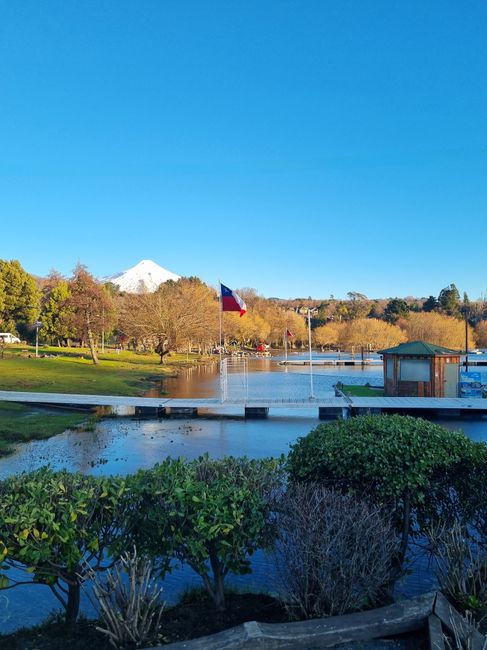
Puerto Varas is a small lakeside town in Chile’s Lake District, on the southern shore of Lake Llanquihue, one of the largest lakes in the country, with the snowy cone of Osorno volcano rising on the far side of the water. Founded by German settlers in the mid-19th century, it still has wooden houses with steep roofs, a landmark red church, cake shops serving kuchen and a strong sense of order and tidiness, along with a lively outdoor scene of tour agencies, cafés and lake-view restaurants. It’s the best base for the southern Lake District: the turquoise Petrohué waterfalls and Lake Todos los Santos in Vicente Pérez Rosales, Chile’s oldest national park; the lakeside towns of Frutillar and Llanquihue; rafting, kayaking, hiking and skiing on the volcanoes; Chiloé island; and the boat-and-bus crossing to Bariloche in Argentina. Expect green landscapes and rain at any time of year; the driest months are December to March.
Right now in Puerto Varas
- Wed9–17°C48–62°FPartly cloudy
- Thu8–18°C46–65°F1 mm rain
- Fri10–16°C50–62°F2 mm rain
- Mon 12 Oct Columbus Day (Día del Descubrimiento de Dos Mundos)
Top tours in Puerto Varas
See all tours for Puerto Varas →
From local operators, with prices and reviews; you check availability and book on Viator, our partner. We may earn a commission at no extra cost to you. How we earn money
Puerto Varas at a glance
- Best for: lake and volcano scenery, the Petrohué falls, hiking, kayaking and rafting, German-Chilean heritage and food, and a base for Chiloé and the crossing to Argentina.
- How long: 3 days for the town, the falls and Frutillar; 5–6 days to add Chiloé, a volcano hike or the lake crossing.
- Best time: December to March, with highs of 19–20 °C (66–68 °F) and the least rain; spring and fall are greener, quieter and wetter.
- Getting there: fly to Puerto Montt’s El Tepual airport (PMC), about 2 hours from Santiago, then 30–40 minutes by shuttle or car; long-distance buses from Santiago.
- Fees to know: as of October 2026, foreign adults pay CLP 8,200 (about US$8) to enter Vicente Pérez Rosales National Park at the Petrohué falls.
- Before you go: entry rules, money and general safety are in our Chile travel guide.
The town: where things are
Puerto Varas is small and walkable. The center is a grid of a few blocks between the lakeshore promenade (the Costanera) and the hills behind, with the main square, restaurants, cafés, outdoor shops and tour agencies. The red-roofed Sacred Heart Church (Iglesia del Sagrado Corazón), a wooden church built in the early 20th century and modeled on a church in the Black Forest, stands on a rise above the center. Many 19th- and early 20th-century German-style wooden houses survive in the streets around it, and a heritage walking route links them. Cerro Philippi, a short walk uphill, has a viewpoint over the lake and volcanoes. The town spreads east along the lake toward Ensenada, where many lodges and cabins sit on the shore.
Top things to see around Puerto Varas
Petrohué falls and Vicente Pérez Rosales National Park
About 60 km (37 miles) east of town, past Ensenada and the foot of Osorno volcano, the Petrohué River rushes through channels of black volcanic rock in a series of turquoise rapids and waterfalls, with the volcano behind. The falls are in Vicente Pérez Rosales, Chile’s oldest national park, run by CONAF. According to the official pass site, as of October 2026 entry costs:
| Visitor | Price |
|---|---|
| Foreign adult (also seniors and visitors with a disability) | CLP 8,200 (about US$8) |
| Foreign youth | CLP 4,500 (about US$5) |
| Chilean adult | CLP 3,900 |
| Children | Free |
The site opens daily from 9 a.m. to 6 p.m. from December to March (last entry 5:30 p.m.) and 9 a.m. to 5 p.m. from March to November, subject to weather; buy tickets online at Pases Parques. Short trails with viewing platforms lead along the falls in about an hour.
Lake Todos los Santos and Peulla
Just beyond the falls, the village of Petrohué sits on the shore of Lake Todos los Santos, an emerald-green lake surrounded by forested mountains and the peaks of Osorno, Puntiagudo and Tronador. Boats cross the lake to Peulla, a remote hamlet near the Argentine border, on day trips and as part of the lake crossing to Bariloche; short boat trips and kayak outings also leave from Petrohué.
Osorno volcano
The almost perfect snow-capped cone of Osorno, about 2,650 m (8,700 ft) high, dominates every view in the area. A road climbs its western flank to a mountain center with a chairlift and viewpoints in summer and a small ski area in winter; the summit is a technical glacier climb for experienced mountaineers with guides only. The Calbuco volcano, which erupted in 2015, rises to the south.
Frutillar
About 25 km (16 miles) north along the lake, Frutillar is one of the prettiest towns in Chile: a lakeside strip of German-style houses, cake shops and the modern Teatro del Lago concert hall, built out over the water, which hosts concerts year-round and the Semanas Musicales classical music festival in summer. The German Colonial Museum (Museo Colonial Alemán) recreates the life of the 19th-century settlers with a mill, a blacksmith’s shop and a farmhouse.
Llanquihue and the lakeshore
The small town of Llanquihue, between Puerto Varas and Frutillar, sits where the Maullín River leaves the lake. The road around Lake Llanquihue, about 180 km (112 miles) long, makes a scenic day’s drive or a challenging bike tour, passing Frutillar, Puerto Octay and Las Cascadas on the way to Ensenada.
More to see
- Puerto Montt: the regional capital, 20 km (12 miles) south, with the busy Angelmó fish market and craft stalls, and ferries south into the fjords of Patagonia.
- Alerce Andino National Park: forests of ancient alerce trees, some thousands of years old, south-east of Puerto Montt.
- Cochamó valley: a granite valley sometimes called the “Yosemite of Chile,” reached on foot or horseback for multi-day hikes and climbing; campsites must be booked ahead in the high season.
Other things to do in Puerto Varas
Rafting, kayaking and boat trips
The Petrohué River below the falls is one of the classic rafting rivers in southern Chile, with grade III–IV rapids and views of the volcano; trips run from Puerto Varas in the warmer months. Sea and lake kayaking tours explore Lake Llanquihue, Lake Todos los Santos and the Reloncaví fjord. See our guide to boat trips.
Hiking
Trails in Vicente Pérez Rosales lead through temperate rainforest to lakes, lava fields and lookouts, including routes on the slopes of Osorno and the Desolación pass. Longer hikes in Alerce Andino and the Cochamó valley need good boots and rain gear. See our guide to hiking.
Cycling
The lakeside road between Puerto Varas, Llanquihue and Frutillar has a bike path for much of the way, and bike rental is easy in town. See our guide to cycling.
Skiing
In winter, the Osorno volcano ski center offers small-scale skiing with lake views, usually from about July to September, depending on snow.
Food and drink
The Lake District’s food blends southern Chilean and German traditions. Try kuchen (fruit cakes and tarts, especially with murta or raspberries), strudel at afternoon tea (“once”), smoked salmon and trout, and from the coast and Chiloé, curanto (shellfish, meat, sausages and potatoes cooked in a pit or pot), cancato (salmon baked with cheese and sausage) and milcao (potato bread). Puerto Varas has excellent restaurants for its size, from lakefront grills to craft beer bars brewing southern ales, and local berries and cream appear in desserts all summer.
Day trips and onward journeys
- Chiloé: a ferry from Pargua crosses the Chacao Channel in about 30 minutes to Chiloé, an island of misty hills, fishing villages, stilt houses (palafitos) in Castro and 16 wooden churches on the UNESCO World Heritage List. Castro is about 3 hours from Puerto Varas; it’s best with a night or two.
- The lake crossing to Bariloche: a classic full-day journey by bus and boat across Lake Todos los Santos to Peulla, over the border, and across Argentine lakes to Bariloche; it can also be done in two days with a night in Peulla. See our San Carlos de Bariloche travel guide.
- By road to Argentina: buses cross the Cardenal Samoré pass from Osorno to Villa La Angostura and Bariloche, usually 6–7 hours from Puerto Varas; the pass can close in winter snow.
- Puerto Octay and Lake Llanquihue: a scenic circuit with German-era villages and lake views.
- Reloncaví fjord and Cochamó: the road south-east from Puerto Varas follows the Reloncaví estuary, with hot springs and boat trips.
Nearby destinations
- San Carlos de Bariloche142 km
Getting there and getting around
By air
Puerto Montt’s El Tepual airport (PMC), about 30–40 minutes from Puerto Varas, has frequent flights from Santiago, about 1 hour 45 minutes to 2 hours, plus flights to Punta Arenas, Balmaceda and other southern cities. Shuttles meet flights and drop you at your hotel in Puerto Varas; taxis and rental cars are also available.
By bus
Overnight buses from Santiago take about 12–14 hours to Puerto Varas or Puerto Montt; several companies offer “cama” seats. Local minibuses run frequently between Puerto Montt, Puerto Varas, Llanquihue and Frutillar, and to Ensenada and Petrohué in season.
Getting around
The town is walkable, and day tours cover the falls, Frutillar and Chiloé. Renting a car is the easiest way to explore the lake and the national park at your own pace; roads are paved to Petrohué, but gravel beyond. Watch for cyclists on the lake roads.
When to go and how long to stay
The Lake District has a temperate oceanic climate: mild summers, cool, rainy winters and green landscapes all year. The table uses the Meteorological Directorate’s 1991–2020 normals for Puerto Montt’s El Tepual airport, about 20 km (12 miles) south-west of Puerto Varas, as published by the World Meteorological Organization.
| Season | Average high / low | Rainy days per month | What it’s like |
|---|---|---|---|
| Summer (Dec–Feb) | 19–20 °C (65–68 °F) / 8–9 °C (47–49 °F) | 8–11 | The driest, sunniest time; long days; busiest season |
| Fall (Mar–May) | 18 °C falling to 13 °C (65 to 55 °F) / 8 °C falling to 6 °C (47 to 42 °F) | 12–16 | Golden forests and fewer people; rain increases |
| Winter (Jun–Aug) | 10–11 °C (50–52 °F) / 4 °C (38–40 °F) | 18–19 | Cold, wet and often cloudy; snow on the volcanoes and the ski season |
| Spring (Sep–Nov) | 13 °C rising to 17 °C (55 to 62 °F) / 4 °C rising to 7 °C (39 to 44 °F) | 13–15 | Fresh and green, with flowers and changeable weather |
El Tepual records about 1,566 mm (62 in) of rain a year, and rain falls in every month, so bring waterproof clothes whenever you visit. The lake water is cold, around 15–18 °C (59–64 °F) in summer.
Puerto Varas month by month
| Month | High / low | Rain | What to expect |
|---|---|---|---|
| January | 20 °C (68 °F) / 9 °C (49 °F) | 77 mm (3.0 in) | Driest and warmest; busiest month; Frutillar’s music festival |
| February | 20 °C (68 °F) / 9 °C (48 °F) | 69 mm (2.7 in) | Warm, long days; rafting and kayaking season |
| March | 18 °C (65 °F) / 8 °C (47 °F) | 99 mm (3.9 in) | Quieter; good weather often continues |
| April | 15 °C (59 °F) / 6 °C (44 °F) | 142 mm (5.6 in) | Fall colors; rain increases |
| May | 13 °C (55 °F) / 6 °C (42 °F) | 181 mm (7.1 in) | Wet and cool; low season |
| June | 10 °C (51 °F) / 4 °C (40 °F) | 213 mm (8.4 in) | Wettest month; short days |
| July | 10 °C (50 °F) / 4 °C (38 °F) | 177 mm (7.0 in) | Winter school holidays; skiing on Osorno |
| August | 11 °C (52 °F) / 4 °C (39 °F) | 175 mm (6.9 in) | Cold and rainy; snow on the volcanoes |
| September | 13 °C (55 °F) / 4 °C (39 °F) | 116 mm (4.5 in) | Spring; changeable weather |
| October | 14 °C (58 °F) / 5 °C (42 °F) | 121 mm (4.8 in) | Green and blooming; fewer crowds |
| November | 16 °C (62 °F) / 7 °C (44 °F) | 102 mm (4.0 in) | Longer days; good hiking weather |
| December | 18 °C (65 °F) / 8 °C (47 °F) | 93 mm (3.7 in) | Summer begins; busy from Christmas |
Crowds and prices: January and February are the peak, along with Easter and the July winter holidays; book hotels and the lake crossing ahead. October, November and March are good-value months. Puerto Varas uses mainland Chile time, UTC−4 in winter and UTC−3 in summer.
Three days in Puerto Varas
Day one, walk the town, the Costanera and the Sacred Heart Church, and climb Cerro Philippi for sunset. Day two, the Petrohué falls and a boat trip on Lake Todos los Santos, with a stop at the Osorno volcano viewpoint. Day three, cycle or drive to Llanquihue and Frutillar for the German Colonial Museum, kuchen and a concert at the Teatro del Lago.
Five or six days
Add a rafting or kayaking day, a hike in Vicente Pérez Rosales or Alerce Andino, and an overnight trip to Chiloé, or finish with the lake crossing to Bariloche.
Where to stay
- Central Puerto Varas: hotels, guesthouses and hostels within walking distance of restaurants, agencies and the lake; the best choice without a car.
- The lakeshore toward Ensenada: lodges, cabins and hotels with lake and volcano views, closer to the national park; a car is useful.
- Frutillar: quieter, charming lakeside guesthouses and boutique hotels.
- Puerto Montt: more practical than pretty, but handy for early flights and ferries.
Foreign tourists who pay for a hotel registered with Chile’s tax service in US dollars or with a card issued abroad don’t pay the 19% VAT (IVA) on the room; show your passport and entry record.
What a trip to Puerto Varas costs
These are our estimates for October 2026 at about CLP 985 per US dollar, except the park fee, which is official.
| Item | Typical price |
|---|---|
| Vicente Pérez Rosales park (Petrohué falls), foreign adult | CLP 8,200 (US$8), official |
| Airport shuttle El Tepual–Puerto Varas | CLP 8,000–15,000 (US$8–15) |
| Day tour to the falls and Lake Todos los Santos | CLP 40,000–70,000 (US$40–70) |
| Rafting on the Petrohué River, half day | CLP 45,000–70,000 (US$45–70) |
| Kuchen and coffee | CLP 5,000–8,000 (US$5–8) |
| Dinner for one with wine, mid-range | CLP 25,000–40,000 (US$25–40) |
| Hostel bed | CLP 18,000–30,000 (US$18–30) |
| Mid-range double room | CLP 80,000–150,000 (US$80–150) |
Practical tips for Puerto Varas
- Rain gear: it can rain on any day, even in summer; carry a waterproof jacket.
- Volcanoes: Osorno, Calbuco and other volcanoes in the region are monitored by Chile’s geology and mining service (SERNAGEOMIN); follow official alerts from SENAPRED and local authorities.
- Rivers and lakes: the water is cold and currents strong; raft and kayak only with licensed operators, wear the safety gear provided, and swim only at calm, supervised beaches.
- Driving: roads near the volcanoes can be icy in winter; carry chains if told to. Fill up before heading into the park.
- Safety: Puerto Varas is a relaxed town where serious crime against visitors is rare; take normal precautions with bags and don’t leave valuables in cars at trailheads.
- Emergencies: 133 for the police, 131 for an ambulance, 137 for emergencies on the water.
What to pack for Puerto Varas
A waterproof jacket and pants (see our guide to rain jackets), warm layers and a hat even in summer evenings, waterproof hiking boots (see hiking shoes), quick-dry clothes for rafting and kayaking, swimwear for warm summer days, sunscreen and sunglasses, insect repellent for the horseflies (tábanos) of January and February, and a type C/L plug adapter for Chile’s 220 V sockets.
Puerto Varas travel FAQ
How do I get to Puerto Varas?
Fly from Santiago to Puerto Montt’s El Tepual airport, about 1 hour 45 minutes to 2 hours, then take a 30- to 40-minute shuttle or taxi to Puerto Varas. Overnight buses from Santiago take about 12–14 hours.
How much does it cost to visit the Petrohué falls?
As of October 2026, foreign adults pay CLP 8,200 (about US$8) to enter Vicente Pérez Rosales National Park at the falls; buy online at Pases Parques.
What are the opening hours of the Petrohué falls?
According to the official pass site, 9 a.m. to 6 p.m. from December to March and 9 a.m. to 5 p.m. from March to November, subject to weather.
How many days do I need in Puerto Varas?
Three days for the town, the falls and Frutillar; five or six to add Chiloé, rafting, a volcano hike or the lake crossing to Bariloche.
When is the best time to visit Puerto Varas?
December to March, the driest and warmest months. It rains year-round, so bring waterproof clothes in any season.
Can I climb Osorno volcano?
The summit is a technical glacier climb, only with experienced mountain guides. Most visitors drive up to the ski center on its flank for views and short walks.
Can I travel from Puerto Varas to Bariloche by boat?
Yes. The lake crossing combines buses and boats across Lake Todos los Santos and Argentine lakes in a long day or two days. Buses also run via the Cardenal Samoré pass.
Is Chiloé a day trip from Puerto Varas?
It’s possible, as Castro is about 3 hours away including the 30-minute ferry, but one or two nights let you enjoy the island at a slower pace.
What is kuchen?
A German-style cake or fruit tart, often made with local berries, which became a southern Chilean tradition through the 19th-century German settlers.
Is Puerto Varas safe?
Yes, it’s a calm, small town. The main risks are natural: cold water, changeable weather and volcanic activity in the region.
Plan your trip
Partner links: TravelerCenter may earn a commission if you book, at no extra cost to you.
🇪🇸 Useful Spanish phrases for Puerto Varas
All 38 Spanish phrases: restaurant, hotel, emergencies, romance (printable) →
Sources · last reviewed 4 October 2026
Researched and last reviewed on 4 October 2026. Vicente Pérez Rosales fees, hours and the park’s status as Chile’s oldest: CONAF’s official pass site, Pases Parques; emergency numbers: chile.travel; exchange rate: the Central Bank of Chile; hotel VAT exemption: Decree-Law 825; climate: the Meteorological Directorate’s 1991–2020 normals for Puerto Montt’s El Tepual airport, as published by the World Meteorological Organization. Town history, the church, Lake Llanquihue, volcano heights and eruptions, Frutillar’s theater and festival, distances, the lake crossing, buses and flights, rafting grades, Chiloé’s ferry and churches, Cochamó, lake temperatures, food notes and typical costs come from general references and are flagged for checking; costs are our estimates. Fees and hours change, so check the official sites before you go. For entry rules and money, see our Chile travel guide.
Data: Weather: MET Norway (CC BY 4.0) · Air quality: OpenAQ · Rates: ECB · Holidays: Nager.Date · Costs: World Bank ICP and price levels · Wikidata (CC0)