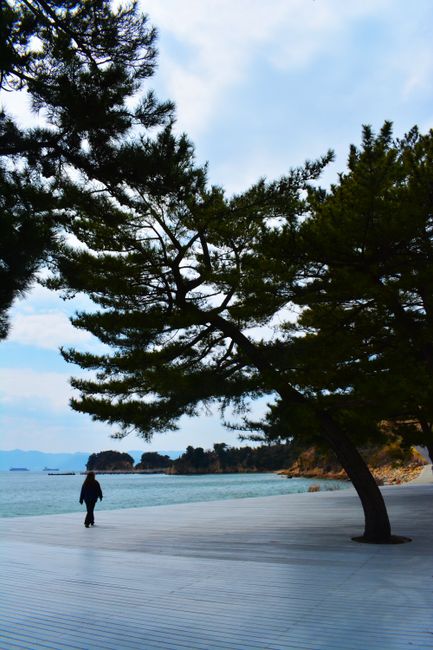
Naoshima is a small, hilly island of about 3,000 people in the Seto Inland Sea, between Okayama on Honshu and Takamatsu on Shikoku, that has become one of the world’s great destinations for contemporary art. Since the 1990s, the Benesse Art Site Naoshima project has filled its coast and its old fishing village with museums by the architect Tadao Ando, Yayoi Kusama’s polka-dot pumpkins on the beach, and old houses turned into artworks. The Chichu Art Museum, built almost entirely underground, shows Claude Monet’s “Water Lilies” in natural light alongside works by James Turrell and Walter De Maria. Come for the art and the architecture, the calm island pace, bike rides past beaches and fishing ports, and an art-filled bathhouse. Spring and fall are the best seasons; most museums close on Mondays.
Right now in Naoshima
- Wed 15–23°C 59–73°F 1 mm Mostly clear
- Thu 13–23°C 55–73°F Clear
- Fri 17–24°C 62–76°F Clear
- Mon 12 Oct Sports Day (スポーツの日)
Weather: MET Norway (CC BY 4.0) · Sea temperature: NOAA CoastWatch · Rates: ECB · Holidays: Nager.Date
Top tours in Naoshima
See all tours for Naoshima →
From local operators, with prices and reviews; you check availability and book on Viator, our partner. We may earn a commission at no extra cost to you. How we earn money
Naoshima at a glance
- Best for: contemporary art and architecture, Tadao Ando’s museums, Yayoi Kusama’s pumpkins, cycling and island life.
- How long: a full day at least; 2 days to see the main museums without rushing, or 3 with Teshima and Inujima.
- Best time: March to May and October to November, with highs of about 17–23 °C (63–74 °F).
- Getting there: by ferry from Uno Port near Okayama (about 15–20 minutes) or from Takamatsu (about 30–60 minutes).
- Getting around: the town bus, rental bicycles and e-bikes, the Benesse shuttle bus and walking.
- Fees to know: the Chichu Art Museum costs ¥2,500 on weekdays and ¥2,700 on weekends and holidays when booked online, as of October 2026; timed reservations are required.
- Closing days: most museums close on Mondays (or on Tuesday when Monday is a national holiday); check the Benesse Art Site calendar before you plan.
- Before you go: entry rules, rail passes, money and general safety are in our Japan travel guide.
Naoshima’s areas: where things are
The island is only about 8 km² (3 sq miles), with three main areas: the port of Miyanoura in the west, the old village of Honmura in the east, and the museum zone around Benesse House on the southern coast. A copper smelter, still working, occupies the northern part of the island.
Miyanoura
The main ferry port, with Yayoi Kusama’s “Red Pumpkin” on the quay, the I♥Yu bathhouse, bike rental shops, cafés and guesthouses. Most visitors arrive and leave here.
Honmura
An old fishing and castle village on the east coast, with narrow lanes of black-walled wooden houses, small shrines and temples. The Art House Project and the Ando Museum are here, as well as the Honmura port, with boats to Uno.
The Benesse House area
The southern coast, where Benesse House, the Lee Ufan Museum, the Chichu Art Museum and Yayoi Kusama’s “Yellow Pumpkin” sit among hills, beaches and open-air sculptures. Private cars cannot drive into most of this area; use the bus, a bike or the free shuttle.
Tsutsuji-so and the beaches
The south-eastern shore, with the Gotanji beach, a campsite with Mongolian yurts, and the bus stop for the museum shuttle.
Top things to see on Naoshima
Chichu Art Museum
Designed by Tadao Ando and opened in 2004, the Chichu (“in the earth”) Art Museum is built mostly underground so as not to spoil the coastline, yet it is lit almost entirely by daylight from above. It holds five of Monet’s late “Water Lilies” paintings in a white room of tiny marble cubes, a vast room with a granite sphere by Walter De Maria, and three works by James Turrell, including “Open Sky”, a room open to the sky. The light changes the experience by the hour and the season, so give it at least 1.5 hours.
According to Benesse Art Site Naoshima, advance reservation with a date and time is required. As of October 2026, tickets cost ¥2,500 (about US$16) on weekdays and ¥2,700 (about US$17) on weekends and holidays when bought online, or ¥2,800 / ¥3,000 on site, and children 15 and under enter free; if online tickets sell out, nothing is sold on the day. The museum opens from 10 a.m. to 5 p.m. (last entry 4 p.m.) and closes on Mondays (when Monday is a national holiday, it opens and closes the next day instead). On Friday and Saturday evenings, a 45-minute Night Program at sunset in Turrell’s “Open Sky” costs ¥3,700 (about US$23) including admission.
Benesse House Museum
The original museum-hotel by Tadao Ando (1992), on a hill above the sea, with works by artists including Bruce Nauman, Jennifer Bartlett and Hiroshi Sugimoto, and sculptures placed on the beaches and rocks outside. According to Benesse Art Site, it is open every day from 8 a.m. to 9 p.m. (last entry 8 p.m.), and admission costs ¥1,300 (about US$8.2) online or ¥1,500 on site; hotel guests enter free. Nearby, the Valley Gallery, also by Ando, holds a field of mirror balls by Yayoi Kusama and a work by Shinro Ohtake.
Yayoi Kusama’s pumpkins
Kusama’s “Yellow Pumpkin” sits at the end of a small pier near Benesse House and has become Naoshima’s symbol; it was swept away by a typhoon in 2021 and reinstalled. Her larger “Red Pumpkin”, which you can step inside, greets ferries at Miyanoura. Both are free to see at any time.
Lee Ufan Museum
A half-buried concrete building by Ando in a quiet valley near the sea, dedicated to the Korean-born artist Lee Ufan, a leader of the Mono-ha movement, with paintings and sculptures of stone and steel. According to Benesse Art Site, it opens from 10 a.m. to 5 p.m. (last entry 4:30 p.m.), closes on Mondays, and costs ¥1,200 (about US$7.6) online or ¥1,400 on site.
Art House Project in Honmura
Since 1998, artists have turned empty houses, a shrine and a temple site in Honmura into artworks: a dark, silent room by James Turrell in Minamidera, in a building by Ando; Tatsuo Miyajima’s digital counters in a pond inside the house Kadoya; Hiroshi Sugimoto’s glass staircase into the rock at Go’o Shrine; and Shinro Ohtake’s collage-covered dentist’s house Haisha. According to Benesse Art Site, a ticket for five of the houses costs ¥1,200 online (¥1,400 on site); Minamidera and Kinza need separate tickets, and the houses close on Mondays and for a lunch break.
More art and architecture
- Naoshima New Museum of Art: Ando’s newest museum on the island, opened in 2025 near Honmura, showing contemporary art from Japan and Asia; ¥1,500 online, closed Mondays, according to Benesse Art Site.
- Ando Museum: a concrete space inserted inside a 100-year-old wooden house in Honmura, telling the story of Ando’s work on the island; ¥600 online.
- Naoshima Bath “I♥Yu”: a working public bathhouse decorated by Shinro Ohtake, with a palm tree, an elephant and colorful tiles, open in the afternoon and evening; ¥660.
- Naoshima Pavilion: a translucent sculpture of white steel mesh by Sou Fujimoto at Miyanoura port, conceived as the 28th island of the Naoshima archipelago.
- Outdoor works: sculptures by Niki de Saint Phalle, Karel Appel and others along the beaches near Benesse House.
- Miyanoura Gallery 6: a former pachinko parlor turned into an exhibition space near the port.
Other sights
- Naoshima Bath I♥Yu
Museums
- Ando Museum
- Chichu Art Museum
- Lee Ufan Museum
Other things to do on Naoshima
Cycling the island
Naoshima is ideal for a bike: the loop from Miyanoura to Honmura and the museum area is about 10 km (6 miles), but there are some steep hills, so most people rent an e-bike at Miyanoura. Stop at the beaches and lookouts along the way, and remember that cars and bikes are restricted in the Benesse House area, where you walk or take the shuttle.
Beaches and the sea
The calm, shallow beaches at Gotanji and near the yurt campsite are fine for a summer swim, with views of the islands. The sea is warm enough from July to September. For more ideas, see our guide to beaches.
Food and drink
Naoshima’s cafés and small restaurants, many in old houses in Honmura and Miyanoura, serve island fish, curry, udon and coffee, but they are few, close early and often take a day off midweek, so book dinner or eat at your guesthouse. Benesse House has the island’s finest restaurants. Try sanuki udon, the firm noodles of nearby Kagawa, on the way through Takamatsu, and Okayama’s peaches and muscat grapes in season. Many cafés are cash-only.
Teshima and Inujima
Two neighboring islands extend the art trail. On Teshima, the Teshima Art Museum, a shell-shaped concrete space by Ryue Nishizawa and Rei Naito, where drops of water move across the floor, is one of the most beautiful buildings in Japan; it also needs reservations. Inujima has an art museum in the ruins of a copper refinery and houses turned into galleries. High-speed boats link Miyanoura, Teshima and Inujima.
The Setouchi Triennale
Every three years, the Setouchi Triennale brings dozens of new works and events to Naoshima and a dozen other islands in spring, summer and fall. The last edition was held in 2025; the next is due in 2028. Ferries and museums are much busier during the festival.
Activities and best months
- CultureThe Chichu Art Museum needs an advance date-and-time reservation (¥2,500-3,000), opens 10:00-17:00 and closes on Mondays; the Benesse House Museum is open every day 8:00-21:00. · source
Day trips from Naoshima
- Teshima: the Teshima Art Museum, Christian Boltanski’s heartbeat archive and terraced rice fields, about 20–25 minutes by high-speed boat from Miyanoura.
- Inujima: the Seirensho museum in a former copper refinery and village art houses, about 1 hour by boat via Teshima.
- Takamatsu: Ritsurin Garden, one of Japan’s finest strolling gardens, and sanuki udon, about 30–60 minutes by boat.
- Okayama and Korakuen: one of Japan’s three great gardens and a black-walled castle, about 1 hour by boat and train.
- Kurashiki: a canal-side merchant quarter with the Ohara Museum of Art, about 1.5 hours away.
- Shodoshima: the olive island, with the Kankakei Gorge and soy sauce breweries, reached via Takamatsu.
Nearby destinations
Getting there and getting around
From Okayama and Uno
From Okayama Station, JR trains run to Uno in about 50–60 minutes (some need a change at Chayamachi). According to the operator, Shikoku Kisen, as of October 2026 ferries and passenger boats from Uno Port to Miyanoura take 15–20 minutes and cost ¥370 (about US$2.3) each way for adults; smaller boats also run from Uno to Honmura. Okayama is about 45 minutes from Shin-Osaka and 3 hours 15 minutes from Tokyo by the Sanyo Shinkansen.
From Takamatsu
Shikoku Kisen ferries from Takamatsu Port to Miyanoura take about 50–60 minutes and cost ¥680 (about US$4.3), and high-speed passenger boats take about 30 minutes for ¥1,590 (about US$10), according to the operator. Takamatsu has an airport with flights from Tokyo and some Asian cities, and trains from Okayama across the Seto Ohashi Bridge.
Rail passes
The Japan Rail Pass (¥50,000 (about US$316) for 7 days on the official site, as of October 2026) covers the shinkansen to Okayama and JR trains to Uno or Takamatsu, but not the ferries, which are run by private companies. JR West’s Kansai WIDE Area Pass (¥12,000 (about US$76) for 5 days) covers the Sanyo Shinkansen from Shin-Osaka to Okayama.
On the island
The Naoshima town bus links Miyanoura, Honmura and the Tsutsuji-so stop, where a free Benesse shuttle continues to Benesse House, the Lee Ufan Museum and the Chichu Art Museum. Buses are small and fill up at ferry times. Rental bikes and e-bikes from shops near Miyanoura port are the most flexible option; reserve e-bikes in busy seasons. Walking between Honmura and the museums takes about 40 minutes over a hill. Taxis are very few, and visitors’ cars are not allowed in the museum area.
When to go and how long to stay
Naoshima has the mild, fairly dry climate of the Seto Inland Sea: cool winters, a rainy early summer and hot, humid summers, but less rain than most of Japan. There is no JMA station on Naoshima, so the table uses the Japan Meteorological Agency’s (JMA) 1991–2020 normals for its Tamano station at Uno, just across the strait: average daily highs and lows, total precipitation and days with at least 1 mm.
| Month | Average high / low | Precipitation (days with 1 mm or more) | What to expect |
|---|---|---|---|
| January | 9 °C (49 °F) / 2 °C (36 °F) | 36 mm (1.4 in), 5 days | Cold and dry; quiet; most museums open |
| February | 10 °C (49 °F) / 2 °C (36 °F) | 43 mm (1.7 in), 6 days | Cold; clear days; good for photography |
| March | 13 °C (55 °F) / 5 °C (40 °F) | 78 mm (3.1 in), 9 days | Warming; cherry blossoms usually open in late March |
| April | 18 °C (65 °F) / 10 °C (49 °F) | 79 mm (3.1 in), 9 days | Pleasant; cherries peak early in the month; a great month |
| May | 23 °C (73 °F) / 15 °C (58 °F) | 103 mm (4.1 in), 9 days | Warm and sunny; Golden Week crowds |
| June | 26 °C (79 °F) / 19 °C (67 °F) | 146 mm (5.8 in), 11 days | Rainy season usually from about June 5 |
| July | 30 °C (87 °F) / 24 °C (74 °F) | 152 mm (6.0 in), 9 days | Hot and humid; rainy season usually ends around July 17 |
| August | 32 °C (90 °F) / 25 °C (77 °F) | 78 mm (3.1 in), 6 days | The hottest month; hot for cycling; swimming season |
| September | 29 °C (83 °F) / 21 °C (71 °F) | 137 mm (5.4 in), 8 days | Hot early in the month; typhoons possible |
| October | 23 °C (74 °F) / 15 °C (60 °F) | 97 mm (3.8 in), 7 days | Comfortable and dry; one of the best months |
| November | 17 °C (63 °F) / 9 °C (49 °F) | 48 mm (1.9 in), 6 days | Cool and clear; autumn colors on the hills |
| December | 12 °C (53 °F) / 4 °C (40 °F) | 40 mm (1.6 in), 6 days | Cool and dry; quiet; short days |
The Seto Inland Sea is sheltered by mountains on Honshu and Shikoku, so the Tamano area gets only about 1,040 mm (41 in) of precipitation a year, one of the lowest totals in Japan, with the most in June, July and September. The JMA’s normal rainy season for Shikoku runs from about June 5 to July 17; in 2026 it ran from about June 2 to July 10. Winters are cold but rarely snowy. In July and August, cycling in the midday heat can be exhausting; start early and carry water.
Weather month by month
Averages from JMA normals 1991–2020, Tamano (Uno) · Last reviewed 5 Oct 2026
Typhoons: according to the JMA’s 1991–2020 normals, about three typhoons a year come close to the Shikoku region, most often in August and September. Ferries stop in high winds, and outdoor works may close; keep a spare day if you have a flight to catch.
Cherry blossoms: the JMA’s normal date for the first cherry blossoms in Takamatsu, the nearest station that observes them, is March 27, with full bloom around April 4; in 2026 they opened on March 25 and peaked on April 1.
Crowds: Naoshima gets very busy in Golden Week, in mid-August, during the Setouchi Triennale and on weekends in spring and fall, when Chichu tickets sell out and buses overflow. Weekdays outside the holidays are much calmer. Remember that most museums close on Mondays.
One day on Naoshima
Take an early ferry from Uno to Miyanoura, rent an e-bike, and ride to the museum area for your timed Chichu Art Museum slot, then the Lee Ufan Museum, the Valley Gallery and Benesse House Museum, with a stop at the Yellow Pumpkin. Finish in Honmura with two or three art houses, or soak at I♥Yu before the last ferry.
Two or three days with Teshima
Stay overnight to see Honmura’s Art House Project and the Naoshima New Museum of Art at a gentler pace, then take the boat to Teshima for the Teshima Art Museum, and to Inujima if you have time.
Where to stay on Naoshima and taxes
- Benesse House: the museum-hotel with rooms in the museum itself and in separate wings by the sea; guests can visit the museum after hours. Book well ahead.
- Miyanoura: guesthouses, small hotels and minshuku near the port; best for ferries and bikes.
- Honmura: guesthouses in old houses in the village, close to the Art House Project.
- Tsutsuji-so: yurts and cabins by the beach, simple and popular in summer.
- Takamatsu or Okayama: more choice and lower prices, if you visit on a day trip.
Rooms on the island are limited, so book early for weekends, holidays and the Triennale. As of October 2026, neither the Town of Naoshima nor Kagawa Prefecture charges an accommodation tax; hotels in Takamatsu or Okayama may have different rules, so check when you book.
What a trip to Naoshima costs
Prices are approximate, for October 2026, converted at about ¥158 to the US dollar.
| Item | Typical cost |
|---|---|
| Ferry Uno–Miyanoura, one way | ¥370 (about US$2.3) |
| Chichu Art Museum, online, weekday / weekend | ¥2,500 / ¥2,700 (about US$16 / US$17) |
| Benesse House Museum, online | ¥1,300 (about US$8.2) |
| Lee Ufan Museum, online | ¥1,200 (about US$7.6) |
| Art House Project, five houses, online | ¥1,200 (about US$7.6) |
| I♥Yu bathhouse | ¥660 (about US$4.2) |
| E-bike rental, per day | ¥1,500–3,000 (about US$9.5–19) |
| Guesthouse double, per night | ¥10,000–20,000 (about US$63–127) |
| Benesse House double, per night | ¥45,000–100,000 (about US$285–633) |
Practical tips for Naoshima
- Book the Chichu first: reserve a time slot online as soon as your dates are fixed, then plan the rest of the day around it.
- Avoid Mondays: most museums and many cafés close on Mondays; Benesse House Museum is the main exception.
- Plan your meals: restaurants are few and close early; book dinner or bring snacks.
- Mind the last ferry: the last boats to Uno and Takamatsu leave in the evening; check the timetable before you set off.
- Respect the village: the art houses are in a living neighborhood; keep noise down and don’t enter private homes.
- Visitor hotline: the JNTO’s Japan Visitor Hotline, 050-3816-2787, answers in English 24 hours a day.
Safety
Naoshima is extremely safe. Its risks are practical: heat on summer bike rides, steep, narrow roads with small trucks around the smelter and the museum area, and sea conditions, as ferries and high-speed boats are suspended in strong winds and typhoons, mostly from August to October. Swim only at the beaches in calm weather and watch for jellyfish in late summer. Japan is earthquake and tsunami country: if you feel strong shaking near the coast, move to high ground and follow the alerts. In an emergency, call 110 for the police, 119 for an ambulance or fire, or 118 for the Japan Coast Guard at sea, and keep the JNTO’s Safety Tips app on your phone.
What to pack for Naoshima
Comfortable shoes you can slip off (some art houses ask you to remove them), a hat, sunscreen and water for cycling, a light rain jacket from May to September, a small towel for the bathhouse, and a light sweater for air-conditioned galleries. Japan uses 100 V and two-pin type A plugs like the US.
Naoshima travel FAQ
Do I need to book the Chichu Art Museum?
Yes. Admission is by advance reservation with a date and time; if online tickets sell out, none are sold at the door.
How much is the Chichu Art Museum?
¥2,500 on weekdays and ¥2,700 on weekends and holidays when booked online, as of October 2026; children 15 and under enter free.
Which day are Naoshima’s museums closed?
Most close on Mondays, or on Tuesday when Monday is a national holiday; Benesse House Museum opens every day.
How do I get to Naoshima?
By ferry from Uno Port near Okayama (15–20 minutes, ¥370) or from Takamatsu (30–60 minutes, ¥680 to ¥1,590).
Does the JR Pass cover the ferry to Naoshima?
No. It covers JR trains to Uno or Takamatsu, but the ferries are run by Shikoku Kisen and need separate tickets.
Is one day enough for Naoshima?
One day is enough for the Chichu, Benesse House and the pumpkins; stay overnight to add Honmura’s art houses and Teshima.
How do I get around Naoshima?
By town bus, the free Benesse shuttle in the museum area, rental bikes and e-bikes, or on foot.
When is the next Setouchi Triennale?
The last edition took place in 2025, and the festival is held every three years, so the next is expected in 2028.
Can I see Yayoi Kusama’s pumpkins for free?
Yes. The Yellow Pumpkin near Benesse House and the Red Pumpkin at Miyanoura port are outdoors and free to see.
Where should I stay on Naoshima?
At Benesse House for the art, or in a guesthouse in Miyanoura or Honmura; Takamatsu and Okayama have more choice for day trips.
Sources
- © OpenStreetMap contributors · ODbL · fetched 5 Oct 2026
- Wikidata · CC0 · fetched 5 Oct 2026
Sources and last review
Researched and last reviewed on 4 October 2026. Museum hours, fees, reservations, closing days and the Night Program: Benesse Art Site Naoshima; ferry fares and times: Shikoku Kisen; JR West passes: JR West; JR Pass: the official Japan Rail Pass website; climate normals, rainy season, typhoon statistics and cherry blossom dates: the Japan Meteorological Agency (JMA); visitor hotline: JNTO; exchange rate: the US Federal Reserve. Population, island area, history, sight descriptions, the Triennale schedule, journey times, the absence of an accommodation tax, bus and bike details and typical prices are general references or estimates, flagged for checking. Prices and hours change, so check the official sites before you go. For entry rules, money and general safety, see our Japan travel guide.
Plan your trip
Partner links: TravelerCenter may earn a commission if you book, at no extra cost to you.
🇯🇵 Useful Japanese phrases for Naoshima
All 38 Japanese phrases: restaurant, hotel, emergencies, romance (printable) →