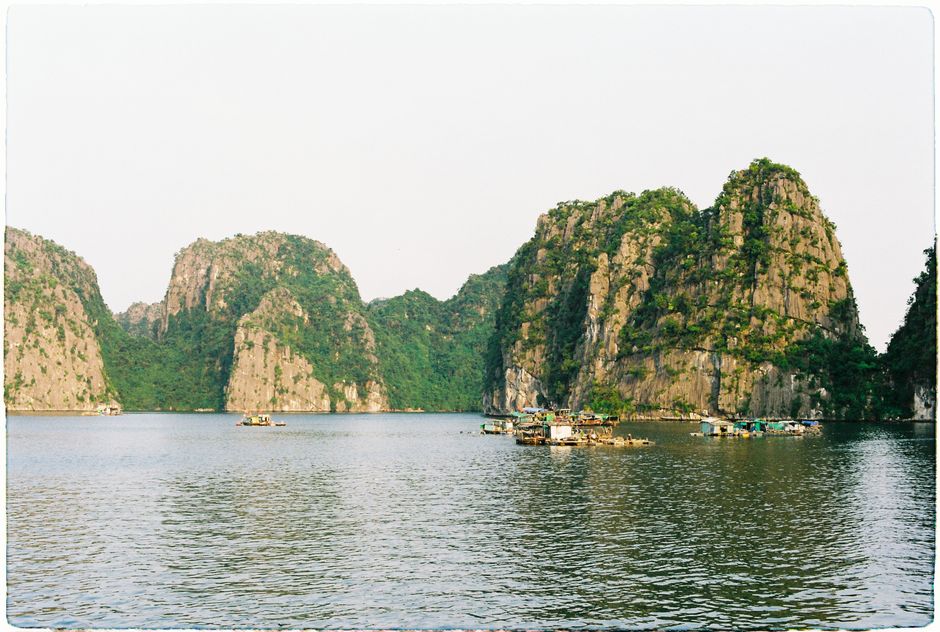
Ha Long Bay, in the Gulf of Tonkin in northeastern Vietnam, is one of the world’s great seascapes: well over a thousand steep limestone islands and pillars, many crowned with jungle, rising from calm green water, with caves, hidden lagoons and floating fishing villages among them. UNESCO first inscribed the bay as a World Heritage Site in 1994, recognized its geology in 2000 and, in 2023, extended the site to include the Cat Ba archipelago next door, as “Ha Long Bay – Cat Ba Archipelago.” Most visitors see it from a boat, either on a day cruise or, better, on an overnight cruise that lets you watch sunset and dawn among the islands, kayak into sea caves and swim from quiet beaches. The bay lies off the coast of Quang Ninh, which became a centrally governed city in August 2026, about 165 km (100 miles) east of Hanoi. The best months are from March to May and from September to November; winter is cool and misty, and summer is hot, with occasional storms that can suspend cruises.
Right now in Ha Long Bay (Bai Chay)
- Wed20–30°C67–86°FMostly clear
- Thu21–30°C70–86°FMostly clear
- Fri23–30°C74–85°FPartly cloudy
Top tours in Ha Long Bay
See all tours for Ha Long Bay →
From local operators, with prices and reviews; you check availability and book on Viator, our partner. We may earn a commission at no extra cost to you. How we earn money
Ha Long Bay at a glance
- Best for: overnight cruises, kayaking, cave visits, island viewpoints, seafood, and the quieter neighboring bays of Bai Tu Long and Lan Ha.
- How long: one night on a cruise is the minimum; two nights reach the quieter corners of the bay.
- Best time: March to May and September to November; December to February is cool and often foggy, and June to August is hot, with a risk of storms.
- Getting there: about 2.5 hours by expressway from Hanoi to the cruise ports at Tuan Chau and Bai Chay; Van Don International Airport is about an hour away.
- Sightseeing fees: set per route by the Ha Long Bay management board, from 70,000 to 600,000 VND per person for day trips and from 500,000 to 750,000 VND for overnight stays; most cruise prices include them.
- Good to know: buy tours from licensed operators or the official ticket offices at the passenger ports, not from touts on the road.
- Before you go: the e-visa, visa-free stays, money and general safety are in our Vietnam travel guide.
The bay, the ports and the towns: where things are
The protected area of Ha Long Bay lies south and east of the old city of Ha Long, which since the 2025 reform has been divided into wards such as Hong Gai and Bai Chay. Most boats leave from two ports on its western shore, and the cruise routes fan out into the bay from there.
Bai Chay and Tuan Chau
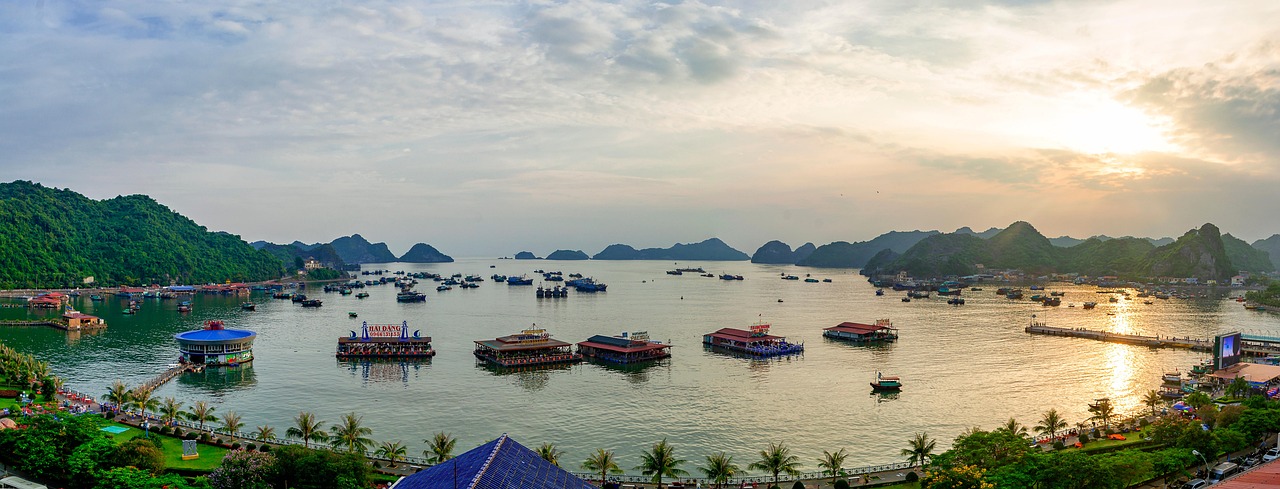
Bai Chay, on the west side of the Cua Luc strait, is the tourist town, with the Ha Long International Passenger Port, beach hotels, the Sun World Ha Long amusement park and its cable car, a night market and seafood restaurants. Tuan Chau, an island linked to the mainland by a causeway a few kilometers west, has the Tuan Chau International Passenger Port, where many overnight cruise boats are based, plus resorts and a marina.
Hong Gai
Across the bridge from Bai Chay, Hong Gai is the older, working part of town, with the provincial offices, local markets and the Quang Ninh Museum, and the headquarters of the Ha Long Bay management board.
Bai Tu Long Bay
Northeast of Ha Long Bay, Bai Tu Long Bay has the same limestone scenery with fewer boats, and includes Bai Tu Long National Park. Some cruises start from Hon Gai or from Van Don, near the international airport.
Lan Ha Bay and Cat Ba
To the southwest, Lan Ha Bay and Cat Ba Island belong to Hai Phong. Lan Ha has small sandy beaches and good kayaking, and Cat Ba has a national park with forest trails. Some Ha Long cruises cross into this area; route VHL5 ends at Gia Luan on Cat Ba.
The cruise routes and fees
The Ha Long Bay management board divides the bay into eight sightseeing routes, each with its own fee, collected per person per trip. The figures below are from the board’s official fee table, last updated on March 31, 2025.
| Route | Main stops | Fee per person |
|---|---|---|
| VHL1 | Thien Cung and Dau Go caves, the Dog Rock, Ba Hang, the Incense Burner and Fighting Cocks islets | 250,000 VND (about US$9.60) |
| VHL2 | Soi Sim and Ti Top islands, Sung Sot cave, Me Cung cave, Luon cave and the lagoons | 250,000 VND |
| VHL3 | Cua Van floating cultural center, Tien Ong cave, Ba Ham lake, Ba Men temple, Ang Du, Rung Truc | 200,000 VND (about US$7.70) |
| VHL4 | Co (Thien Canh Son) cave, Thay cave, Cap La cave, Vung Vieng, Tung Ang, Cong Do island | 200,000 VND |
| VHL5 | The VHL1 sights, ending at Gia Luan on Cat Ba (Hai Phong) | 250,000 VND |
| VHL6 | Chan Voi, Ba Cua, Tung Lam and Cap Bai, bordering Lan Ha Bay | 150,000 VND per day (about US$5.80) |
| VHL7 | Routes VHL1 to VHL4, for exploration cruise yachts only | 600,000 VND (about US$23) |
| VHL8 | The coastal route between Tuan Chau, Ha Long port and Nam Cau Trang | 70,000 VND (about US$2.70) |
According to the board, fees for routes VHL6, VHL7 and VHL8 have applied since May 1, 2025. For overnight cruises, combined sightseeing-and-stay fees apply: 550,000 VND for route 2 with one night and 750,000 VND with two nights, and 500,000 VND (one night) or 650,000 VND (two nights) on routes 3 and 4. A one-night stay is limited to 24 hours from departure and a two-night stay to 48 hours. Children shorter than 1.2 m (4 ft) or under 7 years old go free, and children aged 7 to under 16 get 20% off; elderly Vietnamese citizens pay half.
Cruise prices usually include these fees, but check. According to the board, boats may leave port from 5 a.m. and must return by 8 p.m. from April 1 to October 31, and leave from 5:30 a.m. and return by 7 p.m. from November 1 to March 31. Caves on the main routes open to visitors from about 7:30 or 8 a.m. to 5 or 5:30 p.m., depending on the season.
Top things to see in Ha Long Bay
Sung Sot Cave
On Bo Hon Island, Sung Sot (“Surprise”) Cave is the largest cave discovered in the bay, 20 m (65 ft) above sea level, reached by a steep, shaded stairway. Inside, two huge chambers of stalactites and stalagmites open up, with a freshwater pool in the first and a formation said to resemble the Bodhisattva of Mercy in the last.
Thien Cung and Dau Go caves
On Dau Go Island, at the western edge of the heritage area, Thien Cung (“Heavenly Palace”) Cave has a floor area of about 3,000 m² (32,000 sq ft), with glittering white formations lit in colors. Neighboring Dau Go Cave was one of the first discovered in the bay and was visited by Ho Chi Minh.
Ti Top Island
Named by Ho Chi Minh after the Soviet cosmonaut Gherman Titov, who visited in 1962, Ti Top has a crescent of sand and a stairway of about 400 steps to a summit with one of the best views over the bay. Go early or late, as the stairs are crowded at midday.
Luon Cave and the lagoons
On route VHL2, Luon Cave is a low tunnel through a limestone island into a hidden, enclosed lagoon, explored by kayak or bamboo rowing boat; macaques sometimes appear on the cliffs. Similar enclosed lagoons, such as Ba Ham, can be explored on route VHL3.
Fishing villages
The floating fishing villages, such as Cua Van and Vung Vieng, once housed hundreds of families. Most residents have moved ashore, but some houses remain, and at Cua Van a floating cultural center shows the old way of life; at Vung Vieng, local rowers take visitors around the village by bamboo boat.
More highlights
- Fighting Cocks Islet: the two rocks facing each other, a symbol of Ha Long tourism, on route VHL1.
- Soi Sim Island: a beach and viewpoint at the heart of the protected zone.
- Sun World Ha Long: an amusement park with the Queen Cable Car over the Cua Luc strait and a big Ferris wheel in Bai Chay.
- Quang Ninh Museum: a striking black-glass museum in Hong Gai on the region’s nature and history.
Other things to do in Ha Long Bay
Kayaking and swimming
Most overnight cruises include kayaking or bamboo-boat trips through caves and lagoons and a swim stop when the water is warm, from May to October. Swim only where your crew says it is safe, away from boat traffic. See our boat trips guide.
Seafood and food on board
Ha Long is known for its seafood, especially squid cakes (cha muc), clams, oysters and grilled fish. Cruise menus usually feature seafood; tell the operator in advance about allergies or a vegetarian diet. In Bai Chay and Hong Gai, seafood restaurants sell by weight, so check prices first.
Hiking and viewpoints
Climb Ti Top for the classic view, walk Cat Ba’s national park trails, or hike Bai Tho Mountain in Hong Gai for views over the city and the bay. See our hiking guide.
Responsible travel
The management board asks visitors not to use single-use plastics on the bay, not to throw rubbish into the water, not to break off stalactites or carve on cave walls, not to buy coral, and not to buy from small boats that pull alongside cruise ships.
Day trips and side trips
- Lan Ha Bay and Cat Ba: quieter beaches and kayaking; Cat Ba’s town and national park are good for a night or two.
- Bai Tu Long Bay: a quieter cruise area with similar scenery, from Hon Gai or Van Don.
- Yen Tu: the Buddhist mountain complex where King Tran Nhan Tong founded the Truc Lam Zen school, with pagodas and a cable car, about 1 hour from Ha Long; it is part of a World Heritage site with the relics of Vinh Nghiem and Con Son–Kiep Bac.
- Hanoi: the capital is about 2.5 hours away by expressway. See our Hanoi guide.
- Ninh Binh: “Ha Long Bay on land,” with karsts and rice fields, about 3.5 hours by road. See our Ninh Binh guide.
Getting there and getting around
From Hanoi
The Hanoi–Hai Phong–Ha Long expressway has cut the trip from Hanoi to about 2.5 hours. Almost all cruise operators offer shuttle buses or limousine vans from the Old Quarter, usually leaving around 8 a.m.; public buses and private cars are alternatives. In April 2026, work began on a Hanoi–Quang Ninh high-speed railway, scheduled to be completed by the end of 2028.
By air
Van Don International Airport (VDO), about 50 km (30 miles) northeast of Bai Chay, has domestic flights from Ho Chi Minh City and some other cities. Cat Bi International Airport (HPH) in Hai Phong, about 1 to 1.5 hours away, has more domestic and some international flights. Most international visitors fly into Hanoi’s Noi Bai airport.
On the bay
Cruise boats, day boats and the official sightseeing boats leave from the Tuan Chau and Ha Long (Bai Chay) international passenger ports. If you arrive without a booking, go into the port terminal, where the management board’s ticket and guide office can sell route tickets and recommend boats; the board warns against hiring boats from people touting outside the ports or along the road into town.
When to go and how long to stay
Ha Long Bay has the climate of northern Vietnam’s coast: a hot, wet summer and a cool, dry, often misty winter. March to May and September to November usually have the best combination of warmth, calm seas and visibility. December to February is cool, with drizzle and fog that softens the views; it can feel cold on deck. June to August is hot and humid, with the most rain and the highest risk of tropical storms, when the authorities can suspend all boat trips for a day or more. There is no long-term official climate station on the bay in the World Meteorological Organization’s (WMO) lists, so the table uses the 1991–2020 climate normals for Hai Phong, about 50 km (30 miles) to the southwest, from Vietnam’s National Center for Hydro-Meteorological Forecasting (NCHMF), as published by the WMO.
| Month | Average high / low | Rain (rainy days) | What to expect |
|---|---|---|---|
| January | 20 °C (68 °F) / 15 °C (58 °F) | 40 mm (1.6 in), 11 days | Cool and misty; chilly on deck |
| February | 21 °C (70 °F) / 16 °C (60 °F) | 21 mm (0.8 in), 13 days | Cool, damp and foggy; Tet on February 6 in 2027 |
| March | 23 °C (73 °F) / 18 °C (65 °F) | 54 mm (2.1 in), 19 days | Mild; mist clearing toward the end of the month |
| April | 27 °C (80 °F) / 22 °C (71 °F) | 61 mm (2.4 in), 14 days | Warm and pleasant; a good month to cruise |
| May | 31 °C (87 °F) / 24 °C (76 °F) | 202 mm (8.0 in), 14 days | Warm; swimming season begins |
| June | 33 °C (91 °F) / 26 °C (79 °F) | 218 mm (8.6 in), 14 days | Hot and humid; storms possible |
| July | 32 °C (90 °F) / 26 °C (79 °F) | 267 mm (10.5 in), 16 days | Hot; frequent showers and storm risk |
| August | 32 °C (89 °F) / 25 °C (78 °F) | 361 mm (14.2 in), 18 days | The wettest month; cruises may be suspended by storms |
| September | 31 °C (88 °F) / 25 °C (76 °F) | 251 mm (9.9 in), 14 days | Warm; storm risk easing late in the month |
| October | 30 °C (85 °F) / 22 °C (72 °F) | 88 mm (3.5 in), 9 days | Dry, clear and pleasant; one of the best months |
| November | 26 °C (79 °F) / 19 °C (67 °F) | 45 mm (1.8 in), 7 days | Cool and dry; good visibility |
| December | 22 °C (72 °F) / 16 °C (60 °F) | 25 mm (1.0 in), 7 days | Cool and dry; fewer boats |
Hai Phong gets about 1,630 mm (64 in) of rain a year, three quarters of it from May to September.
One night on the bay
Leave Hanoi in the morning, board around noon, cruise route 2 or 3 in the afternoon with a cave visit and kayaking, watch sunset from the deck, take a tai chi session at dawn, visit a cave or a fishing village and return to port around noon.
Two nights
A two-night cruise reaches the quieter areas, such as Lan Ha Bay or Bai Tu Long Bay, with more kayaking, swimming and beach time, or you can spend a night on a boat and a night on Cat Ba.
Where to stay around Ha Long Bay
- On a cruise boat: the best way to experience the bay; boats range from simple wooden junks to luxury ships with balconies.
- Bai Chay: beach hotels, high-rise hotels and the night market, close to the main port.
- Tuan Chau: resorts and the main cruise marina.
- Cat Ba: guesthouses and hotels for Lan Ha Bay and the national park.
Weekends and Vietnamese holidays are busiest; book cruises ahead from March to May and September to November.
What a trip to Ha Long Bay costs
Prices are approximate, for October 2026, converted at about 26,000 dong (VND) to the US dollar.
| Item | Typical cost |
|---|---|
| Sightseeing fee, route VHL1 or VHL2, per person | 250,000 VND (about US$9.60) |
| Overnight fee, route 2 with one night | 550,000 VND (about US$21) |
| Day cruise with lunch and the fee, from the port | 800,000–1,500,000 VND (about US$31–58) |
| Overnight cruise, mid-range, per person in a shared cabin, with meals and transfer | 3,000,000–6,000,000 VND (about US$115–230) |
| Shuttle bus or limousine van from Hanoi, one way | 250,000–400,000 VND (about US$10–15) |
| Seafood dinner in Bai Chay | 300,000–700,000 VND per person (about US$12–27) |
| Hotel double in Bai Chay, per night | 700,000–1,800,000 VND (about US$27–69) |
Practical tips for Ha Long Bay
- Book with licensed operators: choose boats that are registered, have a clear safety record and give a safety briefing.
- Check what’s included: sightseeing fees, transfers, kayaking and drinks vary between cruises.
- Avoid touts: buy at the port terminals or through reputable agencies.
- Pack layers: decks are windy and cool in the evening, even in spring and autumn.
- Expect weather changes: cruises can be canceled at short notice when storms approach; ask about refunds or rebooking before paying.
Safety
Most cruises run safely, but boats vary, and accidents have happened. On February 27, 2026, a wooden tourist cruise boat caught fire near Hang Co cave; the crew evacuated all 41 people on board, and the government then ordered Quang Ninh to inspect every tourist vessel in the bay and to suspend boats that fail safety and technical standards. Choose established operators, look for life jackets in every cabin and on deck, listen to the safety briefing, and wear a life jacket when kayaking or on small boats. Tropical storms can reach the Gulf of Tonkin between about May and November; when warnings are issued, the authorities halt sightseeing boats, and you should follow the crew’s and local authorities’ instructions. Cave stairways are steep and can be slippery, so wear shoes with grip. On land, traffic on the roads from Hanoi is heavy, and helmets are compulsory on motorbikes. In an emergency, call 113 for police, 114 for fire and 115 for an ambulance.
What to pack for Ha Long Bay
A light jacket or sweater for evenings on deck, a warm layer from December to March, swimwear and a quick-drying towel from May to October, shoes with good grip for caves, sunscreen, a hat, and a dry bag for kayaking. Vietnam uses 220 V, with sockets for flat (type A) and round (type C) two-pin plugs. See our water shoes, rain jackets and travel adapters guides.
Ha Long Bay travel FAQ
How much is the Ha Long Bay entrance fee?
The management board sets fees per route: 250,000 VND for routes VHL1, VHL2 and VHL5, 200,000 VND for VHL3 and VHL4, 150,000 VND per day for VHL6, 600,000 VND for VHL7 and 70,000 VND for VHL8. Overnight packages cost 500,000–750,000 VND.
Is one night on Ha Long Bay enough?
One night gives you sunset, dawn, a cave and kayaking. Two nights let you reach quieter areas such as Lan Ha or Bai Tu Long Bay.
Can I visit Ha Long Bay as a day trip from Hanoi?
Yes, it takes about 2.5 hours each way by expressway, but you’ll spend about five hours on the road for four or five hours on the water.
What is the best time to visit Ha Long Bay?
March to May and September to November. Winter is cool and misty, and summer is hot, with storms that can suspend cruises.
Which cruise route is best?
Route VHL2, with Sung Sot Cave, Ti Top Island and the Luon Cave lagoon, is the classic first visit. Routes 3 and 4 are quieter, with fishing villages and lagoons.
Are Ha Long Bay cruises safe?
Most are, but standards vary. Book licensed, well-reviewed operators, check for life jackets, and follow crew instructions. After a boat fire in February 2026, the government ordered safety inspections of all tourist vessels in the bay.
What is the difference between Ha Long Bay and Lan Ha Bay?
Lan Ha Bay, off Cat Ba Island in Hai Phong, has similar limestone scenery with more small beaches and fewer boats; both are part of the same World Heritage site.
Can you swim in Ha Long Bay?
Yes, from about May to October, at beaches such as Ti Top and from cruise boats where the crew allows it.
Where do Ha Long Bay cruises leave from?
Mostly from Tuan Chau International Passenger Port and Ha Long International Passenger Port in Bai Chay; some leave from Hon Gai, Van Don or Cat Ba.
Do cruises run in the rain?
Yes, but when storm warnings are issued, the authorities suspend boat trips, sometimes for several days.
Plan your trip
Partner links: TravelerCenter may earn a commission if you book, at no extra cost to you.
🇻🇳 Useful Vietnamese phrases for Ha Long Bay
All 38 Vietnamese phrases: restaurant, hotel, emergencies, romance (printable) →
Sources · last reviewed 4 October 2026
Researched and last reviewed on 4 October 2026. Route fees, overnight fees, stay limits, fee exemptions and discounts, departure windows, cave opening hours, visitor rules and the bay’s geology and cave details: the Ha Long Bay–Yen Tu World Heritage Management Board (halongbay.com.vn); Quang Ninh’s status as a centrally governed city, the February 2026 boat fire and inspection order, and the Hanoi–Quang Ninh high-speed railway: the Government of Vietnam’s news portal; climate normals for Hai Phong: Vietnam’s National Center for Hydro-Meteorological Forecasting (NCHMF), via the World Meteorological Organization’s World Weather Information Service; exchange rate: Vietcombank. The UNESCO inscription and extension dates, the number of islands, the Ti Top stair count, the fishing-village history, the Yen Tu details, airport distances, travel times and typical cruise prices are general references or estimates, flagged for checking. Prices and hours change, so check the official sites before you go. For entry rules, money and general safety, see our Vietnam travel guide.
Data: Weather: MET Norway (CC BY 4.0) · Sea temperature: NOAA CoastWatch · Rates: ECB · Costs: World Bank ICP and price levels · Wikidata (CC0)