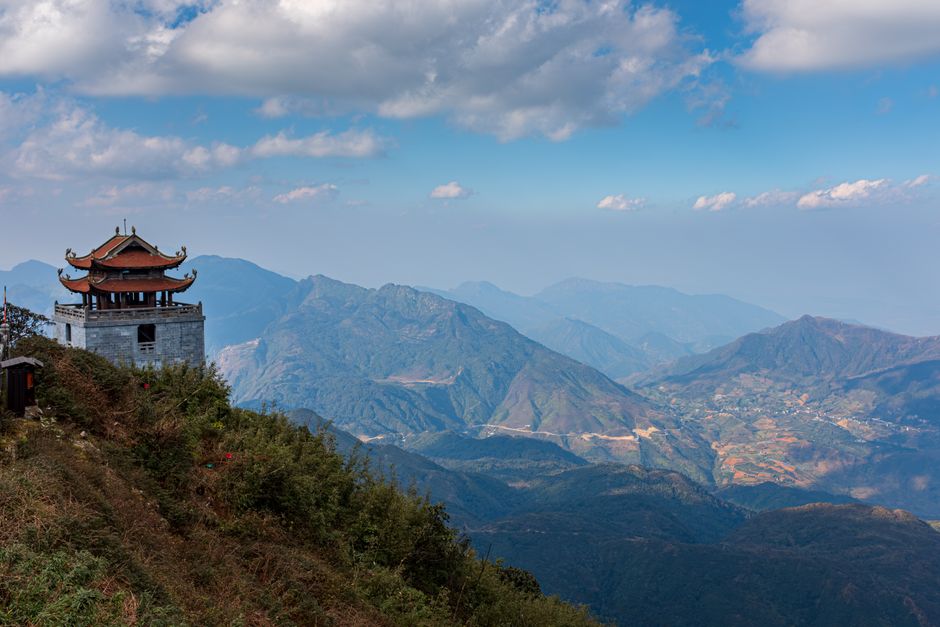
Sa Pa is a mountain town in the far northwest of Vietnam, perched at about 1,500 m (4,900 ft) in the Hoang Lien Son range, close to the Chinese border. Founded as a French hill station in the early 20th century, it is now the base for some of the most beautiful landscapes in Asia: the rice terraces of the Muong Hoa Valley, carved into the mountainsides over generations by the Hmong, Dao, Tay and Giay peoples, and Fansipan, at 3,143 m (10,311 ft) the highest mountain in Indochina, reached by a record-breaking cable car or a hard two-day trek. Visitors come to trek between villages with local guides, stay in homestays, see the terraces turn green in early summer and gold before the harvest in September, and enjoy cool air that can feel like a different country after the heat of the lowlands. Since 2025, Sa Pa has been a ward of Lao Cai province, which merged with neighboring Yen Bai. The best months are from September to November and from March to May; summer is wet, and winter is cold and often misty, with rare frost and snow.

Right now in Sa Pa
- Wed12–22°C54–72°FPartly cloudy
- Thu11–23°C51–73°FPartly cloudy
- Fri14–24°C56–74°FPartly cloudy
Top tours in Sa Pa
See all tours for Sa Pa →
From local operators, with prices and reviews; you check availability and book on Viator, our partner. We may earn a commission at no extra cost to you. How we earn money
Sa Pa at a glance
- Best for: trekking through rice terraces and villages, ethnic minority cultures and markets, homestays, mountain views and Fansipan.
- How long: 2 to 3 nights; 4 or more with a multi-day trek or a trip to Bac Ha market.
- Best time: September to November for clear skies and the golden harvest (terraces are ripest in September); March to May for spring flowers and green terraces.
- Getting there: about 5 to 6 hours by expressway bus or limousine van from Hanoi, or an overnight train to Lao Cai and 1 hour by road up the mountain.
- Getting around: on foot in town and on the trails, by Grab, taxi or private car to villages and passes, and by funicular and cable car to Fansipan.
- Good to know: the Fansipan cable car reopened on September 28, 2026, after its annual maintenance, with hours that vary by day of the week.
- Before you go: the e-visa, visa-free stays, money and general safety are in our Vietnam travel guide.
Sa Pa and the valleys: where things are
Sa Pa town sits on a ridge with views across the Muong Hoa Valley to Fansipan. The main trekking areas fan out from it into the valleys to the south and west.
Sa Pa town
The town center, around the lake, the stone church and the square, has most of the hotels, restaurants, cafés, gear shops and the market. It has grown rapidly, and new hotels cover the hillsides, but the views remain spectacular. The Sun World complex and the funicular station for Fansipan are in the town center.
The Muong Hoa Valley
Southeast of town, the Muong Hoa River winds through the valley that holds the most famous terraces and the villages of Lao Chai (Black Hmong), Ta Van (Giay and Hmong) and, farther on, Ban Ho. A road follows the valley, but the best way to see it is on foot along the paths through the fields.
Cat Cat and the west
Cat Cat village, a Black Hmong village about 2 km (1.2 miles) below the town, can be reached on foot by a paved path, with a waterfall, craft shops and a fee to enter. Farther west, the road climbs to the Silver Waterfall and the O Quy Ho Pass, one of the highest road passes in Vietnam, on the border with Lai Chau province.
Ta Phin and the north
Ta Phin, about 12 km (7.5 miles) northeast, is a Red Dao and Hmong village known for its herbal baths and embroidery, with a cave and quieter terraces.
Top things to see in Sa Pa
Fansipan by cable car
The Fansipan cable car, built with Austria’s Doppelmayr and run by Sun World Fansipan Legend, climbs from the valley near Sa Pa to just below the summit in about 15 minutes, crossing forests, cloud and the Muong Hoa Valley. From the top station, a stairway or a short funicular leads to the summit marker at 3,143 m (10,311 ft), surrounded by pagodas, a giant Buddha statue and temples built as a spiritual complex. A mountain railway, the Muong Hoa funicular, runs from the town center to the cable car station. According to Sun World, after maintenance the cable car reopened on September 28, 2026, carrying passengers up from 8 a.m. to 2:30 p.m. from Monday to Thursday (last return 4 p.m.), from 8 a.m. to 3:30 p.m. on Friday and from 7:30 a.m. to 3:30 p.m. on Saturday (last return 5 p.m.), and from 7:30 a.m. to 2:30 p.m. on Sunday (last return 4 p.m.); hours change with the weather. It is often 10 to 15 °C (18 to 27 °F) colder at the top than in town, and clouds can hide the view, so check the forecast and go early.
Trekking the Muong Hoa Valley
The classic walk leaves town and descends through Lao Chai to Ta Van, about 12 km (7.5 miles), on paths between terraces, bamboo groves and streams, ending with a homestay night or a car back to town. Longer treks continue to Ban Ho or cross to remote valleys. Trails are steep and slippery in the rain; local guides, many of them Hmong and Red Dao women, know the paths and the villages, and the authorities require trekkers to go with a licensed guide in parts of the area. See our hiking guide.
Climbing Fansipan on foot
Fit hikers can climb Fansipan from the Tram Ton Pass in one long day or, more comfortably, over two days with a night in a mountain camp, inside Hoang Lien National Park. It is a steep, rough, muddy trek requiring a licensed guide and park permits, usually arranged by trekking agencies. The best months are October to April, outside the heaviest rains.
Sa Pa town sights
The stone church, built by the French in the 1890s, is the town’s landmark, facing the square where the weekend “love market” and dances once took place. Walk around Sa Pa Lake, up Ham Rong Mountain for views and gardens, and through the market, where minority women sell embroidery and indigo-dyed fabrics.
Passes and waterfalls
The O Quy Ho Pass, about 15 km (9 miles) west, crosses the Hoang Lien Son range at about 2,000 m (6,500 ft) with sweeping views, especially at sunset; stop at the Silver Waterfall and the Love Waterfall trail on the way.
More classic sights
- Cat Cat village: a short walk from town, with a waterfall and old water wheels; busy and commercialized but easy.
- Ta Van and Lao Chai: the heart of the terraced valley, with homestays.
- Ta Phin: herbal baths and Red Dao embroidery.
- Bac Ha Sunday market: see Day trips below.
Other things to do in Sa Pa
Food and drink
Mountain food in Sa Pa includes thang co, a Hmong stew of horse meat and offal; lon cap nach, small free-ranging pigs, roasted; grilled salmon and sturgeon farmed in the cold streams; com lam, rice cooked in bamboo; and hot pot, perfect on cold evenings. Street stalls grill eggs, corn, sweet potatoes and skewers at night. Try ruou ngo, the local corn spirit, sparingly, and hot ginger tea.
Homestays and culture
A night in a family homestay in Ta Van, Lao Chai or Ta Phin is one of the highlights of a visit, with home-cooked meals and a chance to see daily life. Be respectful: ask before photographing people, especially children; don’t give sweets or money to children; and buy crafts directly from makers when you can.
Herbal baths and crafts
The Red Dao are known for their herbal baths, made from dozens of mountain plants, offered in Ta Phin and in town. Hmong batik, indigo dyeing and Dao embroidery workshops are found in several villages.
Festivals
Sa Pa’s cool weather makes it a favorite escape for Vietnamese at Tet (February 6, 2027), when the peach and plum trees blossom, and on summer holidays. Sun World holds a Xoe dance festival on Fansipan, and villages celebrate the harvest in September and October.
Day trips from Sa Pa
- Bac Ha Sunday market: the biggest and most colorful market in the region, where Flower Hmong and other groups trade buffalo, horses, produce and textiles, about 2.5 to 3 hours by road; combine with the Vua Meo palace.
- Y Ty: a remote highland area on the Chinese border, famous for its seas of cloud and terraces, about 3 hours away.
- Lao Cai and the border: the provincial town on the Red River, with the Hekou border crossing into China.
- Ha Giang: the dramatic limestone landscapes of the Ha Giang Loop, now part of Tuyen Quang province, a multiday trip of its own, usually started from Ha Giang town.
Getting there and getting around
By road
The Hanoi–Lao Cai expressway has made the trip much faster: buses, sleeper buses and comfortable limousine vans run from Hanoi‘s Old Quarter and bus stations to Sa Pa town in about 5 to 6 hours. The last section climbs a winding mountain road from Lao Cai. Private cars take about 5 hours.
By train
Overnight sleeper trains run from Hanoi Station to Lao Cai in about 8 hours, with private operators attaching more comfortable sleeper carriages to some trains; from Lao Cai station, minibuses and taxis take about 1 hour to climb 35 km (22 miles) to Sa Pa. Book on Vietnam Railways’ website, dsvn.vn, or through a carriage operator.
Around Sa Pa
The town is compact and walkable but hilly. Grab, taxis and drivers can take you to the passes, villages and Fansipan station. Most visitors trek with a guide; motorbike rental is possible, but the mountain roads are steep, winding and often foggy or wet, and a license valid in Vietnam is required.
When to go and how long to stay
Sa Pa is far cooler than the rest of Vietnam because of its altitude. Summers are mild and very wet, and winters are cold, damp and misty, with occasional frost and, in some years, a dusting of snow on the peaks. September to November brings dry, clear weather and the rice harvest; March to May is mild, with blossoms and young rice; June to August is the rainy season, with lush green terraces but frequent heavy rain, landslides and leeches on the trails; December to February can be cold enough to need a warm jacket, and fog often hides the views. No long-term official climate normals for Sa Pa are published through the World Meteorological Organization, so the temperatures below are typical values from general climate references, not official normals. For comparison, Lao Cai city, about 1,200 m (3,900 ft) lower, has official 1991–2020 normals from Vietnam’s National Center for Hydro-Meteorological Forecasting of 20 °C (68 °F) / 15 °C (58 °F) in January and 33 °C (92 °F) / 26 °C (79 °F) in July.
| Month | Typical high / low (approximate) | Rain | What to expect |
|---|---|---|---|
| January | 11 °C (52 °F) / 5 °C (41 °F) | Light; drizzle | Cold and misty; frost possible |
| February | 13 °C (55 °F) / 7 °C (45 °F) | Light | Cold; peach blossoms; Tet on February 6 in 2027 |
| March | 17 °C (63 °F) / 10 °C (50 °F) | Moderate | Warming; spring flowers |
| April | 21 °C (70 °F) / 14 °C (57 °F) | Moderate | Pleasant; terraces being flooded and planted |
| May | 23 °C (73 °F) / 16 °C (61 °F) | Increasing | Mild; water-filled terraces reflect the sky |
| June | 24 °C (75 °F) / 18 °C (64 °F) | Heavy | Wet; green terraces |
| July | 24 °C (75 °F) / 18 °C (64 °F) | Very heavy | The wettest period; landslide risk |
| August | 24 °C (75 °F) / 18 °C (64 °F) | Very heavy | Wet; rice ripening late in the month |
| September | 22 °C (72 °F) / 16 °C (61 °F) | Moderate | Golden terraces; harvest begins |
| October | 20 °C (68 °F) / 13 °C (55 °F) | Light | Clear and fresh; excellent for trekking |
| November | 16 °C (61 °F) / 10 °C (50 °F) | Light | Cool and dry; good views |
| December | 13 °C (55 °F) / 6 °C (43 °F) | Light | Cold; fog and occasional frost |
Sa Pa receives roughly 2,500–2,800 mm (100–110 in) of rain a year, most of it from May to September.
2 nights in Sa Pa
Day one, arrive, walk around the town, the lake and the market, then Cat Cat village. Day two, trek through Lao Chai to Ta Van with a homestay or a car back. Day three, ride the cable car up Fansipan in the morning before the clouds, and leave in the afternoon.
4 nights with a longer trek
Add a two-day trek to Ban Ho or a Fansipan climb, the O Quy Ho Pass at sunset, and Bac Ha market on Sunday.
Where to stay in Sa Pa
- Sa Pa town: the widest choice, from guesthouses to luxury hotels with valley views, close to restaurants and the Fansipan funicular.
- Ta Van and Lao Chai: homestays and eco-lodges among the terraces, best for trekking.
- Ta Phin: homestays and herbal baths in a quieter valley.
- Muong Hoa Valley resorts: boutique and luxury lodges with terrace views, a short drive from town.
Hotels fill at Tet, on Vietnamese holidays and on weekends in autumn and spring; book ahead.
What a trip to Sa Pa costs
Prices are approximate, for October 2026, converted at about 26,000 dong (VND) to the US dollar.
| Item | Typical cost |
|---|---|
| Limousine van from Hanoi, one way | 300,000–450,000 VND (about US$12–17) |
| Sleeper berth, Hanoi–Lao Cai train | 400,000–900,000 VND (about US$15–35) |
| Fansipan cable car, adult, round trip | about 800,000–1,000,000 VND (about US$31–38) |
| Guided day trek with lunch | 400,000–800,000 VND (about US$15–31) |
| Homestay night with dinner and breakfast | 250,000–500,000 VND (about US$10–19) |
| Hot pot dinner | 150,000–300,000 VND per person (about US$6–12) |
| Herbal bath in Ta Phin | 100,000–200,000 VND (about US$3.85–7.70) |
| Mid-range hotel double, per night | 700,000–1,800,000 VND (about US$27–69) |
Practical tips for Sa Pa
- Hire licensed local guides: they know the trails and villages, and guides are required in parts of the area.
- Go up Fansipan early: clouds often build by midday.
- Pack layers: mornings and evenings are cold even in summer, and winter nights can be near freezing.
- Respect local people: ask before photographing, and don’t give money or sweets to children.
- Watch the weather: in the rainy season, landslides can close roads and trails.
Safety
Sa Pa is safe, but the mountains bring their own hazards. Mountain roads, including the climb from Lao Cai and the O Quy Ho Pass, are steep and winding, often foggy or wet, and used by trucks and buses; landslides can block them after heavy rain, especially from June to September. If you rent a motorbike, you need a license valid in Vietnam, such as a 1968-convention international driving permit with your home license; helmets are compulsory, and riding these roads is only for experienced riders. The same applies to the famous Ha Giang Loop, where accidents involving inexperienced foreign riders are common; many visitors choose to ride as a passenger with a local driver. On the trails, rain makes paths slippery, rivers can rise quickly, and weather on Fansipan changes fast, so go with a licensed guide, carry warm and waterproof layers, and tell your hotel your plans. In winter, nights can approach freezing, and some guesthouses have little heating. Village children selling crafts can be persistent; a polite “no, thank you” works. In an emergency, call 113 for police, 114 for fire and 115 for an ambulance.
What to pack for Sa Pa
Warm layers, a fleece or down jacket from November to March, a waterproof jacket all year, hiking shoes with good grip, trekking poles for steep descents, a hat and sunscreen for the high-altitude sun, and a headlamp for homestays. Vietnam uses 220 V, with sockets for flat (type A) and round (type C) two-pin plugs. See our hiking shoes, rain jackets and travel adapters guides.
Sa Pa travel FAQ
How do I get from Hanoi to Sa Pa?
By expressway bus or limousine van in about 5 to 6 hours, or by overnight train to Lao Cai (about 8 hours) and then 1 hour by road.
What are the Fansipan cable car hours?
Since it reopened on September 28, 2026, it has carried passengers up from 8 a.m. to 2:30 p.m. Monday to Thursday, 8 a.m. to 3:30 p.m. on Friday, 7:30 a.m. to 3:30 p.m. on Saturday and 7:30 a.m. to 2:30 p.m. on Sunday, with the last return 1.5 hours later. Hours change with the weather.
How high is Fansipan?
3,143 m (10,311 ft), the highest mountain in Vietnam, Laos and Cambodia.
When is the best time to see the rice terraces?
September, when the terraces turn gold just before the harvest; May and June are also beautiful, when the terraces are flooded and newly planted.
Do I need a guide to trek in Sa Pa?
A licensed local guide is strongly recommended, and required in parts of the area and on Fansipan; guides also arrange homestays.
How cold does Sa Pa get?
From December to February, days are often around 10–13 °C (50–55 °F) and nights can fall close to freezing, with occasional frost and rare snow.
How many days do I need in Sa Pa?
Two or three nights for the town, a trek and Fansipan; four or more for a multi-day trek or Bac Ha market.
Is Sa Pa crowded?
The town is busy and built up, especially at weekends and holidays, but the trails and villages beyond Ta Van and Ta Phin are much quieter.
Can I climb Fansipan on foot?
Yes, in one long day or two days from the Tram Ton Pass, with a licensed guide and park permits; it is steep and demanding.
Is Sa Pa part of Lao Cai?
Yes. Sa Pa is a ward of Lao Cai province, which merged with Yen Bai province in 2025.
Plan your trip
Partner links: TravelerCenter may earn a commission if you book, at no extra cost to you.
🇻🇳 Useful Vietnamese phrases for Sa Pa
All 38 Vietnamese phrases: restaurant, hotel, emergencies, romance (printable) →
Sources · last reviewed 4 October 2026
Researched and last reviewed on 4 October 2026. The Fansipan cable car’s reopening, operating hours, ride time, summit height and construction history: Sun World Fansipan Legend; Sa Pa’s altitude, ethnic groups and seasons: the Government of Vietnam’s news portal; the 2025 merger of Lao Cai and Yen Bai: the government news portal; Lao Cai climate normals: Vietnam’s National Center for Hydro-Meteorological Forecasting (NCHMF), via the World Meteorological Organization’s World Weather Information Service; railway booking: Vietnam Railways; exchange rate: Vietcombank. The Sa Pa temperature and rainfall figures, guide requirements, trek distances, the Fansipan cable car fare, the history of the town, travel times and other typical prices are general references or estimates, flagged for checking; driving-license and helmet rules are from the UK government’s factual safety pages. Prices and hours change, so check the official sites before you go. For entry rules, money and general safety, see our Vietnam travel guide.
Data: Weather: MET Norway (CC BY 4.0) · Rates: ECB · Costs: World Bank ICP and price levels · Wikidata (CC0)