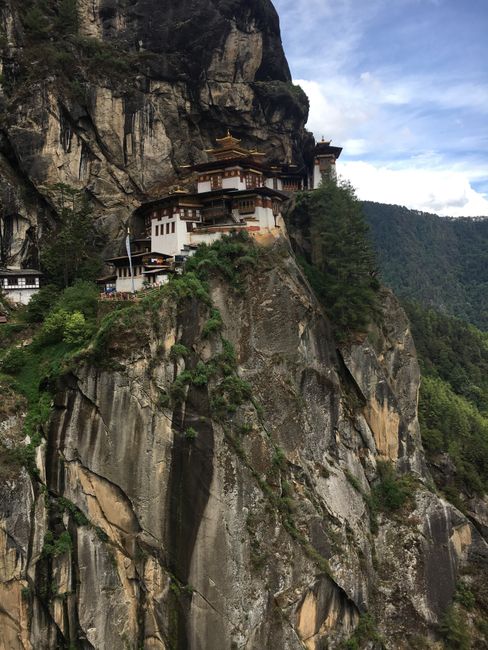
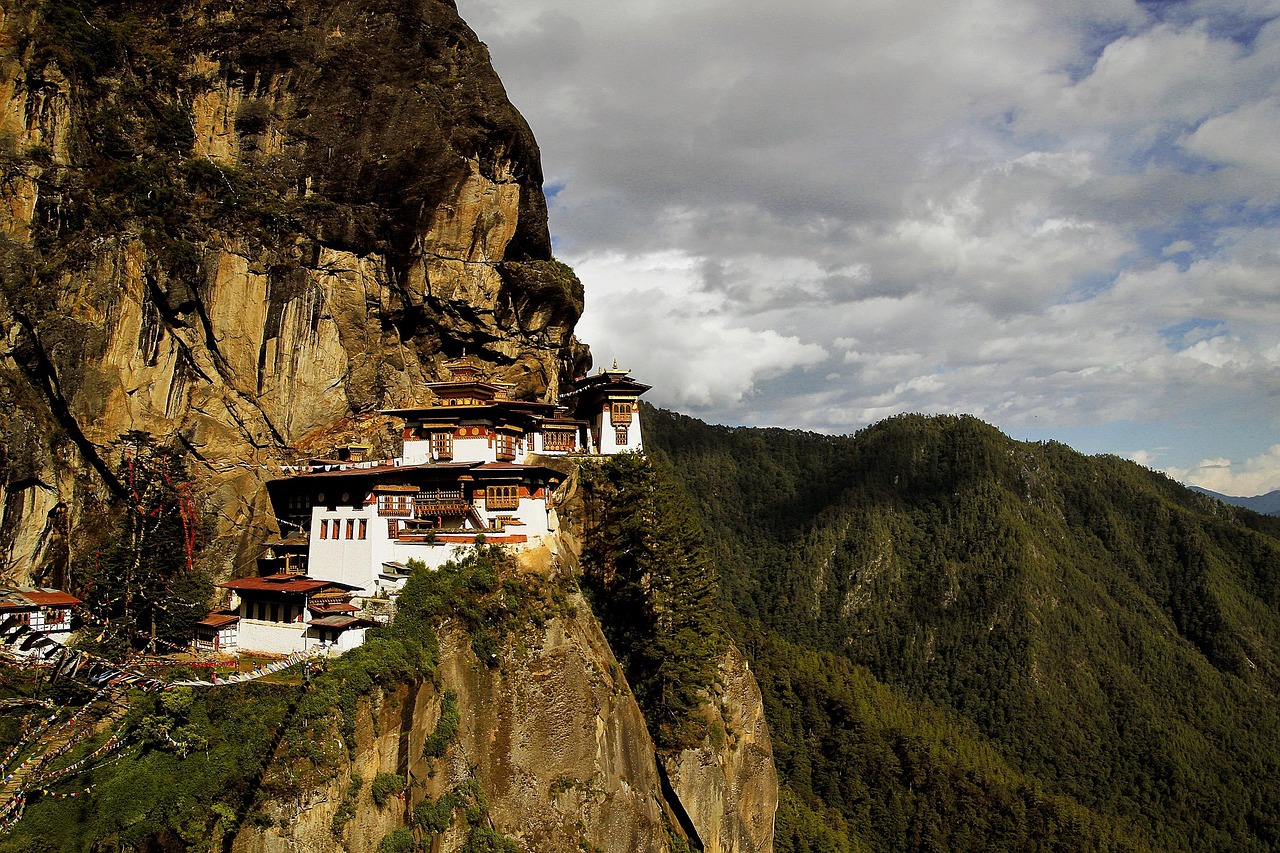
Bhutan is a small Himalayan kingdom between India and China (Tibet) that has chosen to open itself to visitors slowly and on its own terms. Its valleys are dominated by dzongs, the massive whitewashed fortress-monasteries that house both monks and district government; prayer flags flutter on every pass; archery is the national sport; and the country measures its progress by Gross National Happiness and keeps more than two thirds of its land under forest. Bhutan’s tourism policy, known as “High Value, Low Volume,” means that most visitors pay a daily Sustainable Development Fee (SDF), currently US$100 per night for adults until August 31, 2027, apply for a visa in advance and travel with a licensed Bhutanese guide. In return, they find uncrowded monasteries, colorful masked-dance festivals called tshechus, superb trekking, and the cliff-hanging Taktsang Monastery, the Tiger’s Nest, above the Paro valley. All international flights land at Paro, and most first trips combine Paro, the capital Thimphu and the Punakha valley over a week. The best months are October and November and March to May.
Right now in Bhutan
- Wed 8–17°C 47–62°F 4 mm Showers
- Thu 7–17°C 45–63°F Cloudy
- Fri 10–13°C 49–55°F 9 mm Heavy rain
Weather: MET Norway (CC BY 4.0)
Multi-day tours of Bhutan
Multi-day tours from local operators. You check dates and book on Viator, our partner; we may earn a commission at no extra cost to you. How we earn money
Bhutan at a glance
Bhutan is a constitutional monarchy, ruled by the Wangchuck dynasty since 1907 and a parliamentary democracy since 2008, landlocked between the Tibet Autonomous Region of China to the north and the Indian states of Sikkim, West Bengal, Assam and Arunachal Pradesh to the south. It covers about 38,400 km² (14,800 sq miles), a little smaller than Switzerland, and rises from about 100 m (330 ft) on the Indian plains to more than 7,500 m (24,600 ft) on Gangkhar Puensum, the world’s highest unclimbed mountain. It has fewer than 800,000 people, most of them living in the central valleys and southern foothills, and is divided into 20 districts called dzongkhags.
The national language is Dzongkha, but English is the language of education and is widely spoken; Nepali is common in the south. Vajrayana (Tibetan) Buddhism, of the Drukpa Kagyu school, is the state religion and shapes daily life, architecture and the calendar, and Hinduism is practiced in the south. Bhutanese wear the national dress, the gho for men and the kira for women, at work, in schools and in dzongs. Bhutan Time is UTC+6, with no daylight saving time, 30 minutes ahead of India. According to the Department of Tourism, three plug types are used, the British type G, the European type C and the Indian type D, so bring adapters for all three; electricity is 230 V.
Bhutan’s regions
- Western Bhutan: Paro, with the international airport and the Tiger’s Nest; Thimphu, the capital; Haa, beyond the Chele La pass; and Punakha and Wangdue Phodrang, in warm lower valleys across the Dochula pass.
- Central Bhutan: the glacial valley of Phobjikha, winter home of black-necked cranes; Trongsa, with its strategic dzong; and the four valleys of Bumthang, the kingdom’s spiritual heartland.
- Eastern Bhutan: remote and little visited, with Mongar, Trashigang, Trashiyangtse and the textile villages of Lhuentse, reached by long mountain roads or a domestic flight to Yonphula.
- The southern foothills: subtropical border towns such as Phuentsholing, Gelephu, Samtse and Samdrup Jongkhar, the land gateways from India, and Royal Manas National Park.
Where to go: dzongs, valleys and mountain trails
Most first-time visitors spend a week in western Bhutan; with ten days to two weeks, you can cross the country to Bumthang. See our guides:
- Paro: the airport valley, with the Tiger’s Nest, Rinpung Dzong, the National Museum and Kyichu Lhakhang, one of the oldest temples in Bhutan, and the start of the Jomolhari and Druk Path treks.
- Thimphu: the world’s only capital without traffic lights, with Tashichho Dzong, the giant Buddha Dordenma, the National Memorial Chorten, craft schools and weekend markets.
Other highlights include Punakha Dzong, at the confluence of two rivers, often called the most beautiful dzong in the country, and the fertility temple of Chimi Lhakhang; the Dochula pass, with 108 memorial chortens and Himalayan views on clear days; the Phobjikha Valley and Gangtey Monastery; Trongsa Dzong and its museum in the Ta Dzong watchtower; the temples and festivals of Bumthang; the Haa Valley; and the Trans Bhutan Trail, a restored historic footpath crossing the country from Haa to Trashigang.
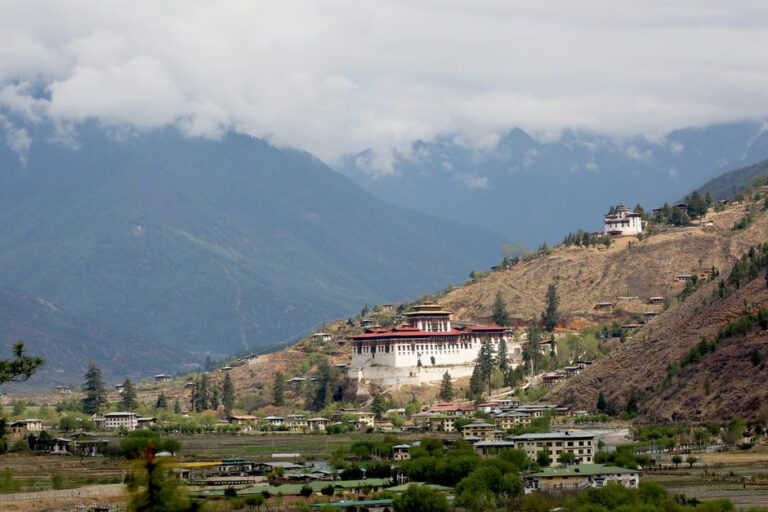
Paro Travel Guide
Plan a trip to Paro: the town, the upper valley and farmhouse stays, the Tiger's Nest hike, entry fee and horse booking rule, Rinpung…
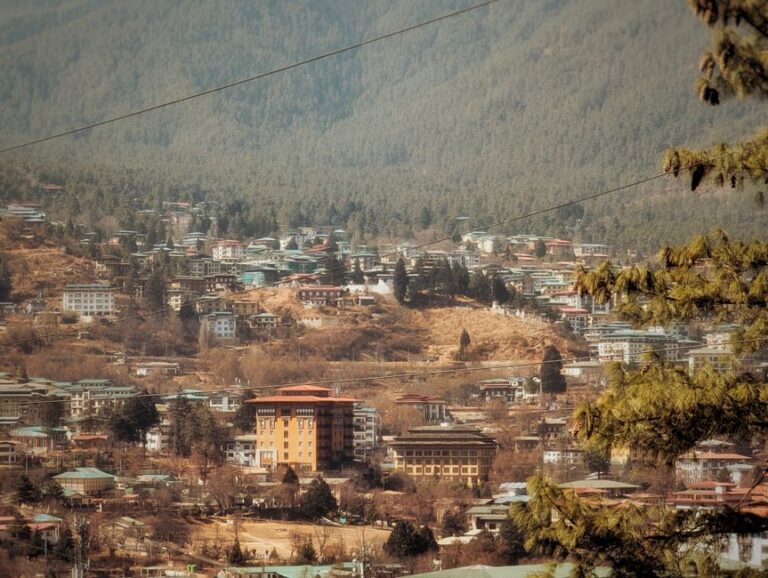
Thimphu Travel Guide
Plan a trip to Thimphu: Norzin Lam, Motithang and where to stay, Tashichho Dzong visiting hours, the Buddha Dordenma, the Memorial Chorten, the Takin…
Beyond Paro and Thimphu
Punakha and Wangdue Phodrang
At about 1,250 m (4,100 ft), the Punakha valley is far warmer than Paro or Thimphu, with rice terraces, orange trees and jacarandas. Punakha Dzong, built in 1637 at the meeting of the Pho Chhu (male) and Mo Chhu (female) rivers, was the capital of Bhutan until the 1950s, and it is where kings are crowned and the royal wedding of 2011 took place; it is the winter home of the Je Khenpo and the central monastic body. A short walk across rice fields leads to Chimi Lhakhang, the temple of the “Divine Madman,” Drukpa Kunley, where couples come to pray for children. Rafting on the Mo Chhu and a walk to the Khamsum Yulley Namgyal Chorten on a ridge above the valley are popular, and a long suspension bridge spans the Pho Chhu. Entry to Punakha Dzong and Chimi Lhakhang is Nu 500 each, according to the Department of Tourism.
Phobjikha and Gangtey
The wide, glacial Phobjikha Valley, at about 3,000 m (9,800 ft), is the winter home, from about late October to February, of rare black-necked cranes, which fly in from the Tibetan plateau. The Black-necked Crane Education Center, run by the Royal Society for Protection of Nature, explains their story, and the hilltop Gangtey Monastery overlooks the valley. Easy nature trails cross the marshes and farmland.
Trongsa
The huge Trongsa Dzong, sprawling down a ridge above a deep gorge in the center of the country, was the seat of the Wangchuck family before they became kings; the crown prince traditionally serves as governor of Trongsa before taking the throne. The watchtower above it houses a museum on the monarchy.
Bumthang
The four valleys of Bumthang (Chokhor, Tang, Ura and Chhume), at 2,600–4,000 m (8,500–13,100 ft), are Bhutan’s spiritual heartland, dotted with some of its oldest temples, such as Jambay Lhakhang and Kurjey Lhakhang, where Guru Rinpoche left his body print in a rock. Bumthang is known for buckwheat dishes, apples, cheese, honey and local beer, and for the colorful yathra wool weaving of Chhume.
Haa and the east
The Haa Valley, west of Paro over the Chele La, opened to tourists only in 2002 and remains one of the most traditional valleys in the west. Far to the east, Trashigang, Trashiyangtse and Lhuentse are known for textiles, woodturning and paper, and the semi-nomadic Brokpa people of Merak and Sakteng live in the high pastures near the Indian border.
Best time to visit Bhutan
Bhutan’s climate varies with altitude, from subtropical in the southern foothills to alpine in the north. Autumn, from late September to November, is the most popular season, with clear skies, mild days, mountain views from the passes and the big Thimphu and Bumthang festivals. Spring, from March to May, brings rhododendrons and magnolias, warm days and the Paro Tshechu, though with more haze. Winter, from December to February, is dry and sunny, with frosty nights and snow above about 3,000 m (9,800 ft); it is the quietest season, ideal for the black-necked cranes in Phobjikha and for the warmer Punakha valley. The monsoon, from June to September, brings rain, especially in the south; landslides can block roads, and the mountains are often hidden, but the valleys are green and rice is growing.
The table shows rounded averages published by Bhutan’s National Center for Hydrology and Meteorology (NCHM) on the World Meteorological Organization’s (WMO) World Weather Information Service, based on the years 1996 to 2018 (NCHM has not published 1991–2020 normals there).
| Area (station) | January high / low | July high / low | Rain a year | Wettest months |
|---|---|---|---|---|
| Paro valley: Paro | 13 °C (55 °F) / −1 °C (29 °F) | 24 °C (76 °F) / 15 °C (60 °F) | about 570 mm (22 in) | July and August |
| Capital: Thimphu | 15 °C (59 °F) / −2 °C (28 °F) | 27 °C (81 °F) / 16 °C (61 °F) | about 590 mm (23 in) | July and August |
| Punakha area: Wangdue Phodrang | 19 °C (67 °F) / 5 °C (41 °F) | 29 °C (84 °F) / 21 °C (70 °F) | about 660 mm (26 in) | July and August |
| Central Bhutan: Bumthang | 11 °C (53 °F) / −4 °C (25 °F) | 23 °C (73 °F) / 14 °C (58 °F) | about 750 mm (29 in) | July and August |
| Eastern Bhutan: Trashigang | 15 °C (59 °F) / 3 °C (38 °F) | 26 °C (78 °F) / 17 °C (62 °F) | about 1,150 mm (45 in) | June to August |
| Southern foothills: Bhur, near Gelephu | 22 °C (72 °F) / 13 °C (56 °F) | 30 °C (85 °F) / 24 °C (75 °F) | about 5,070 mm (199 in) | June to September |
Bhutan month by month
| Month | Weather | Highlights | Crowds and prices |
|---|---|---|---|
| January | Cold, dry and sunny; frosty nights | Black-necked cranes in Phobjikha; clear mountain views | Low |
| February | Cold and dry; warming late in the month | Punakha Drubchen and Tshechu in some years; Losar (Lunar New Year) | Low to moderate |
| March | Mild days; spring haze | Paro Tshechu in some years; rhododendrons begin | Rising |
| April | Warm and pleasant | Paro Tshechu in some years; rhododendrons in full bloom on the passes | High |
| May | Warm; showers begin | Wildflowers; good trekking at middle altitudes | Moderate |
| June | Monsoon arrives; humid in the south | Green valleys; Haa Summer Festival in some years | Low |
| July | Wettest month in most places | Rice paddies; fewer visitors | Low |
| August | Wet; landslides possible on roads | Matsutake mushroom season in Bumthang | Low |
| September | Rains easing late in the month | Thimphu Tshechu in some years; rice harvest begins | Rising |
| October | Clear, dry and mild; the best mountain views | Thimphu and Wangdue tshechus in some years; Jambay Lhakhang Drup in Bumthang | Very high |
| November | Crisp and clear; cold nights | Black-necked Crane Festival in Phobjikha (November 11); trekking season | High |
| December | Cold and sunny; snow on the passes | Dochula Druk Wangyel Festival (December 13); quiet roads | Low to moderate |
Tshechus and other festivals
Every major dzong and temple holds an annual tshechu, a religious festival of masked dances (cham) performed by monks and laypeople in the courtyard, honoring Guru Rinpoche, the saint who brought Buddhism to Bhutan in the 8th century. The biggest are the Paro Tshechu in spring, which ends at dawn on the last day with the unrolling of a huge thangka (thongdrel) that blesses those who see it, and the Thimphu Tshechu in autumn. Festival dates follow the Bhutanese lunar calendar and change every year; the Department of Tourism publishes them. Dress smartly, cover shoulders and knees, and do not use flash or drones during the dances.
Other festivals worth planning around
- Punakha Drubchen and Tshechu: in February or March, the Drubchen reenacts a 17th-century battle against Tibetan invaders, with militiamen (pazaps) in traditional armor, followed by the Punakha Tshechu.
- Jambay Lhakhang Drup: in Bumthang in October or November, famous for its midnight fire blessing (mewang), when crowds run under a burning gate to be cleansed.
- Black-necked Crane Festival: in the courtyard of Gangtey Monastery in Phobjikha on November 11, with children’s dances celebrating the cranes’ return.
- Dochula Druk Wangyel Tshechu: on December 13 at the Dochula pass, a festival of dances performed by the Royal Bhutan Army, with the Himalaya as a backdrop on clear days.
- Haa Summer Festival: in July in the Haa Valley, with nomad culture, local food and traditional sports.
- Losar: the Bhutanese New Year, in February or March, celebrated with family gatherings and archery.
The Department of Tourism publishes each year’s festival calendar. Hotels in Paro, Thimphu and Bumthang fill months ahead for the biggest festivals, so plan early.
How long to stay: sample itineraries
- 4–5 days: Paro (2 nights) with the Tiger’s Nest, Thimphu (1) and Punakha (1) over the Dochula pass.
- 7 days: Paro (3 nights) with the Tiger’s Nest and Chele La, Thimphu (2), Punakha (2) with Chimi Lhakhang.
- 10 days: add Phobjikha (1) and Bumthang (2), returning by road or flying back from Bumthang to Paro.
- Two weeks or more: cross the whole country to Trashigang and exit by land at Samdrup Jongkhar, or add a trek: the Druk Path (5–6 days), Jomolhari (7–9 days) or a section of the Trans Bhutan Trail.
Entry, money and costs
The Sustainable Development Fee (as of October 2026)
According to Bhutan’s Department of Tourism, the SDF is US$100 per night for adults from all countries except India, under a discount on the standard rate of US$200 that the government introduced on September 1, 2023, for four years, until August 31, 2027. Children from 6 to under 12 pay US$50 a night, and children under 6 pay nothing. Indian nationals pay Nu 1,200 (or the same in Indian rupees) per person per night, and Nu 600 for children from 6 to under 12. Tourists who stay no more than 24 hours in the designated zones of the border towns of Samtse, Phuentsholing, Gelephu and Samdrup Jongkhar do not pay the SDF; the government renewed this waiver from June 2, 2026, for a year until August 2027. The SDF is paid with the visa application and refunded for nights not spent in Bhutan, minus bank charges. It funds free healthcare and education, conservation, infrastructure and training in tourism.
Visas
According to the Department of Tourism, all visitors except Indian nationals need a visa, and all except citizens of Bangladesh and the Maldives must obtain it before traveling. Apply online through the official visa portal, or through a licensed tour operator or hotel, with a digital copy of your passport, a recent photo, your travel dates and payment for the one-off, non-refundable US$40 visa fee and the SDF for your stay. Applications are reviewed within five working days, and the visa allows a stay of up to 90 days; extensions are made through the same portal. Indian nationals need a permit, issued online or at the point of entry, with an Indian passport or voter ID card. Travel insurance has not been mandatory since April 23, 2024, but is recommended.
Guides and tour operators
Since Bhutan reopened on September 23, 2022, visitors may book flights, hotels and transport independently instead of through a tour operator. However, according to the Department of Tourism, it is mandatory to be accompanied by a guide certified by the department at all times, a guide is required to enter monuments and dzongs, and all treks must be done with an accredited tour operator or guide. Route permits for moving between districts are no longer required for tourists with a certified guide. In practice, most visitors book a package with a licensed Bhutanese operator, which arranges the visa, guide, driver and hotels. You may stay only in accommodation certified by the Department of Tourism, from homestays to five-star lodges.
Customs
Visitors may bring cash up to the equivalent of US$10,000. Exporting antiques and religious artifacts is prohibited without clearance, and buying newer crafts may need an export permit for non-antique artifacts, which reputable shops help with. Tobacco is tightly controlled and duty is payable. Drones are generally not permitted for tourists.
Money and cards
The currency is the ngultrum (Nu), pegged one-to-one to the Indian rupee, which is also widely accepted. On October 2, 2026, the Royal Monetary Authority of Bhutan quoted about Nu 95–96 to the US dollar; prices on this site use 96. You can change money at Paro airport, banks and larger hotels. ATMs in towns accept Visa and Mastercard, and cards are widely used in urban areas but less so elsewhere; the Bank of Bhutan’s goBoB and Bhutan National Bank’s MyPay digital wallet apps can be linked to international cards. Carry some cash in ngultrum, Indian rupees or US dollars for the countryside.
Tipping
Tipping is not traditional but is welcome in tourism; most visitors tip their guide and driver at the end of a trip.
What a trip costs
Prices are approximate, for October 2026, converted at about Nu 96 to the US dollar. The SDF, visa fee and monument fees are those published by the Department of Tourism.
| Item | Typical cost |
|---|---|
| Sustainable Development Fee, adult, per night | US$100 |
| Visa fee, one-off | US$40 |
| Tiger’s Nest (Taktsang) entry | Nu 1,000 (about US$10.40) |
| Tashichho Dzong or Punakha Dzong entry | Nu 500 (about US$5.20) |
| Certified guide, per day | Nu 2,500–4,500 (about US$26–47) |
| Car and driver, per day | Nu 6,000–10,000 (about US$63–104) |
| Lunch of ema datshi, rice and vegetables in a local restaurant | Nu 250–600 (about US$2.60–6.25) |
| Three-star hotel double, per night | Nu 5,000–12,000 (about US$52–125) |
| Luxury lodge double, per night | US$600 and up |
A typical guided trip with three-star hotels, a guide, a car and driver, meals and entry fees, plus the SDF, costs roughly US$250–400 per person per day for two people sharing; budget and luxury trips range well below and far above.
Getting there and getting around
Airports and flights
Paro International Airport (PBH) is Bhutan’s main gateway, at about 2,200 m (7,300 ft) in a narrow valley surrounded by peaks; only specially trained pilots fly there, in daylight, and the approach is famously spectacular. According to the Department of Tourism, Drukair and Bhutan Airlines, the two Bhutanese airlines, fly to Paro from destinations including Bangkok, Delhi, Kolkata, Bagdogra, Bodh Gaya, Dhaka, Kathmandu, Guwahati, Dubai and Singapore. On the Kathmandu and some Delhi flights, sit on the left going to Paro for views of the Himalaya, including Everest on clear days. Gelephu, in the south, also has an airport, and domestic flights serve Bumthang (Bathpalathang) and Yonphula in the east. Flights are often delayed by weather, so avoid tight connections.
Land borders
Visitors can enter by road from India at Phuentsholing (from Siliguri and Bagdogra in West Bengal), Gelephu, Samdrup Jongkhar (from Guwahati in Assam) and Samtse. You need your visa clearance in advance, and a certified guide must meet you at the border if you travel beyond the border towns.
Getting around
There are no trains and few public buses for tourists, and you cannot rent a car to drive yourself. Most visitors travel in a private car or minibus with a driver arranged by their tour operator or hotel; the Druk Ride app books local transport. Roads are narrow, winding and slow: the lateral highway across the country takes several days, and the 50 km (31 miles) between Paro and Thimphu take about an hour. Domestic flights save time between Paro, Bumthang, Gelephu and Yonphula. Helicopter services are available for special itineraries and rescues. As a rough guide to driving times, Thimphu to Punakha over the Dochula pass takes about 2.5 to 3 hours, Punakha to Phobjikha about 3 hours, Phobjikha to Bumthang via Trongsa about 5 to 6 hours, and Bumthang to Trashigang a full day, on roads that are being widened in places, with delays for roadworks and, in the monsoon, landslides.
National parks, treks and the natural world
More than half of Bhutan is protected in national parks, wildlife sanctuaries and biological corridors, home to takins (the national animal), red pandas, snow leopards, golden langurs, Bengal tigers and some 700 species of birds; a permit, issued online, is needed to enter national parks. Classic treks include the Druk Path between Paro and Thimphu, the Jomolhari trek to the base of the sacred peak on the Tibetan border, the Dagala Thousand Lakes trek and the remote, demanding Snowman Trek across the Lunana region, one of the hardest in the Himalaya. The Trans Bhutan Trail, about 400 km (250 miles) of restored historic paths and steps, crosses the country from Haa to Trashigang and can be walked or cycled in sections. All treks require a licensed operator and guide. See our hiking and cycling guides.
Culture, food and everyday etiquette
Food
Bhutanese cooking is built on chilies, which are eaten as a vegetable rather than a spice. The national dish is ema datshi, chilies stewed in a sauce of local cheese, served with red rice, which grows in the Paro and Punakha valleys. Try kewa datshi (potatoes with cheese), shamu datshi (mushrooms with cheese), phaksha paa (pork with radish and chili), dried yak meat, momos, buckwheat pancakes (khuli) and noodles (puta) in Bumthang, and suja, salty butter tea. The local spirit, ara, is distilled from rice or grains. Hotels on tourist itineraries often tone down the chili; ask for the real thing.
Textiles and crafts
Weaving is Bhutan’s most celebrated art. Women weave kira and gho cloth on backstrap and treadle looms in intricate patterns, and the finest silk brocades take months to complete. Thimphu’s Royal Textile Academy, the craft school of the National Institute for Zorig Chusum and the workshops of Khoma in Lhuentse, Bumthang and Trashiyangtse show the country’s 13 traditional arts (zorig chusum), from painting and woodcarving to embroidery, sculpture and papermaking. Buy from cooperatives and reputable shops, which can arrange the export permit needed for some items.
Gross National Happiness
The fourth king, Jigme Singye Wangchuck, declared in the 1970s that Gross National Happiness was more important than Gross National Product, and the idea, which weighs good governance, sustainable development, cultural preservation and environmental conservation, still guides policy. The constitution requires at least 60% of the country to remain under forest, and Bhutan describes itself as carbon-negative. Its tourism policy grew from the same thinking: fewer visitors, paying more, with the SDF funding public services.
Etiquette
Dress respectfully, covering shoulders and knees, when visiting dzongs and temples; hats come off inside, and photography is usually not allowed inside temples. Walk clockwise around chortens, temples and prayer wheels. Do not touch religious objects or point your feet at altars, and ask before photographing people. Smoking in public places is restricted. Bhutanese people hold the royal family in great affection; speak respectfully of it.
Photography
Bhutan is very photogenic, and most people are happy to be photographed if you ask first. Photography is generally not allowed inside temples, dzong shrine rooms and monasteries, and your guide will tell you where cameras must be put away; outdoor courtyards and festival dances can usually be photographed, but without flash and without blocking the view of worshippers. Drones are not permitted for tourists without a permit. Avoid photographing military and security installations.
Trekking seasons
Most treks are best from late September to November, when skies are clearest and high passes are free of snow, and in April and May, with flowers but more cloud. High routes such as the Snowman Trek and Lunana are usually open only in a short autumn window, and winter closes the high passes. Treks are fully supported, with cooks, horsemen and camping equipment, and are organized only through licensed operators.
Safety, health and connectivity
Bhutan is one of the safest countries in Asia for travelers, with very little crime. The things to know are mostly natural:
- Altitude: Paro and Thimphu lie at about 2,200–2,350 m (7,200–7,700 ft), and passes such as Dochula and Chele La are higher still; take it easy on the first days, and trekkers should ascend gradually, as altitude sickness can affect anyone above about 2,500 m (8,200 ft).
- Mountain roads and the monsoon: according to the Department of Tourism, flooding and landslides are occasional hazards, and from June to September the monsoon can affect transport and services; roads can be closed for hours or days.
- Flights: flights to and from Paro depend on visibility and are often delayed or rerouted in bad weather.
- Stray dogs: dogs are common in towns, especially at night; keep your distance.
- Health: good basic healthcare is available in Thimphu and district hospitals, but facilities are limited for serious cases; have travel insurance that covers evacuation.
- Emergencies: call 113 for police, 112 for an ambulance and 110 for fire; for tourism-related problems, the Department of Tourism’s hotline is +975 17661974 (or 2300 within Bhutan).
Mobile coverage from B-Mobile (Bhutan Telecom) and TashiCell is good in towns and along the main roads. Visitor SIM cards are sold at the Paro airport visitor information center and in town offices; most hotels have Wi-Fi.
Things to do: monasteries, festivals, treks and hot stone baths
Climb to the Tiger’s Nest; watch masked dances at a tshechu; explore the dzongs of Paro, Thimphu, Punakha and Trongsa; hike the Druk Path or a section of the Trans Bhutan Trail; try archery, the national sport; raft the Mo Chhu below Punakha Dzong; soak in a traditional hot stone bath (dotsho); watch the black-necked cranes in Phobjikha in winter; and shop for handwoven textiles in Thimphu. See our hiking, city sightseeing and cycling guides, and our hiking shoes and travel adapters guides.
Bhutan travel FAQ
How much is the Sustainable Development Fee in Bhutan?
US$100 per adult per night until August 31, 2027, according to the Department of Tourism; US$50 for children from 6 to under 12, and free for children under 6. Indian nationals pay Nu 1,200 per night.
Do I need a visa for Bhutan?
Yes, unless you are an Indian national, who needs a permit instead. Apply online before you travel; the visa fee is US$40, paid with the SDF, and applications are reviewed within five working days.
Do I have to travel with a tour operator in Bhutan?
No, you can book independently, but you must be accompanied by a guide certified by the Department of Tourism at all times, so most visitors use a licensed operator.
How do I get to Bhutan?
By air to Paro on Drukair or Bhutan Airlines from cities such as Bangkok, Delhi, Kolkata, Kathmandu, Dhaka, Singapore and Dubai, or by road from India through Phuentsholing, Gelephu, Samdrup Jongkhar or Samtse.
What is the best time to visit Bhutan?
October and November, for clear skies and festivals, and March to May, for flowers and the Paro Tshechu. Winter is quiet and sunny; the monsoon, from June to September, is wet.
How many days do I need in Bhutan?
Five days for Paro, Thimphu and Punakha; a week to ten days to add Phobjikha and Bumthang.
How much does a trip to Bhutan cost per day?
With the US$100 SDF, a guide, a car and driver, three-star hotels and meals, roughly US$250–400 per person per day for two people sharing.
Can I hike to the Tiger’s Nest?
Yes, with your guide. The trail climbs about 500 m (1,640 ft) in 2 to 3 hours from the parking area in the Paro valley; the monastery entry fee is Nu 1,000. See our Paro guide.
What currency is used in Bhutan?
The ngultrum (Nu), pegged one-to-one to the Indian rupee, which is also accepted. Cards work in towns, and ATMs accept Visa and Mastercard.
Can I fly a drone in Bhutan?
Tourists are generally not permitted to bring drones; operating one requires a permit obtained in advance.
Is Bhutan safe for tourists?
Yes, very. The main risks are mountain roads, landslides in the monsoon, altitude on treks and high passes, and stray dogs.
Can I combine Bhutan with Nepal?
Yes. Drukair and Bhutan Airlines fly between Paro and Kathmandu. See our Nepal travel guide.
What is the time difference in Bhutan?
Bhutan Time is UTC+6, 30 minutes ahead of India and 15 minutes ahead of Nepal, with no daylight saving time.
Sources and last review
Researched and last reviewed on 4 October 2026. The Sustainable Development Fee, its discount until August 31, 2027, child and Indian rates, the border-town waiver renewed from June 2, 2026, visa fees and processing, the guide rule, independent travel since September 2022, travel insurance, airlines and routes, airports, land borders, money, digital wallets, cash limits, drones, plugs, SIM cards, monument fees, national park permits, safety and emergency numbers: Bhutan’s Department of Tourism (bhutan.travel, its visa, FAQ and announcements pages and its monument and museum fee list); exchange rate: the Royal Monetary Authority of Bhutan; climate data: Bhutan’s National Center for Hydrology and Meteorology (1996–2018), via the World Meteorological Organization’s World Weather Information Service. Population, area, history, peak heights, festival timing, the Trans Bhutan Trail’s length, wildlife, travel times, guide, driver and hotel prices and daily budgets are general references or estimates, flagged for checking. Fees and rules change, so check the official sites before you go.
Plan your trip
Partner links: TravelerCenter may earn a commission if you book, at no extra cost to you.