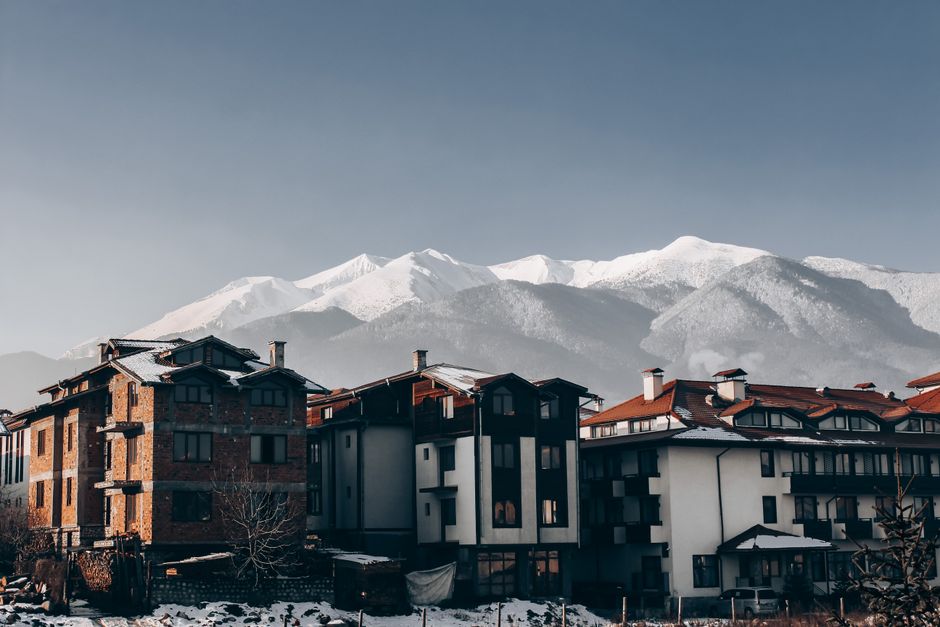
Bansko is Bulgaria’s best-known ski resort and a year-round mountain town at the foot of the Pirin, about 160 km south of Sofia. Its old quarter of stone houses, walled courtyards and cosy taverns (mehani) serving slow-cooked meat and local wine sits below a gondola that climbs into a ski area of pine forest and open slopes under the marble peaks of Pirin National Park, a UNESCO World Heritage Site. Winter brings skiers from across Europe; summer brings hikers heading for glacial lakes and the summit of Vihren, jazz fans for the August festival, and travellers on the slow narrow-gauge train through the mountains. Give it a long weekend in summer or a week of skiing.
Right now in Bansko
- Wed 9–20°C 49–68°F Partly cloudy
- Thu 9–21°C 49–70°F Mostly clear
- Fri 12–22°C 53–71°F 6 mm Partly cloudy
Weather: MET Norway (CC BY 4.0) · Rates: ECB
Top tours in Bansko
See all tours for Bansko →
From local operators, with prices and reviews; you check availability and book on Viator, our partner. We may earn a commission at no extra cost to you. How we earn money
Bansko at a glance
- Best for: skiing and snowboarding on a budget, Pirin hiking and lakes, the old town’s taverns, the Bansko Jazz Festival and the narrow-gauge railway.
- How long: a week for a ski holiday; 3–4 days in summer for the old town, the gondola and two mountain hikes.
- Season: as of October 2026, the operator lists the 2026/27 winter season from 1 December 2026 to 11 April 2027, depending on snow; summer hiking is best from July to September.
- Getting in: about 2 hours 30 minutes to 3 hours by car or bus from Sofia and its airport; the narrow-gauge train from Septemvri takes about 4 hours 30 minutes.
- Getting around: the town is walkable; the gondola starts at the southern edge of town, and ski buses and taxis link the hotels.
- Before you go: Bulgaria has used the euro since 1 January 2026 and is a full Schengen member; country-wide entry rules, money and driving are covered on our Bulgaria country page.
How Bansko works: the town, the gondola and the mountains
Bansko lies at about 900–950 m on the edge of the Razlog valley, with the Pirin rising directly to the south. The old town, around Nikola Vaptsarov Square and the Holy Trinity Church, is a protected area of 18th- and 19th-century houses built like small fortresses, with thick stone walls, heavy wooden gates and hidden courtyards. South of it, a newer district of hotels and apartments runs up Pirin Street to the gondola station at the top of town.
The gondola climbs from Bansko to Banderishka Polyana, a meadow at about 1,600 m at the heart of the ski area, where chairlifts continue up to Shiligarnik, Chalin Valog and the Plato area below Todorka peak, at more than 2,500 m. In winter, a long ski road brings skiers back down through the forest to the bottom of the gondola. In summer, the same gondola takes hikers and walkers up for views, mountain cafés and trails. A few kilometres east, the town of Razlog and the village of Dobrinishte, with its hot mineral springs, are quieter alternatives.
Top things to see in Bansko
Prices and times below are as of October 2026, from the official ski-area operator’s site where it publishes them.
The old town and the Holy Trinity Church
Walk the cobbled lanes of the old town to see its stone houses and carved gates. The Church of the Holy Trinity, finished in 1835 with permission from the Ottoman authorities on condition that it was no taller than the mosque, has a high stone wall around it, a bell tower added later and an interior full of icons and murals by local painters of the Bansko school. Several house-museums show how wealthy merchant families lived: the Velyanov House, with painted rooms by the master Velyan Ognev, the house of the 19th-century scholar Neofit Rilski, and the house of the poet Nikola Vaptsarov on the main square. Entry fees are small; check hours locally, as some close on Mondays or out of season.
The gondola to Banderishka Polyana
The gondola is the way into the mountains in both seasons. As of October 2026, a return ticket costs €27 for adults, €24 for students aged 12 to 18 and retirees under 75, €19 for children aged 7 to 11 and €0.60 for under-7s, according to the operator’s price list. Its summer and autumn 2026 timetable: from 27 June to 6 September it ran daily in both directions from 08:00 to 16:30; outside that period, and until 30 November 2026, it runs on weekdays in one direction only, up at 08:00 and down at 16:30, so check before planning a walk. In winter the gondola runs from 08:30 to 17:00 and the other lifts from about 08:45 to 16:15.
Pirin National Park and Vihren
Pirin National Park, a UNESCO World Heritage Site since 1983, protects the highest part of the Pirin: limestone and granite peaks, about 170 glacial lakes, pine and fir forests and endemic flowers such as the Pirin poppy. Its highest point, Vihren (2,914 m), is the second-highest peak in Bulgaria. The classic climb starts at the Vihren hut (about 1,950 m), reached by a mountain road of about 16 km from Bansko, and takes about three hours up on a steep, rocky marked path; experienced hikers can continue along the exposed Koncheto ridge. On the way to the hut, stop at Baykusheva Mura, a Bosnian pine over 1,300 years old, one of the oldest trees in Bulgaria.
Lakes and easier walks
Gentler walks start at the Vihren and Banderitsa huts: the Fish Lakes and the Frog Lake above Banderitsa, the Valyavitsa lakes, or the trail from the top of the gondola to Todorka peak in summer. Further east, the Bezbog hut, reached by chairlift from near Dobrinishte in summer, is the start for Popovo Lake, the largest in Pirin. Trails are well marked, but most start above 1,800 m, so the season is short: usually July to September.
Museums
- Neofit Rilski House Museum
- Nikola Vaptsarov House Museum
- Velyanov House
Churches and cathedrals
- Holy Trinity Church, Bansko
Nature
- Baykusheva Mura (Baikushev's Pine)
- Pirin National Park
Viewpoints
- Vihren
Skiing in Bansko: season and lift passes 2026/27
Bansko is Bulgaria’s biggest and most modern ski area, with fast lifts, snowmaking on the main runs and slopes for every level; it hosts FIS Alpine and snowboard World Cup races. As of October 2026, the operator lists the 2026/27 season from 1 December 2026 to 11 April 2027, subject to snow.
- Season passes: until 1 December 2026, seasonal and year-round passes for 2026/27 are on sale at early-booking prices: €870 for adults, €820 for students aged 12 to 18 and retirees under 75, €460 for children aged 7 to 11 and €55 for children under 7 and retirees over 75, from MAXSPORT shops in Sofia and Bansko and the cash desks at the bottom of the gondola. The year-round pass is only for Bansko Loyalty Club members.
- Day and multi-day passes: the operator had not published daily prices for 2026/27 as of October 2026. For reference, in the 2025/26 peak season (27 December to 31 March) a 1-day adult pass cost €59, 3 days €172 and 6 days €341, and a child pass (7 to 11) €30 a day; half-day passes from 12:30 cost €46. Expect similar prices; check the operator’s site before you book.
- Gondola queues: the morning queue at the bottom of the gondola can be long in high season. Go up early, or buy a season pass, which includes a fast-access corridor. Some hotels run minibuses to the gondola.
- Ski school and hire: many schools and rental shops in town and at Banderishka Polyana; lessons in English are easy to find.
The busiest weeks are Christmas, New Year and the February school holidays in Britain and elsewhere; January and March are quieter.
The Rhodope narrow-gauge railway
Bansko is a stop on Bulgaria’s last working narrow-gauge passenger line, the 760 mm railway from Septemvri, on the main Sofia–Plovdiv line, to Dobrinishte, about 125 km of curves, tunnels and bridges through the Rhodope and Rila foothills via Velingrad, Avramovo, Yakoruda, Razlog and Bansko. Avramovo, at about 1,267 m, is often called the highest railway station in the Balkans. On BDZ’s October 2026 timetable, four trains a day run in each direction, taking about 4 hours 20 minutes to 4 hours 50 minutes for the whole line; one daily service is a fast train with compulsory seat reservation and a buffet. It is slow but beautiful, and very cheap: sit on the right-hand side for the best river views between Septemvri and Velingrad. Timetables change during repair works, so check the BDZ timetable for your date.
Bansko Jazz Festival and other events
Every August, the Bansko Jazz Festival fills the main square with free open-air concerts by Bulgarian and international musicians, and the town’s taverns stay busy late into the night. The 2026 festival ran from 31 July to 9 August, when the operator also ran the Banderitsa chairlifts to the foot of Todorka peak; the 2027 dates had not been announced as of October 2026, but it is usually in early August. In winter, the town hosts ski World Cup races and New Year celebrations on the square.
Activities and best months
- HikingJulAugSepBansko, at the foot of the Pirin, is the starting point for routes to the Banderitsa, Demyanitsa and Vihren huts and the Tevno lake shelter; Vihren (2,914 m) is Pirin's highest peak. In summer 2026 the gondola to Banderishka Polyana ran daily in both directions from 27 June to 6 September (08:00-16:30), and on weekdays one way only outside that period until 30 November. · source
Getting there and around
From Sofia and Sofia Airport. Bansko is about 160 km south of Sofia, about 2 hours 30 minutes to 3 hours by car via the Struma motorway and the road over the Predela pass. Buses run several times a day from Sofia’s Central Bus Station in about three hours; in winter, shuttle transfers run from Sofia Airport. Plovdiv is about 2 hours 30 minutes by car.
By train. Take a BDZ train from Sofia or Plovdiv to Septemvri (about 2 hours 15 minutes from Sofia), then the narrow-gauge train to Bansko (about 4 hours). It is a scenic journey rather than a fast one.
Driving. Motorways and most main roads outside towns need the e-vignette (one day €5.30, weekend €6.60, one week €10 for a car as of October 2026), bought online at bgtoll.bg. In winter, carry chains or have winter tyres, and allow extra time on the Predela pass and the road to the Vihren hut, which closes in snow.
In town. Walk, or use the local ski buses and taxis to reach the gondola. In summer, minibuses and taxis go up the road to the Vihren hut for hikers.
Nearby destinations
When to go and how long to stay
Bansko has snowy winters and warm, sunny summers with afternoon thunderstorms in the mountains. Bulgaria’s National Institute of Meteorology and Hydrology (NIMH) publishes no climate normals for Bansko itself, so the table shows two reference points: Blagoevgrad, about 60 km west in the Struma valley at about 400 m (NIMH 1991–2020 normals), and Musala peak, the highest weather station in the Balkans at 2,925 m in the Rila range (WMO 1991–2020 normals). Bansko, at about 930 m, is several degrees colder than Blagoevgrad; the ski area’s upper slopes are closer to the mountain figures.
| Season | Average temperature, Blagoevgrad (400 m) | Average temperature, Musala (2,925 m) | What it’s like in Bansko |
|---|---|---|---|
| Winter (Dec–Feb) | 1.2–3.6 °C | about −10 °C | Ski season, cold and snowy; the town is busy |
| Spring (Mar–May) | 7.6 °C rising to 17 °C | −8 °C rising to 0 °C | Late ski days in March; quiet in April and May |
| Summer (Jun–Aug) | 21–23.5 °C | 4–6 °C | Warm days in town, cool at altitude; best hiking |
| Autumn (Sep–Nov) | 18.5 °C falling to 7.4 °C | 3 °C falling to −4 °C | Clear, golden September; first snow on the peaks |
Blagoevgrad gets about 550 mm of rain a year, and the high Rila and Pirin about 830 mm or more, much of it as snow. Summer storms are common after midday above the tree line, so start hikes early.
A ski week in Bansko
Six days on the slopes, with a rest afternoon at the hot springs of Dobrinishte or Banya, and evenings in the old town’s taverns. If the snow is thin, Borovets and Pamporovo are other options a few hours away.
3 days in summer
Day 1: the old town, the Holy Trinity Church and the Velyanov House, then dinner in a tavern. Day 2: the Vihren hut and Baykusheva Mura, with the climb to Vihren for fit hikers or a lake walk for everyone else. Day 3: the gondola to Banderishka Polyana for a walk, or the narrow-gauge train to Avramovo and back.
Weather month by month
Averages from NIMH normals 1991–2020, Sofia · Last reviewed 4 Oct 2026
Where to stay in Bansko
- The old town: family-run guesthouses in stone houses, close to the taverns; a 10–20 minute walk or ski-bus ride to the gondola.
- Near the gondola: ski-in, ski-out hotels and apartments on Pirin Street and around the lift station; the most convenient for skiers.
- Razlog and Dobrinishte: cheaper hotels and spa resorts a few kilometres away, best with a car.
Prices peak at Christmas, New Year and in February, and are much lower in summer and in late March. A small tourist tax per night is added to most bills.
Practical tips for Bansko
- Book the season pass early: the early-booking price for 2026/27 ends on 1 December 2026.
- Beat the gondola queue: be at the bottom station before 08:30 in high season.
- Mountain safety: in the national park, stay on marked trails, carry water and layers, and turn back if storms build; call 112 for mountain rescue.
- Check the gondola: outside July and August it runs on weekdays in one direction only until the ski season.
- Cash: carry some euros for huts, taxis and small taverns.
- Respect the park: no wild camping or fires outside permitted areas, and leave the flowers.
What to pack for Bansko
In winter: warm ski clothing, gloves, a helmet (or hire one), goggles, sunglasses and high-factor sunscreen for the strong mountain sun, plus boots with good grip for the icy streets. In summer: proper hiking shoes for the rocky Pirin trails, a waterproof jacket (see our guide to rain jackets) and warm layers, a sun hat and enough water for long climbs. Bring a type F or C plug adapter if you need one. See our guide to hiking.
What to pack
- Day packs and anti-theft bagsA 20–30 litre pack carries layers, water, a head torch and snacks on full-day levada walks.
- Fleeces and warm layersSummits like Pico do Areeiro averaged about 11 °C over 2024, so a fleece is needed even in summer.
- HeadlampsLevada routes such as PR1 and PR9 pass through long, dark, wet tunnels.
- Hiking shoes and bootsMadeira's levadas and the Azores' crater rims are wet, rocky and slippery, so grippy shoes matter more than anywhere else in Portugal.
- Rain jacketsMountain and island weather changes fast; a real shell beats an umbrella in the wind.
- Trekking polesLong stone staircases and steep descents on Madeira's peaks and the Azores' crater rims are easier on the knees with poles.
- Water bottles and hydration packsAlgarve and Alentejo trails are hot and exposed with few refill points.
Bansko travel FAQ
When does the ski season start in Bansko in 2026?
As of October 2026, the operator lists the 2026/27 season from 1 December 2026 to 11 April 2027, depending on snow conditions.
How much is a ski pass in Bansko for 2026/27?
A season pass costs €870 for adults if bought by 1 December 2026. Daily prices for 2026/27 had not been published as of October 2026; in the 2025/26 peak season a 1-day adult pass cost €59 and 6 days €341.
How much is the Bansko gondola?
As of October 2026, a return ticket costs €27 for adults, €24 for students and retirees under 75, and €19 for children aged 7 to 11.
Does the Bansko gondola run in summer?
Yes. In summer 2026 it ran daily in both directions from 27 June to 6 September; from 7 September to 30 November it runs on weekdays, up at 08:00 and down at 16:30.
How hard is the climb to Vihren?
It is a steep, rocky hike of about three hours up from the Vihren hut (about 1,950 m) to the 2,914 m summit, with about 950 m of ascent. It is non-technical in summer, but you need good shoes, fitness and settled weather.
How do I get from Sofia to Bansko?
By car or bus in about 2 hours 30 minutes to 3 hours, or by train to Septemvri and the narrow-gauge line, which takes much longer. In winter, transfers run from Sofia Airport.
How long does the narrow-gauge train take?
On BDZ’s October 2026 timetable, about 4 hours 20 minutes to 4 hours 50 minutes for the whole line from Septemvri to Dobrinishte, with four trains a day each way. Septemvri to Bansko takes about 4 hours.
When is the Bansko Jazz Festival?
Usually in early August. The 2026 festival ran from 31 July to 9 August; 2027 dates had not been announced as of October 2026.
Is Bansko good for beginners?
Yes. There are nursery slopes and easy runs at Banderishka Polyana and Chalin Valog, many ski schools with English-speaking instructors, and cheap equipment hire.
When is the best time for hiking in the Pirin?
July to September, when the high trails and lakes are usually free of snow. Start early to avoid afternoon storms.
Sources
- © OpenStreetMap contributors · ODbL · fetched 4 Oct 2026
- Wikidata · CC0 · fetched 4 Oct 2026
Sources and last review
Researched and last reviewed on 4 October 2026. Ski season dates, season-pass prices, the 2025/26 and off-season lift prices, gondola fares and timetables, and the Bansko Jazz Festival lift dates: the ski-area operator (banskoski.com); narrow-gauge train times: BDZ; climate: the 1991–2020 normals of the National Institute of Meteorology and Hydrology (NIMH) for Blagoevgrad and the WMO 1991–2020 normals for Musala; Pirin’s UNESCO listing: UNESCO; vignette prices: BG TOLL and Bulgarian National Television. Daily lift prices for 2026/27 were not yet published. Vihren hut distances and hiking times, the Bezbog chairlift, bus and car journey times and house-museum details come from general knowledge or secondary sources and are flagged for checking. Prices, timetables and rules change, so check the official links before you go.
Plan your trip
Partner links: TravelerCenter may earn a commission if you book, at no extra cost to you.
🇧🇬 Useful Bulgarian phrases for Bansko
All 38 Bulgarian phrases: restaurant, hotel, emergencies, romance (printable) →