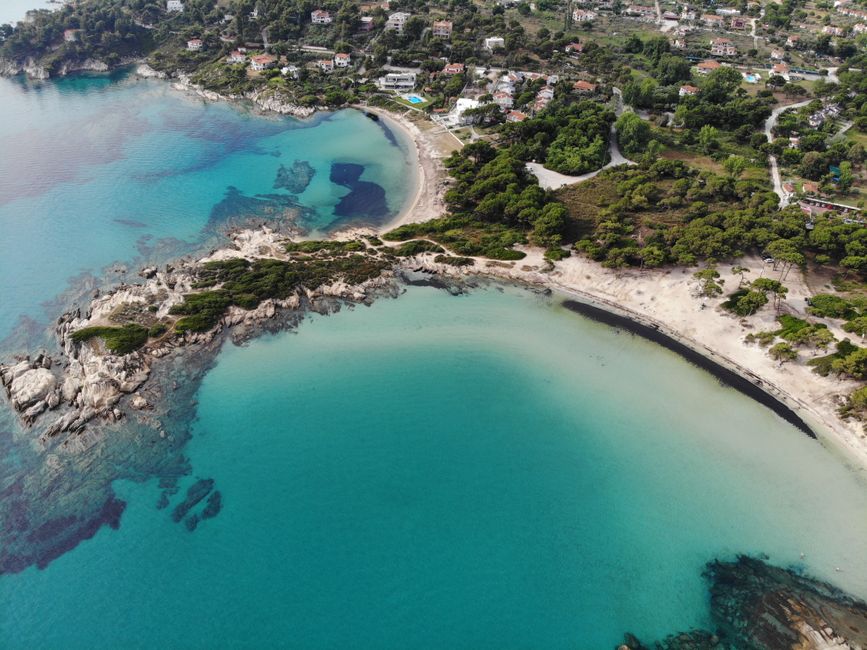
Halkidiki is the summer playground of northern Greece: a big peninsula south-east of Thessaloniki that ends in three long “fingers” reaching into the Aegean, each with its own character. Kassandra, the nearest, is lively, with sandy beaches, big resorts and beach bars. Sithonia, in the middle, is wilder and greener, with pine forests running down to coves of white sand and turquoise water. The third finger is Mount Athos, a self-governing monastic republic of twenty monasteries that only men with a special permit may enter, though anyone can admire it from the sea on a boat cruise from Ouranoupoli. Add Aristotle’s birthplace at ancient Stagira, a cave where one of Europe’s oldest human skulls was found, honey and green olives, and beaches that won more Blue Flags in 2026 than any other part of Greece. Come from June to September for swimming, or in May and October for quiet walks, and give it four days to a week.
Right now in Halkidiki (Nikiti)
- Wed 16–24°C 60–74°F Mostly clear
- Thu 16–23°C 61–74°F Mostly clear
- Fri 17–25°C 63–77°F Clear
Weather: MET Norway (CC BY 4.0) · Sea temperature: NOAA CoastWatch · Rates: ECB
Top tours in Halkidiki
See all tours for Halkidiki →
From local operators, with prices and reviews; you check availability and book on Viator, our partner. We may earn a commission at no extra cost to you. How we earn money
Halkidiki at a glance
- Best months: June and September for swimming without the peak crowds; July and August are hot and busy. Average highs at nearby Thessaloniki run from about 25 °C in May to 32 °C in July and August, while winters are cold, around 10–11 °C by day (HNMS normals 1991–2020). Most resorts open from May to October.
- Days needed: 1 for a quick beach day from Thessaloniki; 4–7 to explore Kassandra and Sithonia, cruise along Mount Athos and see Stagira or Petralona.
- Getting there: fly into Thessaloniki airport (SKG), then drive about an hour to the first beaches of Kassandra, about 1½ hours to Sithonia and 2 hours to Ouranoupoli; KTEL Chalkidikis buses run from Thessaloniki.
- Getting around: a car is by far the easiest; buses link the main resorts with Thessaloniki but rarely each other.
- Budget level: wide range, from campsites and family-run rooms to some of Greece’s most expensive resorts on Kassandra. Like everywhere in Greece, a climate resilience fee is added per room per night (€2–€15 from April to October, depending on the type of accommodation). See our Greece guide for money, entry rules and daily costs.
Halkidiki’s peninsulas, and who each one suits
- Kassandra (the first finger): the closest to Thessaloniki, flatter and the most developed, with long sandy beaches, the resort villages of Kallithea, Pefkochori and Chanioti, beach bars and nightlife, and the luxury resorts of Sani and Possidi in the west. For families, groups of friends and short trips from the city.
- Sithonia (the middle finger): hillier and greener, ringed by pine-backed coves, campsites and small resorts such as Nikiti, Neos Marmaras, Vourvourou, Sarti and Toroni. For nature lovers, campers, snorkellers and couples.
- Athos peninsula (the third finger): the land side has the villages of Ierissos and Nea Roda, the little island of Ammouliani and the port of Ouranoupoli, the last village before the monastic state. For boat trips, history and quiet beaches.
- The north and the mountains: Polygyros, the capital, the forested Holomontas range with the villages of Arnaia and Taxiarchis, and the west coast around Nea Moudania and Nea Potidea. For cooler air, villages and local life.
Top things to see in Halkidiki
Prices and hours of state sites come from the Greek Ministry of Culture’s ticketing service (Hellenic Heritage), as of October 2026. At all state sites entry is free for all under-18s and EU citizens under 25 with ID, and on a few set days a year.
Mount Athos: the monastic republic
Mount Athos has been a centre of Orthodox monasticism for more than a thousand years. Twenty great monasteries, many founded in Byzantine times, cling to its cliffs and shores below the marble peak of Athos (2,033 m), along with sketes, cells and hermitages, and the whole peninsula is a UNESCO World Heritage Site. It governs itself under Greek sovereignty, with its capital at Karyes, and keeps its ancient rules. The most famous is the avaton: no women may enter, and only men may visit.
- Who can go: adult men, and boys under 18 only with their father (or with written, certified parental consent). Women and girls cannot enter the monastic state, but anyone can see it from the sea (see below).
- The permit (diamonitirio): every visitor needs this entry permit, issued by the Mount Athos Pilgrims’ Office. Numbers are strictly limited, to about 100 Orthodox and 10 non-Orthodox visitors a day, so book months ahead through the Pilgrims’ Office in Thessaloniki, then collect the permit in person with your passport at the Pilgrims’ Office in Ouranoupoli on the morning you sail. A standard permit allows a stay of four days (three nights) on fixed dates, sleeping in monasteries that you must also contact in advance. The fee, paid on collection, has been reported at €30 (€10 for students); check it with the Pilgrims’ Office.
- Getting in: there are no roads into Mount Athos from the outside: pilgrims take the morning ferry from Ouranoupoli to the port of Dafni, then a bus up to Karyes, or small boats along the coast to the monasteries. Dress modestly (long trousers and sleeves), follow the monasteries’ daily routine and ask before taking photos.
Ouranoupoli and the Athos boat cruises
For everyone else, women included, the way to see Mount Athos is a coastal cruise from Ouranoupoli. From spring to autumn, boats sail down the south-west coast of the peninsula for about three hours, passing the great monasteries of Dochiariou, Xenophontos, Agios Panteleimon (the Russian monastery) and Simonopetra, perched on its rock, at a set distance from the shore. Book at the harbour or online; sea conditions can cancel sailings. In Ouranoupoli itself, the Byzantine Prosforios Tower on the seafront, which once belonged to Vatopedi monastery, has a small museum on its history and on the refugees who settled here in the 1920s (€5, €3 reduced; from April to October 8:30–15:30, closed on Tuesdays; closed in winter). Just outside the village, the walled Zygos Monastery, an 11th-century monastery left outside Athos when its border was redrawn, is open to women as well as men (€5, €3 reduced; 8:30–15:30, closed on Tuesdays). See our boat trips guide.
Ancient Stagira, Aristotle’s birthplace
The philosopher Aristotle was born in 384 BC in Stagira, a city founded by colonists from Andros on a small, pine-covered headland near today’s Olympiada, on the east coast. Philip II of Macedon destroyed it in 349 BC and later rebuilt it at the request of Aristotle, who was tutoring his son Alexander. Paths wind past city walls, towers, the agora, a stoa and houses, with sea on three sides and a little beach below. How to visit: entry is free; it opens 8:30–15:30 all year, closed on Tuesdays. It is about 1½ hours’ drive from Thessaloniki. The modern village of Stagira, up in the hills, has an Aristotle Park with a statue of the philosopher and simple instruments that bring his science to life.
Petralona Cave
At the foot of Mount Katsika, about 50 minutes from Thessaloniki, villagers looking for water found the Petralona Cave in 1959. A year later, a human skull was found inside, dated to between 150,000 and 300,000 years ago, the most important fossil of early humans in Greece. The cave covers about 10,000 m², with stalactites and stalagmites and fossils of bears, hyenas and big cats; it reopened in February 2024 after restoration. The Anthropological Museum next door displays the finds and stone tools. How to visit: the cave is €10, €5 reduced, and the museum €5, €3 reduced. From April to October both open daily 8:00–20:00; from November to March 8:30–15:30, closed on Tuesdays. Last entry is 20 minutes before closing.
Olynthus, Polygyros and the Xerxes canal
Olynthus, near the base of Kassandra, was the most important city of Halkidiki in classical times, laid out on a grid plan on two hills, until Philip II destroyed it in 348 BC; its house plans and mosaics show daily life 2,400 years ago (€10, €5 reduced; 8:30–15:30, closed on Tuesdays). The Archaeological Museum of Polygyros, in the regional capital, gathers finds from across the peninsula, with digital displays on Aristotle (€10, €5 reduced; 8:30–15:30, closed on Tuesdays). On the neck of the Athos peninsula, near Nea Roda, faint traces remain of the Xerxes canal, dug by the Persian king around 480 BC so that his fleet could avoid the storms off Mount Athos that had wrecked an earlier Persian fleet.
Beaches in Halkidiki
Halkidiki’s beaches are its biggest draw: in 2026 the regional unit had 93 Blue Flag beaches, more than any other in Greece, among them Sani, Possidi, Kallithea and Pefkochori on Kassandra, Nikiti, Toroni and Sarti on Sithonia, and Ouranoupoli and Ierissos on the Athos side. The water is calm and shallow on most of the west coasts and clearer and deeper on the rocky south of Sithonia.
- Sani and Possidi (Kassandra): long sandy beaches on the west coast, Sani backed by dunes and wetlands, Possidi on a thin sandy cape with a lighthouse. Shallow and family-friendly.
- Kallithea and Pefkochori (Kassandra): lively organised beaches on the east coast, with beach bars and water sports.
- Karydi (Sithonia): near Vourvourou, a small cove of white sand and smooth, sculpted rocks with shallow turquoise water; magical early in the morning.
- Kavourotrypes (Sithonia): a string of tiny white-sand coves between pine trees and granite rocks on the east coast, very busy in August. Arrive early, and leave nothing behind.
- Kalamitsi and Toroni (Sithonia): wide, sheltered sandy bays in the south, with tavernas and campsites; Toroni has the ruins of a Byzantine castle on its headland.
- Ammouliani: a small, flat island off the Athos coast with sandy beaches such as Alykes and Agios Georgios, reached by a short car ferry from Tripiti.
Under Greece’s coastal law, part of every organised beach must be left free of sunbeds and you can always reach the water with your own towel. See our beaches guide and our snorkeling guide.
Boat trips, diving and hiking
- Boat trips: besides the Athos cruises, boats from Vourvourou visit the small islands of the Diaporos bay, a lagoon-like inlet of turquoise water; licence-free motorboats can be rented in Vourvourou and Neos Marmaras, and day cruises circle the coast of Sithonia.
- Diving and snorkelling: the rocky coasts of Sithonia and the Athos side have clear water, reefs and walls; licensed dive centres operate in the resorts. See our diving guide.
- Hiking and cycling: marked trails climb Mount Itamos in the centre of Sithonia and through the chestnut and oak forests of Holomontas around Taxiarchis; spring and autumn are best. See our hiking guide and our cycling guide. From 1 May to 31 October, Greece’s fire-season rules apply: no fires outdoors, and forests can be closed on very-high-risk days.
Food and wine in Halkidiki
Halkidiki is famous for its big, fleshy green olives, its pine and thyme honey (the hill village of Arnaia has a honey tradition) and its mussels and fresh fish, best eaten at a taverna on the water in Nea Moudania, Nikiti or Ouranoupoli. On Sithonia, the vineyards around Neos Marmaras grow international and Greek grapes and welcome visitors for tastings; see our wine tasting guide. Try bougatsa for breakfast, and the chestnut sweets of the mountain villages in autumn.
Day trips from Halkidiki
Thessaloniki, an hour from Kassandra, makes an easy day out for its Byzantine churches, the White Tower, the waterfront and some of the best food in Greece. Further away, the monasteries of Meteora are a long day by car (allow at least 3½–4 hours each way from Halkidiki), better with a night in Kalambaka. On the Athos side, combine an Athos cruise with a swim on Ammouliani.
Nearby destinations
Getting there and getting around
Flights and Thessaloniki airport
Thessaloniki “Makedonia” airport (SKG) has flights from Athens (about 50 minutes) and many European cities, and it sits on the south-east edge of the city, on the way to Halkidiki. From the airport, the drive is about an hour to the start of Kassandra, about 1½ hours to Nikiti and Sithonia, and about 2 hours to Ouranoupoli. Many hotels and agencies arrange transfers, and car hire desks are at the airport. See our Thessaloniki guide for airport buses into the city.
KTEL Chalkidikis buses
KTEL Chalkidikis runs the long-distance buses from its own terminal in Thessaloniki, on the Thessaloniki–Nea Moudania road (9th km), in the south-eastern suburbs, to Kassandra, Sithonia, Polygyros and the Athos side, including Ierissos and Ouranoupoli. Note that this is not the city’s main KTEL Macedonia terminal in the west: city buses link the two, and taxis from the airport are short. Tickets can be bought online, through the company’s app or at the terminal. Services are frequent in summer and much fewer in winter, and buses between the peninsulas are rare, so a car is the practical choice for exploring.
Driving
A dual carriageway runs from Thessaloniki towards Nea Moudania; beyond it, roads are good but get very busy on summer weekends, when half of Thessaloniki heads to the beaches. The coast roads of Sithonia are winding and slow, so allow time. The Kassandra peninsula is joined to the mainland across the narrow Potidea canal. You need a driving licence valid for the vehicle (from outside the EU, usually with an International Driving Permit); helmets are compulsory on scooters and quads.
When to go and how long to stay
Halkidiki has hot summers and colder winters than the southern islands. The swimming season runs from June to September, often into early October; July and August are hottest and busiest, especially at weekends, with Greek families and visitors from the Balkans. May, June and September are the sweet spot. From November to April most beach hotels and tavernas close, but the mountain villages, Polygyros and the sites stay open, and autumn is lovely for walking among the chestnut trees.
| Season | Average high / low | What it’s like |
|---|---|---|
| Spring (Mar–May) | 15–25 °C / 6–14 °C | Green and quiet; good for walking and sites; sea still cool; resorts open from May. |
| Summer (Jun–Aug) | 30–32 °C / 19–21 °C | Hot and sunny, sometimes humid; warm sea; peak crowds at weekends. |
| Autumn (Sep–Nov) | 16–27 °C / 8–17 °C | September is ideal for beaches; resorts close during October; chestnut season inland. |
| Winter (Dec–Feb) | 10–11 °C / 2–4 °C | Cool, damp and quiet; most beach places closed; occasional snow on the mountains. |
Temperatures are the 1991–2020 climate normals of the Hellenic National Meteorological Service (HNMS) for its Thessaloniki airport station, the nearest station with published normals; the coasts of Kassandra and Sithonia are usually a little milder in winter. Greece’s wildfire season runs from 1 May to 31 October: on days of high fire risk (category 4–5 on the daily map of the Ministry of Climate Crisis and Civil Protection), forests may be closed and any outdoor fire is banned. Halkidiki’s pine forests burn easily, so never light a fire or barbecue outdoors, and call 112 if you see a fire.
3 days in Halkidiki
Day 1: drive from Thessaloniki, stop at Petralona Cave, then swim at Sani or Possidi on Kassandra. Day 2: cross to Sithonia for Karydi in the morning, a boat around the Diaporos islands from Vourvourou and the sunset at Neos Marmaras. Day 3: the Athos cruise from Ouranoupoli, a swim on Ammouliani, and back to Thessaloniki.
5–7 days in Halkidiki
Split your stay between Sithonia (three or four nights) and the Athos side or Kassandra (two or three). Add ancient Stagira and a swim below it, Olynthus and the Polygyros museum, a drive round the south of Sithonia via Sarti, Toroni and Kalamitsi, a hike on Mount Itamos or in the Holomontas forests, and a day in Thessaloniki at the end.
Where to stay in Halkidiki
- Close to Thessaloniki, families and nightlife: Kassandra, with Kallithea, Pefkochori and Chanioti for a lively stay and Sani or Possidi for big resorts.
- Nature and coves: Sithonia, around Vourvourou, Nikiti, Sarti or Toroni, including some of Greece’s best seaside campsites.
- Athos cruises and pilgrims: Ouranoupoli or Ammouliani, the starting point for boats along Mount Athos.
- Cooler and local: the mountain villages of Arnaia and Taxiarchis, with a car.
Greece adds a climate resilience fee per room per night, set by type of accommodation, usually paid at the property (from April to October €2 for 1–2-star hotels and rooms up to €15 for 5-star hotels; campsites and youth hostels are exempt).
Practical tips for Halkidiki
- Avoid summer weekends on the road: traffic from Thessaloniki builds on Friday evenings and Saturday mornings, and back on Sunday evenings.
- Mount Athos: men only, with a permit booked well ahead; everyone else can take the cruise from Ouranoupoli.
- Go early to famous coves: Karydi and Kavourotrypes fill up by late morning in July and August.
- Fire risk: no barbecues or fires outdoors from May to October; follow 112 alerts.
- Emergencies: call 112; tourist police 1571; coast guard 108.
What to pack for Halkidiki
Pack light summer clothes, a sun hat, sunglasses, high-factor sunscreen and a refillable water bottle, plus a swimsuit, a snorkel mask and water shoes for the rocky coves of Sithonia. Bring walking shoes for Stagira and the forest trails, a light layer for evening boat trips, and a scarf to cover shoulders in churches and at Zygos. Men visiting Mount Athos need long trousers, long-sleeved shirts and their passport. From October to April, pack a warm jacket.
Halkidiki travel FAQ
Which is better, Kassandra or Sithonia?
Kassandra is closer to Thessaloniki and livelier, with long sandy beaches, resorts and nightlife. Sithonia is wilder and greener, with pine forests, quiet coves and campsites. Many visitors stay on Sithonia and visit Kassandra for a day.
Can women visit Mount Athos?
No. Women may not enter the monastic state. Everyone, women included, can see the monasteries from the sea on a boat cruise from Ouranoupoli, and visit the Zygos Monastery and the Prosforios Tower just outside its border.
How do I get a permit to visit Mount Athos?
Men apply for a diamonitirio through the Mount Athos Pilgrims’ Office, months ahead, then collect it in person with a passport in Ouranoupoli before the morning ferry. Only about 10 non-Orthodox and 100 Orthodox visitors are admitted a day, usually for four days.
How long is the Mount Athos boat cruise?
About three hours from Ouranoupoli, along the south-west coast past several monasteries, from spring to autumn, weather permitting.
How much does Petralona Cave cost?
€10, or €5 reduced, as of October 2026, with the museum €5 extra (€3 reduced). From April to October it opens daily 8:00–20:00; in winter 8:30–15:30, closed on Tuesdays.
Is ancient Stagira worth visiting?
Yes, for Aristotle’s birthplace on a beautiful headland with the sea on three sides. Entry is free; it opens 8:30–15:30 and closes on Tuesdays.
How do I get from Thessaloniki airport to Halkidiki?
By hire car or transfer, about an hour to Kassandra and two hours to Ouranoupoli; or by KTEL Chalkidikis bus from its terminal on the Nea Moudania road, a short taxi or city-bus ride from the airport.
What are the best beaches in Halkidiki?
Karydi and Kavourotrypes on Sithonia for white sand and turquoise coves, Kalamitsi for a wide bay, and Sani and Possidi on Kassandra for long sandy beaches.
Do I need a car in Halkidiki?
It is strongly recommended. KTEL buses link the resorts with Thessaloniki, but rarely each other, and the best coves are off the bus routes.
When is the best time to visit Halkidiki?
June and September: hot, sunny, a warm sea and fewer people than in July and August. Most resorts are open from May to October.
Sources and last review
Researched and last reviewed on 4 October 2026. Prices and hours of Petralona Cave, ancient Stagira, Olynthus, the Polygyros museum, the Prosforios Tower and Zygos Monastery come from the Greek Ministry of Culture’s Hellenic Heritage service, with travel times from Thessaloniki as published there. Mount Athos rules come from the Mount Athos Center (Agioritiki Estia); the permit fee and cruise details were not confirmed on an official page and should be checked. Bus information comes from KTEL Chalkidikis and airport information from our Thessaloniki guide; Blue Flag beaches from the Blue Flag programme in Greece. The climate resilience fee is set by Greek tax law and collected by AADE. Climate figures are the HNMS 1991–2020 normals for Thessaloniki. Check the Pilgrims’ Office, KTEL Chalkidikis and the boat operators before you travel.
Plan your trip
Partner links: TravelerCenter may earn a commission if you book, at no extra cost to you.
🇬🇷 Useful Greek phrases for Halkidiki
All 38 Greek phrases: restaurant, hotel, emergencies, romance (printable) →