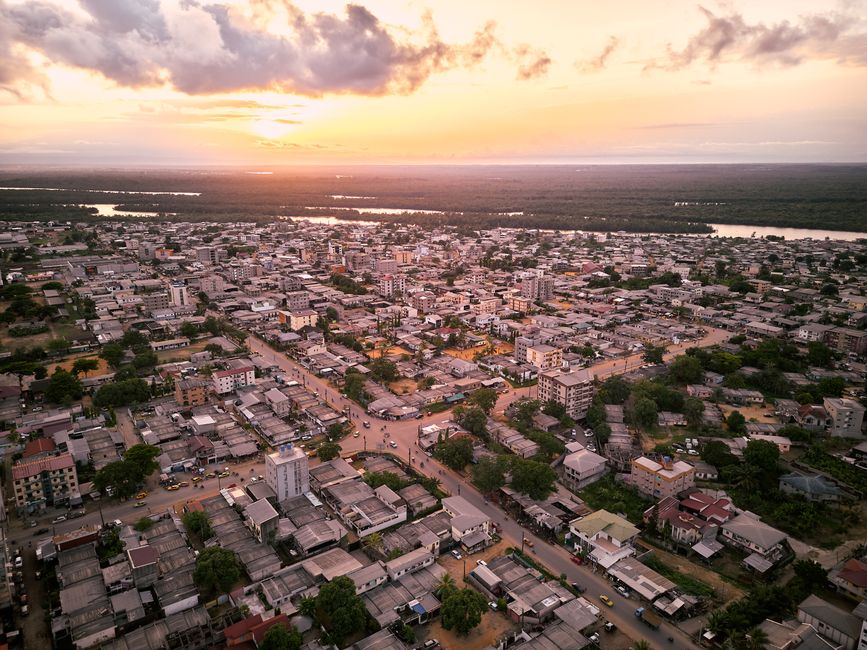
Douala is Cameroon’s largest city, its main port and its economic capital: a hot, humid, energetic city spread along the wide Wouri estuary, where most visitors to the country arrive. It isn’t a polished tourist city, but it rewards a couple of days: the old colonial quarter of Bonanjo with the Pagode, the palace of the Bell kings; the cathedral and the Maritime Museum; a remarkable collection of public art; huge markets; and some of the best food and live music in Central Africa, from grilled fish by the river to makossa, the dance music born here. Douala is also the gateway to the beaches of Kribi, the waterfalls of the Littoral and the coast at Limbe. Almost every visitor needs a visa applied for online at evisacam.cm, and a yellow fever certificate. December to February is the driest and most pleasant time; give it two days.
Right now in Douala
- Sat25–32°C77–90°F1 mm rain
- Sun25–30°C76–86°F4 mm rain
- Mon25–33°C77–91°FMostly clear
Douala: quick answers
- Things to do in Douala
- The Pagode and Bonanjo, The Cathedral of Saints Peter and Paul, The Douala Maritime Museum, doual’art and the city’s public art, Markets, The Wouri river and bridges. More
- Best time to visit Douala
- December to February, the dry season. July to September is the wettest time, with very heavy rain. More
- Where to stay in Douala
- Bonanjo, Akwa, Bonapriso, Bali, Deido and Bonabéri. More
Douala at a glance
- Best months: December to February, the dry season. Douala receives about 3,610 mm of rain a year, and the wettest months, July to September, average 550–690 mm each (official 1991–2020 normals for Douala).
- Days needed: 1–2 for the city; 4–5 with Kribi or the Littoral’s waterfalls.
- Getting there: Douala International Airport (DLA) is on the edge of the city, south-east of the center; the city also has the main railway station for trains to Yaoundé.
- Getting around: taxis booked through your hotel, or a car with a driver; city taxis are shared and pick up other passengers.
- Money: the Central African CFA franc (XAF), fixed at 655.957 to the euro; carry cash. See our Cameroon guide for visas, health and money.
Explore Douala in videos
Hand-picked travel videos from YouTube creators to help you picture the trip. They play from YouTube; the facts in this guide come from our own research.
Douala’s districts and where to stay
Douala spreads along the left bank of the Wouri, with the industrial port, the main districts and the airport, while Bonabéri lies across the bridges on the right bank. Most visitors stay in Bonanjo, Akwa or Bonapriso.
Bonanjo
The old administrative quarter by the river, with government offices, banks, colonial-era buildings, the Pagode and the Maritime Museum. It’s quieter and greener than the rest of the center, with several of the city’s business hotels. Good for a first visit and for business.
Akwa
The commercial heart of the city, with the cathedral, shops, banks, restaurants and nightlife along Boulevard de la Liberté and the streets around it. Busy and noisy by day, lively at night; a central base for exploring.
Bonapriso
A leafy, upmarket residential area south of Akwa, with villas, embassies, restaurants, cafés, bakeries and some boutique hotels. The calmest choice for a comfortable stay.
Bali, Deido and Bonabéri
Bali is a central residential district near Akwa with restaurants and bars; Deido, to the north, is known for its nightlife and its public sculptures; Bonabéri, across the Wouri bridges, is the gateway to the roads west to Limbe and the highlands. These are interesting with a local guide but less suited for a first stay.
Top things to see in Douala
Opening hours and ticket prices aren’t published online for most sights, and they change, so ask your hotel or call ahead before you go.
The Pagode and Bonanjo
The Pagode, a striking red-and-white building with a pagoda-style roof built in 1905, was the palace of the Bell (Manga Bell) kings, the traditional rulers of the Duala people. It stands in the heart of Bonanjo, close to the colonial-era administrative buildings, the riverfront and the city’s oldest streets. Walk the quarter in the early morning or late afternoon, when it’s cooler, and look for the monuments to the city’s history.
The Cathedral of Saints Peter and Paul
In Akwa, the cathedral, completed in the 1930s, is one of the city’s best-known landmarks, a large, pale church with a tall facade and stained glass. It’s an active place of worship; dress modestly and visit outside services.
The Douala Maritime Museum
In Bonanjo, the Maritime Museum tells the story of Cameroon’s ports and coast, from traditional pirogues and fishing to the colonial era and the modern port, with ship models, navigation instruments and exhibits on the Wouri estuary. Guided visits are available; call the museum to check opening hours before you go.
doual’art and the city’s public art
doual’art, a contemporary art center founded in the early 1990s in Bonanjo, runs exhibitions and the SUD (Salon Urbain de Douala) triennial, which has filled the city with public sculptures and installations, such as the giant “New Freedom Statue” at the Deido roundabout, made from recycled metal. Following the city’s public art is one of the best ways to discover its districts.
Markets
The Marché Central is the city’s huge main market, with fabrics, household goods and food. The Marché des Fleurs sells crafts from across the country, including masks, carvings, bronze work and beadwork from the West Region. Bargaining is expected; take your time and keep valuables out of sight.
The Wouri river and bridges
The Wouri estuary is the reason Douala exists. Watch the river traffic from the Bonanjo riverfront, cross the Wouri bridges to Bonabéri, and ask a reputable local guide or operator about pirogue trips into the mangroves of the estuary.
Food, drink and nightlife
Douala eats well. Try ndolé, the national dish of bitter-leaf greens with peanuts and fish or prawns, served with plantains or miondo; poisson braisé, whole grilled fish with spicy sauce, best at the open-air grills along the river and in Youpwé; mbongo tchobi, a black, smoky fish stew from the coast; koki bean cakes; poulet DG; and evening soya, spiced grilled beef skewers from street stalls. Bonapriso and Akwa have restaurants serving Cameroonian, French, Lebanese and other food, and bakeries and cafés for breakfast.
Douala is the home of makossa, and the city’s bars and clubs, especially around Akwa, Bali and Deido, have live music and DJs late into the night at weekends. Use a taxi arranged by your hotel or restaurant to get back after dark.
Day trips and short trips from Douala
- Kribi: about three hours south by road, Cameroon’s best-known beach town, with sandy beaches, grilled seafood and the Lobé Falls, which fall straight into the sea. Better as an overnight trip than a day trip.
- Edéa and the Sanaga: about an hour east on the road to Yaoundé, with the river, the dam and the forest.
- Ekom-Nkam Falls: a long day trip into the forested hinterland of the Littoral, for one of the country’s most spectacular waterfalls.
- Manengouba twin lakes: crater lakes in the hills north of the city, a highland excursion listed by the Ministry of Tourism.
- Limbe and Buea: about two hours west, black-sand beaches, the botanic garden, the Limbe Wildlife Centre and the base for climbing Mount Cameroon; check current local conditions and road access before you go.
For more ideas, see our beaches guide, our hiking guide and our boat trips guide.
Getting there and getting around
From the airport
Douala International Airport (DLA), run by Aéroports du Cameroun (ADC), is one of the country’s three international airports, with flights to Europe and around Africa. There is no visa on arrival without an approved application: apply online at evisacam.cm and, if you collect the visa on arrival, bring your approval, passport and yellow fever card. Health screening such as temperature checks may take place on arrival. According to the Ministry of Tourism and Leisure, a taxi to or from the airport costs about 3,500 FCFA by day and 5,000 FCFA at night after 18:00; the airport is introducing an official airport taxi service, but the easiest option is a transfer booked through your hotel, especially if you land at night. Make sure your passport is stamped on arrival.
Taxis and getting around
Douala’s yellow city taxis are shared: they pick up passengers going the same way, and you name your destination and price before getting in. The ministry gives a minimum fare of 250 FCFA and about 2,000 FCFA for a private trip in town. For comfort and peace of mind, book a taxi through your hotel or restaurant, or hire a car with a driver for the day. Motorbike taxis (bend-skins) are everywhere but risky in heavy traffic. Traffic is heavy at rush hour, especially on the Wouri bridges.
Trains and buses
Camrail’s Douala–Yaoundé line runs daily passenger trains from the Bessengué station; book through the MyCamrail site or at the station, and carry your passport. Private bus companies run frequent coaches to Yaoundé, Kribi, Limbe, Buea, Bafoussam and Dschang, leaving from their own stations; book a day ahead and travel by day.
When to go and how long to stay
Douala is hot and humid all year and very wet. The dry season runs from December to February, when rainfall drops to about 23–67 mm a month and the sun comes out. Rain builds from March, and from June to October the city is drenched, with about 690 mm in August alone and long, heavy downpours that can flood streets and slow traffic. If you come in the rainy season, plan indoor sights, carry an umbrella and allow extra time for every trip.
One day in Douala
Morning in Bonanjo for the Pagode, the riverfront and the Maritime Museum; lunch on ndolé or grilled fish; an afternoon at doual’art, the cathedral in Akwa and the crafts of the Marché des Fleurs; dinner in Bonapriso, then live music in Akwa or Bali.
Two days
Add a tour of the city’s public art and the Marché Central, a pirogue trip on the estuary or a drive to Edéa, then continue to Kribi for a night or two on the beach.
What a trip to Douala costs
Hotels in Douala are relatively expensive, but local food and transport are cheap. These are our estimates for November 2026, at about 585 CFA francs to the US dollar:
| Item | Typical cost |
|---|---|
| Ndolé or grilled fish at a local restaurant | 2,000–5,000 FCFA (about US$3.50–8.50) |
| Mid-range restaurant dinner | 10,000–25,000 FCFA (about US$17–43) |
| Shared city taxi (minimum fare, per the ministry) | 250 FCFA |
| Private taxi trip in town (per the ministry) | about 2,000 FCFA (about US$3.50) |
| Airport taxi (per the ministry) | 3,500 FCFA by day, 5,000 FCFA at night |
| Mid-range hotel double, per night | 45,000–100,000 FCFA (about US$77–170) |
| Cameroon short-stay visa | 153 euros (about 100,000 FCFA) |
The visa fee and the ministry’s taxi fares are official; the other figures are estimates, not official prices.
Practical tips for Douala
- Cash: carry cash in small notes; cards are rarely accepted outside international hotels and big stores. Use ATMs inside banks or hotels.
- Language: French is the main language in Douala, with Pidgin English widely spoken in the markets; English is understood in many businesses.
- ID: carry your passport or a valid ID at all times, and keep copies of your passport and visa separately.
- Photos: never photograph the airport, the port, military sites, government buildings or uniformed personnel, and ask before photographing people.
- Clothing: don’t wear camouflage or military-style clothing, which is an offence.
- SIM cards: MTN, Orange, Camtel and Nexttel SIMs are cheap and need your passport to register.
- Power: plugs are the European two-pin type (C and E) at 220 volts, and power cuts happen; bring a power bank. See our travel adapters guide.
Health and safety in Douala
Most visits pass without problems. Keep valuables out of sight, especially in markets, at bus stations and on public transport; avoid walking alone at night; and book taxis through your hotel or restaurant rather than hailing them in the street. Malaria is present all year, so use repellent and preventive medicine as advised by your doctor, and drink bottled or filtered water. Medical facilities are limited, so take insurance that covers treatment and evacuation. Emergency numbers: police 117, fire 118 and medical assistance 119, according to the Canadian government’s travel service; the UK government lists 112 for an ambulance.
What to pack for Douala
Light, breathable clothes, a sun hat, sunscreen and insect repellent, sandals and comfortable shoes that can cope with puddles, a compact umbrella or rain jacket (essential from March to November), a smarter outfit for restaurants and bars, a power bank and flashlight, your yellow fever card, and printed copies of your visa authorization and hotel booking.
Douala travel FAQ
Is Douala worth visiting?
Yes, for a day or two: for Bonanjo and the Pagode, the public art, markets, food and music, and as the gateway to Kribi and the coast.
What is the best time to visit Douala?
December to February, the dry season. July to September is the wettest time, with very heavy rain.
How do I get from Douala airport to the city?
By taxi or a hotel transfer. The Ministry of Tourism lists airport taxi fares of about 3,500 FCFA by day and 5,000 FCFA at night.
Do I need a visa for Douala?
Almost certainly. Apply online at evisacam.cm before you travel; a short-stay visa costs 153 euros. There’s no visa on arrival without an approved application.
Is Douala the capital of Cameroon?
No. Douala is the largest city and economic capital; the capital is Yaoundé.
Where should I stay in Douala?
Bonanjo for history and business, Akwa for a central base with nightlife, and Bonapriso for a calmer, leafy stay.
How far is Kribi from Douala?
About three hours by road to the south.
How do I get from Douala to Yaoundé?
By Camrail train, by intercity coach (about four hours) or by a short domestic flight.
What should I eat in Douala?
Ndolé, grilled fish, mbongo tchobi, koki and evening soya skewers.
What is the emergency number in Douala?
Police 117, fire 118 and medical assistance 119; the UK government lists 112 for an ambulance.
Plan your trip
Partner links: TravelerCenter may earn a commission if you book, at no extra cost to you.
🇫🇷 Useful French phrases for Douala
All 38 French phrases: restaurant, hotel, emergencies, romance (printable) →
Before you go: guidebooks and travel gear
Affiliate links: we may earn a commission at no extra cost to you. As an Amazon Associate we earn from qualifying purchases. We pick items for the place, not for the commission. How we earn money
Sources · last reviewed 10 November 2026
Researched and last reviewed on 10 November 2026. The visa process and fee: the official evisacam.cm portal; airport and city taxi fares, the railway and the Manengouba lakes: Cameroon’s Ministry of Tourism and Leisure; the airport operator and its taxi service: Aéroports du Cameroun; rainfall averages: the official 1991–2020 normals for Douala submitted to the World Meteorological Organization; exchange rates: the Bank of Central African States (BEAC); no visa on arrival, airport health screening and passport stamps: the UK government’s factual entry pages; cards, ID, photography, clothing and emergency numbers: the Canadian government’s travel service, used for practical facts only; malaria: the US CDC. District descriptions, sights and their dates, public art, food, transport details, distances and typical prices come from general references or are our estimates, and are flagged for checking. Rules and prices change, so check the official sites before you go.
Data: Weather: MET Norway (CC BY 4.0) · Sea temperature: NOAA CoastWatch · Rates: ECB · Wikidata (CC0)